SpaceX Reveals $1.45B Bitcoin Stash In S-1 Filing, Surpassing Market Estimates

bitcoinistPublished on 2026-05-21Last updated on 2026-05-21

Abstract

SpaceX's S-1 filing revealed it holds 18,712 Bitcoin, valued at roughly $1.45 billion as of March 31. This amount, more than double prior market estimates, places the company seventh among public companies by Bitcoin holdings and ahead of Tesla's stash. The coins were purchased at an average price of $35,320 each. As SpaceX prepares for a historic IPO aiming to raise around $75 billion, its stock will offer investors indirect exposure to one of the largest corporate Bitcoin positions. The disclosure indicates a deliberate, long-term crypto strategy that was largely hidden until the filing.

Blockchain analysts had it wrong — by a wide margin. When SpaceX filed its S-1 registration statement with US securities regulators ahead of its planned June 12 stock market debut, the company disclosed Bitcoin holdings that were more than double what tracking firms had estimated.

A Closer Look At The Numbers

SpaceX reported owning 18,712 Bitcoin valued at roughly $1.45 billion as of March 31. That figure caught much of the crypto world off guard.

Companies like BitcoinTreasuries.NET and Arkham had pegged the company’s holdings at around 8,285 Bitcoin — less than half the actual amount.

The coins were purchased at an average price of $35,320 each, according to the SEC filing. At current prices, the position represents a substantial gain.
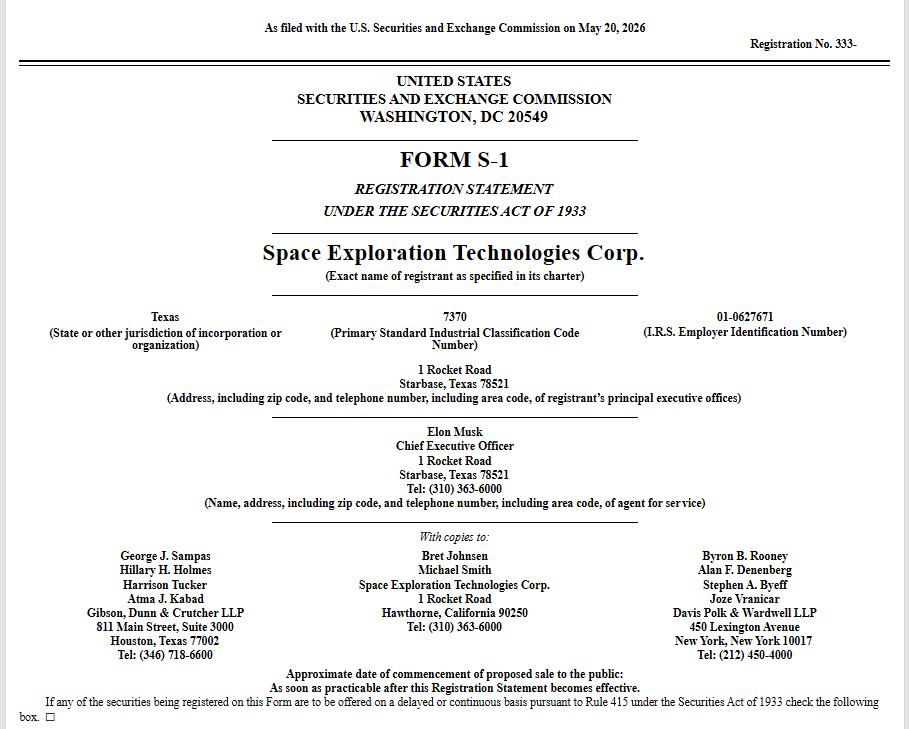
SpaceX Form S-1 filing with the SEC.

The disclosure places SpaceX seventh among publicly listed companies by Bitcoin holdings. That ranking is set to become official once the company completes its IPO, which would push it past several well-known names in the corporate Bitcoin space.

Bigger Than Tesla

SpaceX’s stash also puts it ahead of Tesla, the electric vehicle company also led by Elon Musk. Tesla holds 11,509 Bitcoin — roughly 7,000 fewer coins.

Both companies began buying Bitcoin around the same time. Reports indicate SpaceX started accumulating the cryptocurrency in early 2021, right around when Tesla made its own move into digital assets. The parallel timing suggests Bitcoin adoption across Musk’s companies was no coincidence.
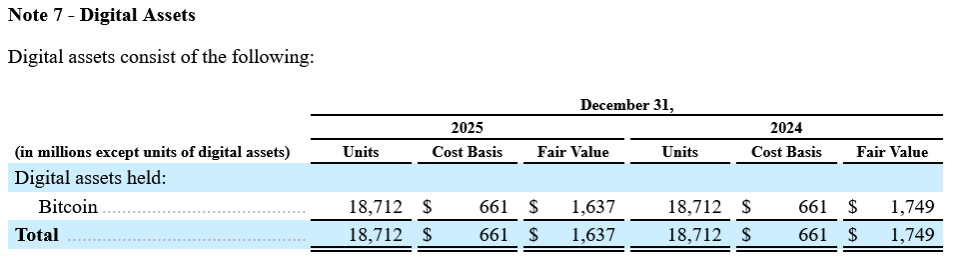
SpaceX’s BTC holdings as of Dec. 31, 2025. Source: SEC

The IPO itself carries numbers that are hard to ignore. SpaceX is aiming to raise around $75 billion, with an estimated company valuation ranging from $1.75 trillion to $2 trillion.

If achieved, it would rank as the largest public offering in capital markets history. The company says it is targeting what it described in its filing as the largest addressable market in human history — a $28.5 trillion opportunity spanning artificial intelligence, space exploration, and global connectivity.

BTCUSD now trading at $77,566. Chart: TradingView

A New Layer For Investors

Once SpaceX begins trading, its stock will offer investors something beyond aerospace exposure. Owning shares would also mean indirect access to one of the largest corporate Bitcoin positions among public companies.

That combination — rockets, satellites, AI ambitions, and a billion-dollar crypto holding — gives the offering a profile unlike most traditional IPOs.

SpaceX joins a short list of major corporations that have moved Bitcoin onto their balance sheets in a meaningful way.

The company’s filing makes clear the position was not a small experiment. Nearly 19,000 coins held over several years points to a deliberate, long-term strategy — one that was largely hidden from public view until now.

Featured image from Unsplash, chart from TradingView

Related Questions

QHow many Bitcoin did SpaceX disclose holding in its S-1 filing, and what was its approximate value?

ASpaceX disclosed holding 18,712 Bitcoin, valued at roughly $1.45 billion as of March 31.

QHow did SpaceX's actual Bitcoin holdings compare to the estimates from blockchain tracking firms?

AThe actual holdings were more than double the estimates. Tracking firms like BitcoinTreasuries.NET and Arkham had estimated SpaceX held around 8,285 Bitcoin, which is less than half of the 18,712 Bitcoin reported.

QHow does SpaceX's Bitcoin holding compare to Tesla's?

ASpaceX holds more Bitcoin than Tesla. SpaceX reported 18,712 Bitcoin, while Tesla holds 11,509 Bitcoin — roughly 7,000 fewer coins.

QWhat significant corporate milestone is SpaceX pursuing alongside the disclosure of its Bitcoin holdings?

ASpaceX is pursuing an Initial Public Offering (IPO), aiming to raise around $75 billion, which could result in the largest public offering in capital markets history with an estimated valuation between $1.75 trillion and $2 trillion.

QWhat unique aspect does the SpaceX stock offer to investors beyond aerospace exposure, according to the article?

AOwning SpaceX stock will offer investors indirect access to one of the largest corporate Bitcoin positions among public companies, combining rockets, satellites, AI ambitions, and a major crypto holding.

Related Reads

Anthropic Major Release: "The Founder's Playbook" - All 4 Stages of Entrepreneurship, Completely Reimagined with AI

**Anthropic Releases "The Founder's Playbook," Reimagining the Four Stages of Startups with AI** The logic of entrepreneurship is being fundamentally reshaped by AI. Anthropic's new handbook, "The Founder's Playbook: Building an AI-Native Startup," defines the AI-native startup as a new species: not a traditional company with AI tools, but a venture driven by AI from day one. The founder's role is transforming from a hands-on builder to a conductor or architect, orchestrating AI agents for execution while focusing on high-level judgment and strategy. Anthropic outlines a product matrix of Claude tools for different tasks: Claude Chat for interactive research, Claude Code for generating production-ready code, and Claude Cowork for automating knowledge-intensive workflows. The handbook structures the startup lifecycle into four stages, detailing core goals, pitfalls, and AI applications for each: 1. **Idea Stage**: Focuses on validating a real problem. The core challenge is avoiding confirmation bias. AI practices include using Claude as a "structured devil's advocate" to challenge assumptions and for automated market/competitor research. 2. **MVP Stage**: Aims to gather early signals of Product-Market Fit (PMF). Key risks are technical debt and scope creep due to rapid AI-assisted development. Recommended AI uses include maintaining project memory documents (e.g., CLAUDE.md), using Claude Code for structured coding, and automating user feedback analysis. 3. **Launch Stage**: Centers on establishing scalable growth, operations, and compliance. Challenges include accelerating technical debt and founders becoming bottlenecks. AI should be used to build an "operating system" for launch—automating routine tasks (scheduling, reporting, content) and code audits—freeing founders for critical decisions. 4. **Scale Stage**: Focuses on achieving sustainable business operations. The main challenge is delegating operational control. AI should be leveraged for differentiated marketing, operational optimization, and building competitive moats through data network effects. The handbook concludes that in the AI era, "Can we build it?" is no longer the primary constraint. The advantage shifts back to foundational strengths: **insight, judgment, and a deep understanding of a specific problem and audience.**

marsbit6h ago

Anthropic Major Release: "The Founder's Playbook" - All 4 Stages of Entrepreneurship, Completely Reimagined with AI

marsbit6h ago

Eight Departments Launch Severe Crackdown on Cross-Border Securities Firms, How to Interpret This?

China's top financial regulators, including the CSRC and seven other ministries, have launched a sweeping crackdown on unlicensed cross-border securities operations. The core action involves a joint enforcement plan and the issuance of administrative penalties against major offshore internet brokers like Futu and Tiger Brokers for conducting unauthorized securities business in mainland China without a domestic license. The primary legal basis is China's requirement for securities businesses to operate with proper, locally issued licenses. The crackdown aims to eliminate a major regulatory gray area, plugging channels that allowed massive, unmonitored capital outflows which posed risks to financial stability, currency controls, and foreign exchange reserves. It also seeks to protect mainland investors who previously lacked legal recourse when dealing with offshore platforms and to secure sensitive financial data. The immediate impact is severe for the targeted brokers, including a complete ban on new mainland business, forced liquidation of existing mainland client positions over two years, and the confiscation of illegal profits estimated in the billions. Their U.S.-listed shares plummeted in response. Market analysts warn that the forced sell-off of an estimated 250-280 billion RMB in assets, concentrated in U.S. tech stocks, Chinese ADRs, and Hong Kong equities, could create sustained selling pressure on these markets over the next two years, potentially lowering valuations. For mainland investors, legal cross-border investment channels will become extremely constrained. The high asset threshold for the Stock Connect program and the severe shortage of QDII fund quotas—leading to chronic high premiums on popular U.S.-focused ETFs—mean retail access to overseas markets like the U.S. will be sharply limited. Conversely, some of the returning capital may flow into domestic A-share sectors like AI, semiconductors, and advanced manufacturing. However, this could further inflate valuations in these already elevated sectors. In conclusion, regulators frame this move not as closing off cross-border investment, but as a necessary step to enforce compliance, manage systemic risk, and steer investors toward regulated, protected channels like QDII and Stock Connect for the long-term health of the financial system.

链捕手6h ago

Eight Departments Launch Severe Crackdown on Cross-Border Securities Firms, How to Interpret This?

链捕手6h ago

Trading

Spot
Futures

Hot Articles

What is $BITCOIN

DIGITAL GOLD ($BITCOIN): A Comprehensive Analysis Introduction to DIGITAL GOLD ($BITCOIN) DIGITAL GOLD ($BITCOIN) is a blockchain-based project operating on the Solana network, which aims to combine the characteristics of traditional precious metals with the innovation of decentralized technologies. While it shares a name with Bitcoin, often referred to as “digital gold” due to its perception as a store of value, DIGITAL GOLD is a separate token designed to create a unique ecosystem within the Web3 landscape. Its goal is to position itself as a viable alternative digital asset, although specifics regarding its applications and functionalities are still developing. What is DIGITAL GOLD ($BITCOIN)? DIGITAL GOLD ($BITCOIN) is a cryptocurrency token explicitly designed for use on the Solana blockchain. In contrast to Bitcoin, which provides a widely recognized value storage role, this token appears to focus on broader applications and characteristics. Notable aspects include: Blockchain Infrastructure: The token is built on the Solana blockchain, known for its capacity to handle high-speed and low-cost transactions. Supply Dynamics: DIGITAL GOLD has a maximum supply capped at 100 quadrillion tokens (100P $BITCOIN), although details regarding its circulating supply are currently undisclosed. Utility: While precise functionalities are not explicitly outlined, there are indications that the token could be utilized for various applications, potentially involving decentralized applications (dApps) or asset tokenization strategies. Who is the Creator of DIGITAL GOLD ($BITCOIN)? At present, the identity of the creators and development team behind DIGITAL GOLD ($BITCOIN) remains unknown. This situation is typical among many innovative projects within the blockchain space, particularly those aligning with decentralized finance and meme coin phenomena. While such anonymity may foster a community-driven culture, it intensifies concerns about governance and accountability. Who are the Investors of DIGITAL GOLD ($BITCOIN)? The available information indicates that DIGITAL GOLD ($BITCOIN) does not have any known institutional backers or prominent venture capital investments. The project seems to operate on a peer-to-peer model focused on community support and adoption rather than traditional funding routes. Its activity and liquidity are primarily situated on decentralized exchanges (DEXs), such as PumpSwap, rather than established centralized trading platforms, further highlighting its grassroots approach. How DIGITAL GOLD ($BITCOIN) Works The operational mechanics of DIGITAL GOLD ($BITCOIN) can be elaborated on based on its blockchain design and network attributes: Consensus Mechanism: By leveraging Solana’s unique proof-of-history (PoH) combined with a proof-of-stake (PoS) model, the project ensures efficient transaction validation contributing to the network's high performance. Tokenomics: While specific deflationary mechanisms have not been extensively detailed, the vast maximum token supply implies that it may cater to microtransactions or niche use cases that are still to be defined. Interoperability: There exists the potential for integration with Solana’s broader ecosystem, including various decentralized finance (DeFi) platforms. However, the details regarding specific integrations remain unspecified. Timeline of Key Events Here is a timeline that highlights significant milestones concerning DIGITAL GOLD ($BITCOIN): 2023: The initial deployment of the token occurs on the Solana blockchain, marked by its contract address. 2024: DIGITAL GOLD gains visibility as it becomes available for trading on decentralized exchanges like PumpSwap, allowing users to trade it against SOL. 2025: The project witnesses sporadic trading activity and potential interest in community-led engagements, although no noteworthy partnerships or technical advancements have been documented as of yet. Critical Analysis Strengths Scalability: The underlying Solana infrastructure supports high transaction volumes, which could enhance the utility of $BITCOIN in various transaction scenarios. Accessibility: The potential low trading price per token could attract retail investors, facilitating wider participation due to fractional ownership opportunities. Risks Lack of Transparency: The absence of publicly known backers, developers, or an audit process may yield skepticism regarding the project's sustainability and trustworthiness. Market Volatility: The trading activity is heavily reliant on speculative behavior, which can result in significant price volatility and uncertainty for investors. Conclusion DIGITAL GOLD ($BITCOIN) emerges as an intriguing yet ambiguous project within the rapidly evolving Solana ecosystem. While it attempts to leverage the “digital gold” narrative, its departure from Bitcoin's established role as a store of value underscores the need for a clearer differentiation of its intended utility and governance structure. Future acceptance and adoption will likely depend on addressing the current opacity and defining its operational and economic strategies more explicitly. Note: This report encompasses synthesised information available as of October 2023, and developments may have transpired beyond the research period.

363 Total ViewsPublished 2025.05.13Updated 2025.05.13

What is $BITCOIN

Discussions

Welcome to the HTX Community. Here, you can stay informed about the latest platform developments and gain access to professional market insights. Users' opinions on the price of BTC (BTC) are presented below.

活动图片