Written by: SungMo Park, a16z crypto Partner
Compiled by: Luffy, Foresight News
South Korea has long played a very special role in the global cryptocurrency ecosystem.
During the 2017 and 2021 bull market cycles, South Korea was one of the world's most important retail trading markets. The trading volume on local exchanges was substantial, and investors were highly receptive to new tokens. For projects, listing on leading exchanges like Upbit and Bithumb was a key milestone, granting ample liquidity, holders, and market exposure.
While the retail market heat has somewhat cooled down now, the industry is undergoing a structural transformation. Major Korean financial giants and internet platforms are using this window to build institutional-grade blockchain infrastructure based on the strong domestic retail foundation, with stablecoins and the tokenization of real-world assets (RWA) being the two main driving forces.
This article, aimed at overseas companies interested in entering the Korean market or seeking cooperation, provides an overview of the local industry. Numerous pilot projects and cooperation plans are being implemented locally in Korea, with many more still in progress. This article aims to summarize current emerging trends to serve as a reference for overseas teams: which institutions are making moves, what products are being built, and what cooperation opportunities native crypto projects can find.
Stablecoins Go Mainstream, Becoming a Key Policy and Corporate Issue
Stablecoins have now become a significant topic of common interest for Korean regulators, banks, and industry players. Policymakers, banks, and industry stakeholders are currently debating whether Korea will establish a regulated market for the Korean won stablecoin.
The core controversy revolves around the issuer. Banks want to lead stablecoin issuance, fintech and internet platforms demand competitive space, and regulators are weighing innovation benefits against monetary control risks.
The urgency for policy advancement stems from the widespread adoption of US dollar stablecoins. It is estimated that South Korea is facing capital outflows of up to $115 billion, with a large portion flowing into US dollar stablecoins like USDC. This means an increasing amount of payment, trading, and remittance activities are occurring outside the domestic Korean financial system.
Therefore, a compliant Korean won stablecoin is not just a commercial opportunity but also a defensive measure: to anchor future digital financial transactions to the won, local institutions, and the Korean regulatory framework.
Currently, most related businesses are in the pilot stage. Major institutions are actively positioning themselves but remain constrained by regulations: they can conduct tests, collaborations, and preparatory work, while full-scale commercialization awaits a legal framework. Current actions by major players are as follows:
The Bank Camp
KB Financial Group
As a leading traditional financial group in Korea, KB Financial has completed credible pilot implementations, providing a replicable practical model for other banks. The industry leader's execution of a complete case can alleviate the widespread wait-and-see attitude among large enterprises and shift the entire industry's decision-making logic.
Earlier this year, KB Financial Group's banking unit completed a pilot for a full blockchain payment and cross-border remittance process: implementing QR code stablecoin payments at the Hollys Coffee chain and simultaneously opening a cross-border remittance channel to Vietnam, reducing transfer time to under 3 minutes and costs by 87% compared to SWIFT. The significance of this pilot lies not in transaction volume but in a top Korean bank successfully operating a complete end-to-end on-chain financial service.
Hana Financial Group
Hana Financial Group is moving the fastest among mainstream conglomerates, with its recent investment in Dunamu, the operator of crypto exchanges, being a key reason. Hana is now the fourth-largest shareholder of Dunamu, giving it deeper ties to the Korean crypto ecosystem compared to other traditional financial institutions.
The two parties have collaborated on several initiatives. Hana formed a stablecoin alliance with multiple institutions, conducting cross-border remittance tests on Dunamu's in-house public chain, GIWA; Hana Card launched a pilot for USDC payments targeting foreign tourists.
NH Nonghyup Bank
Other banks are selectively positioning themselves based on their inherent strengths. Major commercial bank NH Nonghyup Bank partnered with leading payment service provider NHN KCP to launch a stablecoin merchant settlement solution, targeting offline retailers and payment institutions with practical use cases.
KBank
KBank, Korea's first pure internet bank, is the exclusive banking partner for Upbit, naturally connecting crypto users and exchange payment flows. It is currently developing stablecoin wallet and cross-border remittance services and has partnered with Ripple.
Payment & Credit Card Service Providers
Shinhan Card
Leading payment company Shinhan Card partnered with the Solana Foundation to build underlying infrastructure for stablecoin payments in physical scenarios. With 28 million cardholders and annual transaction volume of 200 trillion won (approximately $145 billion), its vast offline distribution channels give this collaboration real commercial value beyond mere branding.
BC Card
BC Card is Korea's core payment and clearing network. While consumer brand recognition is lower than Hyundai Card or Samsung Card, all bank card issuers rely on its underlying clearing and settlement system. In late 2025, BC Card completed a two-month pilot enabling foreign tourists to use stablecoins for offline spending. This solution integrates stablecoin transactions into the mature credit card authorization and clearing system, solving previous challenges like price volatility and real-time reconciliation for stablecoin offline payments.
Danal
Outside traditional finance, Danal is a highly representative local payment company, with an approach distinct from most crypto-native payment projects.
The company has been developing Korea's payment infrastructure for decades; its payment network, Paycoin, covers 3.2 million users and 150,000 offline merchants. During the 2025 Korea Blockchain Week, Danal officially issued the won-pegged stablecoin KSC and became the first Korean company to join Circle's Alliance Program. The core value of this move lies not in the stablecoin itself, but in its ready-made C-end user and merchant resources—channels that most stablecoin projects struggle to build despite massive resource investment.
Internet Consumer Platforms
KakaoPay, NAVER Pay
Korean internet platforms hold massive traffic and naturally possess financial distribution advantages, covering daily scenarios like search, social media, banking, and e-commerce. High-frequency user stickiness and built-in wallet ecosystems are barriers that banks cannot quickly overcome.
For readers outside Korea, here is a brief introduction:
- KakaoPay is part of the Kakao ecosystem, which also includes KakaoTalk, Korea's dominant instant messaging app.
- NAVER is a Korean internet giant akin to Google, operating the country's largest search engine and news platform. Its subsidiary, Naver Financial, runs digital payment services.
- Naver Financial also agreed to acquire Dunamu, the parent company of Korea's largest crypto exchange, Upbit, further highlighting Korean internet platforms' expansion into payments, financial services, and digital assets.
Kakao and NAVER handle billions of transactions annually, and both have explicitly incorporated stablecoins into their long-term payment strategies. KakaoPay has identified the Korean won stablecoin as its second growth curve for overseas expansion.
Implications for Crypto-Native Projects
The overall market is still early, but windows for cooperation with local institutions have opened. By the time detailed Korean regulations are formalized, key cooperation resources—such as institution-trusted public chains, integrated wallets, custody service providers, and long-term partnership teams—will likely already be secured.
Now is the golden period to establish partnerships. Korean institutions are still exploring the practical value of blockchain infrastructure for implementation. Projects that proactively engage, provide practical solutions, and cooperate according to institutional timelines are more likely to become integral parts of the local stablecoin infrastructure once the market fully opens.
Examples: Solana's partnership with Shinhan Card, Avalanche launching the won stablecoin KRW1, LayerZero's integration with the Korea Gold Exchange and Nexpace (the blockchain subsidiary of Nexon), and the Kaia public chain supporting KB Financial's complete stablecoin pilot. These collaborations were initiated by crypto projects, not passive invitations.
The same applies to underlying infrastructure. Fireblocks integrated into NH Nonghyup Bank's tokenization system; BitGo established an independent entity in Korea, with Hana Financial holding 25% and SK Telecom holding 10%. Such deep architectural collaborations were secured before the regulatory framework was finalized.
Traditional financial institutions have lengthy decision-making processes, value consensus, and require long trust-building cycles. Crypto-native projects that can adapt to institutional rhythms while preserving their technical advantages will succeed long-term in the Korean market.
Real-World Assets (RWA): From Pilot to Official Operation
The development logic of Korea's tokenized asset sector is highly similar to that of stablecoins: regulatory details are still being refined, but the speed at which institutions are implementing infrastructure far exceeds overseas market expectations.
While the global RWA industry often focuses on U.S. Treasuries and private credit, Korea's scope is broader and deeply aligned with local industry characteristics. Brokerages have already issued tokenized securities for various assets within regulatory sandboxes, including real estate, bonds, gold, carbon credits, and short-term debt.
More distinctive developments are concentrated in Korea's strong industry sectors:
- Mirae Asset Securities (a leading Korean brokerage), in collaboration with Korea Land Trust and major shipbuilder HJ Heavy Industries, is exploring ship financing tokenization.
- Hanwha Investment & Securities (under Hanwha Group) plans to tokenize assets within the group's defense industry supply chain.
- Story Protocol partnered with retail investment platform Seoul Exchange to on-chain K-pop copyrights and cultural IP rights.
Both Mirae Asset and Hanwha are family-controlled conglomerates. In this sector, long-term strategic resolve and rapid decision-making efficiency become advantages. Mirae Asset has been aggressive in blockchain, developing its own products rather than waiting for the industry ecosystem to mature. Hanwha has a clear implementation roadmap, planning to launch a tokenized securities platform for general users by mid-2026 while simultaneously advancing defense supply chain asset tokenization.
A series of collaborations indicate that Korea's RWA sector will not simply follow global templates but will develop around its own strengths: shipping, industrial supply chains, and cultural/entertainment IP.
Supporting legal systems are also taking shape. In early 2026, the Korean National Assembly revised the "Capital Markets Act" and "Electronic Securities Act," clarifying rules for issuing security tokens. The laws take effect in early 2027. While short-term large-scale transaction volume may be limited, a complete regulatory framework is now in place.
Two competing platforms have received preliminary approval to operate trading systems for tokenized securities under Korea's new framework, allowing issuance, buying, selling, and settlement: NXT, backed by Shinhan Investment & Securities, Hana Securities, and Eugene Investment; and KDX.
Korean exchanges are simultaneously building supporting secondary markets to address the post-issuance liquidity challenge for tokenized assets, a common shortcoming in the global RWA industry.
Shinhan Investment & Securities leads the sector, having completed 10 investment contract issuances in 2025 and forming the NXT alliance with over 50 institutions. NH Investment & Securities and Mirae Asset Securities follow closely, with pipelines covering shipping assets and cultural IP. While current cooperation scales are modest, the industry positions secured now will be difficult to challenge once the market opens up.
Opportunities for Crypto-Native Projects
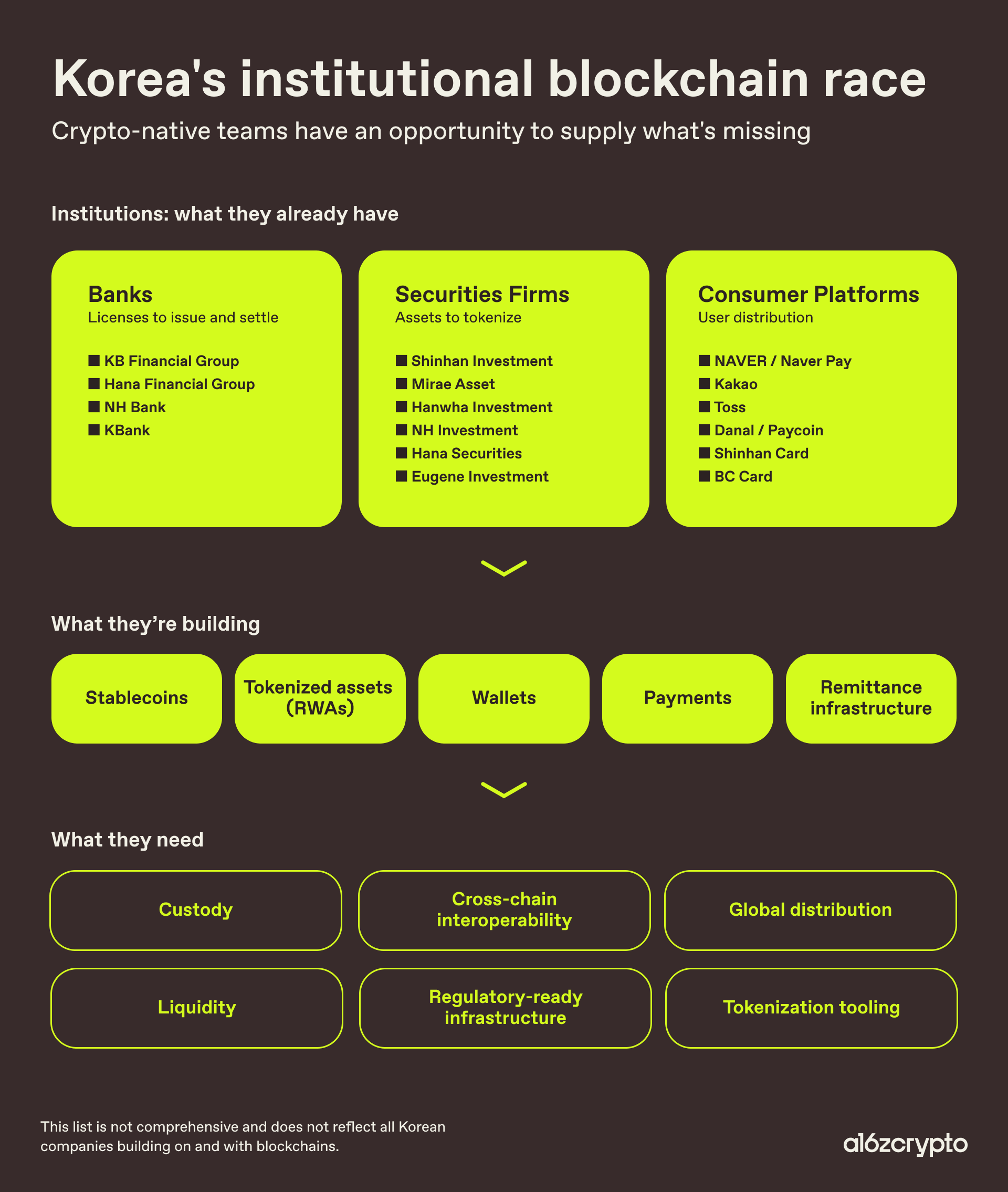
Korean brokerages are fully licensed, possessing permits, institutional resources, and underlying asset supply. However, they lack supporting underlying technology infrastructure, which is the biggest opportunity for crypto projects. Three core gaps are most critical:
- Global Distribution Channels. Korean institutions' tokenized assets target global investors, but they themselves struggle to build overseas reach. Cross-border projects that can connect local issuers with overseas liquidity pools and buyers offer irreplaceable value.
- Liquidity & Cross-Chain Interoperability. Tokenized assets confined to a single public chain have limited value appreciation. LayerZero's collaboration with the Korea Gold Exchange is a prime example: its cross-chain interoperability solution allows gold tokens to flow freely, avoiding fragmented liquidity from multiple wrapped tokens. The long-term opportunity lies in enabling tokenized assets to move across multiple markets, unrestricted by a single platform or chain.
- Enabling Infrastructure, Not Disruptors. Local institutions are deeply entrenched in traditional finance, holding core assets, and do not wish to be disrupted by external projects. Underlying tool projects that empower institutions to optimize asset packaging, distribution, and scalability management will seize sector opportunities first. The RWA supporting tools sector is currently not highly competitive.
So, Where Are the Users?
Currently, the most critical blockchain industry developments in Korea are focused on C-end consumer platforms.
In late 2025, NAVER announced the acquisition of Dunamu, Upbit's operator. The transaction awaits regulatory approval, but the outlook for completion is optimistic. If finalized, Naver Financial will integrate Korea's leading crypto exchange with Naver Pay's 34 million users.
This integration bridges the previously separate worlds of retail crypto trading and daily payment scenarios. NAVER is simultaneously developing its own wallet infrastructure, and Dunamu is building GIWA, a Layer 2 network based on OP Stack, indicating Upbit's ambitions extend beyond being just an exchange to building a complete on-chain business ecosystem.
Kakao has adopted a different strategy, with related work happening at the subsidiary level. KakaoBank is expanding its blockchain R&D team, advancing Korean won stablecoin development, and plans to create a super unified wallet that connects KakaoPay, KakaoBank, and KakaoTalk to store fiat and stablecoins together. The company, having recently achieved annual profitability, has positioned blockchain as its next growth mainstay.
The NAVER and Kakao ecosystems control Korea's top C-end distribution channels, and both position blockchain as underlying infrastructure rather than an add-on feature.
Additionally, there is Toss, which holds full banking, securities, and insurance licenses. Its app itself is an integrated financial wallet. In mid-2025, Toss registered 24 Korean won stablecoin trademarks, established an independent blockchain division, and hinted at possibly developing its own underlying public chain with an integrated wallet.
Toss has a well-established offline payment network. Beyond online transfers, its offline physical merchants are nationwide, covering the two core use cases for stablecoins: payments and cross-border remittances.
For crypto projects, consumer platforms are the most valuable traffic channels to focus on: banks may lead issuance and compliance, brokerages may lead tokenized assets, but internet platforms determine how blockchain products reach ordinary users.
Conclusion: A Critical Inflection Point for Korea's Crypto Industry
As Korea's regulatory framework gradually takes shape and institutional-grade infrastructure continues to be built, the industry's core question is no longer whether traditional finance will enter blockchain (major institutions are already fully engaged), but rather which public chains, projects, and protocols will become the industry's underlying standards.
An external factor worth noting is the U.S. "CLARITY Act." The development of Korean institutions is not isolated. Once U.S. crypto regulatory details are finalized, they will serve as an important reference for Korean regulators and financial institutions. Clear U.S. regulations will also make it easier for Korean companies to drive deeper blockchain implementation internally.
On the eve of regulatory finalization, Korea already possesses a solid foundation for development: a massive retail investor base, mature financial institutions that have completed pilot programs, and a tech-savvy population familiar with digital assets. Crypto enterprises that establish genuine partnerships with local institutions and implement usable scenarios during this phase will help define the future trajectory of Korea's digital asset industry.