Solana wins January on-chain – So why did SOL still drop 20%?

ambcryptoPublished on 2026-02-04Last updated on 2026-02-04

Abstract

Despite leading all blockchain networks in on-chain DEX volume in January with a 20% month-on-month increase to $117.7 billion in trades, Solana's native token, SOL, experienced a significant price drop of approximately 20%. This decline, which saw SOL fall from the $120-125 range to near $100, was attributed to broader market weakness rather than a loss of interest in the Solana network itself. The network demonstrated robust health, with transaction counts and overall activity reaching all-time highs, and an improved ratio of successful to reverted transactions. Notably, Solana accounted for nearly 35% of all on-chain DEX volume at its peak, significantly outperforming competitors like Ethereum, BNB Chain, Base, and Arbitrum. Looking forward, Standard Chartered Bank adjusted its near-term price target for SOL downward from $310 to $250 but raised its long-term forecasts. The bank predicts SOL could reach $400 by the end of 2027, $700 by the end of 2028, and $1,200 by the end of 2029. This optimistic outlook is based on Solana's expanding use cases beyond meme coins, with growing dominance in stablecoin transfers and micropayments, particularly due to its high efficiency and speed compared to other networks like Ethereum. The bank believes this efficiency could unlock new AI-driven micropayment applications, solidifying Solana's long-term value proposition.

Solana is having a moment. Just… not the kind that shows up on a price chart.

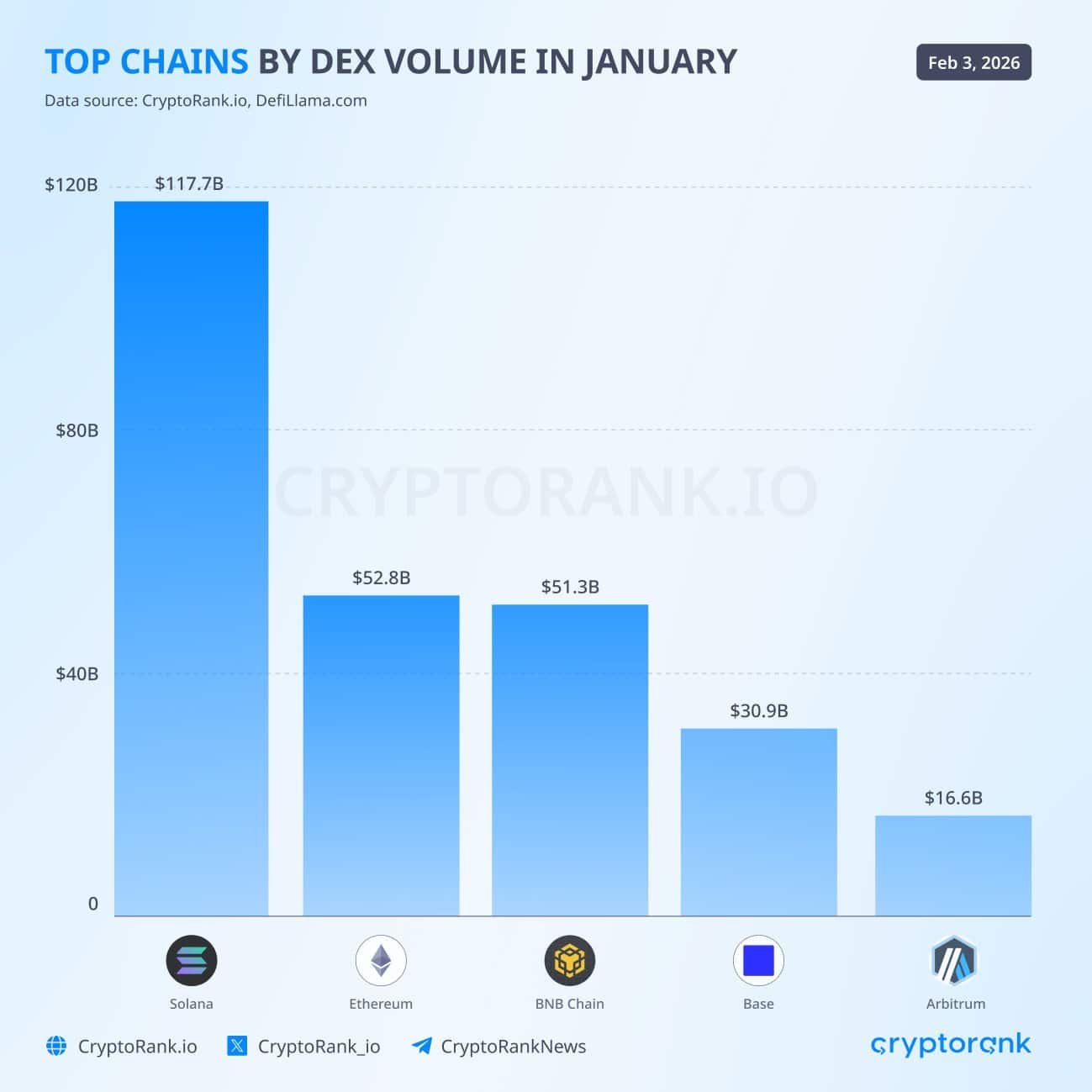
In January, the network was ranked No.1 in DEX Volume rankings, while transactions and usage pushed to ATHs. However, despite it all, SOL’s price has struggled to keep pace.

Will that change?

Solana leads by a wide margin

Recent data per CryptoRank showed that Solana has processed $117.7 billion in trades in January 2026.

Source: CryptoRank

That’s a 20% month-on-month increase, leaving Ethereum [ETH], BNB Chain [BNB], Base [BASE], and Arbitrum [ARB] far behind.

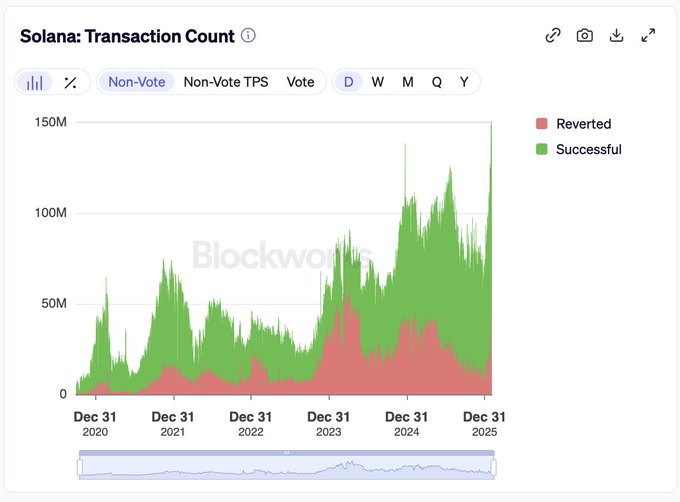
At its peak, Solana [SOL] accounted for nearly 35% of all on-chain DEX Volume.

Source: X

Meanwhile, Transaction Counts and overall network activity are at all-time highs, while the ratio of successful to reverted transactions improved meaningfully.

All these numbers, and yet…

…price has taken a good fall.

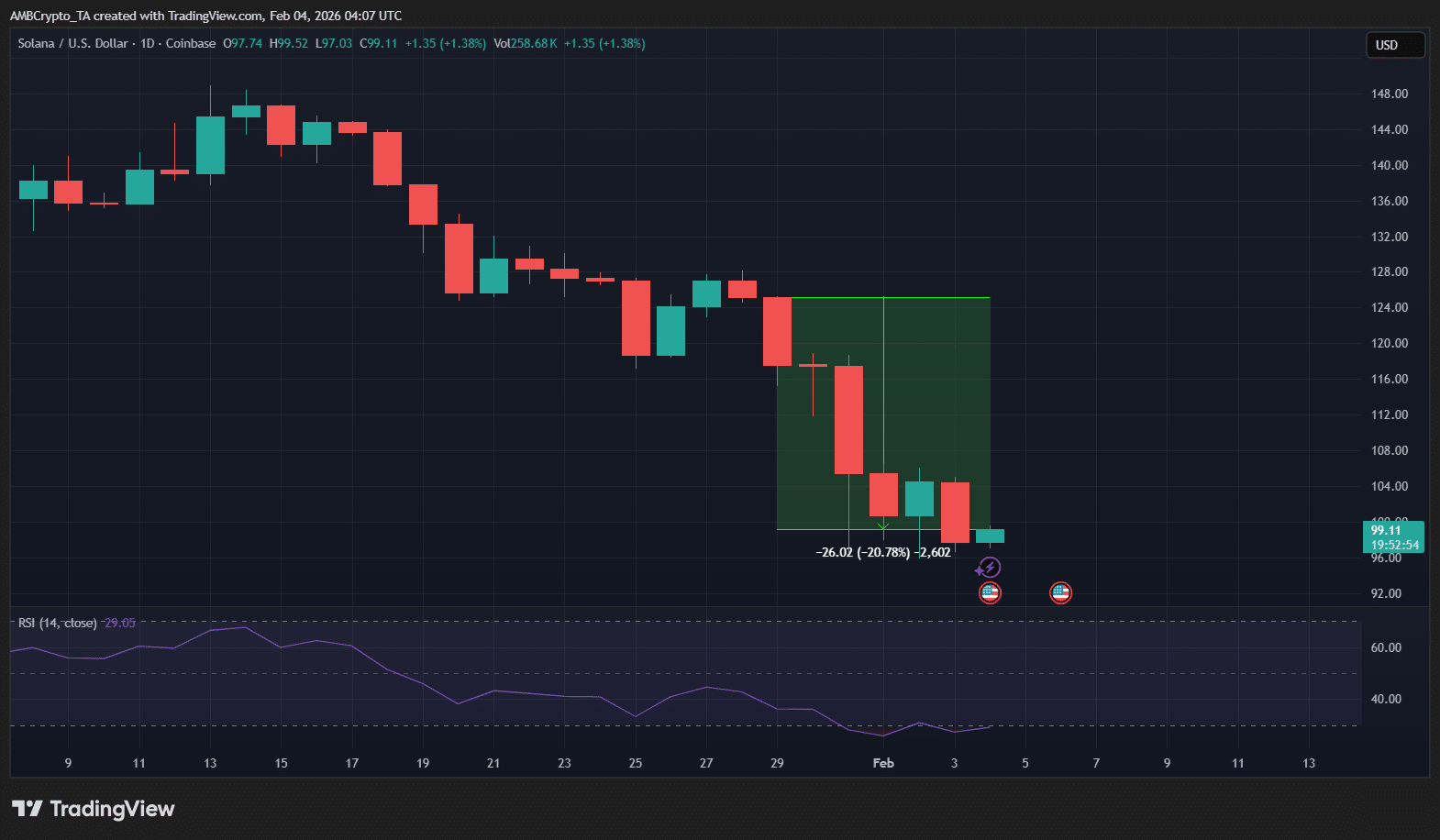
Over the past week, SOL dropped roughly 20%, retracing from the $120-125 range to trade near $100. The price dropped fast with big red candles – caused by the overall market weakness of the recent days, and NOT a loss of interest in Solana.

Source: TradingView

RSI indicated that selling pressure has been intense in a short span of time. In effect, SOL’s price has moved in the opposite direction from its on-chain growth.

The long game

That gap between activity and price is exactly where Standard Chartered sees Solana’s longer-term opportunity.

While the bank trimmed its near-term outlook for SOL from $310 to $250, it recently raised its forecasts further out.

They noted that the network is moving beyond meme coin-led trading cycles and that they will be dominant in stablecoin transfers and micropayments.

The forecasts state that SOL will reach $400 by the end of 2027, $700 by the end of 2028, and $1,200 by end-2029.

According to Geoff Kendrick, Global Head of Digital Assets Research, activity on Solana’s DEXs is moving toward SOL-stablecoin pairs, with stablecoins circulating far faster than on Ethereum.

That efficiency could unlock new use cases (particularly AI-driven micropayments), even if scale takes time to arrive.


Final Thoughts

  • Solana led January DEX volume, even as SOL fell 20%.
  • Standard Chartered’s long-term SOL target depends on stablecoins and micropayments.
Next: Stablecoin volume hit $10T in January – Here’s why it’s THE most bullish signal!
Share
  • Share
  • Tweet

Related Questions

QDespite leading in on-chain DEX volume in January, why did SOL's price drop by 20%?

ASOL's price dropped due to overall market weakness, not a loss of interest in Solana. The decline was characterized by big red candles and intense selling pressure in a short span, as indicated by RSI.

QWhat was Solana's ranking in DEX volume for January, and how much trade volume did it process?

ASolana was ranked No.1 in DEX volume for January, processing $117.7 billion in trades, which was a 20% month-on-month increase.

QWhat are Standard Chartered's long-term price forecasts for SOL, and what factors support these predictions?

AStandard Chartered forecasts SOL to reach $400 by end-2027, $700 by end-2028, and $1,200 by end-2029. The predictions are based on Solana's move beyond meme coin cycles, dominance in stablecoin transfers and micropayments, and faster stablecoin circulation efficiency compared to Ethereum.

QHow did Solana's network activity and transaction performance fare during this period?

ASolana's transaction counts and overall network activity reached all-time highs, with a meaningful improvement in the ratio of successful to reverted transactions.

QWhat new use cases does Standard Chartered believe Solana's efficiency could unlock?

AStandard Chartered believes Solana's efficiency, particularly in stablecoin circulation, could unlock new use cases such as AI-driven micropayments, even though scaling may take time.

Related Reads

Goldman Sachs Bows Down, Bitcoin Finally Breaks Through the Gates of Wall Street

Wall Street giants, including Goldman Sachs, Morgan Stanley, Charles Schwab, and the New York Stock Exchange, have reversed their long-standing opposition to Bitcoin and are now actively embracing it. After years of dismissing Bitcoin as a scam, a bubble, or a tool for illicit activities, these institutions are launching Bitcoin ETFs, enabling spot trading, and building dedicated crypto infrastructure. Goldman Sachs, which once called Bitcoin a "fraud tool," is now offering Bitcoin ETFs. Morgan Stanley, which internally banned the term "cryptocurrency," has launched its largest-ever ETF backed by Bitcoin. Charles Schwab has opened spot crypto trading for its retail clients, integrating Bitcoin alongside traditional assets. The NYSE is building robust infrastructure to support digital assets, signaling a long-term commitment. This dramatic shift is driven not by a change in ideology but by economic necessity. As Bitcoin repeatedly survived market crashes and grew into a multi-trillion-dollar asset class, ignoring it became too costly. Wall Street’s business model relies on capturing fees, and Bitcoin’s rise represented a massive wealth transfer occurring outside their ecosystem. The fear of missing out (FOMO) and client demand forced these institutions to capitulate. The article frames this as a historic surrender to Bitcoin’s mathematical inevitability. Unlike the trust-based traditional financial system, Bitcoin operates on decentralized, transparent, and unchangeable rules. Its scarcity and resilience make it a hedge against fiat currency devaluation and systemic risk. The narrative has flipped: not holding Bitcoin is now seen as the greater risk. The author concludes that Bitcoin has not been co-opted by Wall Street; instead, it has co-opted Wall Street, marking a fundamental shift in the global financial architecture.

marsbit11m ago

Goldman Sachs Bows Down, Bitcoin Finally Breaks Through the Gates of Wall Street

marsbit11m ago

Trading

Spot
Futures

Hot Articles

Discussions

Welcome to the HTX Community. Here, you can stay informed about the latest platform developments and gain access to professional market insights. Users' opinions on the price of SOL (SOL) are presented below.

活动图片