Solana Tries To Turn Fear Into FOMO — Can STRIDE Really Stop The Next $300M Rug?

bitcoinistPublished on 2026-04-07Last updated on 2026-04-07

Abstract

The Solana Foundation has launched a new security initiative called STRIDE (Solana Trust, Resilience and Infrastructure for DeFi Enterprises) in collaboration with Asymmetric Research. This framework is designed to continuously assess and oversee the security of projects built on Solana through an eight-pillar system, with results made public. Alongside STRIDE, the Solana Incident Response Network (SIRN) was introduced—a coalition of security firms focused on threat intelligence and coordinated responses to hacks. These efforts follow a recent $286 million exploit on the Drift Protocol and represent a shift toward continuous, foundation-funded security monitoring rather than one-time audits. While these measures may help restore trust, new exploits on unaudited protocols could still face severe market reactions.

The Solana Foundation has unveiled new security initiatives framed as a “new wave” of ecosystem security.

Solana Attempts To Rebuild The Trust

This Monday, the Solana Foundation announced on a blog post the launching, in collaboration with Asymmetric Research, of the STRIDE (Solana Trust, Resilience and Infrastructure for DeFi Enterprises) program. STRIDE is an organized framework designed to continuously assess and oversee the security of projects built on the ecosystem.

According to Assymetric Research’s own blog post, STRIDE works as an eight‐pillar security framework that will carry out independent reviews of ecosystem protocols to verify they comply with it. The results of these assessments will be released publicly, giving users and investors clear visibility into the safety of the platforms they use.

In parallel to STRIDE, the foundation also released the Solana Incident Response Network (SIRN), a member‐driven coalition of security companies and researchers focused exclusively on the Solana ecosystem. According to the blog post, founding participants of the membership-based network include Asymmetric Research, OtterSec, Neodyme, Squads, and ZeroShadow. SIRN is the “war room”, sharing threat intel and coordinating live hack responses across the ecosystem.

The new initiatives sit on top of existing tools like Hypernative, Range, Riverguard, Sec3, and AuditWare, which are offered free to builders to harden code from day one. This is a core shift away from one‐off audits toward continuous, foundation‐funded monitoring, public security reports and coordinated incident response.

A Shift In Security Protocols, But A Shift In Sentiment?

These moves directly follow the April 1st $286 million attack on the Solana-based Drift Protocol that ended up being attributed to North Korean hackers.

The blog post, however, makes no mention of the attack. Despite that, it does spell out the need to strengthen the security services the foundation offers.

Solana was built for security. And as the ecosystem scales, the stakes scale with it (...) Solana Foundation has a long history of dedicating resources to ensure that security services and tools are available to the ecosystem.

While it is true that security headlines and follow‐through on STRIDE/SIRN may help repair sentiment after the Drift shock, any new exploit on an unevaluated protocol could be punished harder.
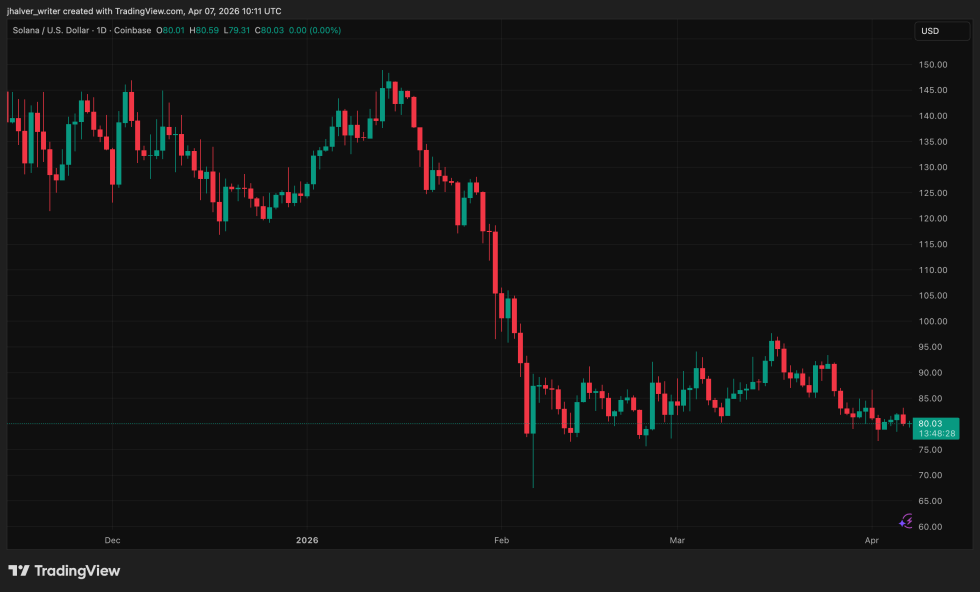
At the moment of writing, SOL trades for exactly $80 on the daily chart. Source: SOLUSD on Tradingview.

Cover image from Perplexity. SOLUSD chart from Tradingview.

Related Questions

QWhat is the name of the new security program launched by the Solana Foundation and Asymmetric Research?

AThe new security program is called STRIDE, which stands for Solana Trust, Resilience and Infrastructure for DeFi Enterprises.

QWhat is the primary function of the Solana Incident Response Network (SIRN)?

ASIRN is a member-driven coalition of security companies and researchers that acts as a 'war room', sharing threat intelligence and coordinating live hack responses across the Solana ecosystem.

QWhich major security incident on the Solana ecosystem preceded the announcement of these new security initiatives?

AThe initiatives directly follow the April 1st $286 million attack on the Solana-based Drift Protocol, which was attributed to North Korean hackers.

QHow does the STRIDE program aim to improve security for users and investors?

ASTRIDE conducts independent reviews of ecosystem protocols and publicly releases the results of these assessments, giving users and investors clear visibility into the safety of the platforms they use.

QWhat core shift in security approach do these new initiatives represent?

AThey represent a core shift away from one-off audits toward continuous, foundation-funded monitoring, public security reports, and coordinated incident response.

Related Reads

Winter for Crypto IPOs: Consensys and Ledger Withdraw Applications

The crypto IPO window is tightening significantly in 2026, marked by prominent companies delaying or pausing their public listing plans. Following a successful 2025 "harvest year" that saw Circle, Bullish, and Gemini go public amidst a bull market, the tide has turned. Consensys, developer of MetaMask, recently postponed its IPO until at least fall 2026. Hardware wallet leader Ledger also suspended its planned US listing due to unfavorable market conditions, with Kraken having previously delayed its own plans. This shift is driven by a cooling market in 2026, characterized by a significant Bitcoin price correction, declining trading volumes, and reduced investor risk appetite for crypto stocks. The poor post-IPO performance of 2025 listings like Circle and Bullish, which saw major share price declines, has heightened investor caution. This contrasts sharply with the current AI sector, where companies like SpaceX, OpenAI, and Anthropic are commanding massive valuations and investor enthusiasm based on narratives of stable, exponential growth. Crypto companies now face pressure to transition from hype-driven models to demonstrating reliable cash flows and robust compliance. While the paused IPO plans may lead to valuation resets and affect ecosystem liquidity, they also accelerate industry consolidation toward stronger, more compliant infrastructure players. A potential recovery in Bitcoin's price and clearer regulations could reopen the IPO window in the latter half of 2026.

marsbit38m ago

Winter for Crypto IPOs: Consensys and Ledger Withdraw Applications

marsbit38m ago

ChatGPT Can Manage Your Money for You. Would You Trust It with Your Bank Account?

OpenAI has launched a personal finance tool for ChatGPT, currently in preview for US-based ChatGPT Pro users. This feature allows users to connect their bank and investment accounts (via Plaid, supporting over 12,000 institutions) directly to ChatGPT. It analyzes transactions, generates visual dashboards, and offers conversational financial advice—such as budgeting or planning for major purchases—based on the user's actual data. This move follows OpenAI's acquisitions of fintech startups Roi and Hiro Finance, signaling a strategic push into vertical "super assistant" applications, similar to its earlier health-focused feature. However, the launch has sparked significant privacy concerns. Critics question the safety of granting such sensitive financial access to an AI, especially amid ongoing lawsuits alleging OpenAI shared user chat data with third parties like Meta and Google. OpenAI emphasizes that ChatGPT only reads data (no transaction capabilities), deletes it within 30 days if disconnected, and offers opt-out options for model training. Yet, trust remains a major hurdle. The trend reflects a broader industry shift: AI companies like Anthropic and Perplexity are also targeting high-value, data-rich domains like finance and health. While technically promising, the tool operates in a regulatory gray area—it provides personalized guidance but disclaims formal financial advice or liability. Ultimately, OpenAI's challenge is convincing users to trust an AI with their most private financial information.

marsbit39m ago

ChatGPT Can Manage Your Money for You. Would You Trust It with Your Bank Account?

marsbit39m ago

Trading

Spot
Futures

Hot Articles

Discussions

Welcome to the HTX Community. Here, you can stay informed about the latest platform developments and gain access to professional market insights. Users' opinions on the price of SOL (SOL) are presented below.

活动图片















