Solana Strengthens RWA Presence With Explosive Growth In Value

bitcoinistPublished on 2026-05-20Last updated on 2026-05-20

Abstract

Despite a recent price pullback to around $85, the Solana network is experiencing significant growth, particularly in its Real-World Asset (RWA) ecosystem. The total value of tokenized assets on Solana has surged to a new all-time high of over $2.8 billion, driven by its fast transaction speeds and low costs. This reflects growing institutional interest in bringing traditional financial assets onto the blockchain. Simultaneously, Solana's perpetual futures (perp) volume has reached record levels, hitting approximately $20 billion in total volume, second only to Hyperliquid. A key driver is GMTrade, an RWA-focused decentralized exchange. SOL's daily perp volume recently hit a high of $4.7 billion, marking a 500% month-over-month increase. While perp open interest on Solana remains lower than competitors, the rising volume indicates heightened trader engagement and market liquidity.

Despite its consistent downside price action, the Solana network remains unshaken, with activity continuing to grow significantly. One of the areas the SOL network is currently seeing massive growth again is its Real-World Asset (RWA) ecosystem.

RWA Value On The Solana Network Climbs Sharply

Solana is gaining the community’s attention once again, even with its price pulling back to the $85 mark. Underneath its sideways price action over the past few weeks, the SOL network is rapidly expanding its footprint in the Real World Asset sector.

As tokenization gains major traction in the crypto space, the value of tokenized assets on the SOL network has seen explosive growth. A recent report from Solana’s official page on the X platform reveals that its RWA value has surged to over $2.8 billion, representing a new all-time high.
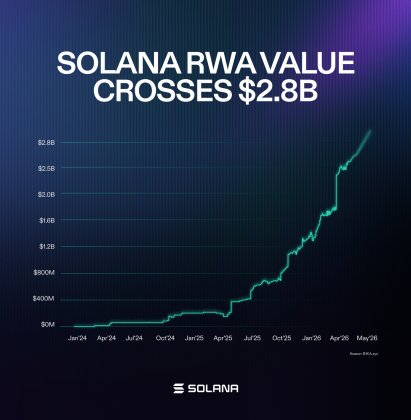
Source: Chart from Solana on X

This figure marks yet another major milestone for the leading network, reinforcing its position in the blockchain sector. The rapid expansion demonstrates the growing interest in bringing conventional financial products such as treasuries and other yield-bearing assets to the blockchain.

SOL attracting this kind of massive value in RWA is largely due to its fast transaction speed and lower costs. As institutional and developer activity around RWAs accelerates, this figure is expected to expand in the future.

SOL Perp Volume Is Trending At Its Highest Level Yet

In other areas, such as Perpetual (Perp) futures volume, the Solana network is also witnessing substantial growth. David Alexander, an on-chain data expert, reported that SOL’s perp volume has climbed sharply, opening the week at an all-time high. Such development has led to a significant rise in trader engagement and speculative activity, with derivatives markets becoming more active in response to SOL’s price fluctuations.

According to the data, the network is now handling about $20 billion in total perp volume, coming second only to Hyperliquid (HYPE), which currently handles over $42 billion. However, open interest across Solana perps is valued at just $223 million compared to the $9 billion of Hyperliquid.

Alexander highlighted that the majority of SOL’s perp volume was led by GMTrade, a leading RWA perp DEX, with $16 billion. Others include Pacifica and Jupiter Exchange, scooping up $2.9 billion and $1.3 billion, respectively.

This milestone comes just a few days after Solana perp volume saw its highest daily perp volume, recording over $4.7 billion in a single day, representing a +500% MoM. At the time of the achievement, SOL accounted for 21% of all perp activity, still only behind Hyperliquid’s 36%. In times of increased volatility and velocity like the current market state, rising perp volume is sometimes seen as an indication of increasing market interest and liquidity.

At the time of writing, SOL’s price was trading at $85, demonstrating a 0.41% increase over the last 24 hours. Its trading volume has also slightly risen by over 1.61% within the same time frame.

SOL trading at $85 on the 1D chart | Source: SOLUSDT on Tradingview.com

Related Questions

QDespite its price action, in which sector is the Solana network experiencing significant growth according to the article?

AThe Solana network is experiencing significant growth in its Real-World Asset (RWA) ecosystem.

QWhat is the reported total value of Real-World Assets (RWAs) on the Solana network as mentioned in the article?

AThe total value of Real-World Assets (RWAs) on the Solana network has surged to over $2.8 billion, representing a new all-time high.

QAccording to the article, what are two key reasons cited for Solana's success in attracting RWA value?

AThe two key reasons are Solana's fast transaction speed and its lower costs.

QWhat milestone did Solana's Perpetual (Perp) futures volume achieve, and which platform is currently handling more volume according to the data presented?

ASolana's Perpetual futures volume opened the week at an all-time high. However, Hyperliquid (HYPE) is currently handling more volume, with over $42 billion compared to Solana's approximately $20 billion.

QAt the time of writing the article, what was the price of SOL and its 24-hour price change?

AAt the time of writing, SOL's price was trading at $85, demonstrating a 0.41% increase over the last 24 hours.

Related Reads

The Value Distribution of Stablecoins

**Summary: The Value Distribution of Stablecoins** The article argues that stablecoins are evolving from mere trading tools into broader channels for dollar access. It divides the stablecoin ecosystem into four layers to analyze how value is distributed: 1. **Issuance Layer:** Mints stablecoins, holds reserve assets, and captures the spread between reserve yield and user costs (e.g., Tether, Circle). This layer currently earns the largest profit margin. 2. **Infrastructure Layer:** Connects stablecoins to the traditional financial system, handling fiat on/off-ramps, banking integration, compliance (KYC/AML), and asset management (e.g., Bridge, BVNK). This is the "unglamorous" but critical work, building the essential bridges between crypto and real-world finance. 3. **Acquiring/Distribution Layer:** Integrates stablecoins into merchant systems, manages payment flows, and provides enterprise financial software (e.g., Stripe, Coinbase). They act as the access point for businesses. 4. **Application Layer:** The end-users and businesses that ultimately use stablecoins for payments, settlements, or as a store of value. They benefit from convenience but have little pricing power. The core thesis is that while the issuance layer currently dominates profits, the often-overlooked **infrastructure layer holds significant long-term potential**. The real challenge and barrier to mass adoption is not the on-chain transfer of stablecoins (which is simple), but the complex "last mile" integration into existing business workflows, banking systems, and regulatory frameworks across different countries. Companies in this layer are currently in a "land grab" phase, investing heavily to build networks, secure bank partnerships, and establish compliance pathways. While their position is currently pressured by the profitable issuers above and distribution platforms below, the article suggests that if stablecoins become a default financial rail for businesses, the infrastructure providers who have done the hard work of integration will ultimately gain strong pricing power and become entrenched, essential players.

marsbit4h ago

The Value Distribution of Stablecoins

marsbit4h ago

The Value Distribution of Stablecoins

The Value Distribution of Stablecoins The article argues that stablecoins are evolving from a mere trading tool into a broad "dollar channel." It analyzes the industry's value chain through four layers: 1. **Issuance Layer (e.g., Tether, Circle):** The top layer that mints stablecoins, holds reserve assets, and captures the thickest interest rate spread. 2. **Infrastructure Layer (e.g., Bridge, BVNK):** Connects stablecoins to the traditional financial system, handling critical but complex "dirty work" like fiat on/off-ramps, banking integration, compliance (KYC/AML), and cross-border settlement. 3. **Acquiring/Distribution Layer (e.g., Stripe, Coinbase):** Embeds stablecoins into merchant systems, manages payment flows, and integrates with enterprise software. 4. **Application Layer:** End-users and businesses that ultimately use stablecoins for payments, settlement, or storing value. The author posits that while the issuance layer currently captures the most profit, the most overlooked and potentially critical layer is infrastructure. The core challenge for stablecoin adoption isn't the on-chain transfer (which is simple), but bridging the gap between blockchain and the real-world financial system. This involves solving practical problems for businesses: fiat conversion, reconciliation, tax handling, and user onboarding. Infrastructure companies are currently in a difficult "land-grab" phase—building networks, securing banking relationships, and achieving compliance country-by-country. They face pressure from both the profitable issuance layer above and distribution platforms below. However, the author suggests this layer is building a crucial moat. Once stablecoins become a default business rail, the infrastructure players who have done the hard work of integration may gain significant, durable value and pricing power.

链捕手4h ago

The Value Distribution of Stablecoins

链捕手4h ago

How to Do Research Well: Deliberately Practice the Real Skills That Matter

No one truly teaches you how to do research. You're often given a desk, a pre-selected problem, and vague instructions to "create something new." Consequently, many people reverse-engineer the job based on visible outputs—papers, posts, announcements—learning only how to *appear* like a researcher rather than how to *become* one. True research capability is built from stacking small, trainable skills, nearly all of which can be developed through deliberate practice. **Pick Your Own Problem:** Most researchers absorb problems from advisors or trends, lacking the underlying reasoning. Choosing a problem you genuinely care about, as John Schulman advises, leads to original work. Develop "taste" like a muscle: predict experiment outcomes, guess paper results from methods, and track which findings remain important over time. **Upgrade Your Inputs:** Relying on shared reading lists (arXiv hot lists, filtered group chats) leads to unoriginal conclusions. Undervalued old literature often holds crucial insights (e.g., MoE, LSTM, backpropagation). Richard Sutton's "The Bitter Lesson" or Claude Shannon's 1952 talk on creative thinking are more predictive than lengthy modern surveys. Breadth matters as much as depth: draw from neuroscience, mechanism design, hardware knowledge, and honest statistics. Read papers directly, especially appendices and limitations sections. **Write Everything Down:** As Paul Graham noted, writing exposes flaws in seemingly mature ideas. Writing is the cheapest defense against self-deception. Following Feynman's principle, Darwin programmatically wrote down facts contradicting his theory to combat memory bias. Maintain a detailed log of hypotheses, setups, predictions, results, and updated understandings. Reviewing past logs fosters essential humility.

marsbit6h ago

How to Do Research Well: Deliberately Practice the Real Skills That Matter

marsbit6h ago

Trading

Spot
Futures

Hot Articles

Discussions

Welcome to the HTX Community. Here, you can stay informed about the latest platform developments and gain access to professional market insights. Users' opinions on the price of SOL (SOL) are presented below.

活动图片