Solana Recovery Narrative Strengthens as RWA Market Hits $1.15B and Regulation Turns Positive

bitcoinistPublished on 2026-02-05Last updated on 2026-02-05

Abstract

Solana's (SOL) recent price decline below $100 has not diminished its broader recovery narrative. Despite a 25% drop from recent highs, key support near $95–$100 is holding, with technical indicators suggesting potential for a rebound toward $150 or higher. On-chain fundamentals are strengthening, with Total Value Locked reaching a record 73.4 million SOL ($7.5 billion) and daily transactions exceeding 100 million. The real-world asset (RWA) market on Solana has grown to $1.15 billion, supported by its low-cost, high-throughput infrastructure. Standard Chartered adjusted its 2026 SOL price target to $250 but raised its 2030 forecast to $2,000, citing Solana's advantages in micropayments, stablecoin transfers, and improving regulatory clarity.

Solana’s (SOL) recent price weakness has not erased the broader recovery narrative forming around the network. While SOL continues to trade below the psychologically important $100 level after a sharp pullback from January highs, on-chain data and institutional forecasts suggest the blockchain’s long-term positioning is improving.

Related Reading: Elon Musk Revives ‘Dogecoin To The Moon’ With Hint For 2027

Growing real-world asset (RWA) activity, record network usage, and a more constructive regulatory backdrop are increasingly shaping analysts’ views of Solana’s next phase.
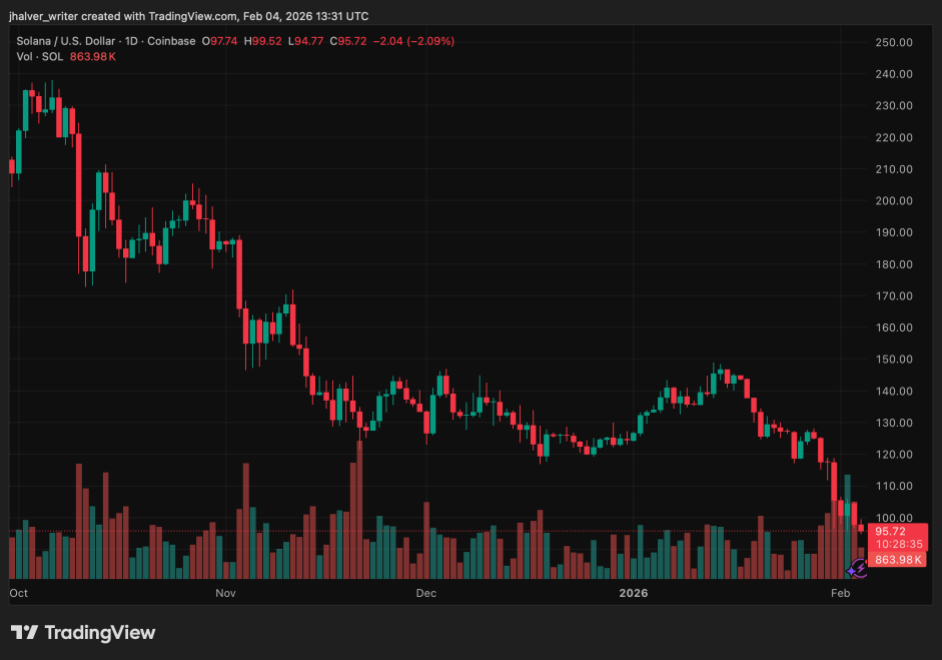
SOL's price trends to the downside on the daily chart. Source: SOLUSD on Tradingview

Price Pressure Persists, But Key Support Holds

SOL has fallen roughly 25% from recent highs near $127, slipping below $100 amid broader crypto market risk-off sentiment. Technical indicators still reflect caution, with bearish momentum dominating short-term charts and some analysts warning of a possible drop toward the $85 area if support near $95 fails.

That said, the $95–$100 zone has repeatedly acted as a major demand area in past market cycles. The daily relative strength index has dipped into oversold territory, a condition that has previously coincided with local bottoms for SOL.

Several technical analysts note that a sustained defense of this range could open the door to a recovery toward the $150 region, with more optimistic scenarios extending toward $215–$260 if resistance levels are reclaimed.

Network Activity And RWA Growth Support The Thesis

Despite price volatility, Solana’s on-chain fundamentals continue to strengthen. Total value locked recently reached an all-time high of 73.4 million SOL, equivalent to roughly $7.5 billion, marking an 18% weekly increase.

On the other hand, daily transactions have surged above 100 million, hitting multi-year highs, while decentralized exchange volumes are also at their strongest levels in months.

Beyond DeFi metrics, the real-world asset market on Solana has expanded rapidly, with tokenized RWAs on the network now estimated at around $1.15 billion. This growth aligns with Solana’s positioning as a low-cost, high-throughput settlement layer, particularly for stablecoins and tokenized financial products.

Faster, more stablecoin-friendly turnover and consistently low transaction fees have made the network increasingly attractive for high-volume use cases.

Standard Chartered Sees Long-Term Upside

Standard Chartered has reinforced this longer-term view, cutting its end-2026 SOL price target to $250 from $310 due to near-term volatility, while raising its 2030 forecast to $2,000.

The bank cited Solana’s dominance in micropayments, stablecoin transfers, and emerging real-world applications as key drivers behind its long-range projections.

According to the bank, Solana’s ability to process large transaction volumes at minimal cost gives it an advantage as regulation around digital assets becomes clearer and more supportive.

Related Reading: Ethereum Active Addresses Near All-Time High Despite Price Plunge

While short-term price action remains uncertain, the combination of rising network usage, expanding RWA activity, and improving regulatory clarity continues to underpin Solana’s recovery narrative.

Cover image from ChatGPT, SOLUSD chart on Tradingview

Related Questions

QWhat are the key factors supporting Solana's recovery narrative despite recent price weakness?

AThe key factors supporting Solana's recovery narrative are growing real-world asset (RWA) activity (now at $1.15B), record network usage (daily transactions above 100M), and a more constructive regulatory backdrop.

QWhat is Standard Chartered's long-term price forecast for SOL by the year 2030?

AStandard Chartered has raised its long-term price target for SOL to $2,000 by the year 2030.

QWhat technical price level is identified as a major demand area and crucial support for SOL?

AThe $95–$100 zone is identified as a major demand area that has acted as crucial support in past market cycles.

QWhat recent milestone did Solana's Total Value Locked (TVL) achieve?

ASolana's Total Value Locked (TVL) recently reached an all-time high of 73.4 million SOL, equivalent to roughly $7.5 billion.

QAccording to the bank, what are the key drivers behind Solana's long-range growth projections?

AAccording to Standard Chartered, the key drivers are Solana's dominance in micropayments, stablecoin transfers, and emerging real-world applications, enabled by its ability to process large transaction volumes at minimal cost.

Related Reads

No Coding Required: Build Your First AI Agent in 2 Days (Complete Tutorial)

A No-Code Guide to Building Your First AI Agent in a Weekend This article presents a weekend, zero-code tutorial for beginners to build a functional AI Agent using tools like Claude. It clarifies the core difference between a chatbot, which responds to queries, and an Agent, which autonomously plans and executes multi-step tasks using tools to deliver a final result. The process is broken into four stages over two days: 1. **Saturday Morning: Understanding Agents.** Learn that an Agent requires a clear Goal, a Plan, necessary Tools, and an execution Loop. Identify a simple, multi-step task from your own work/life as your first project. 2. **Saturday Afternoon: Building with Claude.** Create a one-page "Agent Blueprint" answering: the Goal, sequential Steps, required Tools, the desired Output format, and error-handling rules. Implement this blueprint in Claude (Desktop Cowork or web Projects) and run the Agent for the first time. 3. **Sunday Morning: Debugging & Optimization.** Review the initial (often 60-70% accurate) output. Identify flaws, trace them back to vague instructions in your blueprint, and refine it with more specific criteria and error handling. Iterate this run-review-refine cycle 3-4 times to reach ~90% reliability. 4. **Sunday Afternoon: Expansion.** Apply the learned workflow to quickly build a second, different Agent (e.g., for research, content repurposing, or meeting prep), experiencing the compounding efficiency gains. The core skill is not writing a perfect blueprint initially, but rapidly iterating based on output. By the end of the weekend, you'll have built two usable Agents, moving beyond just chatting with AI to automating multi-step workflows, fundamentally changing how you approach repetitive tasks.

marsbit2h ago

No Coding Required: Build Your First AI Agent in 2 Days (Complete Tutorial)

marsbit2h ago

Trading

Spot
Futures

Hot Articles

Discussions

Welcome to the HTX Community. Here, you can stay informed about the latest platform developments and gain access to professional market insights. Users' opinions on the price of SOL (SOL) are presented below.

活动图片















