Solana And Google Cloud Unveil Pay.sh For Pay-Per-Request API Access

bitcoinistPublished on 2026-05-06Last updated on 2026-05-06

Solana Foundation and Google Cloud have introduced Pay.sh, a Solana-based gateway designed to let AI agents discover, access and pay for APIs on a per-request basis using stablecoins. The launch positions Solana as payment infrastructure for agentic software workflows, with Google Cloud APIs including Gemini, BigQuery, Vertex AI, BigTable and Cloud Run among the first enterprise services supported.

The product addresses a bottleneck that has become more visible as AI agents move from passive assistants to autonomous software operators. Even when an agent can search, code, query data and execute tasks, access to premium APIs still typically requires a human to create accounts, manage billing, handle credentials and maintain subscriptions. Pay.sh attempts to collapse that process into a wallet-based payment flow.

“Agents can now instantly discover, access, and pay-per-request for any API autonomously, for the first time supporting APIs from Google Cloud including Gemini, BigQuery, Vertex AI, and more using stablecoins on Solana,” the Solana Foundation said in its announcement. “No accounts. No API keys. No subscriptions needed.”

Pay.sh begins with a Solana wallet connected to an AI interface, including Gemini, Claude Code, Codex, Openclaw and Hermes, according to the announcement. Developers can fund the wallet with a credit card or stablecoin, after which an agent can browse a unified marketplace of API endpoints, receive live pricing and pay directly from its balance.

The core design is simple: the payment functions as the credential. Rather than requiring every API provider to establish a direct billing relationship with each user or agent, Pay.sh acts as a gateway layer between agents and service providers.

The Foundation said Pay.sh runs as an API proxy built on Google Cloud Platform, sitting in front of Google Cloud services such as BigQuery, Gemini, Cloud Run and others. The user’s Solana wallet acts as the agent’s identity, while the gateway authorizes requests through verified endpoints and applies rate limits, quotas and access controls.

That distinction matters for enterprise APIs. The product is not framed as a way to bypass compliance or security controls, but as a mechanism for handling high-frequency, low-friction payments while still preserving provider-side access management.

Solana Powered-Stablecoin Settlement For Agent Commerce

Payments are processed in stablecoins on Solana and then reconciled with providers, with the announcement emphasizing settlement “in seconds.” Developers pay only for what they consume, while providers avoid manual billing overhead for small or irregular usage patterns.

Solana Foundation Chief Product Officer Vibhu Norby, who announced the launch on X, described Pay.sh as “our pay-as-you-go product for every API,” adding that the collaboration with Google brings micropayments to APIs including “Gemini, BigQuery, YouTube, and Maps.”

“For the first time, developers can access and pay on individual API calls without a billing account or KYC,” Vibhu wrote. “Pay.sh gives your terminal a wallet and financial superpowers with digital dollars on Solana at the root. We’re starting with GCP but you can access 75 other integrations through our open marketplace.”

The marketplace component is broader than Google Cloud. Solana Foundation said Pay.sh also includes more than 50 community API facilitators across ecommerce, market data, communications and onchain infrastructure. Named services include Rye, BigCommerce, Exa, Dune Analytics, Nansen, AgentMail, StablePhone, Helius, Alchemy, QuickNode, Allium and The Graph.

Pay.sh is built on x402 and MPP, which the Foundation described as machine-native payment protocols for agent-to-API commerce. The registry is open-source, and service providers can submit endpoints through GitHub or apply to become official Pay.sh API providers.

Launch partners powering community-sourced endpoints include PayAI, Crossmint, Merit Systems, Corbits, MoonPay, Sponge Wallet, ATXP and Tektonic Company.

For Solana, the launch gives stablecoin payments another concrete enterprise-facing use case beyond trading, remittances and consumer transfers.

At press time, SOL traded at $87.79.
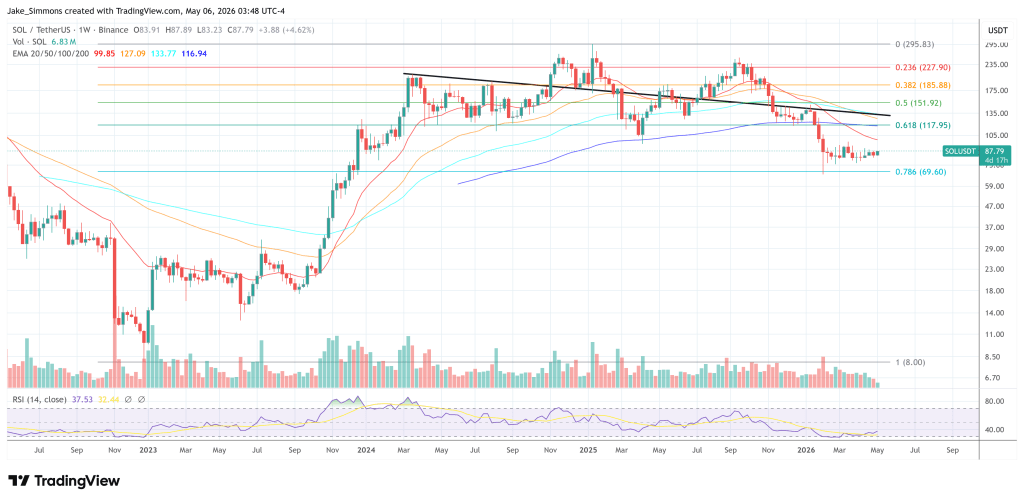
SOL remains below the 200-week EMA, 1-week chart | Source: SOLUSDT on TradingView.com

Related Reads

In a Bull Market, Trade New Coins. Will the 'Hook' Concept Become the Sector That Opens the Bull Market?

In a recent surge of interest, the "Hook" concept on Uniswap v4 has captured significant attention from the retail crypto community, driven by projects like $upeg, $sato, and Slonks. Despite being introduced over a year ago, Hooks—customizable plugins for the Uniswap protocol—gained mainstream traction only recently. The article argues that earlier Uniswap efforts to promote Hooks focused too heavily on technical improvements and liquidity provider (LP) solutions, which failed to capture the imagination of everyday users. The breakthrough came with projects that introduced novel, engaging gameplay. $upeg combines trading with generative art, where each integer purchase creates a unique image, adding a layer of artistic creation and complexity to tokenomics. $sato leverages a bonding curve on Ethereum, appealing to the network's "diamond hands" culture with a decentralized, zero-intervention model that turns into a "belief game." Slonks uses an AI model to redraw CryptoPunks, creating a gamified ecosystem where users can burn or merge NFTs to earn $SLOP tokens based on how much the AI "deviated" from the original. These examples highlight Hooks' potential to transform Uniswap from a simple swap and LP platform into a vibrant ecosystem of innovative applications. While technically possible to build such projects independently, the synergy with Uniswap’s established user base and infrastructure provides mutual benefits. For "Hook" to become a true catalyst for a bull market, the author suggests that projects need compelling, original narratives, and Uniswap must further commit to positioning itself as Ethereum's premier application marketplace for creative on-chain experiences.

marsbit4m ago

In a Bull Market, Trade New Coins. Will the 'Hook' Concept Become the Sector That Opens the Bull Market?

marsbit4m ago

Saylor Softens Stance, STRC Weakens, Is BTC Facing a Do-or-Die Battle?

**Summary: Bitcoin (BTC) at a Critical Juncture? Saylor's Hint and STRC Softness Spark Concerns** This article examines two recent developments that could pressure Bitcoin's price: Saylor's hinted willingness to sell some of MicroStrategy's (MSTR) BTC holdings and a significant slowdown in the issuance of its Structured Token Receipt Capital (STRC) product. Previously, STR C was viewed as a powerful new source of ongoing demand for Bitcoin, as the funds raised were used to buy more BTC with leverage. However, MicroStrategy CEO Michael Saylor's recent acknowledgment that the company *might* sell BTC to pay dividends undermines the "never sell" narrative that underpins MSTR's valuation premium and the entire STRC-driven demand thesis. While mathematically sustainable if BTC appreciates, forced selling during a market downturn would severely damage the company's balance sheet and reverse much of its recent buying. Simultaneously, the STRC "flywheel" appears to be stalling. Unlike in previous cycles, the STRC price has failed to return to its $100 par value ahead of the May dividend date, indicating zero new BTC purchases via this channel for the current period. The author attributes this "softness" to a saturated market of arbitrage traders after huge inflows in March and April, whose selling pressure kept prices down, as well as higher opportunity costs in a surging stock market. The combination risks starting a "reverse flywheel": No STRC issuance means no new BTC buying, putting downward pressure on BTC's price. This weakens STRC's collateral backing, potentially raising its required yield and making it even less attractive, which further starves BTC of demand. Saylor's comments may be preemptively pricing in this scenario. The article concludes that the near-term direction of BTC hinges on whether STRC can regain its par value and resume meaningful issuance in the coming week. A small, recent STRC issuance and a brief return of positive Coinbase premiums are noted as faintly optimistic signals. However, failure of the STRC model could lead to a sharp BTC correction by removing a key perceived source of support.

marsbit11m ago

Saylor Softens Stance, STRC Weakens, Is BTC Facing a Do-or-Die Battle?

marsbit11m ago

Trading

Spot
Futures

Hot Articles

Discussions

Welcome to the HTX Community. Here, you can stay informed about the latest platform developments and gain access to professional market insights. Users' opinions on the price of SOL (SOL) are presented below.

活动图片