SoFi rolls out US dollar stablecoin issued by bank subsidiary

cointelegraphPublished on 2025-12-18Last updated on 2025-12-18

Abstract

SoFi Technologies has launched SoFiUSD, a fully reserved stablecoin issued by its banking subsidiary, SoFi Bank. The stablecoin is backed one-to-one by cash and is redeemable on demand. Initially issued on Ethereum, it is designed for low-cost settlement across payments, card networks, remittances, and enterprise platforms. SoFi's stock rose 5% following the announcement. This move aligns with a broader trend of major U.S. banks, including JPMorgan Chase and Citigroup, exploring stablecoins following the passage of the GENIUS Act, which clarified the regulatory framework for such digital tokens in the United States.

SoFi Technologies has launched SoFiUSD, a fully reserved US dollar stablecoin issued by its banking subsidiary, SoFi Bank.

According to Thursday’s announcement, SoFiUSD is backed one-to-one by cash held by SoFi Bank, a nationally chartered and insured depository institution, and is redeemable on demand. It is designed to support low-cost settlement for banks, fintechs and enterprise platforms.

A SoFi spokesperson told Cointelegraph that SoFiUSD will initially be issued on the Ethereum network, with plans to add support to other blockchains over time.

The company said SoFiUSD can be used across a range of payment and settlement functions, including card networks, retailers, remittances through SoFi Pay and transactions on its Galileo platform, with potential use as a dollar-denominated asset in markets with volatile currencies. The stablecoin is currently live for internal settlement only.

SoFi Technologies (SOFI) is a US financial services company that offers consumer banking, lending, investing and crypto services, while its Galileo platform provides payments and financial infrastructure to fintechs and financial institutions.

The company’s share price rose by about 5% in early trading on Thursday, and has increased by over 70% in the last six months, according to Yahoo Finance data.

The news comes after SoFi launched crypto trading for its customers in November, beginning a phased rollout that includes assets such as Bitcoin (BTC) and Ether (ETH).
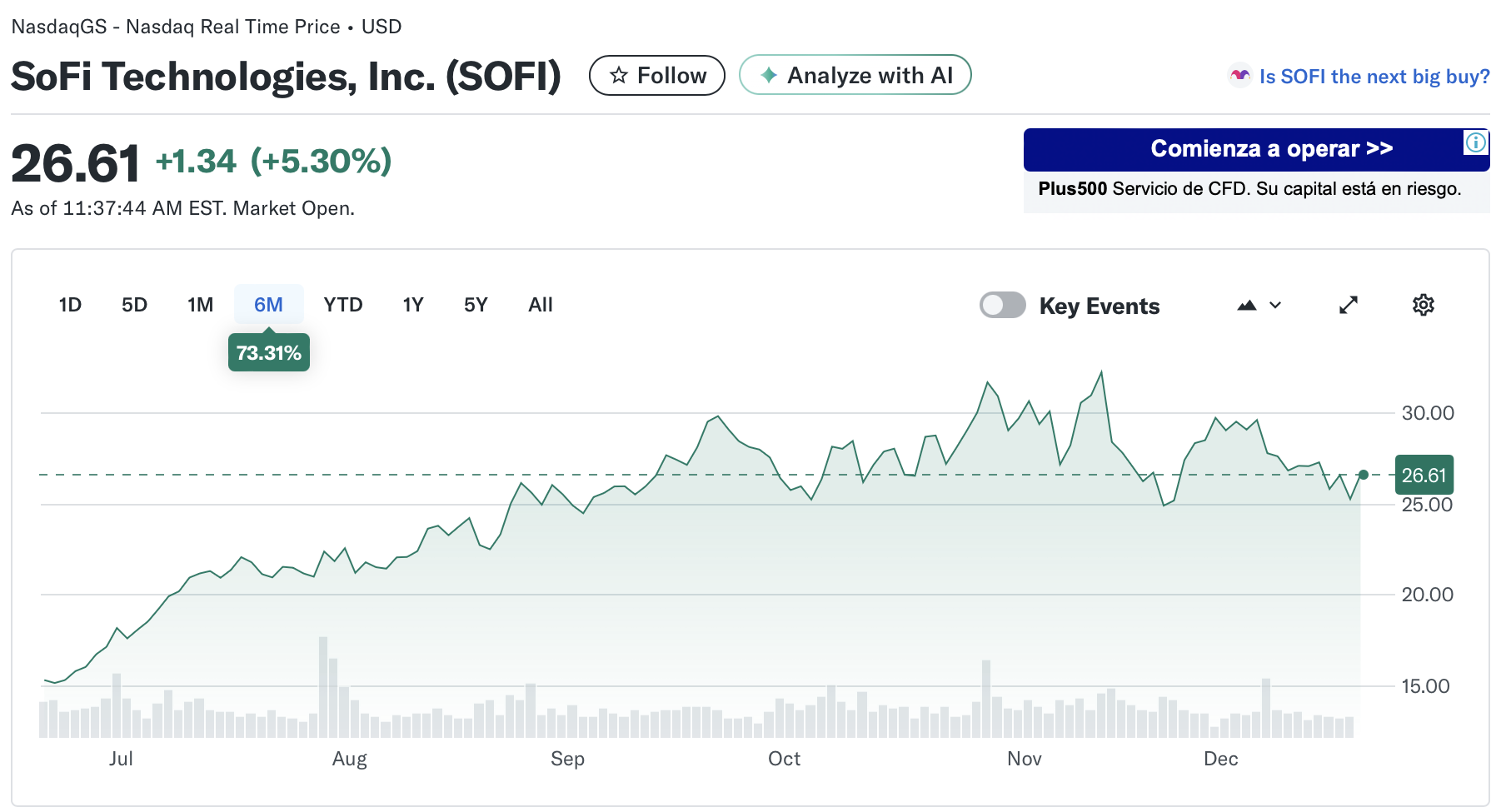
SoFi Technologies’ stock price. Source: Yahoo Finance

Related: US Fed pulls guidance blocking its banks from engaging with crypto

Major US banks explore stablecoins

With the passage of the GENIUS Act in July, which clarifies the regulatory framework for stablecoins in the United States, several US banks have begun exploring the use of dollar-backed digital tokens.

In July, JPMorgan Chase CEO Jamie Dimon said the bank plans to participate in stablecoins and deposit-based digital tokens, citing competition from fintech firms during an earnings call. The comments came the same day Citigroup CEO Jane Fraser said the bank is considering issuing a stablecoin to support digital payments.

That same month, Bank of America CEO Brian Moynihan said the bank was in the early stages of exploring stablecoins, with an initial focus on their use as payment and settlement tools. Moynihan added that the bank has been preparing for potential adoption and would move forward as customer demand and supportive legislation allow.

In October, Wells Fargo Investment Institute issued a report highlighting stablecoins’ potential to enable faster settlement, reduce currency risk and costs, and support self-custody and programmable payments, while noting their possible role in expanding access to financial services.

While major banks are exploring stablecoins, some banks have opposed the use of yield-bearing stablecoins, arguing that such products could draw deposits away from the traditional banking system.

In August, several US banking groups led by the Bank Policy Institute urged Congress to tighten provisions in the GENIUS Act, warning that gaps in the law could allow stablecoin issuers or affiliates to indirectly offer yield.

The GENIUS Act bars stablecoin issuers from paying interest directly, but does not explicitly apply the restriction to exchanges or affiliated entities, a loophole that crypto exchanges have used to offer yield to clients.

Magazine: Big questions: Would Bitcoin survive a 10-year power outage?

Related Questions

QWhat is SoFiUSD and who issues it?

ASoFiUSD is a fully reserved US dollar stablecoin issued by SoFi Bank, a nationally chartered and insured depository subsidiary of SoFi Technologies.

QOn which blockchain will SoFiUSD initially be issued?

ASoFiUSD will initially be issued on the Ethereum network, with plans to add support for other blockchains in the future.

QWhat are some potential use cases for SoFiUSD mentioned in the announcement?

ASoFiUSD can be used for card networks, retailers, remittances through SoFi Pay, transactions on the Galileo platform, and as a dollar-denominated asset in markets with volatile currencies.

QHow did the passage of the GENIUS Act impact US banks?

AThe GENIUS Act, passed in July, clarified the regulatory framework for stablecoins in the US, leading several major banks like JPMorgan Chase, Citigroup, and Bank of America to begin exploring the use of dollar-backed digital tokens.

QWhat is a key concern that some banking groups have raised about stablecoins?

ABanking groups, led by the Bank Policy Institute, have expressed concern that loopholes in the GENIUS Act could allow stablecoin issuers or their affiliates to indirectly offer yield-bearing products, which might draw deposits away from the traditional banking system.

Related Reads

From Theft to Re-entry: How Was $292 Million "Laundered"?

A sophisticated crypto laundering operation was executed following the $292 million hack of Kelp DAO on April 18. The attack, attributed to the North Korean Lazarus group, began with anonymous infrastructure preparation using Tornado Cash to fund wallets untraceably. The hacker exploited a vulnerability in Kelp’s cross-chain bridge, stealing 116,500 rsETH. To avoid crashing the market, the attacker used Aave and Compound as laundering tools—depositing the stolen rsETH as collateral to borrow $190 million in clean, liquid ETH. This move triggered a bank run on Aave, causing an $8 billion drop in TVL. After consolidating funds, the attacker fragmented them across hundreds of wallets to evade detection. A major breakpoint was THORChain, where over $460 million in volume—30 times its usual activity—was processed in 24 hours, converting ETH into Bitcoin. This shift to Bitcoin’s UTXO model exponentially increased tracing complexity by shattering funds into countless untraceable fragments. The final destination was Tron-based USDT, the primary channel for illicit crypto flows. From there, funds were cashed out via OTC brokers in China and Southeast Asia, using unlicensed underground banks and UnionPay networks outside Western sanctions scope. Ultimately, the laundered money supports North Korea’s weapons programs, which rely heavily on crypto hacking for foreign currency. The incident underscores structural challenges in DeFi: its openness, composability, and lack of central control make such laundering not just possible, but inherently difficult to prevent.

marsbit9m ago

From Theft to Re-entry: How Was $292 Million "Laundered"?

marsbit9m ago

Google and Amazon Simultaneously Invest Heavily in a Competitor: The Most Absurd Business Logic of the AI Era Is Becoming Reality

In a span of four days, Amazon announced an additional $25 billion investment, and Google pledged up to $40 billion—both direct competitors pouring over $65 billion into the same AI startup, Anthropic. Rather than a typical venture capital move, this signals the latest escalation in the cloud wars. The core of the deal is not equity but compute pre-orders: Anthropic must spend the majority of these funds on AWS and Google Cloud services and chips, effectively locking in massive future compute consumption. This reflects a shift in cloud market dynamics—enterprises now choose cloud providers based on which hosts the best AI models, not just price or stability. With OpenAI deeply tied to Microsoft, Anthropic’s Claude has become the only viable strategic asset for Google and Amazon to remain competitive. Anthropic’s annualized revenue has surged to $30 billion, and it is expanding into verticals like biotech, positioning itself as a cross-industry AI infrastructure layer. However, this funding comes with constraints: Anthropic’s independence is challenged as it balances two rival investors, its safety-first narrative faces pressure from regulatory scrutiny, and its path to IPO introduces new financial pressures. Globally, this accelerates a "tri-polar" closed-loop structure in AI infrastructure, with Microsoft-OpenAI, Google-Anthropic, and Amazon-Anthropic forming exclusive model-cloud alliances. In contrast, China’s landscape differs—investments like Alibaba and Tencent backing open-source model firm DeepSeek reflect a more decoupled approach, though closed-source models from major cloud providers still dominate. The $65 billion bet is ultimately about securing a seat at the table in an AI-defined future—where missing the model layer means losing the cloud war.

marsbit6h ago

Google and Amazon Simultaneously Invest Heavily in a Competitor: The Most Absurd Business Logic of the AI Era Is Becoming Reality

marsbit6h ago

Trading

Spot
Futures

Hot Articles

What is $BANK

Bank AI: A Revolutionary Step in the Future of Banking Introduction In an era marked by rapid advancements in technology, Bank AI stands at the intersection of artificial intelligence (AI) and banking services. This innovative project seeks to redefine the financial landscape, enhancing operational efficiency, security measures, and customer experiences through the power of AI. As we embark on this exploration of Bank AI, we will delve into what the project entails, its operational dynamics, its historical context, and significant milestones. What is Bank AI? At its core, Bank AI represents a transformative initiative aimed at integrating artificial intelligence into various banking operations. This project harnesses the capabilities of AI to automate processes, improve risk management protocols, and enhance customer interaction through personalised services. The primary objectives of Bank AI include: Automation of Banking Functions: By leveraging AI technologies, Bank AI aims to automate routine tasks, reducing the burden on human resources and enhancing efficiency. Enhanced Risk Management: The project utilises AI algorithms to predict and identify risks, thereby fortifying security measures against fraud and other threats. Personalisation of Banking Services: Bank AI focuses on offering tailored financial products and services by analysing customer data and behaviours. Improving Customer Experience: The implementation of AI-driven solutions, such as chatbots and virtual assistants, aims to provide users with more human-like interactions, revolutionising the way customers engage with banks. With these goals, Bank AI positions itself as a crucial player in rendering banking more efficient, secure, and user-centric. Who is the Creator of Bank AI? Details regarding the creator of Bank AI remain unknown. As such, no specific individual or organisation has been identified in the available information. The anonymity surrounding the project's inception raises questions but does not detract from its ambitious vision and objectives. Who are the Investors of Bank AI? Similar to the project's creator, specific information regarding the investors or supporting organisations of Bank AI has not been disclosed. Without this information, it is challenging to outline the financial backing and institutional support that might be propelling the project forward. Nevertheless, the importance of having a robust investment foundation is pivotal for sustaining development in such an innovative field. How Does Bank AI Work? Bank AI operates on several innovative fronts, focusing on unique factors that differentiate it from traditional banking frameworks. Below are key operational features: Automation: By applying machine learning algorithms, Bank AI automates various manual processes within banks. This results in reduced operational costs and allows human workers to redirect their efforts towards more strategic activities. Advanced Risk Management: The integration of AI into risk management practices equips banks with tools to accurately predict potential threats such as fraud, ensuring that customer information and assets remain secure. Tailored Financial Recommendations: Through continuous learning from customer interactions, the AI systems develop a nuanced understanding of user needs, enabling them to offer tailored advice on financial decisions. Enhanced Customer Interactions: Utilizing chatbots and virtual assistants powered by AI, Bank AI enables a more engaging customer experience, allowing users to have their queries resolved quickly, thus reducing wait times and improving satisfaction levels. Together, these operational features position Bank AI as a pioneer in the banking sector, establishing new benchmarks for service delivery and operational excellence. Timeline of Bank AI Understanding the trajectory of Bank AI requires a look at its historical context. Below is a timeline highlighting important milestones and developments: Early 2010s: The conceptualisation of AI integration into banking services began to gain attention as banking institutions recognised the potential benefits. 2018: A marked increase in the implementation of AI technologies occurred when banks started using AI tools like chatbots for basic customer service and risk management systems for improved security handling. 2023: The sophistication of AI continued to advance, with generative AI being introduced for more complex tasks such as document processing and real-time investment analysis. This year marked a significant leap in the capabilities afforded to banks by AI technology. 2024-Current Status: As of this year, Bank AI is on an upward trajectory, with ongoing research and developments poised to further enhance capabilities in banking operations. Continued exploration of AI applications hints at exciting developments yet to come. Key Points About Bank AI Integration of AI in Banking: Bank AI focuses on adopting artificial intelligence to streamline banking processes and improve user experiences. Automation and Risk Management Focus: The project strongly emphasises these areas, aiming to shift the burden of routine tasks while enhancing security frameworks through predictive analytics. Personalised Banking Solutions: By harnessing customer data, Bank AI enables tailored banking services that cater to individual user needs. Commitment to Development: Bank AI remains committed to ongoing research and development efforts, ensuring its adaptability and ongoing relevance as technology continues to evolve. Conclusion In summary, Bank AI exemplifies a crucial step forward in the banking industry, leveraging artificial intelligence to reshape operational paradigms, enhance security, and promote customer satisfaction. Despite gaps in information surrounding the creator and investors, the clear objectives and functional mechanisms of Bank AI provide a strong foundation for its ongoing evolution. As AI technology continues to advance and merge with the banking sector, Bank AI is well-positioned to significantly impact the future of financial services, enhancing the way we understand and interact with banking.

152 Total ViewsPublished 2024.04.06Updated 2024.12.03

What is $BANK

Discussions

Welcome to the HTX Community. Here, you can stay informed about the latest platform developments and gain access to professional market insights. Users' opinions on the price of BANK (BANK) are presented below.

活动图片