Short-term Bitcoin traders were profitable for 66% of 2025: Will profits rise in 2026?

cointelegraphPublished on 2025-12-12Last updated on 2025-12-12

Abstract

Short-term Bitcoin (BTC) traders were profitable for 66% of 2025, despite BTC posting a negative year-to-date return and struggling to surpass $100,000. The key support level was the STH realized price at $81,000, which acted as a sentiment pivot between panic and recovery phases. BTC’s price repeatedly interacted with this cost basis, leading to alternating periods of profit and loss. STH unrealized losses narrowed from -28% to -12%, indicating reduced selling pressure and potential market stabilization. If BTC holds above $81,000, the recent correction may be ending, setting the stage for a possible expansion phase in 2026.

Bitcoin’s (BTC) short-term holders (STHs) have spent 229 out of 345 days in profit, an outcome that appears contradictory given that BTC is at a negative year-to-date (YTD) return and struggles to trade above $100,000.

However, beneath the weak headline performance, the structure of onchain positioning tells a different story.

Key takeaways:

  • Bitcoin short-term holders logged profits for 66% of 2025, even while BTC traded below its yearly open.

  • The STH realized price at $81,000 acted as a sentiment pivot, which divided phases of panic and recovery.

  • Unrealized losses narrowed from -28% to -12%, signaling fading capitulation.

Bitcoin trades near its realized price

The volatility of 2025 can be explained through the lens of the 1–3 month STH cohort. As illustrated in the chart, Bitcoin’s price repeatedly interacted with its realized price, producing alternating waves of green net-unrealized profit/loss (NUPL) profitability and red NUPL losses.
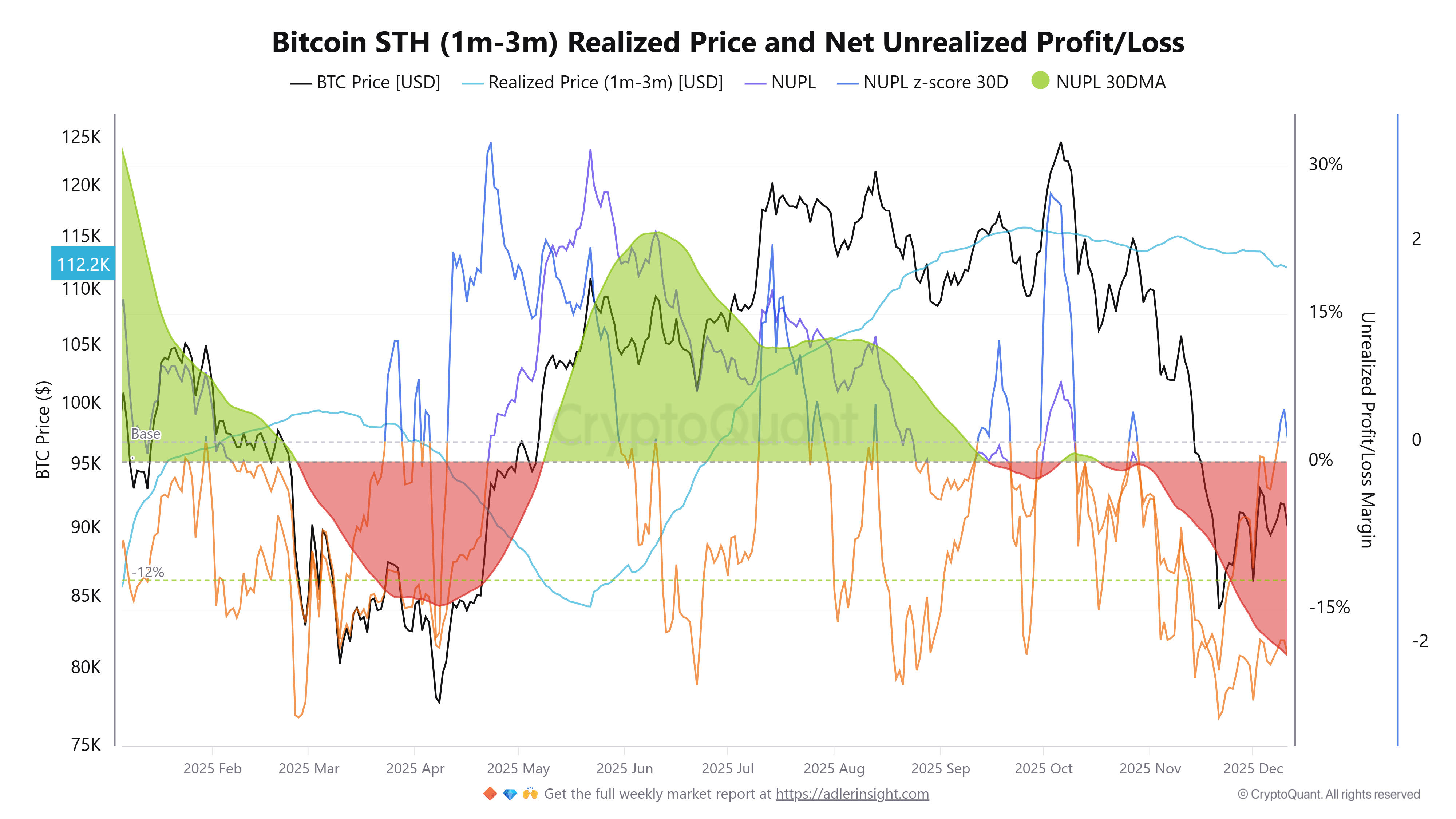
Bitcoin STH realized price and NUPL range. Source: CryptoQuant

Early in 2025, BTC stayed above this cost basis for nearly two months, giving STHs their first pocket of sustained profits. But the shift into February and March saw prices fall below the cohort’s realized price, dragging STH NUPL into deep red and marking one of the year’s longest loss stretches.

However, momentum reversed sharply from late April through mid-October, where the chart’s broad green zones align with Bitcoin’s 172-day period of predominantly profitable STH activity. Even though the broader trend was softening, these recoveries pushed STH profitability far higher than the market narrative implied.

Only in late October did the market slip back beneath the realized price again, triggering the ongoing 45-day period of STH losses that coincides with the swelling red NUPL region.
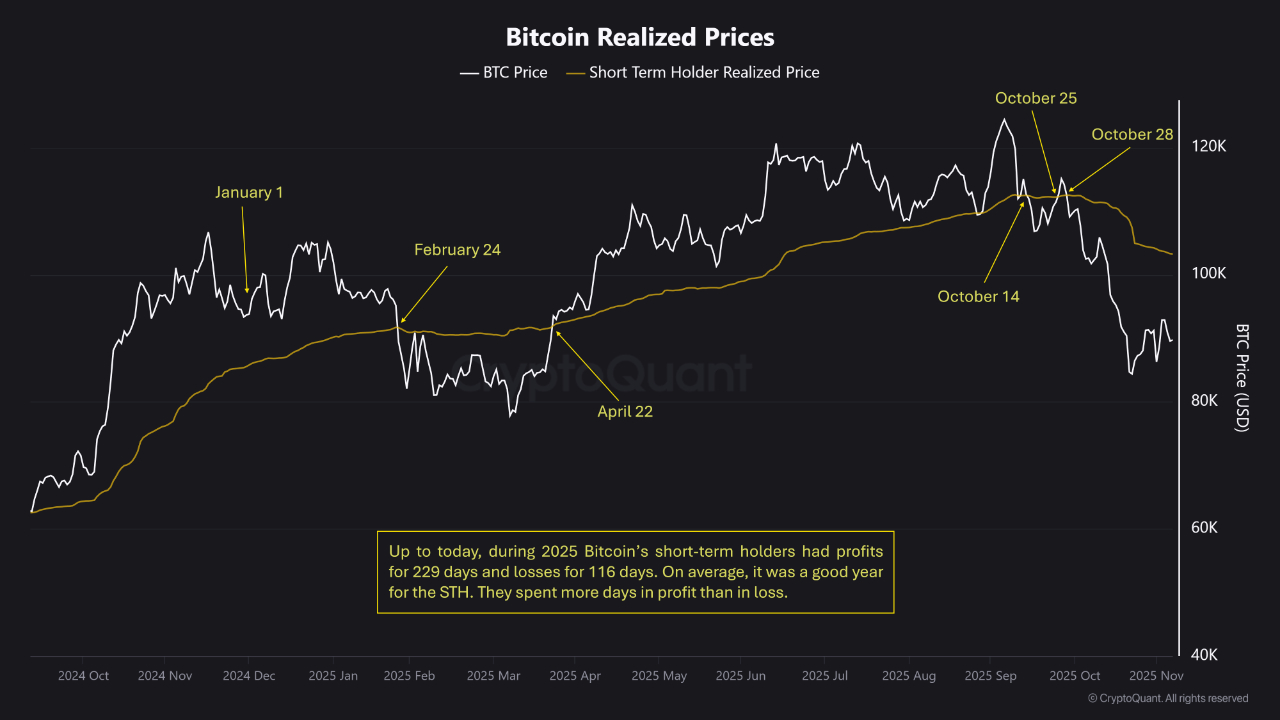
Bitcoin STH realized price against BTC. Source: CryptoQuant

In effect, STH profitability in 2025 was driven less by Bitcoin’s directional trend and more by the frequency with which BTC reclaimed its cost basis. Those repeat rebounds, even within a negative YTD environment, allowed short-term holders to finish with a two-thirds profit ratio.

Related: Bitcoin decouples from stocks in second half of 2025

The BTC cost basis shift may define the next phase again

Bitcoin’s rebound toward $92,500 compressed STH unrealized losses from -28% to -12%, a sign that forced selling is easing and emotional exhaustion is setting in. The STH realized rice at $81,000 remains the psychological fulcrum, as each reclaim historically marks the transition from capitulation into stability.
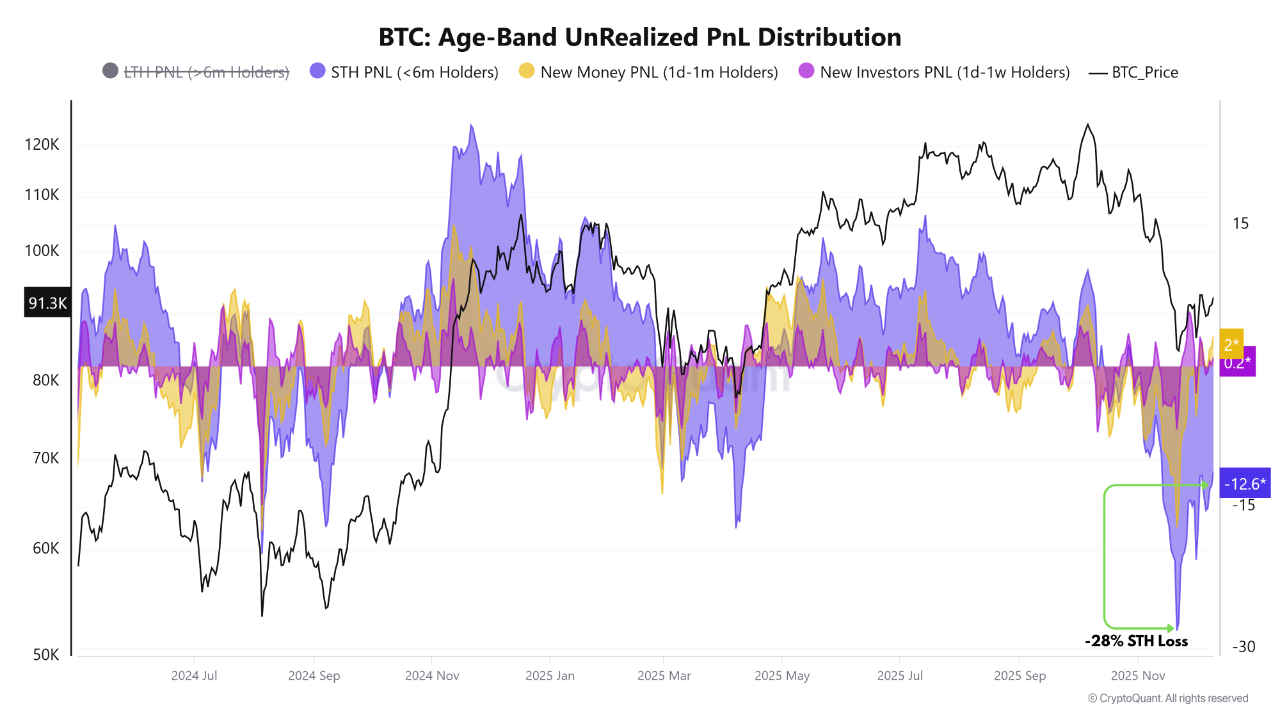
BTC age-band unrealized P&L distribution. Source: CryptoQuant

New money and investors entering within days to weeks, hover near breakeven, reinforcing this stabilizing structure. If BTC continued to improve STH profitability while holding above this $81,000 foundation, the late-year correction could already be nearing completion, setting the stage for the next expansion phase.

Related: Bitcoin new year bear flag sparks $76K BTC price target next

This article does not contain investment advice or recommendations. Every investment and trading move involves risk, and readers should conduct their own research when making a decision. While we strive to provide accurate and timely information, Cointelegraph does not guarantee the accuracy, completeness, or reliability of any information in this article. This article may contain forward-looking statements that are subject to risks and uncertainties. Cointelegraph will not be liable for any loss or damage arising from your reliance on this information.


Related Reads

You Should Still Believe in Crypto

The article "You Should Still Believe in Crypto" addresses the growing sense of burnout and disillusionment within the cryptocurrency industry, sparked by a post from Aevo co-founder Ken Chan titled "I Wasted 8 Years of My Life in Crypto." It acknowledges the collective fatigue many feel due to the industry's fast-paced, often speculative nature, where narratives shift rapidly, and projects frequently fail or disappear. However, the piece argues that the core value of crypto remains vital. It references Nic Carter’s response, highlighting crypto’s potential to create a more robust monetary system, encode business logic via smart contracts, establish true digital property rights, improve capital market efficiency, and enhance global financial inclusion. The article revisits Bitcoin’s origin as a peer-to-peer electronic cash system born from the 2008 financial crisis, emphasizing its purpose as a trustless, decentralized alternative to traditional finance. It points to real-world adoption in high-inflation countries like Argentina and Turkey, where Bitcoin and stablecoins serve as essential financial tools, and notes increasing institutional embrace from firms like BlackRock and Fidelity. Finally, it draws a parallel to the early internet era, arguing that despite chaos, failed projects, and speculative excess, the crypto industry—like the internet—is laying foundational groundwork for future technological and financial evolution. The conclusion is a call to persevere, recognizing that the collective efforts of developers, researchers, and builders worldwide are contributing to a transformative global shift.

marsbit1m ago

You Should Still Believe in Crypto

marsbit1m ago

Oracle Plunges 40%, Will Excessive AI Infrastructure Overbuild Drag Down Giants?

Oracle's stock has plummeted 40% from its September peak, despite securing over $500 billion in AI infrastructure orders, signaling that massive backlogs alone no longer assure investor confidence. Similarly, Broadcom, with a $73 billion AI order backlog, and CoreWeave, which recently landed $36 billion in deals with OpenAI and Meta, have also faced stock declines. The market is growing skeptical of the AI infrastructure boom, concerned not only about suppliers' ability to fund and deliver these projects but also about the financial health and commitment of their major clients—primarily tech giants like Meta, Alphabet, Microsoft, Amazon, Apple, and Nvidia, alongside AI startups like OpenAI and Anthropic. While giants have robust finances, they are increasingly relying on debt to fuel AI capex, with soaring expenditures on data centers straining cash reserves and free cash flow. For instance, Microsoft, Alphabet, and Amazon are projected to collectively invest $1 trillion over four years. However, AI still contributes minimally to their overall revenue, raising questions about the sustainability of using profits from core businesses to fund speculative AI expansions. Execution challenges—such as power grid limitations, cooling issues, and community opposition—further complicate timely deployment. The critical uncertainty remains: if exponential AI demand fails to materialize and monetize quickly enough, these vast investments could lead to underutilized infrastructure, massive losses, and a fundamental weakening of these tech titans. The race between AI infrastructure build-out and actual market payoff will determine whether this bet becomes a triumph or a disastrous overreach.

marsbit50m ago

Oracle Plunges 40%, Will Excessive AI Infrastructure Overbuild Drag Down Giants?

marsbit50m ago

Trading

Spot
Futures
活动图片