Short-Term Bitcoin Holders Return To Losses Despite Elevated Price Levels – Details

bitcoinistPublished on 2026-01-03Last updated on 2026-01-03

Abstract

Bitcoin closed 2025 with a modest annual loss, breaking its typical year-end strength and raising concerns about a potential bear market in 2026. Despite elevated price levels, on-chain data shows short-term holders have returned to an aggregate loss of around -12%, indicating underlying market stress. This often occurs during late-stage corrections or consolidation phases rather than full capitulation. Bitcoin is currently consolidating below $90K, with key support at $85K–$88K. A hold above this zone could lead to a relief rally toward $95K–$100K, while a breakdown may trigger a deeper retracement.

Bitcoin closed 2025 with a modest annual loss, breaking the familiar pattern of strong year-end performance and reinforcing growing concerns that the market may be transitioning into a more challenging phase in 2026.

As macro uncertainty, fading liquidity, and weak risk appetite weigh on sentiment, an increasing number of analysts are openly discussing the possibility of a prolonged bear market. Still, price action tells a more nuanced story. Bitcoin remains locked in consolidation, and the absence of aggressive downside continuation has opened the door to a potential relief rally in the near term.

On-chain data from CryptoQuant adds important context to this setup. Recent metrics show that short-term holders—investors who typically drive momentum during trend expansions—have slipped back into net losses. Aggregate realized profit and loss for this group has turned negative again, with margins hovering near -12%.
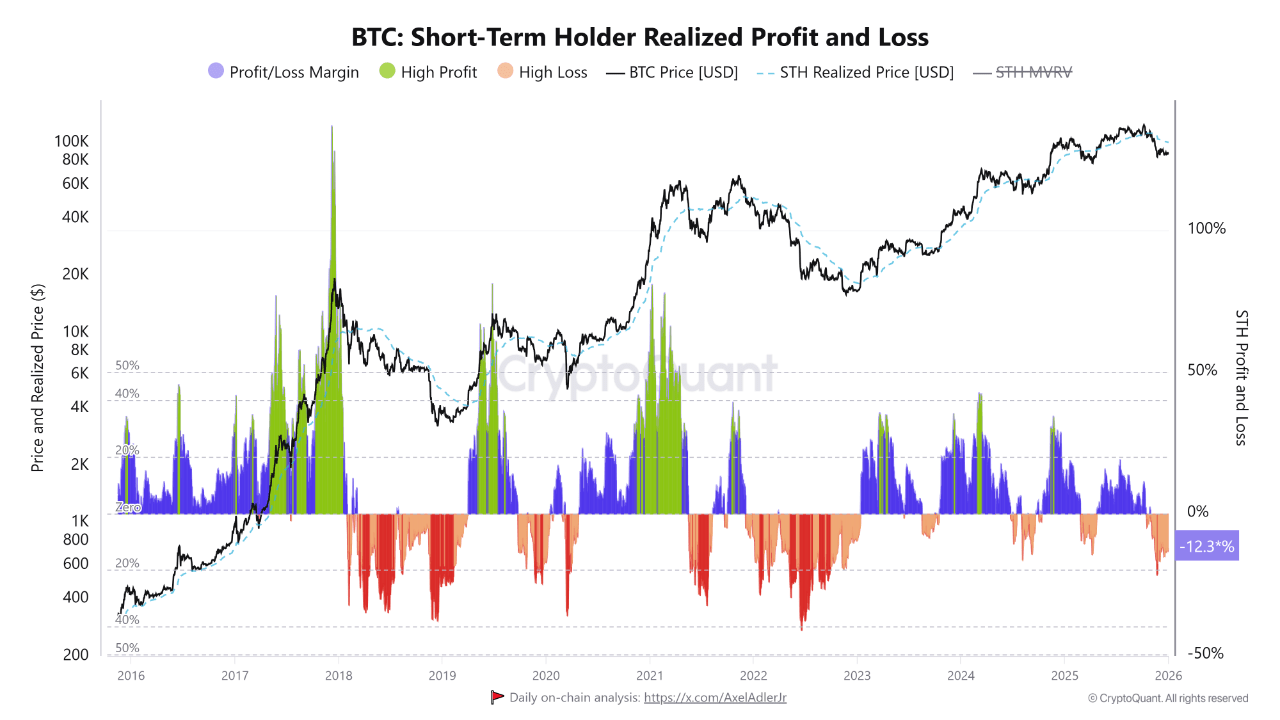
Bitcoin Short-Term Holder Realized Profit and Loss | Source: CryptoQuant

This deterioration is notable because it is occurring while Bitcoin’s price remains relatively elevated compared to previous cycle drawdowns, suggesting that stress is building beneath the surface rather than after a full capitulation.

Historically, periods where short-term holders operate at a loss often coincide with late-stage corrections or consolidation phases within broader market transitions. While this does not confirm a market bottom, it highlights fragility in near-term demand and reinforces the idea that Bitcoin is at a critical inflection point as 2026 approaches.

Short-Term Holder Stress Signals a Market at a Crossroads

Recent on-chain observations suggest Bitcoin is entering a delicate phase where short-term holders are increasingly under strain. When newer market participants slip into losses, it often signals that price has moved faster than incoming demand can comfortably absorb. In past cycles, this condition has typically appeared near the later stages of corrections or during extended sideways phases, rather than at the start of deep bear markets.

What makes the current setup notable is Bitcoin’s proximity to the average acquisition price of short-term holders. This zone has historically acted as a psychological and behavioral battleground. When price hovers near this level, market reactions tend to intensify, as traders decide whether to cut losses or hold through uncertainty. The outcome often defines whether consolidation continues or volatility expands.

Importantly, the scale of losses remains moderate compared to historical capitulation events. Previous market resets, such as those seen in 2018 or mid-2022, were characterized by far deeper and more prolonged stress among short-term holders. The absence of similar extremes today suggests that, while sentiment is weak, the broader market structure has not yet broken down.

That said, persistent pressure on short-term holders reflects fragile near-term demand. If losses begin to narrow, it could signal stabilization and set the stage for a relief move. If they widen instead, downside moves are more likely to accelerate.

Bitcoin Consolidates Below $90K

Bitcoin price action on the 3-day chart shows a clear transition from trend expansion to consolidation following the sharp correction from the $120K–$125K region. After losing the 50-day and 100-day moving averages during the November breakdown, BTC accelerated lower before finding demand in the mid-$80K zone. Since then, price has stabilized and is now compressing just below $90K, suggesting that downside momentum has slowed materially.
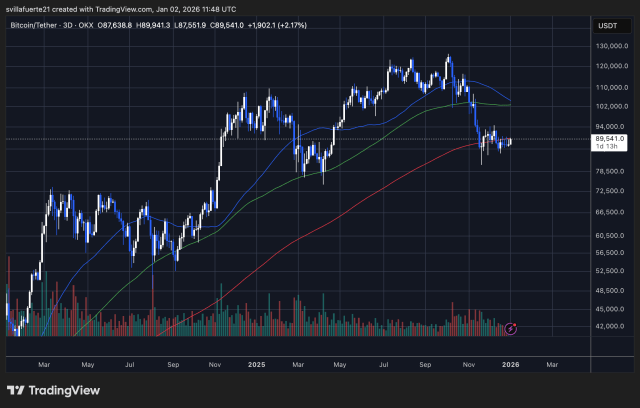
BTC consolidates around 200-3d MA | Source: BTCUSDT chart on TradingView

The current structure reflects a market in equilibrium rather than capitulation. Bitcoin is trading above the 200-day moving average, which continues to slope upward, preserving the broader bullish structure from a higher-timeframe perspective. However, the declining 50-day and 100-day averages overhead are acting as dynamic resistance, capping upside attempts and preventing a clean trend reversal for now.

Selling pressure peaked during the November decline, but recent candles show reduced volume, consistent with seller exhaustion rather than aggressive accumulation. This often precedes a range-bound phase where the market digests prior gains.

From a technical standpoint, holding the $85K–$88K region is critical. A sustained defense of this area keeps the consolidation intact and opens the door for a relief rally toward the $95K–$100K zone.

Conversely, a decisive loss of this support would expose Bitcoin to a deeper retracement toward the 200-day average, shifting the short-term bias back to the downside.

Featured image from ChatGPT, chart from TradingView.com

Related Questions

QWhat is the current state of Bitcoin's short-term holders according to on-chain data?

AOn-chain data from CryptoQuant shows that short-term holders have returned to net losses, with their aggregate realized profit and loss turning negative again, with margins hovering near -12%.

QWhy is the current stress on short-term holders notable despite Bitcoin's price level?

AIt is notable because this stress is occurring while Bitcoin's price remains relatively elevated compared to previous cycle drawdowns, suggesting that stress is building beneath the surface rather than after a full market capitulation.

QWhat is the significance of Bitcoin's price hovering near the average acquisition price of short-term holders?

AThis zone has historically acted as a psychological and behavioral battleground. When price is near this level, market reactions intensify as traders decide whether to cut losses or hold, and the outcome often defines whether consolidation continues or volatility expands.

QWhat is the critical price region that Bitcoin must hold to maintain its current consolidation phase?

AHolding the $85K–$88K region is critical. A sustained defense of this area keeps the consolidation intact and opens the door for a potential relief rally toward the $95K–$100K zone.

QHow does the scale of current losses for short-term holders compare to previous major market resets?

AThe scale of losses remains moderate compared to historical capitulation events like those in 2018 or mid-2022, which were characterized by far deeper and more prolonged stress. This suggests the broader market structure has not yet broken down.

Related Reads

Trading

Spot
Futures

Hot Articles

What is $BITCOIN

DIGITAL GOLD ($BITCOIN): A Comprehensive Analysis Introduction to DIGITAL GOLD ($BITCOIN) DIGITAL GOLD ($BITCOIN) is a blockchain-based project operating on the Solana network, which aims to combine the characteristics of traditional precious metals with the innovation of decentralized technologies. While it shares a name with Bitcoin, often referred to as “digital gold” due to its perception as a store of value, DIGITAL GOLD is a separate token designed to create a unique ecosystem within the Web3 landscape. Its goal is to position itself as a viable alternative digital asset, although specifics regarding its applications and functionalities are still developing. What is DIGITAL GOLD ($BITCOIN)? DIGITAL GOLD ($BITCOIN) is a cryptocurrency token explicitly designed for use on the Solana blockchain. In contrast to Bitcoin, which provides a widely recognized value storage role, this token appears to focus on broader applications and characteristics. Notable aspects include: Blockchain Infrastructure: The token is built on the Solana blockchain, known for its capacity to handle high-speed and low-cost transactions. Supply Dynamics: DIGITAL GOLD has a maximum supply capped at 100 quadrillion tokens (100P $BITCOIN), although details regarding its circulating supply are currently undisclosed. Utility: While precise functionalities are not explicitly outlined, there are indications that the token could be utilized for various applications, potentially involving decentralized applications (dApps) or asset tokenization strategies. Who is the Creator of DIGITAL GOLD ($BITCOIN)? At present, the identity of the creators and development team behind DIGITAL GOLD ($BITCOIN) remains unknown. This situation is typical among many innovative projects within the blockchain space, particularly those aligning with decentralized finance and meme coin phenomena. While such anonymity may foster a community-driven culture, it intensifies concerns about governance and accountability. Who are the Investors of DIGITAL GOLD ($BITCOIN)? The available information indicates that DIGITAL GOLD ($BITCOIN) does not have any known institutional backers or prominent venture capital investments. The project seems to operate on a peer-to-peer model focused on community support and adoption rather than traditional funding routes. Its activity and liquidity are primarily situated on decentralized exchanges (DEXs), such as PumpSwap, rather than established centralized trading platforms, further highlighting its grassroots approach. How DIGITAL GOLD ($BITCOIN) Works The operational mechanics of DIGITAL GOLD ($BITCOIN) can be elaborated on based on its blockchain design and network attributes: Consensus Mechanism: By leveraging Solana’s unique proof-of-history (PoH) combined with a proof-of-stake (PoS) model, the project ensures efficient transaction validation contributing to the network's high performance. Tokenomics: While specific deflationary mechanisms have not been extensively detailed, the vast maximum token supply implies that it may cater to microtransactions or niche use cases that are still to be defined. Interoperability: There exists the potential for integration with Solana’s broader ecosystem, including various decentralized finance (DeFi) platforms. However, the details regarding specific integrations remain unspecified. Timeline of Key Events Here is a timeline that highlights significant milestones concerning DIGITAL GOLD ($BITCOIN): 2023: The initial deployment of the token occurs on the Solana blockchain, marked by its contract address. 2024: DIGITAL GOLD gains visibility as it becomes available for trading on decentralized exchanges like PumpSwap, allowing users to trade it against SOL. 2025: The project witnesses sporadic trading activity and potential interest in community-led engagements, although no noteworthy partnerships or technical advancements have been documented as of yet. Critical Analysis Strengths Scalability: The underlying Solana infrastructure supports high transaction volumes, which could enhance the utility of $BITCOIN in various transaction scenarios. Accessibility: The potential low trading price per token could attract retail investors, facilitating wider participation due to fractional ownership opportunities. Risks Lack of Transparency: The absence of publicly known backers, developers, or an audit process may yield skepticism regarding the project's sustainability and trustworthiness. Market Volatility: The trading activity is heavily reliant on speculative behavior, which can result in significant price volatility and uncertainty for investors. Conclusion DIGITAL GOLD ($BITCOIN) emerges as an intriguing yet ambiguous project within the rapidly evolving Solana ecosystem. While it attempts to leverage the “digital gold” narrative, its departure from Bitcoin's established role as a store of value underscores the need for a clearer differentiation of its intended utility and governance structure. Future acceptance and adoption will likely depend on addressing the current opacity and defining its operational and economic strategies more explicitly. Note: This report encompasses synthesised information available as of October 2023, and developments may have transpired beyond the research period.

363 Total ViewsPublished 2025.05.13Updated 2025.05.13

What is $BITCOIN

Discussions

Welcome to the HTX Community. Here, you can stay informed about the latest platform developments and gain access to professional market insights. Users' opinions on the price of BTC (BTC) are presented below.

活动图片















