Securitize announces ‘real’ tokenized stocks, touts DeFi integration

cointelegraphPublished on 2025-12-17Last updated on 2025-12-17

Abstract

Securitize has announced plans to launch what it claims will be the first compliant, on-chain trading experience for tokenized public stocks, representing real share ownership rather than synthetic exposure. The product, expected in Q1 2026, will use tokens issued directly on the issuer’s cap table and recorded onchain. Trading will occur through a DeFi-style swap interface, enabling real-time transactions even outside traditional market hours. The company criticized existing tokenized stock offerings for lacking true ownership, compliance, and proper KYC/AML controls, often relying on offshore structures. In contrast, Securitize emphasizes regulatory compliance, whitelisted wallets, and its role as an SEC-registered transfer agent to ensure tokens represent legally recognized shares. Beyond faster settlement, the firm highlights programmability—enabling integration with DeFi and smart contracts while maintaining investor protections—as a key upgrade to traditional finance.

Securitize, a company focused on tokenizing securities, said Tuesday it plans to launch what it calls the first compliant, onchain trading experience for public stocks that are issued as tokens representing real share ownership.

According to the announcement, Securitize’s stock product is expected to launch in the first quarter of 2026. The company said the offering is designed to avoid structures that mirror stock prices without conveying ownership, and instead, the tokens “are real, regulated shares: issued onchain, recorded directly on the issuer’s cap table.”

It also said trading will be presented in a “swap-style” interface familiar to users of decentralized finance, or decentralized finance (DeFi).

Securitize argued that natively tokenized public stocks, in which tokens represent actual stock ownership, were held onchain but mostly traded through traditional offchain processes. Its pitch is that buyers and sellers will be able to trade “fully on-chain” in real time, including during hours when traditional markets are closed.
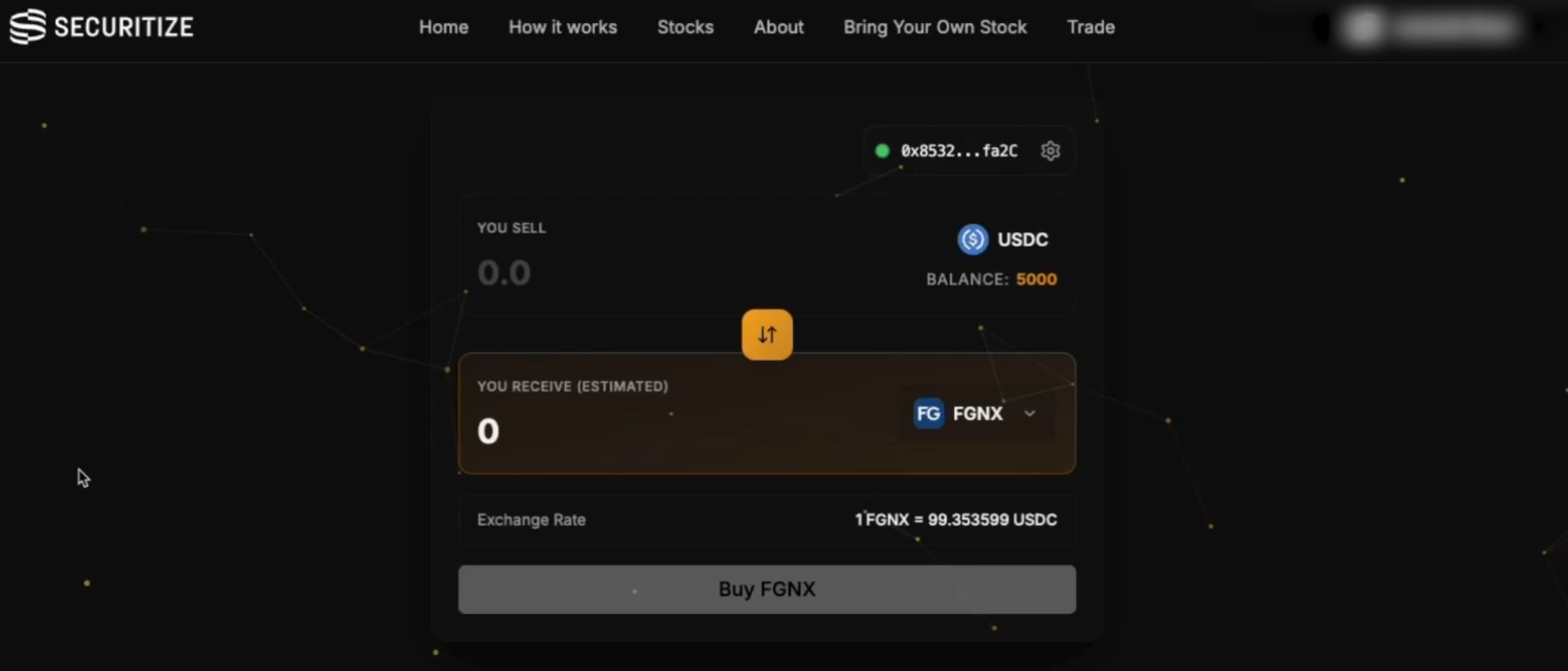
Securitize’s tokenized stock trading user interface. Source: Securitize

Related: Binance hints at stock perps in push to join global tokenized equities race

A compliant tokenized stock ecosystem

Securitize criticized the recent wave of tokenized stock products, claiming they “offer exposure, not ownership.” The company said some products rely on special-purpose vehicles or offshore structures that can add counterparty risk or create pricing mismatches.

It also criticized tokenized stock products, which it said “are not even compliant, since they are issued as permissionless assets without Know Your Customer (KYC) or Anti-Money Laundering (AML) controls.

Still, the company notes that traditional stock infrastructure is antiquated and needs disintermediation and rebuilding, with investors rarely holding “shares in their own name, settlement takes at least a day.”

“If tokenization is going to matter at public-market scale, it must deliver ownership, real securities and maintain investor protections.“

Securitize said its approach is built around regulated securities and compliance requirements, including controls that limit transfers to approved, or whitelisted, wallets.

Related: Ondo wins Liechtenstein approval to offer tokenized stocks in Europe

Regulated shares make their way to DeFi

Securitize said it will act as the transfer agent for the shares, describing itself as registered with the US Securities and Exchange Commission. Transfer agents maintain shareholder records and process changes in ownership. By pairing that role with blockchain-based issuance, the company said the tokens would be legally recognized shares rather than a proxy claim.

Securitize downplayed faster settlement as the main selling point, saying the larger opportunity is programmability, or the ability for tokenized securities to interact with smart contracts and onchain financial applications.

It further argued that this programmability allows tokenized securities to be integrated with DeFi platforms “without compromising compliance or user protections.”

“This is not about replacing traditional finance. It’s about upgrading it,“ Securitize said.
Related Reads

Global Stock Market's Storm Center: South Korea's Stock Market De-leveraging Is Largely Complete

Storm's Eye: South Korean Market De-leveraging Nears Completion The recent sharp correction in South Korean equities, with the KOSPI index dropping 32% from its June high, has been a key trigger for global tech stock volatility. The core driver was not a fundamental shift but a forced de-leveraging process within the market's unique structure, which is now largely complete. Two main leverage channels amplified the sell-off: 1. **Leveraged ETFs:** Their size, proportionally four times larger than in the U.S., peaked near $50 billion. Their mandatory daily rebalancing mechanism created a vicious cycle of "price drop → forced selling → further drop." Approximately 75% of this excess has been unwound, shrinking to $26 billion, with regulatory curbs now blocking new inflows. 2. **Hedge Fund Leverage:** Using swaps to magnify exposure, hedge funds saw their net long positioning fall by over 50% from peak levels. The most intense phase of this institutional de-leveraging is over. In contrast, **retail margin debt** poses minimal systemic risk. At 0.5% of market cap, it is far lower than in the U.S. or China, lacks automatic triggers, and is concentrated in smaller stocks. The conclusion: the high-leverage structures most prone to "chain-reaction selling" have been substantially cleared. The market is transitioning from a liquidity-driven crash to one priced more on fundamentals. The article argues that the AI trend—centered on Korean memory chips—remains intact. This episode represents a painful but necessary clearing of crowded trades, not the end of the AI revolution. For investors, the key question is conviction in the long-term AI direction; if the trend is real, current volatility is a cost of entry, not a terminal risk.

链捕手2h ago

Global Stock Market's Storm Center: South Korea's Stock Market De-leveraging Is Largely Complete

链捕手2h ago

Trading

Spot
活动图片