SEC Pushes for All-Day Trading in US Stocks, Will RWA's Biggest Advantage Disappear?

Foresight NewsPublished on 2026-07-27Last updated on 2026-07-27

Abstract

**Summary: SEC Advances Towards 24-Hour U.S. Stock Trading, Impact on Crypto RWA Tokens** The U.S. Securities and Exchange Commission (SEC) has announced a public roundtable for September 17th to discuss preparations for moving the U.S. equity markets towards 24-hour trading. This signals a potential substantive shift from the traditional 9:30 AM to 4:00 PM ET trading day to a near 24/5 model (23 hours a day, 5 days a week) by late 2026 or early 2027, pending regulatory approval and infrastructure alignment. Key exchanges like NYSE Arca and Nasdaq are planning extended hours, and critical clearing infrastructure from DTCC already supports 24/5 operations. For the crypto industry, particularly the Real World Asset (RWA) tokenization sector, this development directly challenges a core narrative: that tokenized assets offer superior, round-the-clock trading access compared to traditional markets. As U.S. stocks become tradable for most of the global day, the simple advantage of "24/7 availability" for tokenized equities diminishes. This may pressure RWA platforms that relied heavily on this differentiation. However, the shift also presents opportunities for deeper integration. True 7x24 trading including weekends, near-instant atomic settlement on-chain, and programmable features like automated dividends remain inherent blockchain advantages. The regulatory environment is evolving in parallel, with the SEC including tokenized securities in its agenda, potentially creating cle...


Author: Ma He, Foresight News


On July 23, the U.S. Securities and Exchange Commission (SEC) announced it will host a public roundtable on September 17 at its Washington, D.C. headquarters, focusing on preparations for moving towards 24-hour trading in the U.S. stock market. The meeting will discuss infrastructure supporting overnight trading, operations and resilience under a 24-hour market, as well as opportunities and challenges associated with expanding trading hours.



SEC Chairman Paul S. Atkins stated in the announcement: "We are stepping into a new day—and a new night—for the U.S. stock market. As overnight trading expands, I look forward to aligning the U.S. stock market with those markets that have already achieved continuous trading, while also anticipating striking a balance between all-day trading and crucial investor and customer protection."


This roundtable may represent a critical juncture in the substantive transition of U.S. stocks from traditional trading hours to a near-continuous (23x5) model. For the crypto industry, especially the RWA (Real World Asset) tokenization sector, this change both compresses some of its differentiation narratives and opens up deeper avenues for integration.


U.S. Stock Trading Embraces Change


Since 1985, the regular trading hours for major exchanges like the New York Stock Exchange and Nasdaq have been fixed at 9:30 AM to 4:00 PM Eastern Time, Monday through Friday. This arrangement has persisted for over forty years.


While the long-standing maintenance of regular trading hours for U.S. stocks is conducive to centralized price discovery and lower operational costs, in today's era of highly electronic global capital flows, this setup is outdated. Investors in Asia and Europe who wish to trade U.S. stocks during their local daytime often have to rely on futures or the illiquid pre-market and after-hours sessions, an experience far less smooth than trading crypto assets. Simultaneously, retail investors, accustomed to placing orders anytime via mobile apps, are growing increasingly impatient with the "waiting period" after major news announcements when they cannot trade immediately.


Outside regular hours, limited extended trading windows exist. Pre-market trading typically runs from early morning until 9:30 AM; after-hours trading extends from 4:00 PM to around 8:00 PM. These extended sessions are provided by various exchanges, alternative trading systems (ATS), and brokerage platforms, but liquidity is significantly lower than during regular hours, with wider spreads and less efficient price discovery. Regulatory bodies like FINRA have repeatedly warned investors of higher volatility and execution risks during extended hours.


In recent years, some brokers and ATS have further extended trading into overnight hours. For instance, platforms like Interactive Brokers offer overnight trading from Sunday 8:00 PM to approximately 3:50 AM Friday (with brief maintenance windows in between), covering select S&P 500, Nasdaq 100 components, and ETFs. However, according to public market observations, genuine overnight trading volume has long constituted a tiny fraction of the total market, making it difficult to establish deep price discovery.


Overall, U.S. stocks remain characterized by a core of "concentrated trading on weekday days," with markets completely closed on weekends and most holidays. This stands in stark contrast to the crypto asset market's 7x24, year-round operational model, a contrast often emphasized as a point of differentiation in RWA tokenization narratives.


23/5 Trading?


Since 2024, several exchanges and market infrastructure institutions have accelerated efforts towards near-continuous trading.


24X National Exchange is the first SEC-approved national securities exchange authorized to conduct 23-hour trading (23x5), planning to formally launch a complete 23/5 night session in the second half of 2026. NYSE Arca plans to extend trading hours to approximately 22 hours, also targeting the end of 2026. Nasdaq has publicly proposed a "Global Trading Hours" plan, intending to add a night session from 9:00 PM to 4:00 AM the next day, combined with existing hours to create a nearly 23-hour trading day, also targeting the second half of 2026, contingent on regulatory approval and alignment of industry infrastructure. Cboe is also advancing its 23x5 plans for platforms like EDGX.


Progress at the infrastructure level is even more crucial. DTCC's National Securities Clearing Corporation (NSCC) launched its 24x5 clearing service on June 28, 2026, covering trading activities from Sunday 8:00 PM to Friday 8:00 PM, providing immediate central counterparty guarantees for overnight trades and significantly reducing counterparty risk.


These developments suggest that by late 2026 to early 2027, U.S. stocks may achieve near-continuous trading on weekdays within the regulatory framework. True 7x24 trading (including weekends) still faces higher barriers, but the direction towards "money never sleeps" has moved from discussion to implementation. The September 17 roundtable is precisely the SEC's initiative to publicly align exchanges, market makers, clearing agencies, brokers, and investor representatives on core issues such as operational resilience, liquidity management, and investor protection before formally scaling up these changes.


Crypto RWA Platforms


The shift of U.S. stocks towards near-continuous trading directly impacts one of the most commonly used selling points by RWA tokenization platforms in the past—"traditional markets only trade during the day, but on-chain you can trade 7x24."
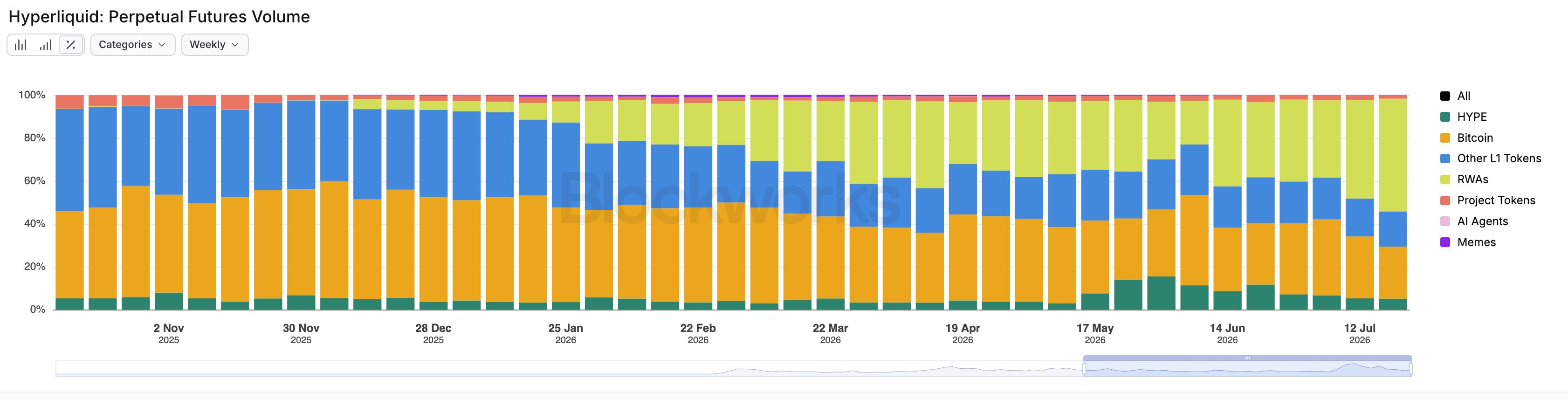


The current RWA market has reached a certain scale, especially in perpetual futures trading volume. According to the latest data from Blockworks, last week, RWA trading volume on the Hyperliquid platform surpassed crypto asset trading volume for the first time, accounting for 54% of the platform's total trading volume. Among these, single-stock trading has become the fastest-growing category. Since June, individual stock trading volume has exceeded that of indices and commodities, now constituting about 61% of Hyperliquid's total RWA trading volume, indicating that on-chain financial markets are expanding from pure crypto asset trading towards traditional assets.


Once U.S. stock trading hours are extended, the mere appeal of "being able to trade real stocks during Asian hours or at night" will be diluted. Institutions and cross-border investors will be able to execute near-continuous trades more directly on regulated traditional exchanges and ATS, without having to rely entirely on tokenized channels. For many large funds, the traditional path remains more attractive in terms of compliance costs, custody, and settlement certainty.


However, the impact is not entirely negative.


True 7x24 trading and instant atomic settlement remain on-chain advantages. Even if U.S. stocks achieve 23x5, gaps on weekends and holidays will persist, and clearing and settlement will still rely on the DTCC system, making it difficult to completely eliminate T+0 and T+1 frictions. RWA tokens can achieve near-instant ownership transfer and settlement on public blockchains and naturally support programmable logic, including automated dividends, collateralization, and composability.


The regulatory environment is evolving simultaneously. Under the leadership of Paul Atkins, the SEC has explicitly included "facilitating on-chain trading of tokenized securities" in its 2026 regulatory agenda and is advancing a token classification framework. Tokenized securities are still defined as securities subject to federal securities laws, but innovative exemptions and related rule adjustments are under discussion. DTCC is also progressing with tokenized settlement pilots. The experience accumulated in managing overnight liquidity, price protection, and system resilience during the extension of U.S. stock trading hours actually provides a reference for regulated RWA secondary markets.


Some crypto platforms have already explored collaborations, such as integrating tokenized U.S. stocks with traditional account systems and global liquidity. On July 10 this year, Backpack launched the world's first 7x24 real U.S. stock trading market for international investors, allowing users to buy, sell, and hold real U.S. stocks around the clock, not synthetic derivatives.


Ondo's tokenized stocks are backed 1:1 by underlying securities and are linked to traditional market liquidity through minting and redemption mechanisms. Users can trade these tokens directly on crypto exchanges, while non-U.S. users gain more convenient exposure to U.S. stocks.


For RWA platforms, the true moat is shifting from "trading time differentiation" to "settlement finality, cross-border accessibility, DeFi composability, and interoperability with traditional infrastructure." The tokenization of private credit, real estate, alternative assets, and other non-public market assets will be less impacted by changes in U.S. stock trading hours and may even benefit from the overall increased acceptance of tokenization.


Risks also need to be acknowledged. Liquidity during overnight hours will inevitably be thin initially, making prices more susceptible to moves. If RWA platforms open trading during low-liquidity windows, they must simultaneously strengthen risk controls, circuit breakers, and market-making mechanisms; otherwise, they risk amplifying volatility and damaging industry credibility. The regulatory pressure on purely permissionless, synthetic products may also increase further as traditional markets extend trading hours, thereby enhancing the value of compliant issuance and ATS/exchange pathways.


Related Questions

QWhat key development announced by the SEC could accelerate the transition of U.S. stock markets towards near-24/5 trading, and what is its purpose?

AThe SEC announced a public roundtable to be held on September 17th, focusing on the preparations for moving towards 24-hour trading in U.S. equity markets. Its purpose is to discuss the supporting infrastructure, operational resilience, and the opportunities and challenges of extending trading hours, serving as a key alignment point before a large-scale rollout.

QAccording to the article, what is one of the most frequently highlighted selling points for RWA (Real World Asset) tokenization platforms that is now being challenged by the move towards extended U.S. stock trading hours?

AOne of the most frequently highlighted selling points for RWA platforms that is being challenged is the argument that 'traditional markets can only trade during the day, while on-chain trading can be 7x24.' As U.S. markets move to nearly 24/5 operation, this time-based advantage is being diluted.

QWhat are some of the core advantages of on-chain RWA tokenization that are expected to remain significant even if U.S. stocks achieve 23/5 trading?

AEven with 23/5 trading, core on-chain advantages include: 1) True 7x24 operation (including weekends and holidays). 2) Near-instant atomic settlement/finality, eliminating T+0/T+1 friction. 3) Programmable logic (e.g., automatic dividends, collateralization, composability). 4) Cross-border accessibility and interoperability with DeFi.

QName one platform where RWA trading volume recently exceeded its crypto-native asset trading volume, and what was the fastest-growing category within its RWA segment?

AAccording to the article, on the Hyperliquid platform, RWA trading volume recently exceeded crypto asset trading volume, making up 54% of total platform volume. The fastest-growing category within its RWA segment is single-stock trading, which accounted for about 61% of its RWA volume since June.

QWhat potential risk for RWA platforms is highlighted in the article regarding trading during low-liquidity periods like extended or overnight hours?

AThe article highlights that if RWA platforms operate during low-liquidity windows (like initial overnight periods), they must strengthen risk controls, circuit breakers, and market-making mechanisms. Otherwise, they risk amplifying price volatility and damaging the industry's credibility due to easier market manipulation or poor execution.

Related Reads

In Conversation with Ray Dalio: We Are Currently in an AI Bubble, with 1% of My Portfolio in Bitcoin

Ray Dalio, founder of Bridgewater Associates, warns in an interview that the current AI boom shows classic bubble characteristics, which could lead to significant economic downturns as seen in past cycles like 1929 or 2000. He explains that speculative enthusiasm, fueled by debt and overvaluation, often precedes a crash when rising rates or taxation force asset sales, causing widespread losses and recession. Dalio also outlines his "Big Cycle" theory, describing an approximate 80-year pattern where widening wealth gaps, massive government deficits, and shifting geopolitical power (like China's rise) create internal conflict and global instability. He emphasizes that we are in a late-cycle, transitional phase where traditional powers like the US and UK face decline. For personal wealth protection, Dalio advises diversification beyond cash into assets like stocks, bonds, real estate, and particularly gold, which he prefers over Bitcoin. While he holds about 1% of his portfolio in Bitcoin as a non-printable hard asset, he views gold as more secure from technological or governmental threats. Regarding AI's impact, Dalio believes it will disproportionately benefit capital owners, worsening inequality by replacing both physical and cognitive labor. He suggests that human intuition and emotional intelligence, combined with AI, will be key for future workers. On taxation, Dalio argues that wealth taxes are impractical and risk triggering asset sell-offs, reducing productive investment. He points to the UK as a cautionary example of debt, low productivity, and political strife. Geopolitically, Dalio foresees a more regionalized world, with the US showing weakness in prolonged conflicts like with Iran, akin to past imperial declines. The ideal outcome, he suggests, is coexisting powerful blocs (e.g., Americas, China-Asia Pacific) without major war.

marsbit2h ago

In Conversation with Ray Dalio: We Are Currently in an AI Bubble, with 1% of My Portfolio in Bitcoin

marsbit2h ago

Daily 7.2 Trillion KRW: Foreign Capital's Record Net Buying on Friday! Wall Street Says Headwinds for Korean Stock Fund Flows Have Subsided

South Korean stock market sees a dramatic shift in fund flows. On July 31, foreign investors made a record net purchase of approximately KRW 7.2 trillion in KOSPI stocks, marking a fundamental reversal from the persistent large-scale net outflows seen in previous months. This contributed to a significant narrowing of foreign net selling in July to KRW 9.8 trillion, down sharply from KRW 48.4 trillion in June and KRW 44.5 trillion in May. Simultaneously, domestic institutional pressure eased. South Korean pension funds and asset managers turned to a net buying position in July, purchasing KRW 1.0 trillion worth of KOSPI shares, contrasting with net sales in May and June. Market volatility is expected to be dampened by new financial regulations. Effective July 31, the Financial Services Commission tightened access for retail investors to single-stock leveraged ETFs by raising the minimum cash deposit requirement. Trading volumes for these products subsequently dropped to about 50% of their monthly average. Citigroup Research maintains its year-end KOSPI target of 10,000 points. The firm cites several supportive factors: the substantial easing of headwinds from capital outflows, a robust fundamental outlook for the semiconductor sector, historically low market valuations, strong economic fundamentals, and the potential for policy support from financial authorities if needed.

marsbit2h ago

Daily 7.2 Trillion KRW: Foreign Capital's Record Net Buying on Friday! Wall Street Says Headwinds for Korean Stock Fund Flows Have Subsided

marsbit2h ago

Thanks to Dice Rolls, Bitcoin Keys Are Stored Offline, But Not Everyone Will Do It

The article discusses using dice rolls to generate secure Bitcoin wallet seeds, providing entropy independent of potentially flawed hardware random number generators. It explains that each fair dice roll offers about 2.585 bits of entropy, with around 50 rolls needed for a standard 12-word seed phrase and 99+ recommended for higher security. This method gained attention after a vulnerability was revealed in some Coldcard hardware wallets, where a faulty firmware RNG (dating back to 2021) compromised generated keys. The analysis notes that while a dice-generated main seed was safe from this specific flaw, other Coldcard functions (like creating paper wallets, backup keys, or passwords) could still be vulnerable if they used the defective RNG. The piece argues that while dice-based entropy is technically robust, the manual process is error-prone, tedious, and unrealistic for most new users, who might make mistakes in recording or inputting rolls. It concludes that while manual entropy generation should remain an option for advanced users, the long-term goal is to develop reliable, user-friendly hardware and software that securely generates randomness without requiring specialized knowledge. Coldcard users are advised to check their firmware version and replace any secondary secrets (like paper wallet keys) created with vulnerable devices, while also considering multi-signature setups with devices from different manufacturers for added security.

cryptonews.ru7h ago

Thanks to Dice Rolls, Bitcoin Keys Are Stored Offline, But Not Everyone Will Do It

cryptonews.ru7h ago

Trading

Spot
活动图片




