SEC confirms years-long director bans for former Alameda, FTX executives

cointelegraphPublished on 2025-12-19Last updated on 2025-12-19

Abstract

The U.S. Securities and Exchange Commission (SEC) has obtained final consent judgments against former Alameda Research CEO Caroline Ellison and former FTX executives Gary Wang and Nishad Singh. They are barred from holding company leadership roles for eight to 10 years due to their involvement in misusing FTX investor funds from 2019 to 2022. Ellison received a 10-year ban, while Wang and Singh each accepted eight-year bans. All three are also subject to five-year conduct-based injunctions. The SEC alleged that, with Ellison's knowledge, FTX co-founder Sam Bankman-Fried and the other executives exempted Alameda from risk measures and provided it with an unlimited line of credit using FTX customer funds. Ellison, who testified against Bankman-Fried, was sentenced to two years in prison and is scheduled for early release on February 20. Wang and Singh also cooperated with authorities and received time-served sentences. Bankman-Fried was sentenced to 25 years for his central role in the exchange’s collapse.

Former Alameda Research CEO Caroline Ellison and former FTX executives Gary Wang and Nishad Singh will be barred from assuming company leadership roles for eight to 10 years following a court judgment.

In a Friday notice, the US Securities and Exchange Commission said that it had obtained final consent judgments against Ellison, Wang and Singh for their roles in the misuse of investor funds at FTX from 2019 to 2022.

The former Alameda CEO consented to a 10-year officer-and-director bar, while Wang and Singh consented to eight-year officer-and-director bars each. All three are also subject to five-year ”conduct-based injunctions,” according to the SEC.

“In reality, as alleged in the complaints, [Sam] Bankman-Fried, Wang, and Singh, with Ellison’s knowledge and consent, had exempted Alameda from the risk mitigation measures and provided Alameda with a virtually unlimited ‘line of credit’ funded by FTX’s customers,” said the SEC. “The complaints also alleged that Wang and Singh created FTX’s software code that allowed FTX customer funds to be diverted to Alameda, and that Ellison used misappropriated FTX customer funds for Alameda’s trading activity.”
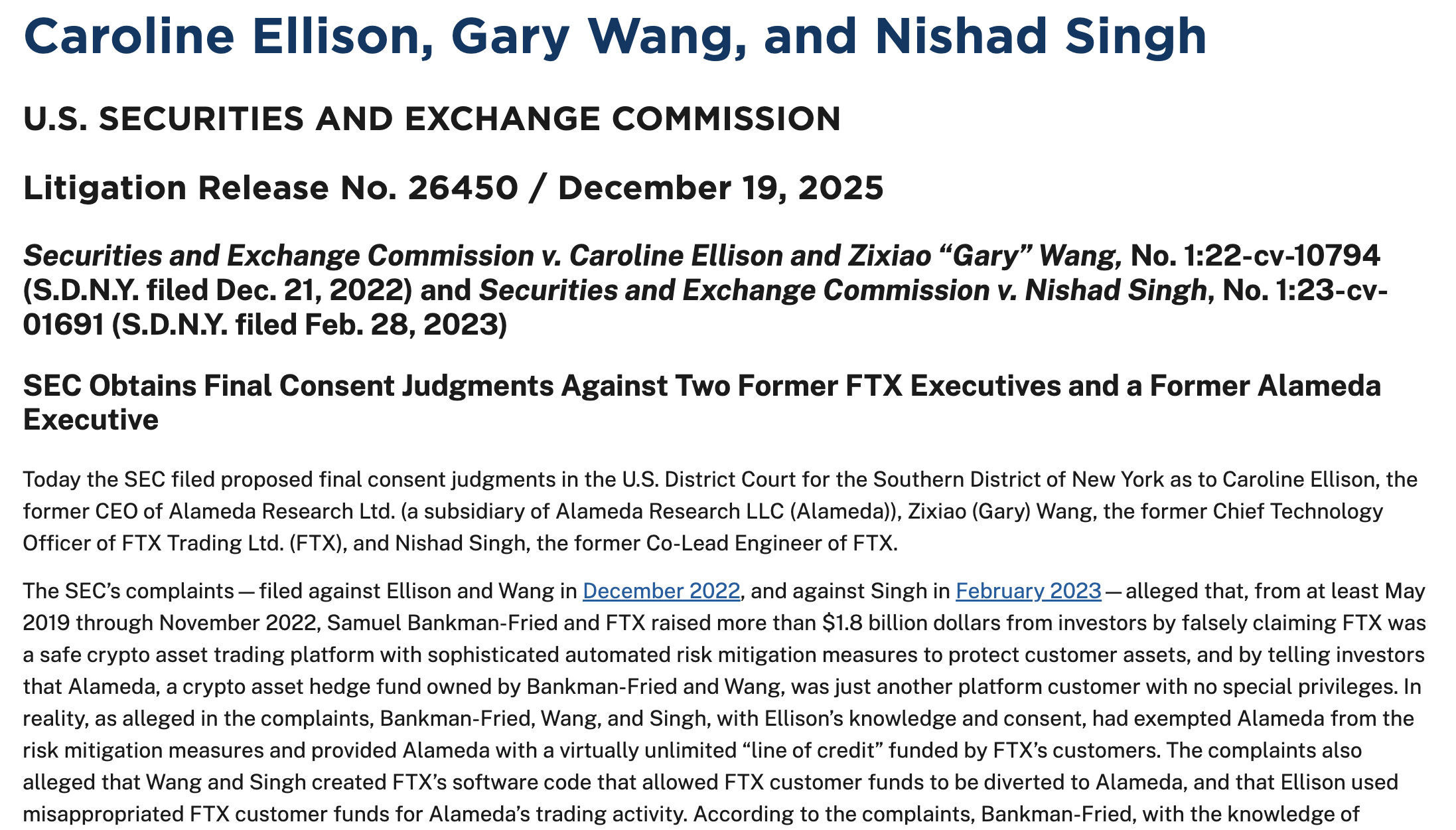
Source: SEC

Former FTX CEO Sam “SBF” Bankman-Fried received a 25-year sentence for his role in the exchange’s collapse. He is awaiting the results of an appeal in the US Court of Appeals for the Second Circuit, where a hearing was held on Nov. 4.

Related: Caroline Ellison blames Sam Bankman-Fried for misuse of FTX user funds at trial

Ellison was sentenced to two years as part of a plea deal in which she testified against Bankman-Fried. Wang and Singh testified against SBF at his criminal trial and were sentenced to time served in 2024.

Ellison will soon be released from custody

The former Alameda CEO, who largely stayed out of the public spotlight between FTX’s collapse and her testimony at SBF’s trial in October 2023, was recently transferred from prison to a Residential Reentry Management field office in New York City.

According to the Federal Bureau of Prisons, she is scheduled to be released on Feb. 20, about nine months before the end of her two-year sentence. The timing suggested she may have been eligible for good-conduct credits to reduce her prison time.

Magazine: When privacy and AML laws conflict: Crypto projects’ impossible choice

Related Questions

QWhat are the specific officer-and-director bar durations for Caroline Ellison, Gary Wang, and Nishad Singh as ordered by the SEC?

ACaroline Ellison consented to a 10-year officer-and-director bar, while Gary Wang and Nishad Singh each consented to an 8-year officer-and-director bar.

QAccording to the SEC, what was the primary allegation against Sam Bankman-Fried, Gary Wang, and Nishad Singh regarding Alameda Research?

AThe SEC alleged that Sam Bankman-Fried, Gary Wang, and Nishad Singh, with Caroline Ellison's knowledge and consent, exempted Alameda from risk mitigation measures and provided it with a virtually unlimited 'line of credit' funded by FTX's customers.

QWhat was the role of Gary Wang and Nishad Singh in the misuse of FTX customer funds as stated in the complaints?

AThe complaints alleged that Gary Wang and Nishad Singh created FTX's software code that allowed FTX customer funds to be diverted to Alameda.

QWhat is the current status of Sam Bankman-Fried's legal case as mentioned in the article?

ASam Bankman-Fried received a 25-year sentence and is awaiting the results of an appeal in the US Court of Appeals for the Second Circuit, where a hearing was held on November 4.

QWhen is Caroline Ellison scheduled to be released from custody and what is the reason for her early release?

ACaroline Ellison is scheduled to be released on February 20, about nine months before the end of her two-year sentence, likely due to being eligible for good-conduct credits to reduce her prison time.

Related Reads

Within Strategy's Framework, STRC's Dividend Yield Remains at 12% as Share Price Stays Below Par Value

Michael Saylor, Executive Chairman of Strategy (MSTR), confirmed that the dividend rate for its STRC perpetual preferred shares will remain at 12.00% through August 2026. The rate has increased from 9% at its July 2025 launch to the current high via a "ratchet" mechanism, which permanently raises the rate by 0.5% whenever the share price falls below $95. This mechanism is intended to push the price back toward its $100 par value and support Strategy's "at-the-market" (ATM) program for issuing new shares to fund Bitcoin purchases. However, the mechanism has not worked as intended. STRC shares closed at $89.46 on July 31, remaining about 10-11% below par value despite the record-high dividend. Competition from rival Strive's higher-yielding SATA securities has pressured demand. The persistent discount has forced Strategy to suspend new STRC issuances via its ATM program, limiting this funding channel for Bitcoin acquisitions. STRC's struggles reflect Bitcoin's own volatility, as the preferred shares historically move in tandem. Analysts have warned the ratchet structure carries long-term, one-way risk. A law firm is investigating Strategy's ability to maintain dividend payments if Bitcoin's price stays low. Retail investors own roughly 83% of outstanding STRC shares, a group seen as prone to panic selling during downturns. In response, Strategy has established financial reserves, including a liquidity cushion covering about 26 months of dividend/interest obligations, and a $2 billion share buyback program alongside a Bitcoin monetization framework, though the company emphasized it is not obligated to sell any Bitcoin.

cryptonews.ru13m ago

Within Strategy's Framework, STRC's Dividend Yield Remains at 12% as Share Price Stays Below Par Value

cryptonews.ru13m ago

Analyst: Bitcoin's Price Will Drop to $60k in August, Then Rebound to $70k

Financial analyst Andrey Poroshin has provided a new forecast for Bitcoin's price dynamics in August. Poroshin, an analyst at the Bitbanker exchange, expects the cryptocurrency market to experience a downturn this month, with prices retesting the $60,000 level due to a lack of supportive macroeconomic catalysts. He noted that the recent US Federal Reserve decision to hold interest rates did not significantly impact the market, while inflation remains above the 2% target. Poroshin stated that Bitcoin is ending July under pressure from moderate volatility and a lack of new macroeconomic stimuli, leading to continued market caution. According to his base scenario, Bitcoin will drop to a range of $60,000 to $62,000 before recovering to $70,000. He pointed out that even $70,000 remains below the cost of mining in the US, which has prompted some miners to shift towards AI data center operations. Poroshin cited the winding down of BitMEX's operations as a potential catalyst for a price rebound, suggesting the exit of weaker players often coincides with market reversals and reduced short-term selling pressure. He believes Bitcoin is currently less susceptible to geopolitical shocks, such as the Iran-US conflict, and does not expect significant market changes in August related to the pending CLARITY Act. Looking ahead, Poroshin forecasts that September will bring more active price fluctuations driven by potential Fed rate decisions and possible discussions or approval of the CLARITY Act.

cryptonews.ru13m ago

Analyst: Bitcoin's Price Will Drop to $60k in August, Then Rebound to $70k

cryptonews.ru13m ago

Trading

Spot
活动图片





