SEC confirms years-long director bans for former Alameda, FTX executives

cointelegraphPublished on 2025-12-19Last updated on 2025-12-19

Abstract

The U.S. Securities and Exchange Commission (SEC) has obtained final consent judgments against former Alameda Research CEO Caroline Ellison and former FTX executives Gary Wang and Nishad Singh. They are barred from holding company leadership roles for eight to 10 years due to their involvement in misusing FTX investor funds from 2019 to 2022. Ellison received a 10-year ban, while Wang and Singh each accepted eight-year bans. All three are also subject to five-year conduct-based injunctions. The SEC alleged that, with Ellison's knowledge, FTX co-founder Sam Bankman-Fried and the other executives exempted Alameda from risk measures and provided it with an unlimited line of credit using FTX customer funds. Ellison, who testified against Bankman-Fried, was sentenced to two years in prison and is scheduled for early release on February 20. Wang and Singh also cooperated with authorities and received time-served sentences. Bankman-Fried was sentenced to 25 years for his central role in the exchange’s collapse.

Former Alameda Research CEO Caroline Ellison and former FTX executives Gary Wang and Nishad Singh will be barred from assuming company leadership roles for eight to 10 years following a court judgment.

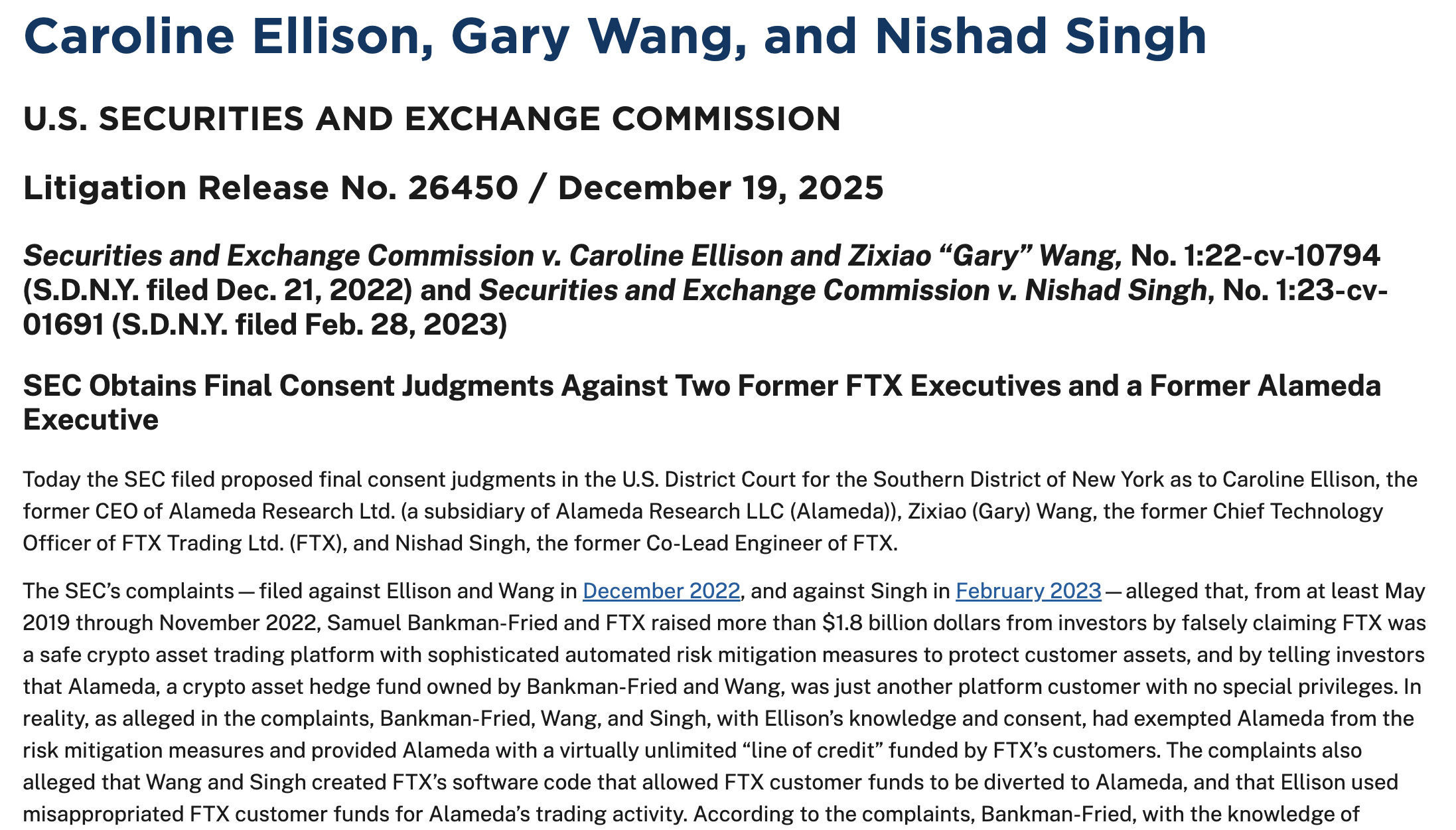
In a Friday notice, the US Securities and Exchange Commission said that it had obtained final consent judgments against Ellison, Wang and Singh for their roles in the misuse of investor funds at FTX from 2019 to 2022.

The former Alameda CEO consented to a 10-year officer-and-director bar, while Wang and Singh consented to eight-year officer-and-director bars each. All three are also subject to five-year ”conduct-based injunctions,” according to the SEC.

“In reality, as alleged in the complaints, [Sam] Bankman-Fried, Wang, and Singh, with Ellison’s knowledge and consent, had exempted Alameda from the risk mitigation measures and provided Alameda with a virtually unlimited ‘line of credit’ funded by FTX’s customers,” said the SEC. “The complaints also alleged that Wang and Singh created FTX’s software code that allowed FTX customer funds to be diverted to Alameda, and that Ellison used misappropriated FTX customer funds for Alameda’s trading activity.”
Source: SEC

Former FTX CEO Sam “SBF” Bankman-Fried received a 25-year sentence for his role in the exchange’s collapse. He is awaiting the results of an appeal in the US Court of Appeals for the Second Circuit, where a hearing was held on Nov. 4.

Related: Caroline Ellison blames Sam Bankman-Fried for misuse of FTX user funds at trial

Ellison was sentenced to two years as part of a plea deal in which she testified against Bankman-Fried. Wang and Singh testified against SBF at his criminal trial and were sentenced to time served in 2024.

Ellison will soon be released from custody

The former Alameda CEO, who largely stayed out of the public spotlight between FTX’s collapse and her testimony at SBF’s trial in October 2023, was recently transferred from prison to a Residential Reentry Management field office in New York City.

According to the Federal Bureau of Prisons, she is scheduled to be released on Feb. 20, about nine months before the end of her two-year sentence. The timing suggested she may have been eligible for good-conduct credits to reduce her prison time.

Magazine: When privacy and AML laws conflict: Crypto projects’ impossible choice

Related Questions

QWhat are the specific officer-and-director bar durations for Caroline Ellison, Gary Wang, and Nishad Singh as ordered by the SEC?

ACaroline Ellison consented to a 10-year officer-and-director bar, while Gary Wang and Nishad Singh each consented to an 8-year officer-and-director bar.

QAccording to the SEC, what was the primary allegation against Sam Bankman-Fried, Gary Wang, and Nishad Singh regarding Alameda Research?

AThe SEC alleged that Sam Bankman-Fried, Gary Wang, and Nishad Singh, with Caroline Ellison's knowledge and consent, exempted Alameda from risk mitigation measures and provided it with a virtually unlimited 'line of credit' funded by FTX's customers.

QWhat was the role of Gary Wang and Nishad Singh in the misuse of FTX customer funds as stated in the complaints?

AThe complaints alleged that Gary Wang and Nishad Singh created FTX's software code that allowed FTX customer funds to be diverted to Alameda.

QWhat is the current status of Sam Bankman-Fried's legal case as mentioned in the article?

ASam Bankman-Fried received a 25-year sentence and is awaiting the results of an appeal in the US Court of Appeals for the Second Circuit, where a hearing was held on November 4.

QWhen is Caroline Ellison scheduled to be released from custody and what is the reason for her early release?

ACaroline Ellison is scheduled to be released on February 20, about nine months before the end of her two-year sentence, likely due to being eligible for good-conduct credits to reduce her prison time.

Related Reads

Day 6 of the rsETH Incident: DeFi United Secures Approximately $100 Million in Intentional Commitments, but a $50 Million Gap Remains

On April 18, Kelp DAO’s rsETH LayerZero bridge was exploited, resulting in the unauthorized minting of 116.5k rsETH (approx. $292M). The attacker borrowed around $190M on Aave V3. The Arbitrum Security Council froze 30,766 ETH linked to the incident. DeFi United, a cross-protocol rescue initiative led by Awe, was formed to cover a total shortfall of 112.2k rsETH ($258M). As of April 24, several protocols have pledged around $100M in support, though most commitments are still under DAO voting or discussion. Key pledges include: - Golem: 1,000 ETH ($2.3M) - Aave founder Stani Kulechov: 5,000 ETH ($11.5M) - EtherFi: up to 5,000 ETH ($11.5M) - Lido: up to 2,500 stETH ($5.75M), contingent on full coverage - Mantle: proposed a $69M loan to Aave DAO under specific terms The remaining shortfall is estimated at $50M. Aave’s treasury and safety module (~$236M combined) can cover the worst-case bad debt scenario ($230M). Three potential loss distribution paths were outlined by DefiLlama’s 0xngmi: 1. Uniform 18.5% haircut for all rsETH holders: Aave bad debt ~$216M 2. Only protect Mainnet, abandon L2: bad debt up to $341M 3. Repay only pre-attack holders: technically difficult, ~$91M net loss KelpDAO has not yet announced a specific plan. The success of DeFi United depends heavily on KelpDAO’s final decision on loss allocation.

marsbit54m ago

Day 6 of the rsETH Incident: DeFi United Secures Approximately $100 Million in Intentional Commitments, but a $50 Million Gap Remains

marsbit54m ago

Trading

Spot
Futures
活动图片