SEC Chairman Explains Why NFTs Are Not Securities: 'Like Buying Trading Cards'

marsbitPublished on 2026-03-19Last updated on 2026-03-19

Abstract

SEC Chairman Paul Atkins explained in a CNBC interview why NFTs are generally not considered securities, comparing them to collectibles like baseball cards. The SEC recently issued guidance identifying four categories of digital assets not classified as securities: digital commodities, digital tools, digital collectibles (including NFTs), and stablecoins. Atkins emphasized that NFTs are typically "bought and held" assets rather than investment contracts, which are central to the definition of a security. He noted that each asset is evaluated based on its specific facts and circumstances, but digital collectibles are generally viewed as immutable purchases not intended for trading like traditional securities. This reflects a broader shift in the SEC’s approach under Atkins’ leadership, moving away from enforcement-driven regulation toward clearer guidance and a more predictable framework. The change aligns with the Trump administration's crypto-friendly stance, with Atkins criticizing past regulatory missteps that he believes set the U.S. back in crypto innovation.

Author: Sam Bourgi

Compiled by: Deep Tide TechFlow

Deep Tide Introduction: SEC Chairman Paul Atkins further explained in a CNBC interview why NFTs generally do not constitute securities. The SEC recently released an interpretive document listing four categories of digital assets that are not securities: digital commodities, digital instruments, digital collectibles (including NFTs), and stablecoins.

Atkins compared NFTs to baseball cards, emphasizing that such assets are "bought and held" and do not involve investment contracts. This is the latest move by the SEC under Atkins' leadership to shift from "enforcement-driven" to "guidance-driven" regulation.

Full text as follows:

After the U.S. Securities and Exchange Commission (SEC) listed four major categories of digital assets not subject to securities laws, Chairman Paul Atkins further explained why non-fungible tokens (NFTs) generally do not meet the definition of securities.

In a CNBC interview on Wednesday, Atkins reiterated the four categories of digital assets identified in the SEC's recent interpretive document that are typically not considered securities: digital commodities, digital instruments, digital collectibles like NFTs, and stablecoins.

During the interview, host Andrew Ross Sorkin pressed the issue of digital collectibles, noting that depending on their structure, they could more easily be classified as securities.

Atkins responded, "That's true of anything." He emphasized that the SEC's analysis still depends on the specific facts and circumstances of each asset, particularly whether it involves an investment contract under long-standing legal precedent.

Atkins stated that digital collectibles are generally viewed as items to be bought and held, similar to physical collectibles, rather than investment contracts. Investment contracts are a core defining feature of securities.

He said, "These collectibles, like baseball cards, memes, memecoins, NFTs, are things someone buys. It's an immutable purchase...unlike other assets that people trade."
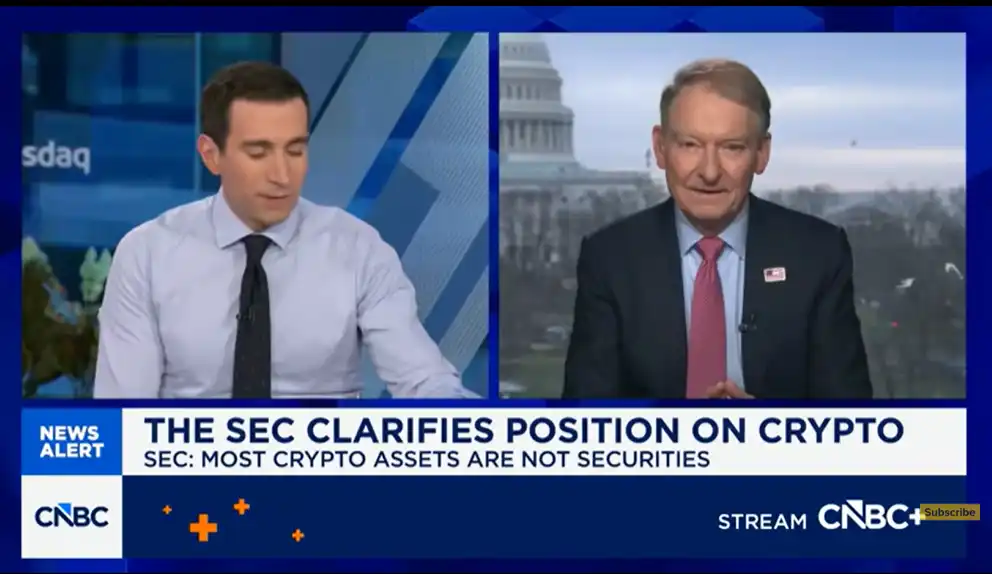
Caption: Paul Atkins interviewed on CNBC. Source: CNBC

SEC Continues to Move Away from "Enforcement-Driven" Crypto Policy

Under Atkins' leadership, the SEC's approach to regulating digital assets has undergone a noticeable adjustment. This shift coincides with the Trump administration, which is more crypto-friendly and took office in early 2025.

Atkins said in the CNBC interview, "We are breaking with the past." He described the SEC's efforts to promote clearer guidance and a more predictable regulatory framework.

Last year, Atkins criticized the SEC's previous reliance on "regulation by enforcement" and promised to move away from this approach. He also noted that tokenization is a key innovation that regulators should support rather than restrict.

Since then, he has repeatedly stated that past regulatory missteps have set the U.S. back by as much as a decade in crypto development and vowed to reverse this situation.


Related Questions

QWhat are the four categories of digital assets that the SEC recently identified as typically not being considered securities?

AThe four categories are digital commodities, digital tools, digital collectibles (including NFTs), and stablecoins.

QHow did SEC Chairman Paul Atkins compare NFTs to explain why they are not securities?

AHe compared NFTs to baseball cards, stating they are 'bought and held' items, similar to physical collectibles, and do not involve investment contracts.

QWhat shift in regulatory approach has the SEC undergone under Chairman Paul Atkins' leadership?

AThe SEC has shifted from an 'enforcement-driven' approach to a 'guidance-driven' one, focusing on clearer guidance and a more predictable regulatory framework.

QAccording to the article, what did Paul Atkins say about the impact of past regulatory mistakes on the U.S. crypto industry?

AHe stated that past regulatory missteps set the U.S. back by as much as a decade in crypto development and vowed to reverse this situation.

QWhat key feature did Atkins emphasize as central to the definition of a security in the context of digital assets?

AHe emphasized that the key feature is whether the asset involves an investment contract under long-standing legal precedent.

Related Reads

Within Strategy's Framework, STRC's Dividend Yield Remains at 12% as Share Price Stays Below Par Value

Michael Saylor, Executive Chairman of Strategy (MSTR), confirmed that the dividend rate for its STRC perpetual preferred shares will remain at 12.00% through August 2026. The rate has increased from 9% at its July 2025 launch to the current high via a "ratchet" mechanism, which permanently raises the rate by 0.5% whenever the share price falls below $95. This mechanism is intended to push the price back toward its $100 par value and support Strategy's "at-the-market" (ATM) program for issuing new shares to fund Bitcoin purchases. However, the mechanism has not worked as intended. STRC shares closed at $89.46 on July 31, remaining about 10-11% below par value despite the record-high dividend. Competition from rival Strive's higher-yielding SATA securities has pressured demand. The persistent discount has forced Strategy to suspend new STRC issuances via its ATM program, limiting this funding channel for Bitcoin acquisitions. STRC's struggles reflect Bitcoin's own volatility, as the preferred shares historically move in tandem. Analysts have warned the ratchet structure carries long-term, one-way risk. A law firm is investigating Strategy's ability to maintain dividend payments if Bitcoin's price stays low. Retail investors own roughly 83% of outstanding STRC shares, a group seen as prone to panic selling during downturns. In response, Strategy has established financial reserves, including a liquidity cushion covering about 26 months of dividend/interest obligations, and a $2 billion share buyback program alongside a Bitcoin monetization framework, though the company emphasized it is not obligated to sell any Bitcoin.

cryptonews.ru12m ago

Within Strategy's Framework, STRC's Dividend Yield Remains at 12% as Share Price Stays Below Par Value

cryptonews.ru12m ago

Analyst: Bitcoin's Price Will Drop to $60k in August, Then Rebound to $70k

Financial analyst Andrey Poroshin has provided a new forecast for Bitcoin's price dynamics in August. Poroshin, an analyst at the Bitbanker exchange, expects the cryptocurrency market to experience a downturn this month, with prices retesting the $60,000 level due to a lack of supportive macroeconomic catalysts. He noted that the recent US Federal Reserve decision to hold interest rates did not significantly impact the market, while inflation remains above the 2% target. Poroshin stated that Bitcoin is ending July under pressure from moderate volatility and a lack of new macroeconomic stimuli, leading to continued market caution. According to his base scenario, Bitcoin will drop to a range of $60,000 to $62,000 before recovering to $70,000. He pointed out that even $70,000 remains below the cost of mining in the US, which has prompted some miners to shift towards AI data center operations. Poroshin cited the winding down of BitMEX's operations as a potential catalyst for a price rebound, suggesting the exit of weaker players often coincides with market reversals and reduced short-term selling pressure. He believes Bitcoin is currently less susceptible to geopolitical shocks, such as the Iran-US conflict, and does not expect significant market changes in August related to the pending CLARITY Act. Looking ahead, Poroshin forecasts that September will bring more active price fluctuations driven by potential Fed rate decisions and possible discussions or approval of the CLARITY Act.

cryptonews.ru12m ago

Analyst: Bitcoin's Price Will Drop to $60k in August, Then Rebound to $70k

cryptonews.ru12m ago

Trading

Spot
活动图片



