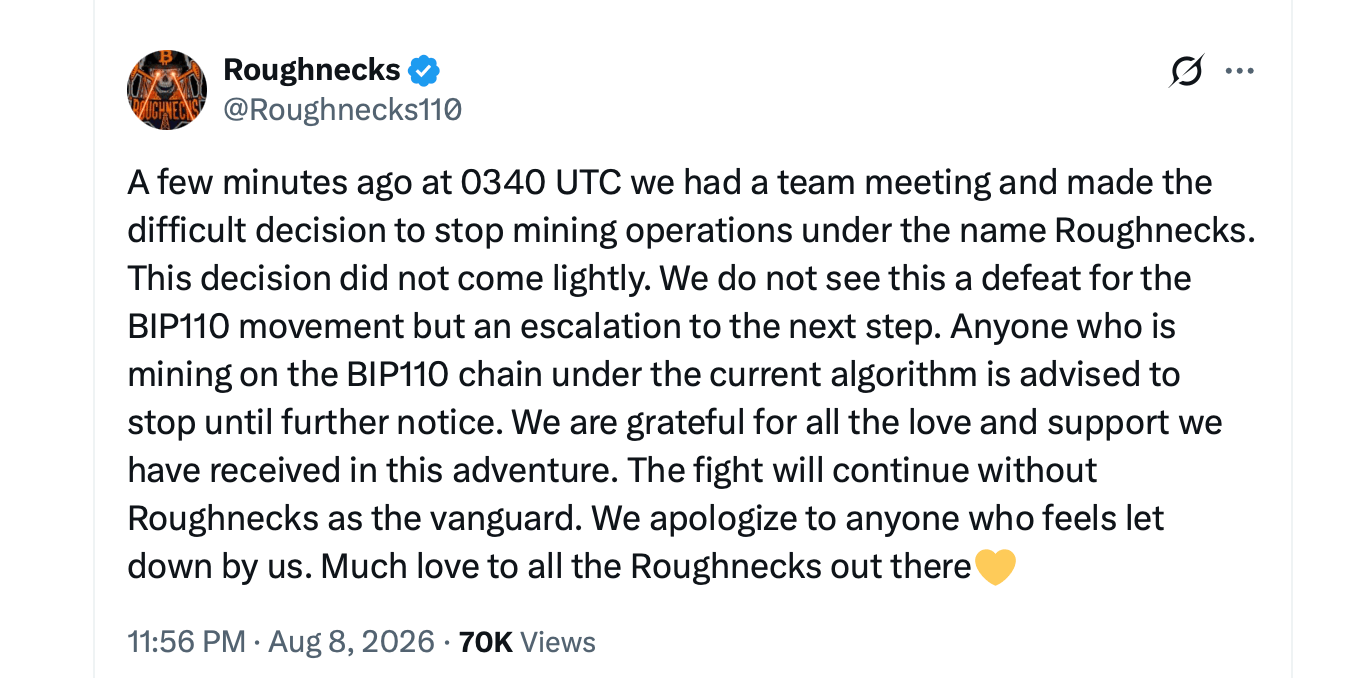
The group announced the decision shortly before 04:00 UTC on August 9, following a team meeting around 03:40 AM. Roughnecks emphasized that this step was not easy, but insisted they do not view retreat as a defeat for BIP-110, calling it a "transition to the next phase." Furthermore, they recommended that anyone still mining on the BIP-110 chain under Bitcoin's current proof-of-work (PoW) algorithm suspend activity until further notice.
The timing of the decision leaves little doubt about the pressure behind it. Roughnecks mined BIP-110 blocks 961632 and 961633 after Bitcoin split at a mandatory signaling point on Saturday, but a third block did not follow. Meanwhile, Bitcoin's dominant chain continued adding blocks normally and quickly pulled ahead of the minority fork by dozens of blocks.
Another alarming signal was the sharp drop in the hashrate metric displayed by Ocean. On August 8, the pool's hashrate reached approximately 36 exahashes per second (EH/s), but by August 9, it had fallen to about 1.25 EH/s, corresponding to a decrease of roughly 96.5%.
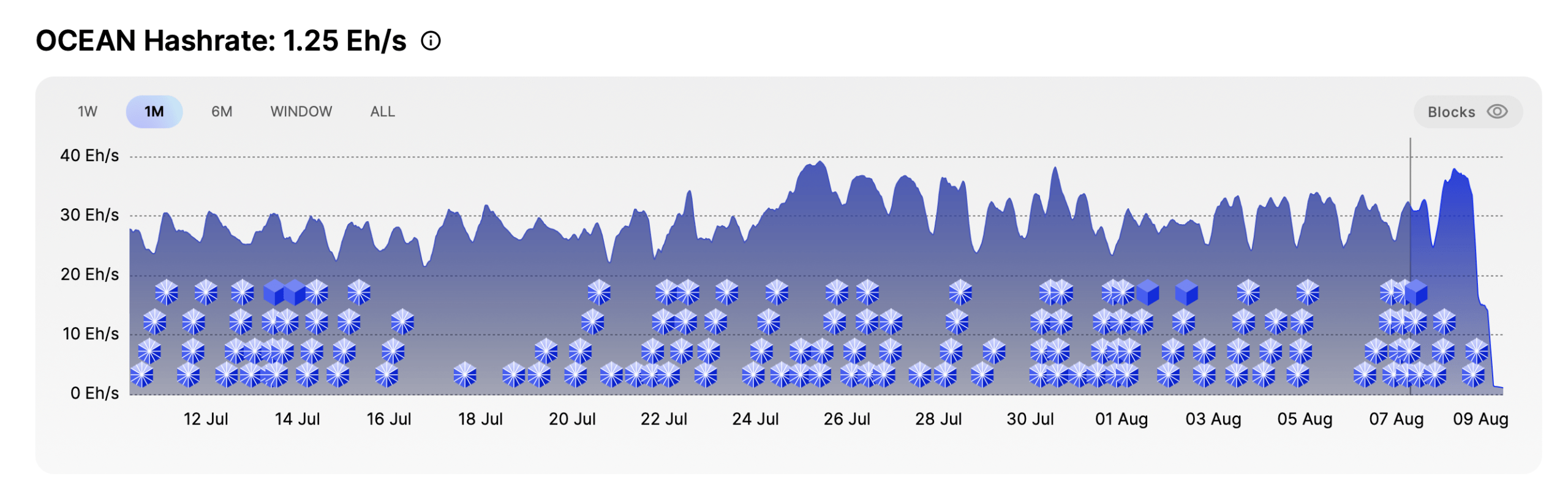
Ocean became the central mining platform associated with BIP-110 signaling, particularly due to its DATUM system, which allows individual miners to create their own block templates and choose whether to signal for the proposal.
Bitcoin Difficulty Became a Trap for Minority Chain
The issue facing the splinter chain is purely mechanical. When BIP-110 nodes rejected Bitcoin's non-signaling block No. 961632 and instead adopted Roughnecks' competing block, their new chain inherited Bitcoin's existing mining difficulty. This difficulty had just risen to approximately 127 trillion—a level calculated for the enormous computing power securing Bitcoin's dominant network.
Difficulty determines how hard miners must work on average to find a valid block. Bitcoin typically adjusts this difficulty every 2,016 blocks to maintain a block generation rate of about one block every 10 minutes. The minority chain, possessing only a tiny fraction of Bitcoin's former hashrate, does not receive an immediate difficulty reduction. It must continue struggling with the same difficulty until the next adjustment point arrives.
This created a draining feedback loop for miners supporting BIP-110. Lower hashrate meant blocks appeared significantly slower, but slower block appearance also meant reaching the next difficulty adjustment point (after 2,016 blocks) became an increasingly distant prospect. According to monitoring service forecasts, given the sharply reduced mining power, completing the required period could take hundreds of days.
BIP-110 Never Won the Hashrate Battle
BIP-110, officially called "Reduced Data Temporary Softfork," was designed to temporarily restrict several methods used for placing non-financial data in Bitcoin transactions. Proponents argued these methods, including activities related to Ordinals and large data transfers, increased data storage and verification burdens while moving Bitcoin away from its primary monetary purpose.
The proposal's activation scheme was the decisive factor. BIP-110 required that 55% of miners vote for the proposal over a difficulty period covering 2,016 blocks. When this threshold was not met, nodes enforcing the proposal were programmed to reject non-signaling blocks at block height 961,632. Miner support never approached the required level, peaking at 2.5–2.6% before the mandatory period began.
This meant the split occurred with the overwhelming majority of Bitcoin's mining power on the other side. Antpool generated block No. 961632 without a signal, which was accepted by the main Bitcoin network, while BIP-110 nodes rejected it and followed Roughnecks' competing block linked to the Ocean network. Roughnecks found another block, number 961,633, but the anticipated transition of additional mining power never materialized into anything meaningful.
BIP-110 proponent, as well as Club Orange founder and CEO Matteo Pellegrini, along with several other supporters, appeared stunned by the outcome. "The lesson of BIP-110 is that 15-20% of nodes is not enough to change Bitcoin's consensus," Pellegrini wrote on X. Pellegrini's admission drew immediate criticism: several commenters suggested he revisit Satoshi Nakamoto's whitepaper, where the inventor of Bitcoin states:
"They vote with their CPU power, expressing their acceptance of valid blocks by working on extending them and rejecting invalid blocks by refusing to work on them. Any needed rules and incentives can be enforced with this consensus mechanism."
Two Blocks Reveal the Economics of a Minority Fork
The outcome clearly illustrates what happens when node rules and mining economics diverge. Software can reject blocks according to a different rule set, but those nodes still need miners willing to expend electricity and computational resources to build the alternative chain. Without sufficient hashrate, confirmation speed plummets, and the chain's utility deteriorates.
Roughnecks acknowledged this reality, characterizing continued mining under current conditions as largely wasteful, while asserting the broader BIP-110 campaign is not over. Potential next steps discussed within the initiative include various coordination strategies or even changing the proof-of-work (PoW) algorithm, though no replacement strategy was defined over this weekend.
For users running BIP-110-enforcing software, the immediate problem is more practical than philosophical. Their nodes follow a chain that has generated only two blocks since the split. As both chains recognize many of the same transactions, users also face potential complications with transaction replays if coins are spent without deliberately separating activity between the two networks.
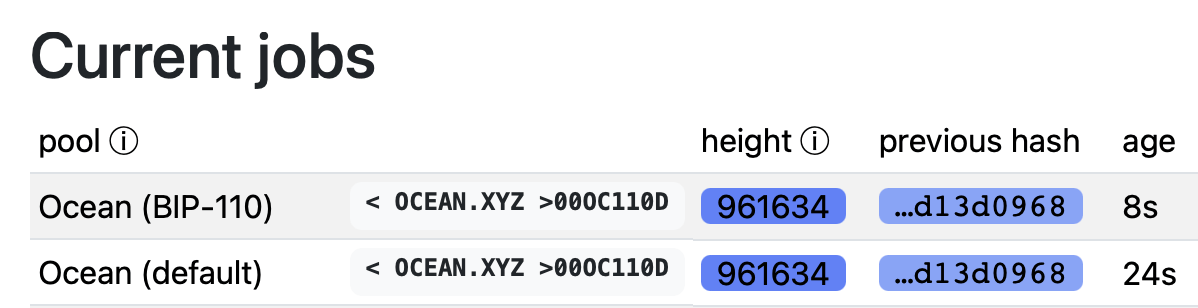
The next question is whether anyone can replace Roughnecks as a significant source of mining power. By the time of the group's announcement, BIP-110 had not yet locked in or activated its transaction limits on Bitcoin's dominant chain, Roughnecks had halted work under its banner, Ocean's displayed hashrate had plunged, and the minority chain remained stuck at two blocks.
Any revival now depends on an influx of new hashrate, a revised technical strategy, or another coordinated attempt to sustain the forked chain. Despite Roughnecks' decision to stop directing hash power to the minority chain, statistics as of 8:00 AM ET on August 9 still show a small fraction of SHA256 hashrate continuing to pursue BIP-110's block 961,634.