Rolling the Snowball in a Cold Market: How a Meme Coin Achieved 20x in 2 Days with an Automated Market-Making Mechanism?

比推Published on 2025-12-22Last updated on 2025-12-22

Abstract

**Summary: Snowball Meme Coin’s 20x Surge in 2 Days via Automated Market-Making Mechanism Amid a sluggish crypto market, the Meme token Snowball, launched on pump.fun on December 18, surged 20 times in value within two days, reaching a $10 million market cap—a rare success in the current bearish environment. Its core innovation lies in an automated market-making mechanism designed to create a "snowball effect." Typically, pump.fun tokens allow creators to collect a fee (0.5%–1%) from each transaction, often leading to devs cashing out and abandoning projects. Snowball redirects 100% of this creator fee to an on-chain market-making bot instead. This bot periodically: 1. Uses accumulated funds to buy back tokens, creating buy pressure. 2. Adds purchased tokens and corresponding SOL to the liquidity pool, improving depth. 3. Burns 0.1% of tokens per operation, inducing deflation. The fee rate fluctuates (0.05%–0.95%) based on market cap: higher fees at lower caps to accelerate fund accumulation, lower fees at higher caps to reduce transaction friction. The idea is that each trade fuels buy pressure and liquidity, not dev profits, theoretically creating a self-sustaining cycle: trading generates fees → fees fund buybacks → buybacks boost price → higher price attracts more trading. On-chain data shows 7,270 holders, with top 10 addresses holding ~20% of supply—relatively distributed. Trading volume reached $11 million in 24 hours, with buys slightly outpacing sells. By...

Author: David, Deep Tide TechFlow

Original Title: 20x in 2 Days, A Quick Look at the Automated Market-Making Mechanism of the New Golden Dog Snowball


The crypto market in December is as cold as the weather.

On-chain transactions have been dormant for a long time, and new narratives are hard to come by. Just look at the drama and gossip in the Chinese CT (Crypto Twitter) these past few days, and you'll know hardly anyone is playing in this market anymore.

But the English-speaking community has been discussing something new.

A Meme coin called Snowball launched on pump.fun on December 18th. In four days, its market cap surged to $10 million and is still hitting new highs; meanwhile, it's barely mentioned in the Chinese crypto circle.
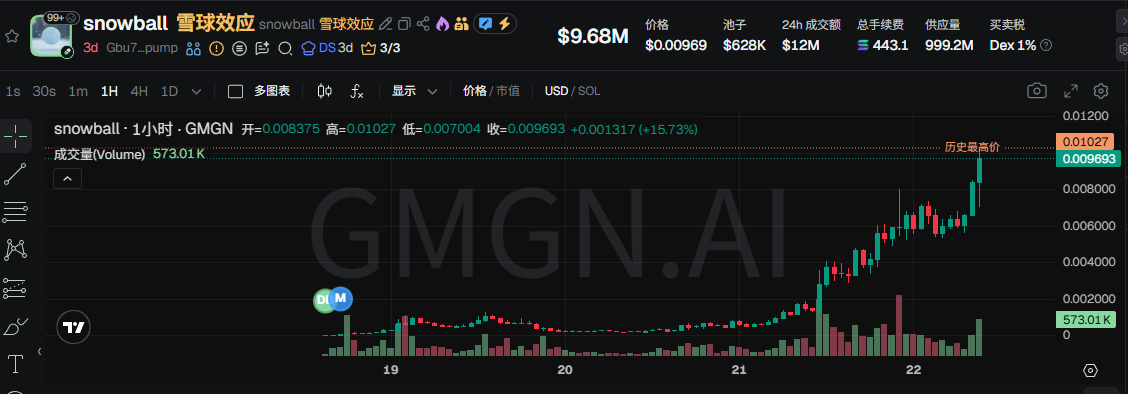
In the current environment where there are few new narratives and even Meme coins are considered unplayable, this is one of the few things that catches the eye and shows some localized wealth effect.

And the name Snowball itself, referring to the snowball effect, is the story it wants to tell:

A mechanism that allows the token to "roll and grow bigger by itself".

Turning Transaction Fees into Buy Pressure, Rolling the Snowball for Market Making

To understand what Snowball is doing, you need to first know how pump.fun tokens typically make money.

On pump.fun, anyone can create a token in minutes. Token creators can set a "creator fee," essentially taking a cut of every transaction into their own wallet, usually between 0.5% and 1%.

This money is theoretically meant for community building and marketing, but in practice, most Devs choose to: accumulate enough and then run.

This is part of the typical life cycle of a shitcoin. Launch, pump, harvest fees, rug. Investors aren't betting on the token itself, but on the developer's conscience.

Snowball's approach is to not take this creator fee money.

To be precise, 100% of the creator fees do not go into anyone's wallet but are automatically transferred to an on-chain market-making bot.

This bot performs three actions at regular intervals:

First, it uses the accumulated funds to buy tokens on the market, creating buy-side support;

Second, it adds the bought tokens and the corresponding SOL to the liquidity pool, improving trading depth;

Third, it burns 0.1% of the tokens with each operation, creating deflation.
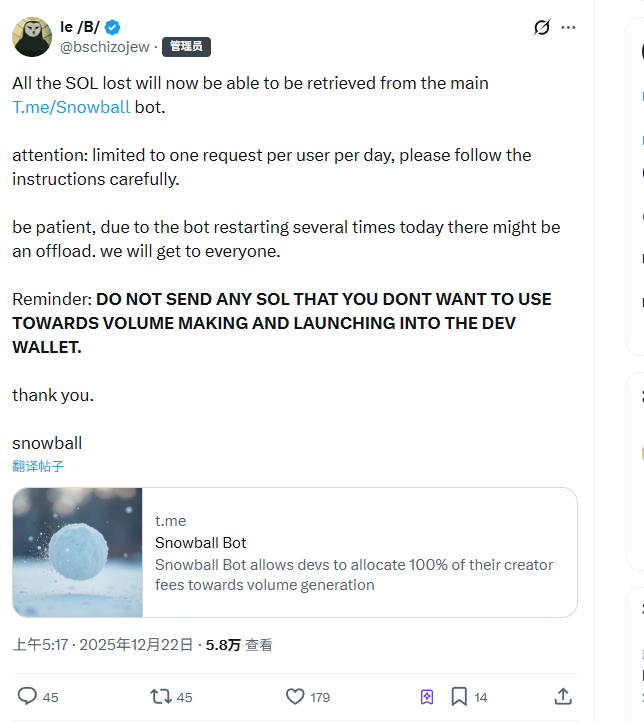
Simultaneously, the percentage of creator fees this coin charges is not fixed; it fluctuates between 0.05% and 0.95% based on market cap.

It takes a higher percentage when the market cap is low, allowing the bot to accumulate ammunition faster; it reduces the fee when the market cap is high, decreasing transaction friction.

To summarize the logic of this mechanism in one sentence: every time you trade, a portion of the money automatically becomes buy pressure and liquidity, instead of going into the developer's pocket.

Therefore, it's easy to understand this snowball effect:

Trading generates fees → Fees become buy pressure → Buy pressure pushes the price up → Higher price attracts more trading → More fees... theoretically, it can roll on its own.

On-Chain Data Situation

Now that the mechanism is explained, let's look at the on-chain data.

Snowball launched on December 18th, so it's been four days now. The market cap grew from zero to $10 million, with a 24-hour trading volume exceeding $11 million.

For a shitcoin on pump.fun, this performance is considered relatively long-lasting in the current environment.

In terms of token distribution, there are currently 7,270 holder addresses. The top ten holders together account for about 20% of the total supply, with the largest single holder holding 4.65%.
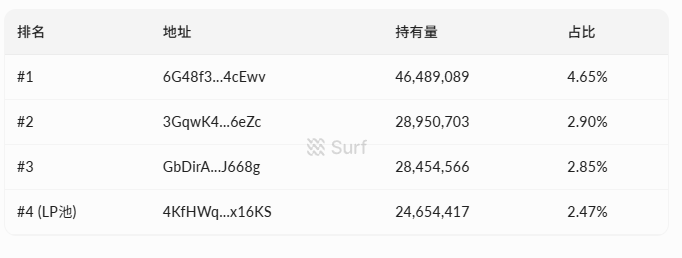
Data source: surf.ai

There's no address holding 20-30% of the supply; the distribution is relatively decentralized.

Regarding trading data, there have been over 58,000 transactions since launch, with 33,000 buys and 24,000 sells. The total buy volume is $4.4 million, and the total sell volume is $4.3 million, resulting in a net inflow of about $100,000. Buying and selling are basically balanced, with no one-sided selling pressure.

The liquidity pool holds about $380,000, half in tokens and half in SOL. For a market cap of this size, the depth isn't very thick, and large orders would still experience significant slippage.

Another noteworthy point is that Bybit Alpha announced listing the token less than 96 hours after launch, which to some extent confirms the short-term hype.

Perpetual Motion Meets a Cold Market

After browsing around, you can see that the English community's discussion about Snowball mainly focuses on the mechanism itself. Supporters' logic is straightforward:

This is the first Meme coin that locks 100% of creator fees into the protocol; developers can't run away with the money, making it structurally safer than other shitcoins, at least.

The development Dev is also playing into this narrative. The developer wallet, market-making bot wallet, and transaction logs are all public, emphasizing "verifiable on-chain."

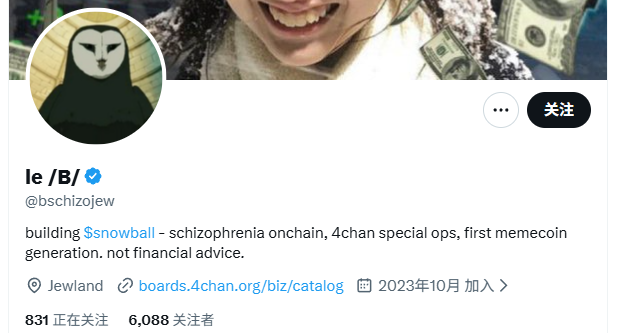
@bschizojew labels himself as "on-chain schizophrenia, 4chan special forces, first-generation Meme coin veteran," radiating a self-deprecating degen vibe that appeals to the crypto-native community.
But mechanism safety and making money are two different things.

The snowball effect relies on the premise that there is sufficient trading volume to continuously generate fees to feed the bot for buybacks. More trading means more ammunition for the bot, stronger buy pressure, higher prices, attracting more people to trade...

This is the ideal state where any Meme coin's so-called buyback flywheel spins up in a bull market.

The problem is, the flywheel needs external momentum to start.

What is the current crypto market environment? On-chain activity is sluggish, the overall heat around Meme coins has declined, and there's simply less capital willing to chase shitcoins. In this context, if new buy-side pressure doesn't keep up and trading volume shrinks, the fees the bot receives will become less and less, buyback strength will weaken, price support will diminish, and trading willingness will decline further.

The flywheel can spin forward, but it can also spin in reverse.

A more realistic problem is that the mechanism solves only one risk point—"developers taking the money and running"—but Meme coins face far more risks than that.

Whales dumping, insufficient liquidity, narratives going out of style—if any of these happen, 100% fee-based buybacks can only do so much.

Everyone is tired of being rugged. A Chinese community member summarized it quite well:

Play if you want, but don't get in over your head.

More Than One Snowball Rolling

Snowball isn't the only project telling this automated market-making story.

Within the pump.fun ecosystem, a token called FIREBALL is doing something similar: automatic buybacks and burns, packaging it as a protocol other tokens can plug into. But its market cap is much smaller than Snowball's.
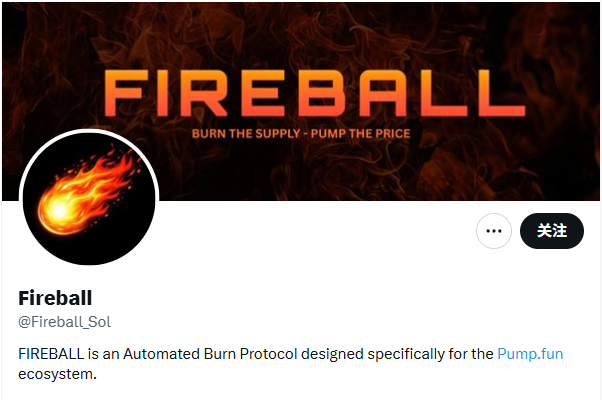
This shows the market is currently reacting to the direction of "mechanism-based Meme coins."

The traditional玩法 of shilling, pumping, and community hype is finding it harder to attract capital. Using mechanism design to tell a "structurally safe" story might be one of Meme coins' recent strategies.

However, talking about artificially creating a mechanism isn't a new玩法 either.

OlympusDAO's (3,3) in 2021 was the most typical case, using game theory to package a staking mechanism and telling the story of "everyone profits if no one sells." It reached a peak market cap of billions of dollars. The ending, as everyone knows, was a death spiral, dropping over 90%.

Earlier, there was Safemoon's玩法 of "taxing every transaction and distributing it to holders," also a narrative of mechanism innovation, which ended with the SEC suing and charging the founder with fraud.

Mechanisms can be great narrative hooks, gathering capital and attention in the short term, but mechanisms themselves do not create value.

When external capital stops flowing in, even the most精巧designed flywheel will stop.

Finally, let's recap what this little golden dog is actually doing:

Turning Meme coin creator fees into an "automated market-making bot." The mechanism itself isn't complicated, and the problem it solves is very clear: preventing developers from directly taking the money and running.

Developers can't run away, but that doesn't mean you'll make money.

If after reading this you find the mechanism interesting and want to participate, remember one thing: it's first and foremost a Meme coin, and only secondly an experiment with a new mechanism.


Twitter:https://twitter.com/BitpushNewsCN

Bitpush TG Discussion Group:https://t.me/BitPushCommunity

Bitpush TG Channel: https://t.me/bitpush

Original article link:https://www.bitpush.news/articles/7597578

Related Questions

QWhat is the core mechanism that allows Snowball to achieve its 'snowball effect'?

AThe core mechanism is that 100% of the creator fees from transactions are automatically sent to an on-chain market-making bot. This bot uses the accumulated funds to buy back tokens (creating buy pressure), add the purchased tokens and corresponding SOL to the liquidity pool (improving depth), and burn 0.1% of the tokens (creating deflation) at regular intervals.

QHow does the creator fee for the Snowball token work and how is it different from a typical pump.fun token?

AUnlike typical pump.fun tokens where the fee goes to the developer's wallet, Snowball's creator fee (which floats between 0.05% and 0.95% based on market cap) is entirely sent to an automated market-making bot. This prevents the developer from directly taking the money and running, as the funds are instead used to support the token's price and liquidity.

QWhat were some key on-chain metrics for Snowball four days after its launch?

AFour days after its launch on December 18th, Snowball reached a market cap of $10 million, with a 24-hour trading volume exceeding $11 million. It had 7,270 holder addresses, with the top 10 holders owning about 20% of the supply. The liquidity pool held approximately $380,000.

QAccording to the article, what is the major risk or prerequisite for the 'snowball effect' to work?

AThe major risk is that the 'snowball effect' relies on sufficient trading volume to continuously generate fees to fuel the market-making bot. If new buying pressure dries up and trading volume decreases, the bot's ability to support the price weakens, which could lead to a negative feedback loop where decreasing price support further reduces trading interest.

QHow does the article contextualize Snowball's mechanism within the history of crypto 'mechanism narratives'?

AThe article contextualizes it as part of a trend of 'mechanism-based meme coins' seeking to attract attention with structural innovation. It draws parallels to past projects like OlympusDAO's (3,3) staking mechanism and Safemoon's transaction tax redistribution, noting that while mechanisms can be a good short-term narrative, they do not create intrinsic value and can fail when external capital inflow stops.

Related Reads

The King of Blind Date Attire in Korea: How SK Hynix Made a Comeback Against Samsung?

In South Korea's dating scene, SK Hynix employees are now highly sought after, a status shift fueled by the company's astronomical profits and employee bonuses, projected to reach up to 6.1 million RMB per person by 2027. This marks a dramatic reversal for the long-time second-place player in memory semiconductors, which has now surpassed its rival Samsung in annual operating profit. The turnaround story began in 2008 when a struggling Hynix, emerging from bankruptcy restructuring, took a risky bet by agreeing to develop High Bandwidth Memory (HBM) with AMD. At the time, HBM had no clear market beyond high-end graphics cards and was a costly, complex technology. Major players like Samsung, pursuing its own HMC technology, declined. For Hynix, with only memory as its core business, it was a gamble born of necessity. The pivotal moment came in 2012 when SK Group Chairman Chey Tae-won acquired Hynix. Defying industry downturns, he invested heavily in R&D and fabrication, sustaining the HBM project through over a decade of commercial uncertainty and internal challenges. A key break occurred around 2016-2017 when Samsung faced production issues supplying HBM2 for Google's TPU, allowing SK Hynix to gain a crucial foothold in the data center market. The AI explosion post-ChatGPT in 2022 was the catalyst, turning HBM into a critical bottleneck for AI accelerators like NVIDIA's GPUs. By 2025, SK Hynix captured 62% of the global HBM market, leaving Samsung at 17%. For the first time, its annual operating profit exceeded Samsung's. Analysts point to the "innovator's dilemma" to explain Samsung's miss: its vast, successful business portfolio made it risk-averse, preventing an all-in bet on the initially niche HBM technology. In contrast, SK Hynix, as a challenger with its back against the wall, had no choice but to commit fully. The story highlights how Korea's chaebol system allows for ultra-long-term bets beyond quarterly pressures. However, SK Hynix's lead isn't guaranteed. Samsung is aggressively catching up on HBM4, and challenges like customer concentration (heavy reliance on NVIDIA) and technical hurdles in advanced packaging remain. The narrative underscores a market truth: the greatest alpha often comes from betting on uncertain, long-term directions others dismiss, much like HBM in 2008.

marsbit12m ago

The King of Blind Date Attire in Korea: How SK Hynix Made a Comeback Against Samsung?

marsbit12m ago

Understanding Hash in One Article: The "Browser Miner" on Ethereum

Hash is an Ethereum-based ERC-20 token described as a "browser-minable post-quantum token." Its key features include enabling browser-based GPU mining without specialized hardware, a fixed supply cap of 21 million tokens, immutable and permissionless smart contracts with no team allocation or pre-mining, and an emphasis on post-quantum security using Keccak256 hashing. The mining mechanism is a simplified on-chain proof-of-work where miners solve unique challenges tied to their wallet address. Key design elements prevent answer theft, with epochs resetting every 100 blocks (~20 minutes) and a per-block minting limit. Emission follows a Bitcoin-like halving schedule every 100,000 mints, starting at 100 tokens per mint. Projections suggest all tokens could be mined within approximately 294 days if a target rate of one mint per minute is sustained. Hash emphasizes "post-quantum" security by leveraging hash-based primitives like Keccak256, which are considered more resistant to quantum attacks compared to elliptic-curve cryptography. While not a fully post-quantum asset, it aligns with Ethereum's broader post-quantum research narrative. The project completed its Genesis sale at $0.03 and began trading on Uniswap, with its price reaching around $0.19. The initial circulating supply is small, with 5% sold in Genesis and 5% allocated to liquidity. The majority (47.6% of total supply) is allocated to early-stage mining, leading to a front-loaded emission schedule. This structure, combined with low initial liquidity, makes Hash a high-volatility, high-risk project dependent on sustained miner participation and market demand to absorb new supply.

marsbit25m ago

Understanding Hash in One Article: The "Browser Miner" on Ethereum

marsbit25m ago

OpenAI's Largest Internal Wealth Creation: 600 People Cash Out a Total of $6.6 Billion, 75 Take Home the Maximum $30 Million Each

A Wall Street Journal report reveals OpenAI's unprecedented pre-IPO wealth creation. In a single employee stock sale last October, over 600 current and former employees sold shares, collectively cashing out approximately $6.6 billion. Due to high investor demand, the company tripled the individual sale cap to $30 million, with about 75 employees selling the maximum amount. This event represents the largest such transaction in tech industry history for a private company. OpenAI's valuation was $500 billion for this tender offer. Employees with over two years of tenure were eligible, allowing many post-ChatGPT hires their first liquidity event. The company's stock has reportedly grown over 100-fold in seven years. Following a restructuring, employees collectively hold about 26% of OpenAI. The scale of executive wealth is also staggering. In court testimony related to Elon Musk's lawsuit, President and co-founder Greg Brockman confirmed his OpenAI stake is worth around $30 billion. Analysis indicates about 165 current and former employees hold a combined ~$164.9 billion in equity, averaging nearly $1 billion per person in paper wealth. OpenAI's per-employee stock-based compensation is estimated to be 34 times the average of major tech firms before their IPOs. OpenAI continues its rapid ascent, closing a $122 billion funding round at an $852 billion valuation in March. With monthly revenue hitting $2 billion, over 900 million weekly ChatGPT users, and plans for a potential trillion-dollar IPO in late 2026, this wealth-creation engine shows no signs of stopping.

链捕手48m ago

OpenAI's Largest Internal Wealth Creation: 600 People Cash Out a Total of $6.6 Billion, 75 Take Home the Maximum $30 Million Each

链捕手48m ago

Trading

Spot
Futures

Hot Articles

Discussions

Welcome to the HTX Community. Here, you can stay informed about the latest platform developments and gain access to professional market insights. Users' opinions on the price of MEME (MEME) are presented below.

活动图片