Ripple Updates XRP ‘Fast Facts’ As ETF And Institutional Momentum Grows

bitcoinistPublished on 2026-01-08Last updated on 2026-01-08

Abstract

RippleX has updated its "FAST FACTS" about XRP, positioning it as infrastructure for real-world utility rather than a speculative asset. The update highlights XRP's role in settlement, liquidity, and moving value across financial systems, with a fixed supply of 100 billion. XRPL is emphasized as a decentralized blockchain with over 116 validators and 6.4 million wallets, settling over $1 trillion in value. The thread also notes XRP's growing role in real-world assets (RWA) and stablecoins, listing key issuers and partnerships. Additionally, it mentions the emergence of institutional treasuries, like Evernorth's $1B commitment, and multiple spot ETFs, signaling regulated, mainstream adoption. XRP traded at $2.20 at the time of writing.

RippleX, the developer-focused arm of Ripple,used a Jan. 6 X thread to refresh a set of “FAST FACTS” about XRP, framing the asset less as a speculative ticker and more as market infrastructure, arriving as spot ETF momentum and early institutional treasury narratives begin to form around the token.

“XRP is a digital asset of choice for real-world utility – from stablecoin settlement to real-world assets, to institutional payments,” RippleX wrote. “With new momentum around XRP ETFs and institutional treasuries forming, here are some updated FAST FACTS about XRP.”

What Is XRP?

The thread’s opening points stick to the positioning Ripple has leaned on for years: XRP as a liquidity and settlement rail between financial systems rather than an app-layer bet.

RippleX described it as “a functional digital asset designed for settlement and liquidity, focusing on moving value between financial systems,” adding that, “acting as a neutral bridge, it helps move value between payments, stablecoins, tokenized financial assets, and collateral across the global economy.”

RippleX also reiterated supply constraints and control narratives that frequently resurface in institutional due diligence. “XRP was created at the launch of XRPL in 2012 and its supply is permanently capped at 100B – no additional XRP can ever be minted and no single entity (including Ripple) controls or can change the total supply,” the post said.

Other “fast facts” were more about market posture than mechanics, including the claim that XRP is “one of the few digital assets with clear regulatory standing in the US” and that it remains a top-three asset by market capitalization.

RippleX devoted several entries to XRPL’s decentralization metrics and operational history, emphasizing that the ledger runs independently of Ripple the company.

“XRPL is a public, decentralized blockchain with 116+ independent validators and 910+ public nodes – it operates independent of Ripple as an entity,” RippleX wrote. “XRP plays a core role on the network as its native settlement and liquidity asset.”

On consensus and execution, RippleX said XRPL uses “Proof-of-Association (PoA),” describing a model with “no mining, no staking, no block rewards,” and “transaction finality in 3–5 seconds.” It also pointed to network-scale usage stats since inception: “4B+ transactions,” “100M+ ledgers,” “6.4M+ wallets,” and “$1T+ in value” settled.

Real-World Assets And Stablecoins

A notable portion of the thread focused on RWAs and stablecoins,two categories where issuers and liquidity relationships matter more than raw TPS.

RippleX said XRPL is “now one of the top 10 blockchains for RWA activity,” listing issuers and initiatives “such as Ondo Finance, OpenEden, Archax/abrdn, Guggenheim Treasury Services, Mercado Bitcoin, VERT, and the Dubai Land Department” as building or launching assets on XRPL.

On stablecoins, RippleX cited a “growing stablecoin ecosystem” including “RLUSD, USDC, XSGD, AUDD, BBRL/USBD, and EURCV,” adding that “XRP often serves as a liquidity pair,” facilitating exchange between stablecoins and other assets on the network.

RippleX’s final “fast facts” aimed directly at regulated access and institutional balance sheets. It claimed XRP “now has its first institutional treasury” via Evernorth, which “has secured more than $1B in commitments,” describing this as a shift “from a traded asset to a regulated, balance-sheet asset for institutions.”

It also said XRP is “now supported by multiple spot ETFs,” naming Bitwise (XRP), Canary Capital (XRPC), Franklin Templeton (XRPZ), and Grayscale (GXRP) as issuers—positioning ETFs as a bridge into “regulated, mainstream investment products.”

Finally, RippleX pointed to wrapped XRP as an interoperability lever, saying it extends XRP’s utility to the “XRPL EVM Sidechain” and to ecosystems including “Ethereum, Solana, Optimism, and HyperEVM.”

At press time, XRP traded at $2.20.
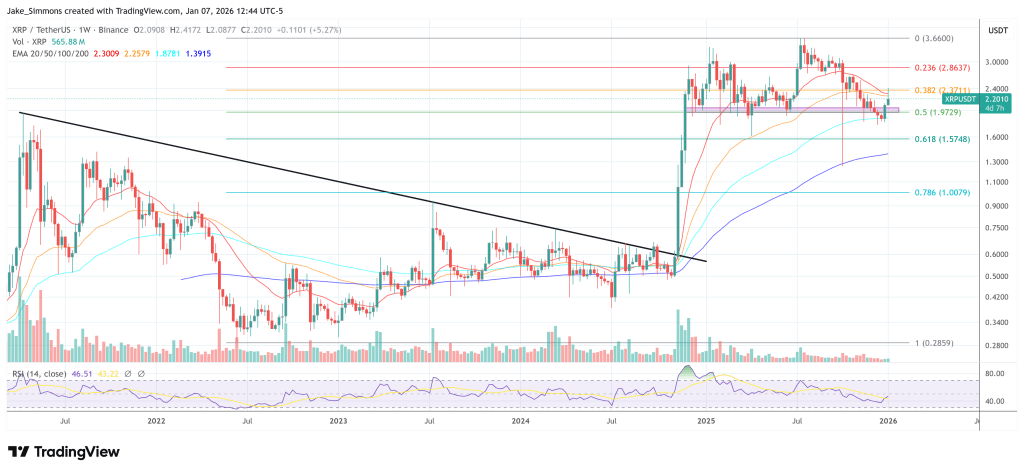
XRP faces the 0.382 Fib, 1-week chart | Source: XRPUSDT on TradingView.com

Related Questions

QWhat is the main purpose of RippleX's updated 'FAST FACTS' about XRP?

ATo frame XRP less as a speculative asset and more as market infrastructure, highlighting its real-world utility and institutional adoption as ETF and treasury momentum grows.

QHow does RippleX describe the role of XRP in the financial ecosystem?

ARippleX describes XRP as a functional digital asset designed for settlement and liquidity, acting as a neutral bridge to move value between payments, stablecoins, tokenized financial assets, and collateral across the global economy.

QWhat are some key technical features of the XRP Ledger (XRPL) mentioned in the article?

AXRPL is a public, decentralized blockchain with over 116 independent validators and 910+ public nodes, using Proof-of-Association consensus with no mining or staking, and achieving transaction finality in 3-5 seconds.

QWhich real-world asset (RWA) and stablecoin initiatives are building on XRPL according to the article?

ARWA initiatives include Ondo Finance, OpenEden, Archax/abrdn, Guggenheim Treasury Services, Mercado Bitcoin, VERT, and the Dubai Land Department. Stablecoins include RLUSD, USDC, XSGD, AUDD, BBRL/USBD, and EURCV.

QHow is XRP gaining institutional adoption through regulated products?

AXRP now has its first institutional treasury via Evernorth with over $1B in commitments, and is supported by multiple spot ETFs from issuers like Bitwise, Canary Capital, Franklin Templeton, and Grayscale, positioning it as a regulated, balance-sheet asset.

Related Reads

How Does Codex Use a Computer? Three Entry Points and Permission Boundaries

This article explains the three primary methods for Codex to interact with a computer, each with distinct use cases, permission boundaries, and trust levels. **1. Computer Use:** This offers the broadest access, allowing Codex to visually control and interact with the graphical user interface of authorized macOS/Windows apps, system settings, and even iOS simulators. It's ideal for tasks lacking APIs or structured tools, such as operating legacy software or multi-app workflows. However, it's the slowest method and has the widest permission scope, requiring careful supervision for sensitive actions. **2. Chrome Extension:** This grants Codex access to the user's logged-in Chrome browser state, including cookies, profiles, and open tabs. It's best for tasks requiring user identity across websites like Gmail, LinkedIn, Salesforce, or internal dashboards. Its key advantage is multi-tab control for complex workflows. While more powerful for browser-based tasks than Computer Use, it carries higher sensitivity as actions are performed under the user's identity. **3. In-App Browser:** This is a browser isolated within the Codex thread, separate from the user's personal browsing data. It excels in web development and debugging scenarios—previewing local servers, testing responsive layouts, or annotating designs directly on the page. Its isolation is a strength for development but a limitation for tasks requiring login sessions. The core principle is to choose the narrowest, safest, and most structured interface for the task. Use plugins or MCPs first, resort to visual control (Computer Use) only for GUI-dependent tasks, employ the Chrome extension for identity-reliant browser work, and prefer the In-App Browser for isolated development. **Appshots** are clarified as a fourth, complementary tool for *inputting* context—capturing a screenshot of a window to point Codex to something—rather than a method for Codex to *act*. Together, this layered approach highlights a key to AI agent productization: not granting unlimited permissions, but constraining them within clear boundaries for specific tasks while preserving user oversight.

marsbit9m ago

How Does Codex Use a Computer? Three Entry Points and Permission Boundaries

marsbit9m ago

The "Iron Rule" of Chip Equipment Is Being Broken

For years, the semiconductor equipment industry followed an unwritten "iron rule": suppliers offered steep discounts for new tool introductions (Design-in) and faced consistent price pressure during repeat orders, especially during market downturns. This long-standing buyer's market dynamic is now being upended. Recently, SK Hynix's primary equipment suppliers have reportedly requested a 3-4% price *increase*, a nearly unprecedented move. This shift is driven by a severe supply-demand imbalance fueled by the AI compute boom. Securing equipment has become an urgent arms race as chipmakers' expansion speed dictates their ability to fulfill massive AI chip orders. Key areas feeling the strain include: **TCB (Thermal Compression Bonding) Equipment:** Demand is exploding, driven by the simultaneous needs of HBM4 memory stacking, AI chip Chip-on-Substrate (C2S), and logic Chiplet Chip-on-Wafer (C2W) packaging. Players like Hanmi Semiconductor, Hanwha Semitech, and ASMPT are receiving major orders. While hybrid bonding is seen as the future, TCB remains the pragmatic choice for HBM4 mass production, with its lifecycle extended by relaxed specifications and ongoing technological upgrades. **Test Equipment Bottlenecks:** Ironically, AI-driven shortages are now crippling test equipment manufacturing. Critical components like FPGAs, Driver ICs, and CPUs face severe shortages and extended lead times (up to 52 weeks for FPGAs), as AI data center and server vendors prioritize supply. This creates a paradoxical cycle: AI chip shortages drive fab expansion, which requires more test equipment, whose production is delayed because its key parts are diverted to make AI chips. The industry is entering a broad, AI-powered upcycle. SEMI forecasts global semiconductor equipment sales to hit a record $156 billion by 2027, fueled by investment in advanced logic/foundry, HBM-driven DRAM, and advanced packaging (like CoWoS). Major players like TSMC, SK Hynix, and Micron are aggressively ramping capital expenditure. In conclusion, leading equipment vendors are no longer just selling tools; they are selling the critical capability to deliver AI-era capacity. Pricing power is shifting decisively to those with indispensable technology in key process nodes like advanced logic, HBM, and advanced packaging, rewriting the industry's traditional power structure.

marsbit22m ago

The "Iron Rule" of Chip Equipment Is Being Broken

marsbit22m ago

Trading

Spot
Futures
活动图片