Ripple expands European footprint with AMINA stablecoin payment partnership

cointelegraphPublished on 2025-12-12Last updated on 2025-12-12

Abstract

Ripple Payments has partnered with Swiss bank AMINA to provide its payment infrastructure, enabling more efficient, faster, and lower-cost transactions using the Ripple USD (RLUSD) stablecoin. This collaboration strengthens Ripple’s presence in Europe, leveraging AMINA’s regulatory standing under Swiss and EU frameworks. The partnership addresses friction faced by crypto-native businesses in traditional banking, particularly in cross-border stablecoin transactions. Ripple aims to bridge fiat and blockchain systems, supporting seamless payments. This move is part of Ripple’s broader strategy to integrate blockchain into traditional finance, following recent expansions in Asia-Pacific and regulatory approvals in Singapore and Abu Dhabi for RLUSD.

The payments subsidiary of blockchain services company Ripple has partnered with Swiss bank Amina to provide it with access to its payment infrastructure.

According to a Friday Ripple Payments announcement, the company will allow Amina to “settle transactions more efficiently without relying on traditional payment infrastructure, making transactions faster, lower cost, and with increased reliability and transparency.” This builds on a previous relationship between the companies, with the bank’s integration of the Ripple USD (RLUSD) stablecoin happening back in July.

The move also reinforces Ripple’s presence in Europe, with Amina being a Swiss Financial Market Supervisory Authority-regulated financial institution. The bank’s Austrian subsidiary also holds a license under the European Union’s Markets in Crypto-Assets Regulation (MiCA) granted by Austria’s Financial Market Authority in October.

Amina chief product officer Myles Harrison said “native web3 businesses often run into friction when working with legacy banking systems,” adding that stablecoins can help solve those issues. “This is particularly the case for cross-border stablecoin transactions which traditional banks are yet to widely adopt.”

Related: Community expects first US spot XRP ETF to launch on Thursday

Banks need crypto services for crypto companies

Harrison explained that the bank’s clients “need payment infrastructure that can handle both fiat and stablecoin rails simultaneously,” which traditional banking networks cannot provide for. Ripple Payments, on the other hand, allowed Amina to offer such services, which led to “reducing cross-border friction and helping our crypto-native clients maintain their competitive edge.”
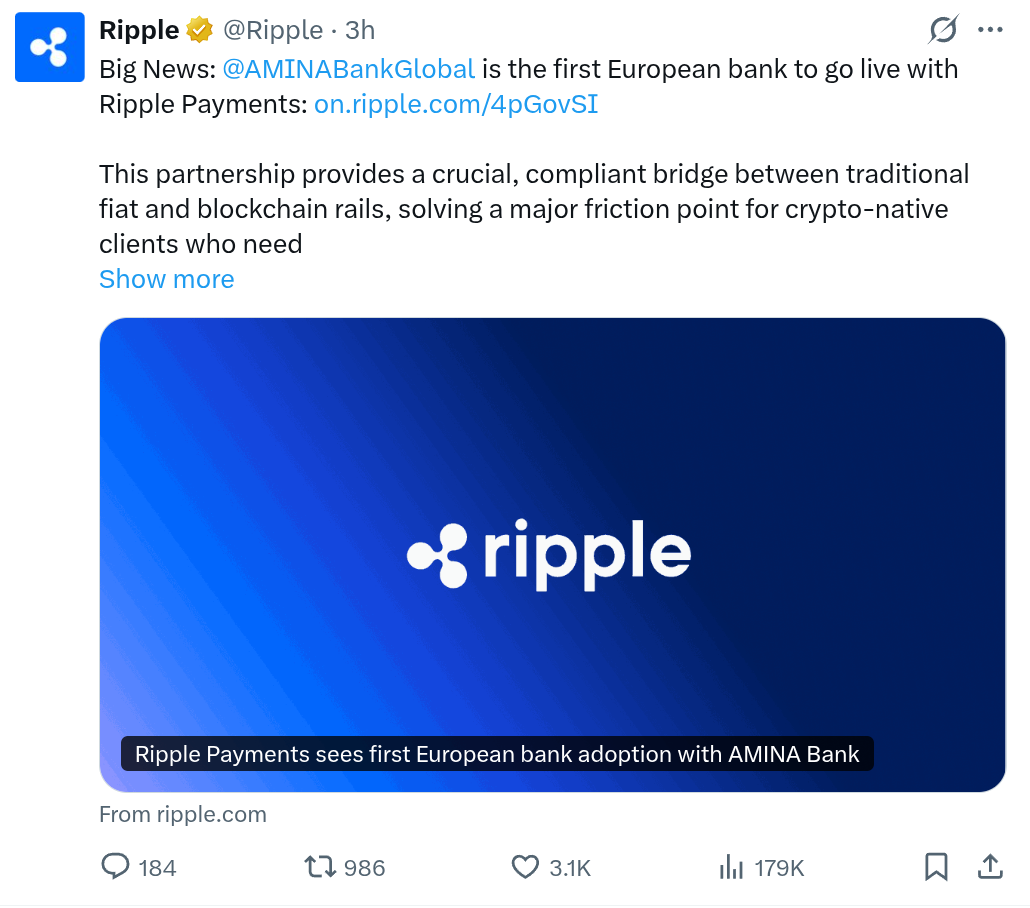
Source: Ripple

Ripple’s managing director for the United Kingdom and Europe Cassie Craddock said that the collaboration lets Amina “serve as the on-ramp for digital asset innovators into traditional financial infrastructure.” He added that Ripple Payments provides a “bridge between fiat and blockchain” that enables seamless stablecoin payments.

Related: Canary Capital filing signals spot XRP ETF set for launch this week

Ripple onboards traditional finance onchain

This is just the latest partnership in which Ripple injected blockchain capabilities into an institution engaged in traditional finance. According to mid-November reports, the company is spending about $4 billion to combine prime trading, treasury tools, payments, and custody to take on traditional finance.

Ripple’s ambitions are also global. Earlier this month, Ripple Labs received approval from Singapore’s central bank to expand its payment activities. This enables the company to offer regulated token services, end-to-end payments and growth across Asia-Pacific.

At the end of November, RLUSD was also cleared for use by institutions in Abu Dhabi after winning recognition as an Accepted Fiat-Referenced Token by the local watchdog.


Related Reads

AMD acquires Taalas: hardware AI manages without scarce HBM memory

AMD has agreed to acquire Toronto-based startup Taalas, which tackles a key bottleneck in AI inference: the constant need to transfer model weights from memory to the processor for each generated token. Taalas's chips eliminate this operation by permanently embedding the model weights into the transistors themselves. This data transfer is what currently limits inference speed and has made high-bandwidth memory (HBM) a scarce commodity. Taalas's first test chip, fabricated on TSMC's 6nm process, reportedly generated tokens for Meta's Llama 3.1 8B model at speeds 48 times faster than comparable Nvidia GPUs. Its architecture features a mask ROM section for fixed weights and SRAM for adaptable components. However, this design comes with a significant trade-off: each chip is permanently dedicated to a single model. Switching models requires a partial redesign and fabrication, a process taking about two months. While the acquisition is seen as part of AMD's rivalry with Nvidia in inference, its broader implication lies in challenging the assumption of a permanent HBM memory shortage. The AI memory market is currently booming, with HBM supply sold out through 2026. Yet, Taalas's technology demonstrates that the memory bottleneck is an engineering challenge, not an absolute physical constraint. This aligns with industry-wide efforts from companies like Nvidia (through model compression) and memory makers like Samsung and SK hynix (developing new packaging and storage technologies) to reduce dependency on scarce HBM. AMD's move suggests that the current high prices for memory, driven by AI demand, may not be sustainable. It highlights a growing engineering push against the premise of perpetual memory scarcity, reminding investors that memory has historically been a cyclical business.

cryptonews.ru3h ago

AMD acquires Taalas: hardware AI manages without scarce HBM memory

cryptonews.ru3h ago

Vance says US-Iran conflict remains in 'midgame', US military 'seeks exit', Iran sets 'six conditions for reopening the strait'

U.S. Vice President Vance described the U.S.-Iran conflict as being in the "mid-game," stating the U.S. is utilizing diplomatic, economic, and military tools, with a focus on increasing oil and gas shipments through the Strait of Hormuz. Meanwhile, U.S. Chairman of the Joint Chiefs of Staff Gen. Dan Caine is reportedly seeking an "exit" privately, expressing concerns that airstrikes alone are insufficient to achieve objectives and that further escalation carries significant risks. He highlighted critical ammunition shortages for key missile defense systems. In response, Iran’s Supreme National Security Council Secretary, Zolgadr, presented six conditions for reopening the Strait of Hormuz: a U.S. pledge never to threaten Iran, an end to aggression against Iran and its allies, withdrawal of forces from the region, war reparations, lifting of all sanctions, and the unconditional unfreezing of Iranian assets. These demands, seen as a high bar set by hardliners, contrast with more pragmatic requests made in backchannel talks, which focus on lifting the blockade, restoring oil sanctions waivers, and accessing frozen funds. While Iran and Oman are close to a technical agreement on a temporary shipping lane, Iran clarified this does not equate to a full reopening of the strait, which remains contingent on U.S. meeting its conditions. Attacks on commercial vessels in the area continue, with recent incidents attributed to Iran. Despite pauses in military action and expressions of openness to talks from both sides, negotiations are currently stalled over Iran's economic demands and U.S. insistence on freedom of navigation.

marsbit4h ago

Vance says US-Iran conflict remains in 'midgame', US military 'seeks exit', Iran sets 'six conditions for reopening the strait'

marsbit4h ago

Trading

Spot
活动图片