Ripple CTO Emeritus Fires Back at XRP Ledger Centralization Claims

bitcoinistPublished on 2026-02-26Last updated on 2026-02-26

Abstract

David Schwartz, Ripple's CTO Emeritus, refuted claims by Justin Bons, founder of Cyber Capital, that the XRP Ledger (XRPL) is centralized due to its Unique Node List (UNL) structure. Bons argued that the UNL grants Ripple "absolute power and control," making validators permissioned. Schwartz countered that the UNL does not enable censorship or double-spending, as validators cannot force dishonest actions on individual nodes. He explained that a malicious validator would simply be ignored by honest nodes, comparing a potential attack to a chain halt rather than a security breach. Schwartz emphasized that XRPL was intentionally designed to limit Ripple's control, even under legal pressure, and that abusing power would destroy trust in the network. He also contrasted XRPL's record with Bitcoin and Ethereum, claiming no history of transaction censorship or malicious re-ordering on XRPL.

Ripple CTO Emeritus David “JoelKatz” Schwartz pushed back against claims that the XRP Ledger (XRPL) is effectively centralized, after founder and CIO of Cyber Capital Justin Bons argued that XRPL’s Unique Node List (UNL) structure makes validators “permissioned” and gives Ripple-aligned entities “absolute power & control over the chain.”

The exchange, sparked by Bons’ broader thread calling for the industry to “reject all centralized ‘blockchains’,” quickly narrowed into a technical dispute over what XRPL validators can and cannot do in practice and what “control” means in a system that relies on curated validator lists rather than Proof-of-Work or Proof-of-Stake.

The XRP Ledger Centralization Allegation

In his thread, Bons lumped Ripple alongside Canton, Stellar, Hedera, and Algorand as networks with permissioned or semi-permissioned elements. His XRPL-specific charge was straightforward: because XRPL nodes typically rely on a published UNL, “any divergence from this centrally published list would cause a fork,” which in his view concentrates power in the hands of whoever publishes that list.

Bons framed it as a binary question: “either fully permissionless or it is not” and argued that even partial permissioning is a deal breaker. He also extended the critique into a broader institutional-adoption thesis: banks and incumbents may prefer controlled environments, but “those institutions will be left behind,” while “crypto natives” win by building and using fully permissionless systems.

Schwartz’s opening rebuttal attacked the logic of Bons’ “absolute power” framing. “‘...effectively giving the Ripple Foundation & company absolute power & control over the chain...’” Schwartz wrote, calling it “as objectively nonsensical as claiming someone with a majority of mining power can create a billion bitcoins.”

Bons responded that he wasn’t alleging supply manipulation or fund theft, but insisted majority influence can still matter. “They can not steal funds, either, but they could potentially double-spend & censor,” Bons said. “Which, again, is exactly the same if someone controlled the majority of mining power in BTC.” He then suggested they debate live on a podcast.

Schwartz rejected the equivalence on mechanics, emphasizing that XRPL nodes do not accept censorship or double-spend behavior simply because a validator says so. “That’s not true. XRPL and BTC don’t work the same,” Schwartz wrote. “You count the number of validators that agree with your node and your node will not agree to double spend or censor unless you, for some reason, want it to.”

He continued the point across multiple posts, leaning on a simple intuition: a dishonest validator is not an oracle; it’s just one vote. “If a validator tried to double spend or censor, an honest node would just count it as one validator that it did not agree with.”

What Schwartz Says The Real Attack Looks Like

Schwartz acknowledged there is still a failure mode, but described it as a liveness problem rather than a theft or double-spend scenario. “Validators could conspire to halt the chain from the point of view of honest nodes,” he said. “But that’s the XRPL equivalent of a dishonest majority attack except they never get to double spend. The cure is to pick a new UNL just as with BTC you’d need to pick a new mining algorithm.”

He also argued the empirical record matters, contrasting XRPL with other major networks. “The practical evidence tells this story,” Schwartz wrote. “Transactions are discriminated against all the time in BTC. Transactions are maliciously re-ordered or censored all the time on ETH. Nothing like this has ever happened to an XRPL transaction and it’s hard to imagine how it could.”

Schwartz later laid out a more detailed explanation of XRPL’s consensus model, emphasizing fast “live consensus” rounds—“every five seconds”—where validators vote on whether a transaction is included now or deferred to the next round. In that framing, the system’s key requirement is not blind trust in validators, but agreement on whether a transaction was seen before a cutoff.

He argued XRPL needs a UNL for two reasons: to prevent an attacker from spawning unlimited validators that force excessive work, and to prevent validators from simply not participating in a way that makes consensus impossible to measure. “That’s it. There’s no control or governance here other than coordinating activation of new features,” Schwartz wrote, adding that validators cannot force a node to enforce rules it does not have code for.

Schwartz closed with a longer, unusually candid rationale: that XRPL’s architecture was intentionally built to reduce Ripple’s ability to comply with demands to censor, even if Ripple itself wanted to be trusted.

“We carefully and intentionally designed XRPL so that we could not control it,” he wrote. “Ripple, for example, has to honor US court orders. It cannot say no... We absolutely and clearly decided that we DID NOT WANT control and that it would be to our own benefit to not have that control.”

He added a blunt incentive argument: even if Ripple could censor or double-spend, using that power would destroy trust in XRPL and therefore destroy the network’s utility. “And the best way to be able to say ‘no’ is to have to say ‘no’ because you cannot do the thing asked,” Schwartz wrote.

At press time, XRP traded at $1.3766.
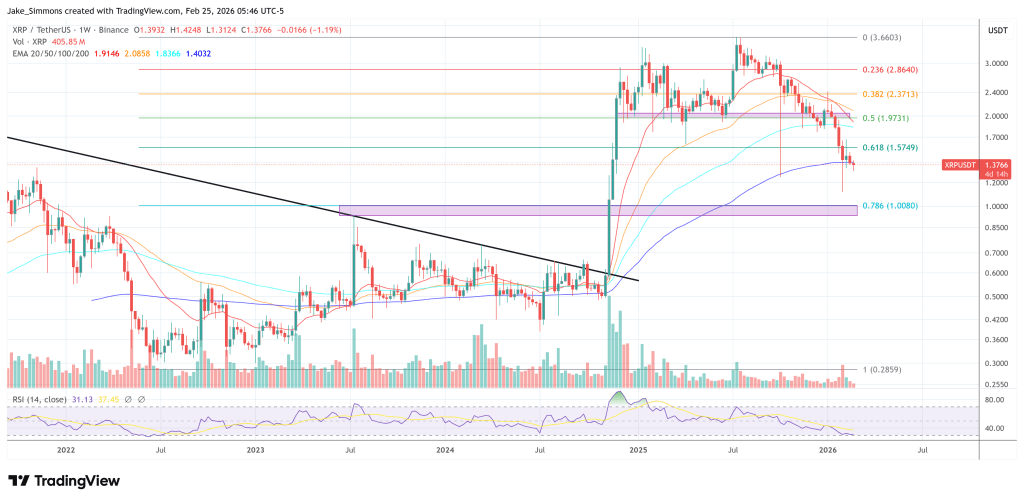
XRP trades below the 200-week EMA, 1-week chart | Source: XRPUSDT on TradingView.com

Related Questions

QWhat was the main argument made by Justin Bons regarding the XRP Ledger's centralization?

AJustin Bons argued that the XRP Ledger's Unique Node List (UNL) structure makes validators 'permissioned' and gives Ripple-aligned entities 'absolute power & control over the chain'.

QHow did David Schwartz counter the claim that Ripple has 'absolute power' over the XRP Ledger?

ASchwartz called the claim 'objectively nonsensical,' explaining that validators cannot force a node to double-spend or censor transactions, and that dishonest validators are merely counted as one disagreeing vote by honest nodes.

QAccording to Schwartz, what is the real failure mode for the XRP Ledger, and how is it resolved?

ASchwartz described the failure mode as a liveness problem where validators could conspire to halt the chain, which is resolved by picking a new UNL, similar to how Bitcoin would require a new mining algorithm.

QWhat two reasons did Schwartz give for why the XRP Ledger needs a Unique Node List (UNL)?

ASchwartz stated the UNL is needed to prevent an attacker from spawning unlimited validators that force excessive work, and to prevent validators from not participating in a way that makes consensus impossible to measure.

QWhat was the key design intention behind the XRP Ledger's architecture, as explained by Schwartz?

ASchwartz stated that the XRP Ledger was 'carefully and intentionally designed' so that Ripple could not control it, even if they wanted to, to avoid being forced to comply with demands to censor and to protect the network's utility.

Related Reads

Justin Sun Sues Trump Family: What $75 Million Bought Was Only a Blacklist

Justin Sun, founder of Tron, has filed a lawsuit in federal court against World Liberty Financial (WLF), alleging he was made the "primary target of a fraudulent scheme" after investing $75 million. Sun claims the investment secured him an advisor title and WLFI tokens, which were later frozen by WLF, causing "hundreds of millions in losses." The dispute began in late 2024 when Sun's investment helped revive WLF's struggling token sale, which ultimately raised $550 million. Shortly after, the SEC dropped its lawsuit against Sun following Donald Trump's inauguration. However, relations soured when Sun refused WLF's demands for additional funding. In August 2025, WLF added a "blacklist" function to its smart contract, allowing it to unilaterally freeze tokens. Sun's holdings, worth approximately $107 million, were frozen, and he was threatened with token destruction. The lawsuit highlights WLF's structure, which directs 75% of token sale profits to the Trump family, who had earned $1 billion by December 2025. WLF's CEO is Zach Witkoff, son of U.S. Middle East envoy Steve Witkoff. The project faces scrutiny for opaque operations, including a controversial loan arrangement on the Dolomite platform, co-founded by a WLF advisor. Despite Sun's history with the SEC, the case underscores centralization risks within DeFi, as WLF controls governance and holds powers to freeze assets arbitrarily. Sun's tokens remain frozen as legal proceedings begin.

marsbit6m ago

Justin Sun Sues Trump Family: What $75 Million Bought Was Only a Blacklist

marsbit6m ago

$500 to Buy OpenAI Stock: Silicon Valley's Most Respectable Liquidity Invitation

Silicon Valley's largest venture capital platform, AngelList, has launched a new fund called USVC, allowing U.S. retail investors to buy into high-profile AI companies like OpenAI, Anthropic, and xAI with a minimum investment of $500—no accredited investor status required. Promoted by AngelList co-founder Naval Ravikant, the fund is framed as an opportunity for ordinary people to access high-growth private tech investments traditionally reserved for VCs. However, critics argue it functions more like an exit vehicle for early insiders. USVC acquires shares not through primary rounds but largely via secondary transactions—purchasing stakes from early investors, VC funds, and employees looking to cash out at peak valuations. With companies like xAI heavily weighted in the portfolio, the fund effectively channels retail money into providing liquidity for insiders who entered at much lower valuations. The fund’s structure raises concerns: shares are illiquid, with no secondary market, and buybacks are limited and discretionary. The actual annual fee reaches 3.61%, far above the advertised 1% management fee. This model parallels the "low float, high fully diluted valuation" strategy seen in crypto, where early investors profit by selling to latecomers at inflated prices. The timing—alongside similar moves by platforms like Robinhood—suggests that Silicon Valley’s sudden interest in retail inclusion may be less about democratizing access and more about securing exits for insiders.

marsbit37m ago

$500 to Buy OpenAI Stock: Silicon Valley's Most Respectable Liquidity Invitation

marsbit37m ago

Trading

Spot
Futures

Hot Articles

What is XRP 2.0

XRP 2.0: A New Frontier in the Cryptocurrency Landscape Introduction to XRP 2.0 In the ever-evolving realm of cryptocurrency, new projects continuously emerge, vying for attention and adoption. One such promising initiative is XRP 2.0, a novel cryptocurrency project designed to leverage advanced blockchain technology and robust encryption methodologies. While the name draws parallels with Ripple’s XRP, it’s crucial to note that XRP 2.0 operates independently, focusing on enhancing transaction security, privacy, and scalability. As the digital financial landscape increasingly embraces decentralized solutions, XRP 2.0 aims to contribute meaningfully to web3 and the overall expansion of crypto projects. What is XRP 2.0? At its core, XRP 2.0 is a cryptocurrency project that aims to create a secure and decentralized digital currency ecosystem. Its foundational technology integrates sophisticated blockchain principles with cutting-edge encryption techniques. The overarching goal of XRP 2.0 is to establish itself as a reliable and efficient platform enabling swift transaction execution while prioritizing enhanced privacy protections for its users. The project is promoted as a solution to many limitations faced by existing cryptocurrencies, proposing a system that can handle a higher volume of transactions with improved speed and privacy. This versatility positions XRP 2.0 as a significant contender in a marketplace riddled with various digital currencies. Who is the Creator of XRP 2.0? The identity of the creator behind XRP 2.0 has been flagged as ‘Wilbur.’ However, comprehensive details regarding Wilbur or their associated entity remain elusive. The anonymity of many cryptocurrency creators is not an uncommon phenomenon in the industry, often designed to maintain a degree of privacy and security. Who are the Investors of XRP 2.0? As of now, specific information related to the investment foundations or organizations supporting XRP 2.0 is not publicly available. In the cryptocurrency sector, the backing by reputed investors can significantly influence a project's credibility and success, yet the transparency regarding the financial supporters of XRP 2.0 has not been established. How Does XRP 2.0 Work? XRP 2.0 stands out by employing a combination of blockchain technology and advanced encryption algorithms that ensures secure and decentralized transactions. Its innovative structure includes unique features designed to foster user engagement and broaden functionalities beyond conventional cryptocurrency transactions. Among these features, XRP 2.0 incorporates AI-powered capabilities, such as text-to-image and text-to-speech functionalities. These additions are designed to enhance the interactive experience for users, promoting broader applicability across various sectors. By bridging technological advancements with user-centered design, XRP 2.0 aims to capture the attention of a diverse range of individuals and enterprises looking to integrate cryptocurrency solutions into their operational frameworks. Timeline of XRP 2.0 Understanding XRP 2.0 requires examining the milestones that have defined its journey thus far: July 23, 2023: XRP 2.0 is introduced as a novel cryptocurrency project, aiming to revolutionize secure and decentralized transaction capabilities in the blockchain domain. September 8, 2023: The launching of another project, XRP20, occurs, marking the emergence of an ERC-20 token on the Ethereum blockchain that remains unrelated to XRP 2.0. November 13, 2023: The XRP Ledger undergoes a significant update with the release of rippled server software version 2.0.0. It is essential to note that this development is disconnected from the XRP 2.0 cryptocurrency project. Key Points About XRP 2.0 To distill the essence of XRP 2.0, several critical factors emerge: Unique Features: The inclusion of features like AI-powered text-to-image and text-to-speech further diversifies the potential applications of XRP 2.0. Blockchain Technology: The framework utilizes advanced blockchain mechanisms and encryption protocols, ensuring a secure and decentralized environment for transactions. Scalability and Privacy: XRP 2.0 prioritizes enhanced privacy protections in transaction processes and the scalability necessary to accommodate a growing user base. No Affiliation with Ripple: Importantly, despite its name, XRP 2.0 does not have any allegiance or collaboration with Ripple’s XRP, distinguishing its operational framework and objectives within the cryptocurrency ecosystem. Conclusion XRP 2.0 represents an ambitious venture into the cryptocurrency sphere, aiming to offer a combination of security, privacy, and efficiency in digital transactions. By integrating sophisticated technologies and user-friendly features, the project sets out to broaden the horizons of what cryptocurrency can achieve in today's digital economy. While the anonymity of its creator and lack of disclosed investors might raise questions for some, XRP 2.0's focus on advanced functionalities and decentralisation enhances its appeal amidst an increasingly crowded crypto market. As the cryptocurrency landscape continues to evolve, XRP 2.0 may yet emerge as a pivotal player in the expansion of secure and scalable blockchain solutions.

941 Total ViewsPublished 2024.04.01Updated 2024.12.03

What is XRP 2.0

Discussions

Welcome to the HTX Community. Here, you can stay informed about the latest platform developments and gain access to professional market insights. Users' opinions on the price of XRP (XRP) are presented below.

活动图片