‘Resilient after crashing 40%’ – Why Bitcoin held steady during U.S.-Iran tensions

ambcryptoPublished on 2026-04-08Last updated on 2026-04-08

Abstract

The article examines Bitcoin's resilience during heightened U.S.-Iran tensions in early 2026. Despite a significant 40% drop from its mid-January high of $96,000 to $65,000 by late February, Bitcoin held relatively steady compared to traditional assets after U.S. President Donald Trump made nuclear threats against Iran. While the threats initially caused market shock and pushed the Crypto Fear and Greed Index into "Extreme Fear," analysts noted Bitcoin's stickiness and a lack of forced sellers. The situation de-escalated following an announcement of an immediate ceasefire, which prompted a market rebound. At press time, the global crypto market cap rose 4.42% and Bitcoin traded at $71,884. The article also notes that Polymarket odds of Trump's impeachment reached 65% due to the event.

‘Operation Epic Fury,’ which began on the 27th of February under U.S. President Donald Trump, has since then shaken the crypto market.

After witnessing the New Year optimism in January 2026, the crypto market derailed with BTC dropping from a high of $96,000 in mid-January to $65,000 by the 28th of February.

This downward trend continued, and even after multiple attempts, Bitcoin was unable to reclaim the $75,000 mark.

President Donald Trump’s threat jitters nations worldwide

Needless to say, this high level of volatility persisted until U.S. President Donald Trump made nuclear threats directed towards Iran.

Taking to his social media platform – ​Truth ​Social, Trump warned,

A whole civilization will die tonight, never to ​be brought back ​again. I don’t want that ‌to ⁠happen, but it probably will.

This sent shockwaves through the nation and even the crypto world, which had turned bearish after modest bullish signs just a day before.

Digital assets class vs the traditional asset class

However, if we compare Bitcoin [BTC] and the broader crypto market to the S&P 500, gold, and other traditional asset classes, then it stood strong. In fact, as per a recent report by Polymarket, Iran was also accepting crypto payments as tolls from ships passing through the Strait of Hormuz.

Remarking on the same, Anthony Scaramucci, Financier and former White House Communications Director, in a recent podcast with Galaxy Digital’s CEO Michael Novogratz, said,

One thing that is sticky and seems resilient after crashing 40% is Bitcoin.

Echoing similar sentiments, but with a pinch of uncertainty, Novogratz added,

We’re stuck between some sellers and some buyers. And volumes are way down. It’s a lot less exciting. But there’s no force sellers anymore.

Yet, despite this optimism, the Crypto Fear and Greed Index was in the “Extreme Fear” zone at press time. Mostly swinging between “Fear” and “Extreme Fear” zones amidst geopolitical turmoil, the crypto market has only reflected cautious investor sentiment.
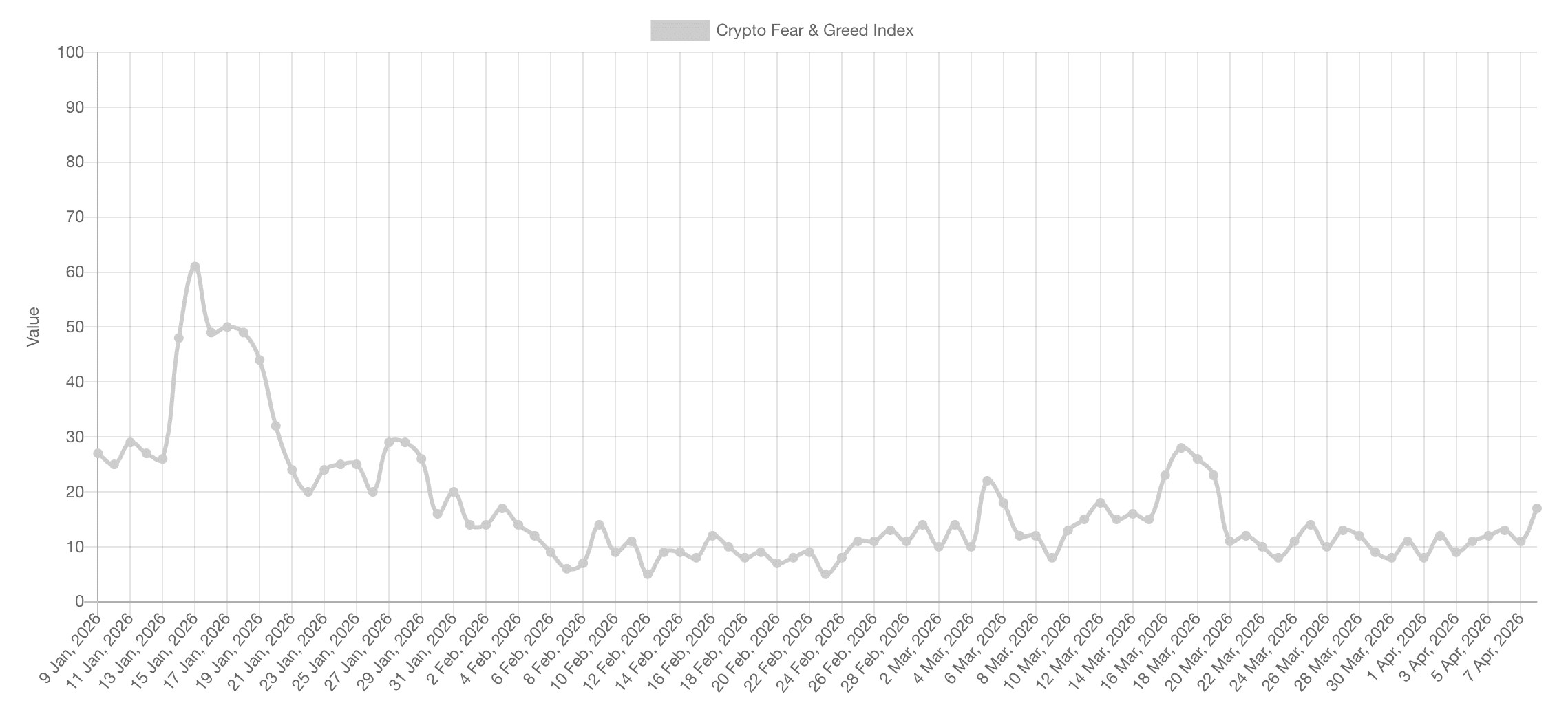
Source: Alternative

Is Trump’s impeachment around the corner?

Needless to say, the recent threat by Trump had pushed many to call for U.S. President Trump’s impeachment under the 25th Amendment.
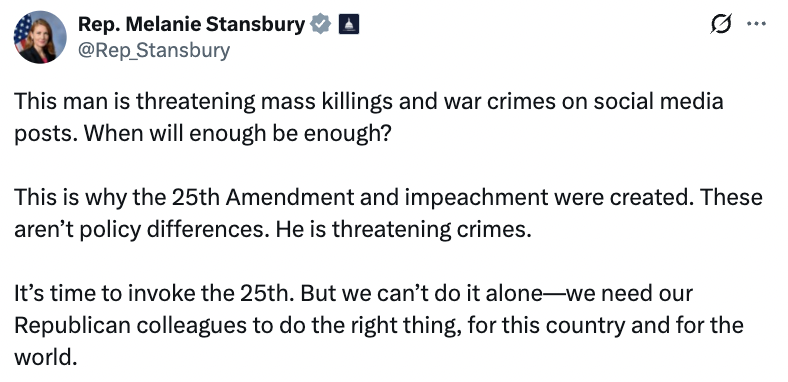
Source: Rep. Melanie Stansbury/X

That said, the Polymarket odds of Trump’s impeachment before his term ends also stood at 65% at the time of reporting.
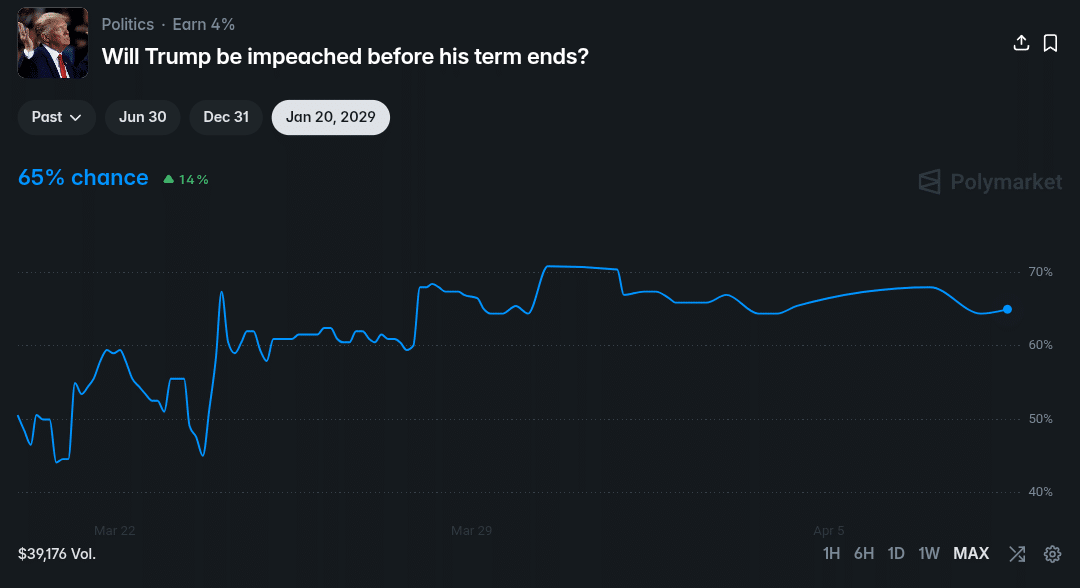
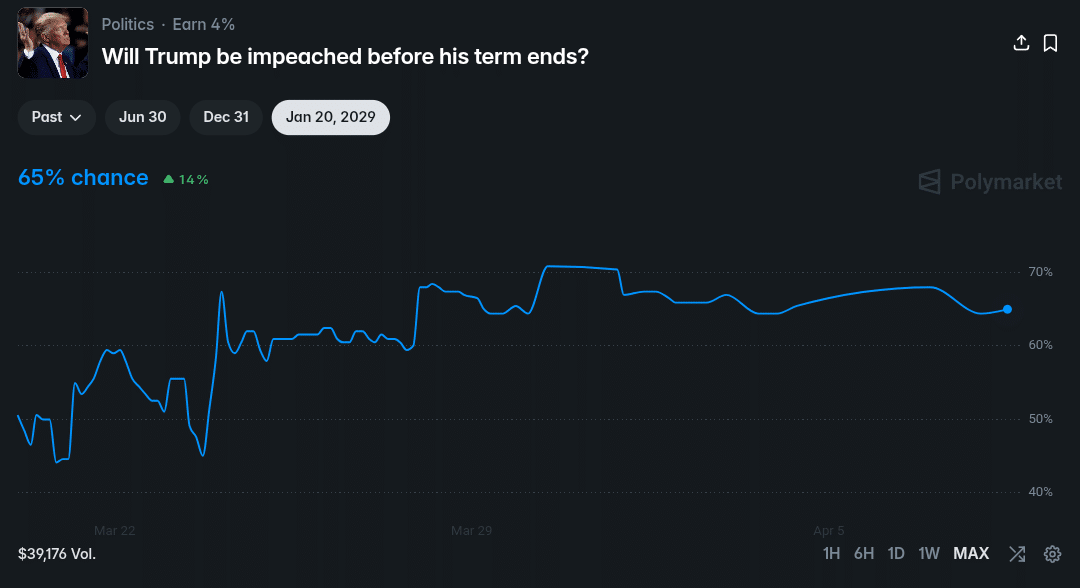
Source: Polymarket

Taken together, this shows how Trump’s pro-crypto policies and plans post-becoming the 47th President of the U.S. now seem debatable.

Peter Schiff takes a different route

However, while the entire world was crippling with this news, Peter Schiff, Chief Economist & Global Strategist at Europac, called this threat a bluff as he said,

If they believed there was a reasonable probability that Trump would actually kill Iranian civilization tonight, stocks would be a lot lower and oil a lot higher.

Schiff argued,

If investors don’t believe Trump, why would the Iranian leadership?

Ceasefire and its impact on the crypto market

However, as of the 8th of April, 5:20 AM IST, Prime Minister of the Islamic Republic of Pakistan, Shehbaz Sharif, injected a breath of fresh air globally when he noted,


Source: Shehbaz Sharif/X

Now, with an agreement on an immediate ceasefire from both ends, the crypto market turned green.

At press time, the global crypto market cap stood at $2.45 trillion, up 4.42% over the last 24 hours. At the same time, Bitcoin was changing hands at $71,884.44 after surging by 5.04% during the same period.


Final Summary

  • The escalating U.S.-Iran tensions had sent the crypto market into the hands of sellers.
  • The immediate ceasefire announcement shifted the market from bearish to bullish, but fear remains.


Related Questions

QWhat was the name of the U.S. military operation that began on February 27th and shook the crypto market?

AOperation Epic Fury.

QAccording to the article, what was the primary reason cited for Bitcoin's resilience during the geopolitical turmoil?

AThe article quotes Anthony Scaramucci stating that Bitcoin is 'sticky and seems resilient after crashing 40%' and also notes that Iran was accepting crypto payments for tolls, which may have contributed to its strength.

QWhat was the status of the Crypto Fear and Greed Index at the time the article was written?

AIt was in the 'Extreme Fear' zone.

QWhat event on April 8th caused the crypto market to turn green and Bitcoin's price to surge?

AAn agreement on an immediate ceasefire between the U.S. and Iran, as announced by Pakistan's Prime Minister Shehbaz Sharif.

QWhat were the Polymarket odds of President Trump's impeachment before his term ended, according to the report?

A65%.

Related Reads

In Conversation with Ray Dalio: We Are Currently in an AI Bubble, with 1% of My Portfolio in Bitcoin

Ray Dalio, founder of Bridgewater Associates, warns in an interview that the current AI boom shows classic bubble characteristics, which could lead to significant economic downturns as seen in past cycles like 1929 or 2000. He explains that speculative enthusiasm, fueled by debt and overvaluation, often precedes a crash when rising rates or taxation force asset sales, causing widespread losses and recession. Dalio also outlines his "Big Cycle" theory, describing an approximate 80-year pattern where widening wealth gaps, massive government deficits, and shifting geopolitical power (like China's rise) create internal conflict and global instability. He emphasizes that we are in a late-cycle, transitional phase where traditional powers like the US and UK face decline. For personal wealth protection, Dalio advises diversification beyond cash into assets like stocks, bonds, real estate, and particularly gold, which he prefers over Bitcoin. While he holds about 1% of his portfolio in Bitcoin as a non-printable hard asset, he views gold as more secure from technological or governmental threats. Regarding AI's impact, Dalio believes it will disproportionately benefit capital owners, worsening inequality by replacing both physical and cognitive labor. He suggests that human intuition and emotional intelligence, combined with AI, will be key for future workers. On taxation, Dalio argues that wealth taxes are impractical and risk triggering asset sell-offs, reducing productive investment. He points to the UK as a cautionary example of debt, low productivity, and political strife. Geopolitically, Dalio foresees a more regionalized world, with the US showing weakness in prolonged conflicts like with Iran, akin to past imperial declines. The ideal outcome, he suggests, is coexisting powerful blocs (e.g., Americas, China-Asia Pacific) without major war.

marsbit3h ago

In Conversation with Ray Dalio: We Are Currently in an AI Bubble, with 1% of My Portfolio in Bitcoin

marsbit3h ago

Daily 7.2 Trillion KRW: Foreign Capital's Record Net Buying on Friday! Wall Street Says Headwinds for Korean Stock Fund Flows Have Subsided

South Korean stock market sees a dramatic shift in fund flows. On July 31, foreign investors made a record net purchase of approximately KRW 7.2 trillion in KOSPI stocks, marking a fundamental reversal from the persistent large-scale net outflows seen in previous months. This contributed to a significant narrowing of foreign net selling in July to KRW 9.8 trillion, down sharply from KRW 48.4 trillion in June and KRW 44.5 trillion in May. Simultaneously, domestic institutional pressure eased. South Korean pension funds and asset managers turned to a net buying position in July, purchasing KRW 1.0 trillion worth of KOSPI shares, contrasting with net sales in May and June. Market volatility is expected to be dampened by new financial regulations. Effective July 31, the Financial Services Commission tightened access for retail investors to single-stock leveraged ETFs by raising the minimum cash deposit requirement. Trading volumes for these products subsequently dropped to about 50% of their monthly average. Citigroup Research maintains its year-end KOSPI target of 10,000 points. The firm cites several supportive factors: the substantial easing of headwinds from capital outflows, a robust fundamental outlook for the semiconductor sector, historically low market valuations, strong economic fundamentals, and the potential for policy support from financial authorities if needed.

marsbit3h ago

Daily 7.2 Trillion KRW: Foreign Capital's Record Net Buying on Friday! Wall Street Says Headwinds for Korean Stock Fund Flows Have Subsided

marsbit3h ago

Thanks to Dice Rolls, Bitcoin Keys Are Stored Offline, But Not Everyone Will Do It

The article discusses using dice rolls to generate secure Bitcoin wallet seeds, providing entropy independent of potentially flawed hardware random number generators. It explains that each fair dice roll offers about 2.585 bits of entropy, with around 50 rolls needed for a standard 12-word seed phrase and 99+ recommended for higher security. This method gained attention after a vulnerability was revealed in some Coldcard hardware wallets, where a faulty firmware RNG (dating back to 2021) compromised generated keys. The analysis notes that while a dice-generated main seed was safe from this specific flaw, other Coldcard functions (like creating paper wallets, backup keys, or passwords) could still be vulnerable if they used the defective RNG. The piece argues that while dice-based entropy is technically robust, the manual process is error-prone, tedious, and unrealistic for most new users, who might make mistakes in recording or inputting rolls. It concludes that while manual entropy generation should remain an option for advanced users, the long-term goal is to develop reliable, user-friendly hardware and software that securely generates randomness without requiring specialized knowledge. Coldcard users are advised to check their firmware version and replace any secondary secrets (like paper wallet keys) created with vulnerable devices, while also considering multi-signature setups with devices from different manufacturers for added security.

cryptonews.ru8h ago

Thanks to Dice Rolls, Bitcoin Keys Are Stored Offline, But Not Everyone Will Do It

cryptonews.ru8h ago

Trading

Spot
活动图片




