Report Analysis: What Is Coherent Planning as CPO Booms?

marsbitPublished on 2026-06-24Last updated on 2026-06-24

Abstract

Title: Report Interpretation: What Moves Is Coherent Making Amid the CPO Boom? Summary: JP Morgan analyst Samik Chatterjee reiterates an Overweight rating on Coherent (COHR), citing undervalued growth potential across three core areas: data center optical transceivers, co-packaged optics (CPO) chips, and industrial lasers/thermal management. COHR's 1.6T data center transceivers are in high demand, with pricing remaining firm. The rise of CPO is seen not as a threat but as a catalyst, creating higher demand for sophisticated optical components, an area where COHR holds a competitive edge with its comprehensive portfolio (lasers, isolators, VCSELs, thermoelectric coolers). Each CPO chip offers significantly greater revenue potential than traditional transceivers. Furthermore, its Optical Circuit Switch (OCS) technology targets a potential $4B market with reliability and power advantages. The company is expanding its InP (Indium Phosphide) device capacity fourfold within two years, securing substrate supply and transitioning to more cost-effective 6-inch wafers. As one of only two major suppliers of high-quality pump lasers—currently in severe shortage—COHR can now move up the value chain from components to complete line cards/systems, boosting ASP over tenfold. Gross margin targets (>42%) may be revised upward due to high-end product premiums, cost improvements from the wafer transition, and contributions from new high-margin products like CPO and OCS. Its efficient thermad...

Author: Rita

TideGuide

J.P. Morgan analyst Samik Chatterjee recently reiterated his Overweight rating on Coherent (stock code COHR) at an investor conference. The company manufactures optical communication chips and components, and the market underestimates its growth potential. The core logic revolves around three product lines: optical transceivers for data centers, Co-Packaged Optics (CPO) chips, and industrial lasers and thermal solutions.

Data Communication Transceivers, Demand Continues to Rise

First, look at the most mature business line. COHR's 1.6T transceivers are now standard in data centers, and supply remains tight. Demand for 1.6T is already present, the pricing environment is healthy, with no significant pressure observed. Some worry that CPO might cannibalize traditional transceiver business, but the analyst believes the opposite is true. CPO integrates optical and electrical chips, which will actually increase demand for high-end optical components rather than replace them.

CPO and OCS, An Underestimated Opportunity

CPO is currently a major industry focus, with all major chip manufacturers involved. COHR's competitive advantage lies in providing a comprehensive portfolio of optical components. It can supply lasers, isolators, VCSELs, and thermoelectric coolers. COHR covers nearly all the optical components required in a CPO system. This means the value COHR can capture per CPO chip is far greater than with traditional transceivers.

The target market size for Optical Circuit Switches (OCS) is $4 billion, and its application scenarios are expanding. From internal data center traffic optimization, it extends to data center interconnects and even Scale-Up scenarios. COHR uses Liquid Crystal technology, competing against MEMS-based solutions, offering clear advantages in reliability and power consumption.

InP Capacity, The Foundation for Upstream Integration

COHR plans to increase its InP (Indium Phosphide) device capacity fourfold within two years. The transition to 6-inch wafers is underway, with yields exceeding those of mature processes. The company has signed agreements with five substrate suppliers to secure supply, addressing the primary bottleneck for capacity expansion.

Pump lasers are currently in particularly short supply. COHR is one of only two global high-quality suppliers, holding about 70% share for certain models. This tight supply environment presents a strategic opportunity: vertical integration. Moving beyond selling just laser components to selling complete line cards or systems. The average selling price per solution can increase by more than tenfold.

Raising Gross Margin Targets, Cost Structure Improving

The company reaffirmed its gross margin target of greater than 42%, hinting at potential future increases. The drivers come from three aspects: premium pricing for high-end products, cost improvements from the transition to 6-inch wafers, and volume ramp-up of high-margin new products like CPO and OCS. The efficiency of the thermal management material "thermadite" is 2 to 5 times that of copper-based solutions, representing another long-term growth driver.

The Industrial Segment, An Overlooked Growth Point
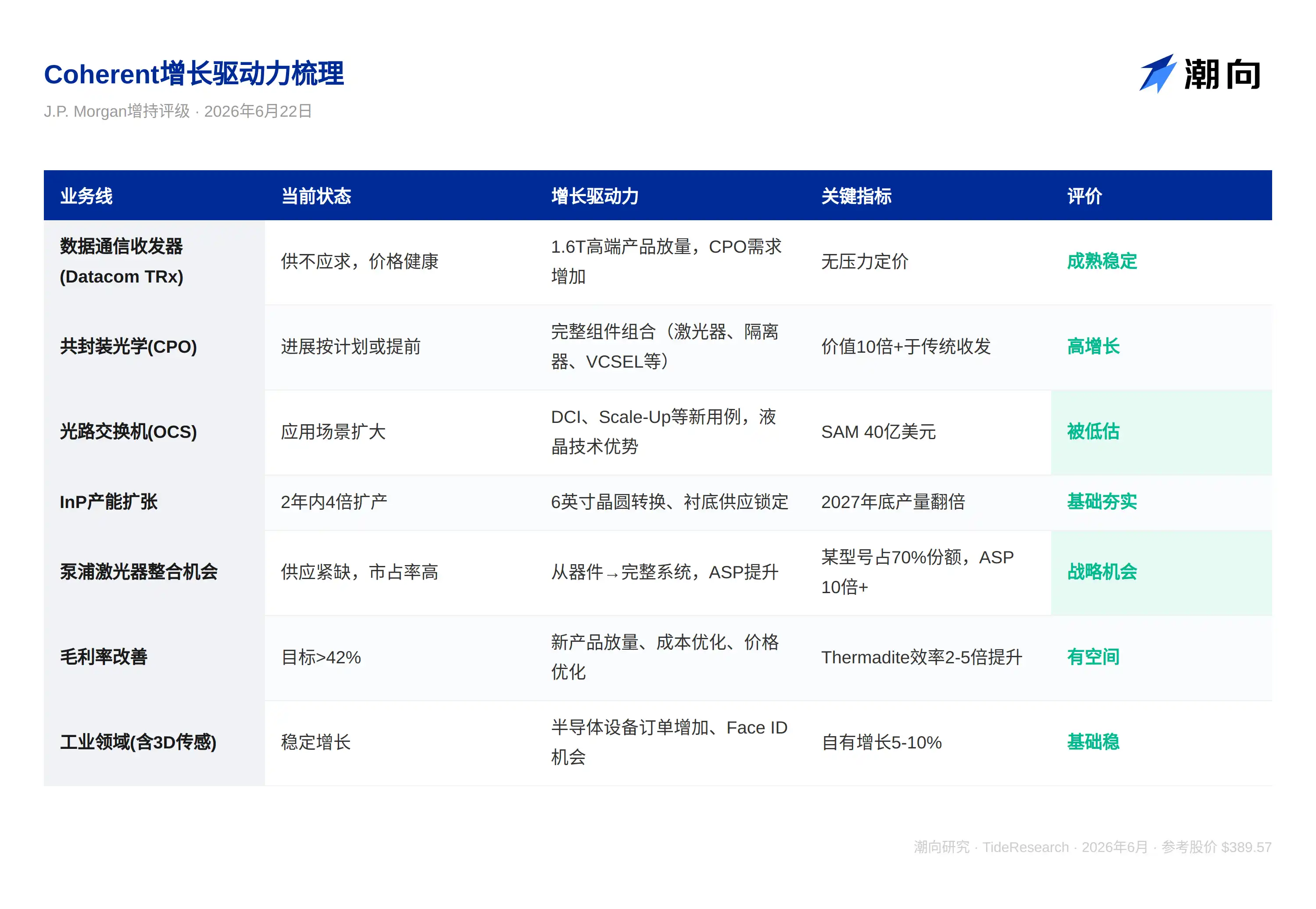
Organic growth in industrial revenue remains steady at 5% to 10%. Semiconductor manufacturing equipment orders are growing. In 3D sensing, Apple's next-generation Face ID might adopt a new protocol, presenting a re-competition opportunity for suppliers.

Optical communication chips are the underlying infrastructure for data centers. AI is driving higher computing power demands, which in turn increases the need for high-speed optical interconnects. COHR holds a critical position in this supply chain. The new opportunities in CPO and OCS, stable growth in the industrial segment, and room for gross margin improvement all support the Overweight rating.
Disclaimer

This article is TideResearch's analysis and interpretation of a third-party brokerage research report. The ratings, price targets, earnings forecasts, and related judgments cited herein are the views of the J.P. Morgan analyst, representing only the stance of their affiliated institution. They do not represent TideResearch's views and do not constitute any investment advice.

Please note three points while reading: First, ratings are analysts' comprehensive judgments on a company's prospects and are subject to frequent adjustments based on performance and market conditions. Second, sell-side research reports are inherently bullish, and some covered companies may have investment banking relationships with the brokerage. Third, the value of research reports lies in their core logic and underlying assumptions, not just a specific price target. Focus on the logic, not just the rating.

Markets involve risks, and investment decisions should be made independently. This article should not be used as a basis for trading any securities.

Data Source: Coherent Corp Investor Conference Minutes (J.P. Morgan, Samik Chatterjee, June 22, 2026)

TideResearch · June 2026

Related Questions

QAccording to J.P. Morgan's analysis, what are the three core growth drivers for Coherent (COHR) mentioned in the article?

AThe three core growth drivers are: 1) Data center optical transceivers, 2) Co-packaged optics (CPO) chips, and 3) Industrial lasers and thermal management.

QWhat is the analyst's view on the relationship between the demand for traditional optical transceivers and the rise of CPO technology?

AThe analyst believes that CPO technology will not replace or cannibalize demand for traditional optical transceivers. Instead, it will increase the demand for high-end optical components, as CPO integrates optical and electrical chips together.

QWhat are Coherent's specific advantages in the CPO market, as highlighted in the report?

ACoherent's competitive advantage lies in providing a complete portfolio of optical components, including lasers, isolators, VCSELs, and thermoelectric coolers, which are essential for CPO systems. This allows them to capture significantly more value per CPO chip compared to traditional transceivers.

QWhat strategic opportunity is presented by the current tight supply of pump lasers for Coherent?

AThe tight supply of pump lasers, where Coherent is one of only two high-quality global suppliers, presents a strategic opportunity for vertical integration. Instead of just selling laser components, the company can now sell complete line cards or systems, increasing the average selling price per solution by more than tenfold.

QWhat three factors are driving the company's target for gross margins to exceed 42%?

AThe three driving factors are: 1) Premium pricing power for high-end products, 2) Cost improvements from the transition to 6-inch InP wafers, and 3) The ramp-up of new high-margin products like CPO and Optical Circuit Switches (OCS).

Related Reads

Warsh Concludes Capitol Hill Visit! A Breakdown: What Did He Say Over These Two Days?

Walsh Concludes Capitol Hill Testimony: Key Takeaways on Independence, Inflation, and AI In his first congressional hearings as Fed Chair, Kevin Walsh faced intense scrutiny over the central bank's independence, internal reforms, and policy transparency. Over two days before House and Senate committees, lawmakers, particularly Democrats, questioned his ties to the Trump administration and recent initiatives like an AI task force led by venture capitalist Marc Andreessen. Walsh staunchly defended the Fed's independence, stating, "Trump selected an independent person to do an independent job," and vowed to ignore political pressure on interest rates. He emphasized a "zero tolerance" approach to inflation, downplaying the significance of a single favorable CPI report and signaling that rate hikes remain an option to restore price stability. He addressed criticism of the Andreessen-led AI working group by clarifying it only has an advisory role. On AI's economic impact, Walsh suggested the investment boom might not be inherently inflationary and could boost productivity and wages over time. Regarding policy, Walsh reiterated his preference to move away from detailed forward guidance, promising all decisions would be released publicly and simultaneously. He framed his internal reform efforts, including five new working groups starting "from a blank slate," as necessary because past Fed policy contributed to current inflation. The hearings ended with a mix of skepticism and a "wait-and-see" attitude from Washington. While Walsh navigated the initial challenge through hawkish rhetoric and debate skills, observers noted his credibility will ultimately depend on concrete actions to fight inflation and safeguard the Fed's autonomy.

marsbit9m ago

Warsh Concludes Capitol Hill Visit! A Breakdown: What Did He Say Over These Two Days?

marsbit9m ago

Understanding the Q2 Crypto Market in 5 Charts: RWA Booms, Fundamentals Continue to Improve

"5 Charts to Decrypt the Crypto Market in Q2: RWA Explosion and Fundamentals Rebound" In Q2 2026, the crypto market presented a complex picture. While major cryptocurrencies fell 36% in H1, underperforming most major asset classes except gold, crypto-related equities surged 23%, doubling the S&P 500's return. This highlights diverse investment opportunities within the sector, from AI-benefiting miners to Wall Street-linked tokenization platforms. Key takeaways from five crucial charts: 1. **Divergence:** A significant performance gap emerged between crypto assets and publicly traded crypto companies. 2. **Robust Fundamentals:** The top 10 crypto applications generated $5.9B in revenue over the past year, with leaders like PancakeSwap nearing $1B, demonstrating real business traction. 3. **RWA Boom:** Tokenized real-world assets (RWA) reached a record $33B, up 12% QoQ and 45% YTD, fueled by tokenized treasuries, credit, and equities. 4. **Prediction Market Growth:** Prediction market open interest hit a new high of $1.8B, with Q2 volume reaching $43B, driven largely by sports and upcoming political events. 5. **Attractive Correlations:** The Bitwise Crypto Innovators 30 Index showed low or negative 90-day rolling correlations with most major assets (like stocks, bonds, gold), offering potential diversification benefits alongside high returns. Overall, despite bearish price action, the data reveals resilient industry fundamentals with continued growth in users, revenue, and institutional adoption, laying groundwork for future cycles.

marsbit36m ago

Understanding the Q2 Crypto Market in 5 Charts: RWA Booms, Fundamentals Continue to Improve

marsbit36m ago

Bitcoin's Anti-Spam Data Soft Fork BIP110: Miner Collective Boycott, Already Doomed to Fail?

The article discusses the controversial Bitcoin Improvement Proposal (BIP) 110, a "data reduction" soft fork aimed at limiting non-monetary data, such as certain scripts, within Bitcoin transactions. Proponents argue this data violates network principles, but the author strongly disagrees. The core argument is that Bitcoin's fundamental value lies in its open-access, censorship-resistant ledger. Anyone can write data by paying fees, and attempting to police how data is interpreted externally is both impossible and contrary to Bitcoin's ethos. The author compares this to free speech and notes that Bitcoin's existing protocol limits (block size, sigops) already manage network load effectively, even spurring layer-2 innovation. Technically, BIP110 would impose significant new restrictions on script size, Taproot features, and upgradability, applying to UTXOs created within about a year of activation. Its deployment mechanism is criticized for having an unusually low 55% miner signaling threshold and a forced activation timeline, representing the most aggressive script limitations since 2010. The author finds the rationale weak, stating the "problem" it addresses is already managed, and the fork's rushed process ignores broader ecosystem consensus. Importantly, they note that users of so-called unwanted data have already adapted their software to work around the proposed rules. The conclusion is that BIP110 is destined to fail. It attempts the impossible—controlling how an open ledger is used—based on flawed reasoning and via a reckless process. The article reports that miners, developers, and the broader community have rejected it, and Bitcoin will emerge stronger by continuing its normal operation without this change.

marsbit49m ago

Bitcoin's Anti-Spam Data Soft Fork BIP110: Miner Collective Boycott, Already Doomed to Fail?

marsbit49m ago

Breaking the Offer Price! SpaceX's Stock Price Falls Below the $135 IPO Price for the First Time, Company Bonds Decline Continuously, Yield Reaches 7.5%, Comparable to Junk Bonds

SpaceX's stock price fell below its $135 IPO price for the first time, trading as low as $132.15 before closing slightly above the offering price. The stock has experienced high volatility typical of new listings, surrendering nearly all its initial 50% surge. Compounding equity pressures, the company's newly issued $25 billion bond due 2056 has also declined in price, pushing its yield to a junk-bond-like 7.5%. Analysts note investor skepticism is growing regarding the costs and distant timeline of SpaceX's xAI and large infrastructure ambitions. A significant 20% of the IPO's $75 billion raise went to retail investors, making the price decline a notable blow to market confidence. Further downside risk looms as lock-up periods for early investors expire soon, potentially triggering significant selling pressure alongside the company's first quarterly earnings report. Initial upward momentum was partly fueled by an estimated $5.4 billion in mandatory buying from index funds after SpaceX's rapid inclusion in major indices like the Nasdaq 100. Despite the current weakness, Wall Street sentiment remains broadly positive. With bank analyst quiet periods ending, over 80% of coverage initiates with a "Buy" rating, and the average price target implies roughly 78% upside from current levels.

链捕手1h ago

Breaking the Offer Price! SpaceX's Stock Price Falls Below the $135 IPO Price for the First Time, Company Bonds Decline Continuously, Yield Reaches 7.5%, Comparable to Junk Bonds

链捕手1h ago

Trading

Spot
活动图片