Regulatory Crossroads: The United States, Europe, and the Future of Crypto Assets

深潮Published on 2025-12-10Last updated on 2025-12-10

Abstract

The article "Regulatory Crossroads: The US, Europe, and the Future of Crypto Assets" examines the divergent regulatory paths shaping the cryptocurrency landscape. It begins by contrasting Bitcoin’s origins as a decentralized, anti-establishment innovation with its current status as a heavily industrialized, energy-intensive asset. The piece draws parallels between the unregulated pre-1933 US stock market and today's crypto space, arguing that a shift from a libertarian "wild west" to a compliant asset class is inevitable. The US approach is portrayed as increasingly pragmatic and institutionally friendly. Key developments include the GENIUS Act, which mandates 1:1 Treasury backing for stablecoins, the repeal of restrictive accounting rules, and a perceived regulatory "regime change" at the SEC under Paul Atkins. This framework aims to integrate crypto into traditional finance, with major banks like JPMorgan now offering crypto-backed loans and the Treasury viewing stablecoins as tools for extending dollar hegemony. In stark contrast, the EU’s Markets in Crypto-Assets (MiCA) regulation is criticized as a risk-averse, innovation-stifling "bureaucratic masterpiece." Its high compliance burdens, treatment of crypto founders like sovereign banks, and effective ban on non-euro stablecoins like USDT are seen as creating a "regulatory moat" that drives talent and startups to more favorable jurisdictions like Switzerland and the UAE. The article concludes that the US is poised to b...

Written by: TradFiHater

Compiled by: AididiaoJP, Foresight News

When Bitcoin's creator Satoshi Nakamoto released the whitepaper, mining was so simple: any gamer with an ordinary home computer could potentially accumulate a fortune worth tens of millions of dollars in the future.

On a home computer, you could have built a vast wealth legacy, freeing future generations from hard labor, as Bitcoin's potential return rate reached as high as 250,000 times.

But at that time, most gamers were addicted to Halo 3 on Xbox, and only a few young people used their home computers to earn fortunes far exceeding those of modern tech giants. Napoleon built his legend by conquering Egypt and Europe, while you only needed to click 'Start Mining'.
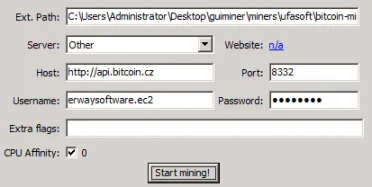
Over fifteen years, Bitcoin has become a global asset, and its mining has evolved into a large-scale industry requiring billions of dollars in funding, specialized hardware, and enormous energy consumption. Today, mining each Bitcoin on average consumes 900,000 kWh of electricity.

Bitcoin has spawned a completely new paradigm, starkly opposed to the financial world we are familiar with, dominated by traditional institutions. It might be the first truly meaningful rebellion against the elite since the failed Occupy Wall Street movement. Notably, Bitcoin was born precisely after the 'Great Financial Crisis' of the Obama era, a crisis largely stemming from the indulgence of high-risk 'casino-style' banking. The Sarbanes-Oxley Act of 2002 was intended to prevent a repeat of the dot-com bubble, yet ironically, the 2008 financial collapse was far more severe.

Whoever Satoshi Nakamoto was, his invention appeared at a perfectly opportune moment—a spasmodic yet deliberate rebellion against a powerful and ubiquitous traditional financial system.

From Disorder to Regulation: The Cycle of History

Before 1933, the U.S. stock market was largely unregulated, relying only on scattered state 'Blue Sky Laws,' leading to severe information asymmetry and rampant fraudulent trading.

The liquidity crisis of 1929 became the 'stress test' that broke this model, proving that decentralized self-regulation could not curb systemic risk. The U.S. government performed a 'forced reset' with the Securities Acts of 1933 and 1934: replacing the 'caveat emptor' principle with a central enforcement agency (the U.S. Securities and Exchange Commission, SEC) and a mandatory disclosure system, establishing uniform legal standards for all public assets to restore market trust in the system's solvency. Today, in the decentralized finance (DeFi) space, we are witnessing the exact same process unfold.

Until recently, cryptocurrency operated as a permissionless 'shadow banking' asset, functionally similar to the pre-1933 U.S. stock market but far more dangerous due to a complete lack of regulation. Its governance relied primarily on code and hype, failing to adequately assess the immense risks this 'beast' might bring. The series of cascading implosions in 2022 became the '1929-style stress test' for the crypto world, demonstrating that decentralization does not equal infinite returns and sound money; instead, it created a risk node capable of devouring multiple asset classes.

We are witnessing a forced shift in the zeitgeist: the crypto world is transitioning from a libertarian, casino-like paradigm to a compliant asset class. Regulators are attempting to make cryptocurrency perform a 'U-turn': once legalized, funds, institutions, the wealthy, and nations can hoard it like any other asset, thereby enabling its taxation.

This article aims to dissect the origins of cryptocurrency's 'institutional rebirth,' a transformation that has become inevitable. Our goal is to extrapolate the logical endpoint of this trend and attempt to depict the final form of the DeFi ecosystem.

Regulation Lands: Step by Step

Before DeFi entered its first true 'dark age' in 2021, its early development was not dominated by全新 legislation, but rather by federal agencies continuously extending existing laws to cover digital assets.

The first major federal action occurred in 2013: the U.S. Financial Crimes Enforcement Network (FinCEN) classified cryptocurrency 'exchangers' and 'administrators' as Money Services Businesses, subjecting them to the Bank Secrecy Act and anti-money laundering (AML) regulations. 2013 can be seen as the year DeFi was first 'acknowledged' by Wall Street, while also paving the way for future regulation and suppression.

In 2014, the Internal Revenue Service (IRS) defined virtual currency as 'property' rather than 'currency' (for federal tax purposes), causing every transaction to potentially generate capital gains tax. Thus, Bitcoin gained a legal characterization, meaning it became taxable—a far cry from its original 'rebellious' intent!

At the state level, New York introduced the controversial BitLicense in 2015, the first regulatory framework requiring disclosure from cryptocurrency businesses. Finally, the SEC capped the狂欢 with the 'DAO Report of Investigation,' confirming that many tokens constituted unregistered securities according to the 'Howey Test.'

In 2020, the Office of the Comptroller of the Currency (OCC) briefly allowed national banks to provide custody services for cryptocurrencies, but this move was later questioned by the Biden administration—almost a 'standard procedure' for successive presidents.

The Shackles of the Old World: Europe's Path

Across the ocean in the 'Old World,' antiquated customs similarly dictate the development of cryptocurrency. Influenced by a rigid Roman law tradition (distinct from the Anglo-American common law system), an anti-individual-liberty atmosphere pervades, limiting the possibilities of DeFi within a regressive civilization. It must be remembered that the American spirit is deeply influenced by Protestant ethics, a spirit of autonomy that shaped American entrepreneurial culture, liberal ideas, and pioneering spirit.

In Europe, Catholic tradition, Roman law, and feudal remnants have collectively fostered a截然不同的 culture. Therefore, it is not surprising that established countries like France, the UK, and Germany have taken different paths. In a society that prefers obedience over risk-taking, cryptocurrency is destined to be harshly suppressed.

Europe's crypto early era was defined by a fragmented bureaucracy rather than a unified vision. The industry scored its first legal victory in 2015: the European Court of Justice ruled in a case that Bitcoin transactions were exempt from value-added tax (VAT), effectively acknowledging the 'monetary'属性 of cryptocurrency.

In the absence of unified EU law, national regulations varied until the Markets in Crypto-Assets Regulation (MiCA) emerged. France established a strict national framework through the PACTE Law, Germany introduced a cryptocurrency custody licensing system, while Malta and Switzerland competed to attract businesses with宽松优惠的 regulations.

In 2020, the Fifth Anti-Money Laundering Directive (5AMLD) ended this chaotic era, mandating strict customer identity verification across the EU, effectively eliminating anonymous trading. The European Commission finally realized that 27 sets of conflicting rules were unsustainable and proposed MiCA in late 2020, marking the end of the 'patchwork era' and the beginning of unified regulation.
America's 'Visionary' Model?

The shift in the U.S. regulatory system is not genuine systemic reform but more driven by opinion leaders. The power transition in 2025 brought a new philosophy: mercantilism压倒 moralism.

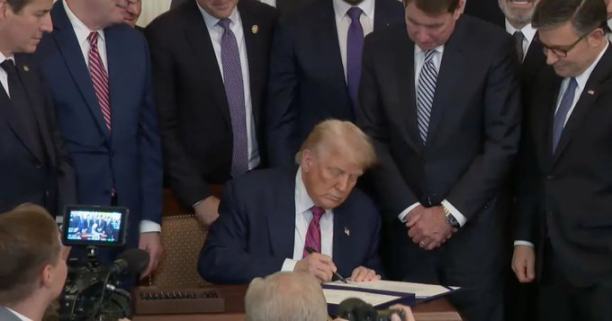
Trump's launch of his controversial 'Meme Coin' in December 2024 was perhaps a symbolic event. It showed that the elite were also willing to 'Make Cryptocurrency Great Again.' Today, several 'Crypto Popes' are leading the direction, committed to securing greater freedom and space for founders, developers, and retail investors.

Paul Atkins taking the helm at the SEC was more like a 'regime change' than an ordinary personnel shift. His predecessor, Gary Gensler, viewed the crypto industry with near hostility, becoming the 'public enemy' of a generation of crypto practitioners. An Oxford University paper even analyzed the pain caused by Gensler's policies. Many believe that due to his aggressive stance, years of development in the DeFi space were delayed; the regulator meant to guide the industry was severely out of touch.

Atkins not only halted numerous lawsuits but also essentially apologized for previous policies. The 'Crypto Project' he promotes is a model of bureaucratic agility. This project aims to establish an extremely dull, standardized, and comprehensive disclosure system, allowing Wall Street to trade crypto assets like Solana as it does oil. According to a summary by Allen & Overy, the plan's core includes:

  1. Establishing a clear regulatory framework for U.S. crypto asset issuance.

  2. Ensuring freedom of choice for custodians and trading venues.

  3. Encouraging market competition and promoting the development of 'super apps.'

  4. Supporting on-chain innovation and decentralized finance.

  5. Setting up innovation exemption mechanisms to ensure commercial viability.

Perhaps the most critical shift occurred at the Treasury. Former Secretary Janet Yellen viewed stablecoins as a systemic risk. Current Secretary Scott Bessent, an official with a hedge fund mindset, saw the essence: stablecoin issuers are the 'only net new buyers' of U.S. Treasury bonds.
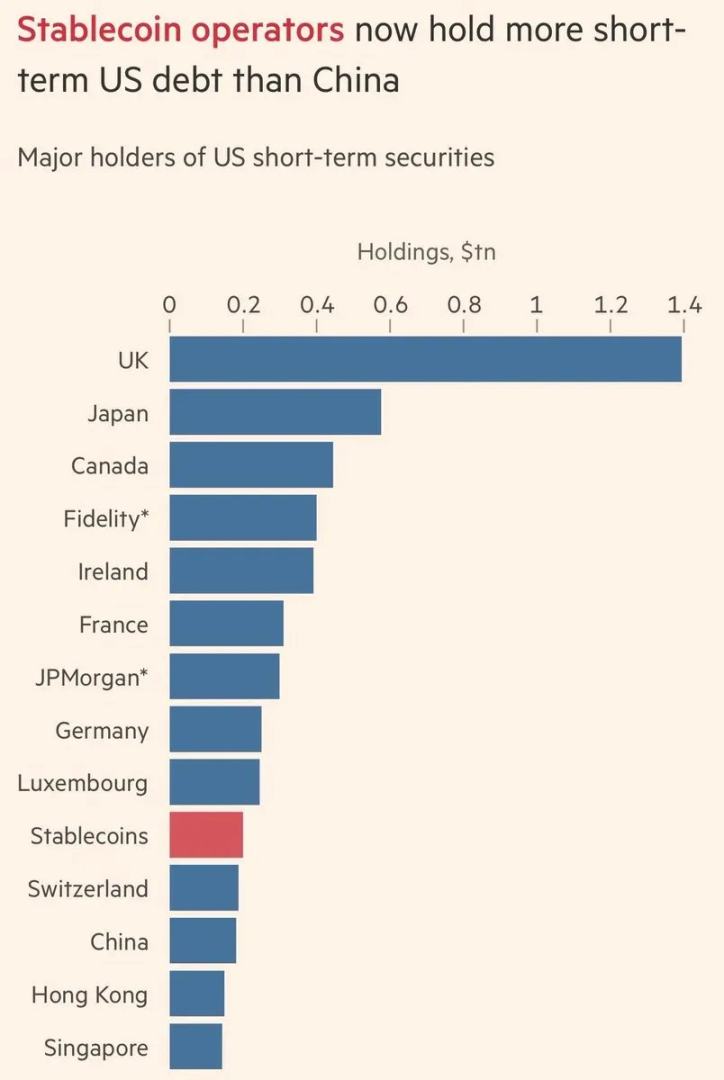
Bessent深知 the severity of the U.S. deficit. Against the backdrop of global central banks slowing their buying of U.S. debt, stablecoin issuers' 'insatiable appetite' for short-term Treasury bonds is a major boon for the new Treasury Secretary. He views USDC, USDT, etc., not as competitors to the dollar, but as its 'vanguard,' extending dollar hegemony to countries where fiat currencies are collapsing and people prefer holding stablecoins.

Another典型 of 'short covering turning into long positions' is JPMorgan Chase CEO Jamie Dimon. He once threatened to fire any employee trading Bitcoin, but has now executed the most profitable '180-degree turn' in financial history. JPMorgan's launch of cryptocurrency-backed lending业务 in 2025 is seen as 'raising the white flag.' According to The Block:

JPMorgan plans to allow institutional clients to use Bitcoin and Ethereum as loan collateral, marking a deeper foray by Wall Street into the cryptocurrency space.

Bloomberg, citing informed sources, reported that the plan will be rolled out globally and will rely on third-party custodians to hold the collateral assets.

When Goldman Sachs and BlackRock began eroding JPMorgan's custody fee income, the 'war' quietly ended; the banks won the war by 'not fighting.'

Finally, Senator Cynthia Lummis, once seen as a 'lone crypto fighter,' has now become the staunchest supporter of the new U.S. collateral system. Her proposal for a 'Strategic Bitcoin Reserve' has moved from fringe theory on internet forums to serious congressional hearings. Her calls, while not directly pushing up Bitcoin's price, are sincere efforts.

The legal landscape in 2025 consists of two parts: 'settled' and 'still pending.' The current administration is so enthusiastic about cryptocurrency that top law firms have纷纷开设 real-time policy tracking services. For example, Latham & Watkins' 'U.S. Crypto Policy Tracker' closely follows the dynamics of various regulatory agencies that are sparing no effort in formulating new rules for DeFi. However, we are still in the 'exploratory stage.'

Currently, two bills dominate the U.S. debate:

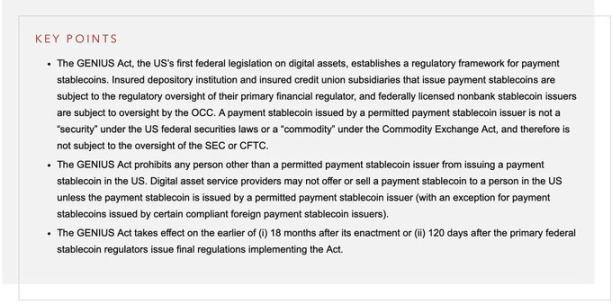
  • The GENIUS Act: Passed in July 2025. This act marks Washington's终于着手 regulation of stablecoins—the most important crypto asset class after Bitcoin. It mandates that stablecoins must have 1:1 reserves, thereby transforming stablecoins from a systemic risk into a geopolitical tool similar to gold or oil. The act effectively authorizes private issuers like Circle and Tether to become 'officially recognized buyers' of U.S. Treasury bonds, achieving a win-win.

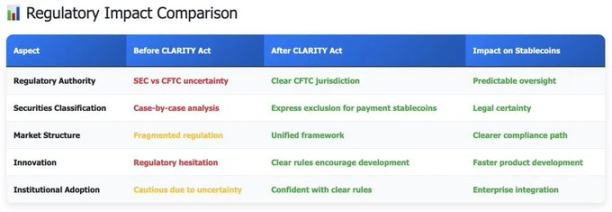
  • The CLARITY Act: This market structure bill, aimed at clarifying the distinction between securities and commodities and resolving the jurisdictional dispute between the SEC and the CFTC, remains stuck in the House Financial Services Committee. Until this bill passes, exchanges exist in a comfortable but fragile 'gray area,' operating on temporary regulatory guidance rather than solid statutory law.
Currently, the bill has become a political football between Republicans and Democrats, seemingly used as a 'weapon' by both sides.
Furthermore, the repeal of Staff Accounting Bulletin No. 121 is of great significance. This accounting rule previously required banks to list custodied crypto assets as liabilities on their balance sheets, effectively preventing banks from holding cryptocurrencies. Its repeal is like opening the 'floodgates,' signaling that institutional capital can finally enter the crypto market without fear of regulatory reprisal. Meanwhile, Bitcoin-denominated life insurance products have begun to appear, and the future seems bright.

The Old World: Inherently Risk-Averse

Just as the Church once sent scientists to the stake, European authorities today have crafted complex and obscure laws whose result may merely be to scare away entrepreneurs. The gap between the vibrant, rebellious young American spirit and the僵化保守, faltering Europe has never been greater. When Brussels had the opportunity to break free from its usual rigidity, it chose to entrench itself.
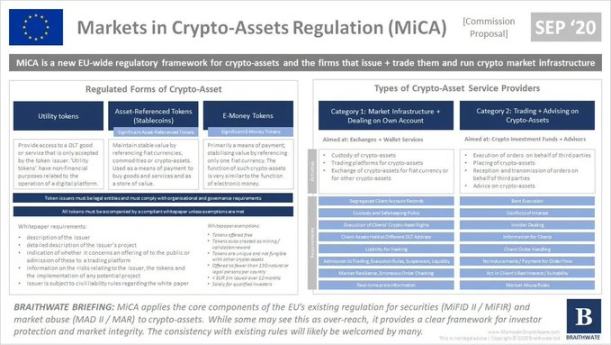
MiCA, fully implemented by the end of 2025, is a bureaucratic 'masterpiece' and an innovation 'disaster.'

MiCA is advertised as a 'comprehensive framework,' a term in Brussels parlance that often means 'comprehensive torture.' It does provide clarity—clarity that makes one want to flee.

The fundamental flaw of MiCA is 'misclassification': it regulates crypto founders as if they were sovereign banks. The compliance costs are high enough to drive most crypto startups to failure.

A memorandum from Norton Rose Fulbright objectively剖析了 the regulation:
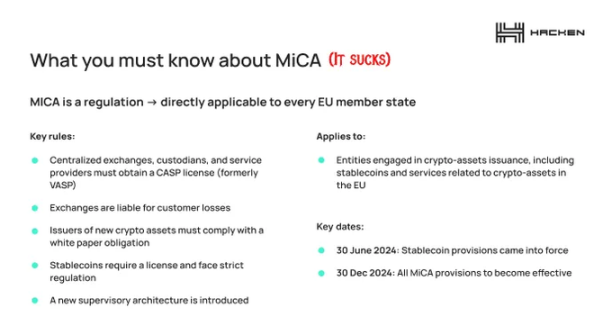
Structurally, MiCA is an 'exclusion mechanism.' It forces digital assets into highly regulated categories and imposes on Crypto-Asset Service Providers (CASPs) a burdensome compliance architecture comparable to MiFID II, which was designed to regulate financial giants.

According to its Titles III and IV, the regulation imposes strict 1:1 liquidity reserve requirements on stablecoin issuers, effectively prohibiting algorithmic stablecoins through legal means (deeming them 'insolvent' from the start). This itself could trigger new systemic risks—imagine being declared 'illegal' overnight by Brussels?

Furthermore, issuers of 'significant' tokens will face enhanced supervision from the European Banking Authority (EBA), including capital requirements daunting enough to deter startups. Today, it is almost impossible to open a crypto business in Europe without a top-tier legal team and capital comparable to traditional financial giants.

For intermediaries, Title V彻底否定了 the offshore, cloud exchange model. Service providers must establish a physical office in an EU member state, appoint a resident director who passes the 'fit and proper test,' and implement strict asset segregation and custody. The 'whitepaper' requirement turns technical documentation into a legally binding prospectus, with any material misstatement or omission leading to strict civil liability,彻底刺破了 the anonymity 'corporate veil' cherished by the industry. One might as well just open a digital bank.

Although MiCA introduces a 'passporting right,' allowing service providers approved in one member state to operate across the entire European Economic Area, this 'unification' comes at a high cost.

It builds a regulatory 'moat'; only extremely well-capitalized institutional players can afford the enormous costs of AML integration, market abuse monitoring, and prudential reporting.

MiCA not only regulates the European crypto market but effectively prevents entrepreneurs lacking legal and financial resources from entering—precisely the situation for most crypto founders.

On top of EU law, the German regulator BaFin has沦为平庸的 a 'compliance paperwork processor,' its efficiency evident only in processing手续 for an increasingly萎靡 industry. France's ambition to become a European 'Web3 hub' has crashed into the high walls it built itself. French startups are not writing code; they are 'voting with their feet.' Unable to compete with U.S. speed or Asian innovation, talent is flowing en masse to Dubai, Thailand, and Zurich.

But the real 'death knell' is the stablecoin ban. The EU, under the guise of 'protecting monetary sovereignty,' has effectively banned non-euro stablecoins like USDT, which is tantamount to strangling the most reliable sector of the DeFi ecosystem. The global crypto economy operates on stablecoins. Forcing European traders to use illiquid 'euro stablecoins' that are无人问津 outside the eurozone, Brussels is digging itself a 'liquidity trap.'

The European Central Bank (ECB) and the European Systemic Risk Board (ESRB) have urged the EU to ban the 'multi-issuance' model (where global stablecoin companies treat tokens issued inside and outside the EU as interchangeable). The ESRB, led by ECB President Christine Lagarde, warned that a run on EU-issued tokens by non-EU holders could 'amplify financial risks within the EU.'

Meanwhile, the UK is considering setting a personal holding limit for stablecoins at £20,000, while lacking regulation for those riskier 'shitcoins.' Europe's risk-averse strategy urgently needs a complete overhaul; otherwise, regulation itself could trigger a systemic collapse.

The reason might be simple: Europe wants its citizens to remain bound to the euro, unable to participate in the U.S. economy to escape their own stagnation or even recession. As Reuters quoted the ECB warning:

Stablecoins could吸走 precious retail deposits from euro area banks, and any run on stablecoins could have broad implications for global financial stability.

The Ideal Model: The Swiss Approach
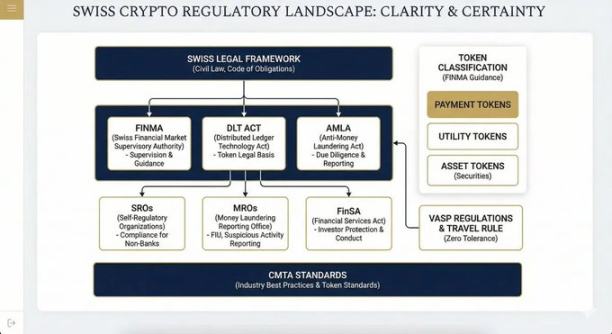
Some countries, free from partisan struggles, foolish decisions, and outdated laws, have successfully navigated the binary trap of 'over-regulation' and 'under-regulation,' finding an inclusive path. Switzerland is such a典范.

Its regulatory landscape is diverse, effective, and friendly,深受从业者和用户喜爱:

  • Financial Market Supervision Act (FINMASA): Enacted in 2007, it integrated banking, insurance, and anti-money laundering regulators, establishing the independent and unified Swiss Financial Market Supervisory Authority (FINMA).

  • Financial Services Act (FinSA): Focuses on investor protection, creating a level playing field for various financial service providers through strict conduct rules, client classification, and disclosure.

  • Anti-Money Laundering Act (AMLA): The core framework for combating financial crime, applicable to all financial intermediaries (including crypto service providers).

  • Distributed Ledger Technology Act (DLT Act): Passed in 2021, it amended ten federal laws, formally recognizing the legal status of crypto assets.

  • Virtual Asset Service Provider Ordinance: Enforces FATF rules with a 'zero-tolerance' attitude.

  • Article 305bis of the Swiss Criminal Code: Explicitly defines money laundering as a criminal offense.

  • Industry Standards: Issued by the Capital Markets and Technology Association (CMTA),虽非强制 but widely adopted.

  • Regulatory System: Parliamentary legislation, FINMA issuing detailed rules, self-regulatory organizations (SROs) for daily supervision, the Money Laundering Reporting Office (MROS) reviewing suspicious reports and referring for prosecution. The structure is clear, with明确权责.

Therefore, the Crypto Valley (Zug) has become a 'sanctuary' for crypto entrepreneurs. Its logically clear framework not only permits innovation but also provides a clear legal umbrella, reassuring users and allowing banks willing to take可控 risks to cooperate放心.

American Embrace and Utilization

The New World's acceptance of cryptocurrency is not purely out of a thirst for innovation (France has yet to send a man to the moon), but more a pragmatic choice under fiscal pressure. Having拱手让予 Silicon Valley the dominance of Web2 internet since the 80s, Europe seems to view Web3 as just another 'tax base' to be harvested, rather than an industry to be nurtured.

This suppression is structural and cultural. Against the backdrop of an aging population and an overburdened pension system, the EU cannot tolerate the rise of a competitive financial industry beyond its control. This is reminiscent of feudal lords imprisoning or killing local nobles to eliminate potential threats. Europe has a lamentable 'self-destructive tendency,' sacrificing the potential of its citizens to prevent uncontrolled change. This is foreign to the U.S., where the culture崇尚 competition,进取, and a Faustian will to power.

MiCA is not a 'development' framework but a 'death sentence.' It aims to ensure that if European citizens engage in crypto transactions, they must do so within the state monitoring grid to guarantee the government 'gets its cut,' like an obese monarch trying to squeeze dry the peasants. Europe is positioning itself as the world's 'luxury consumption colony' and 'eternal museum,' for amazed Americans to come and mourn a past that cannot be revived.

Countries like Switzerland and the UAE have jumped out of historical and structural defects. They lack the imperial baggage of defending a global reserve currency or the bureaucratic inertia of a 27-nation bloc. By exporting 'trust' through laws like the DLT Act, they have attracted foundations with core intellectual property like Ethereum, Solana, and Cardano. The UAE followed closely behind; no wonder more and more French people are 'invading' Dubai.
We are heading towards a period of 'radical jurisdictional arbitrage.'

The crypto industry will experience a geographical split: the consumer-facing side will remain in the U.S. and Europe, subject to full identity verification, high taxes, and integration with traditional banks; while the core protocol layer will migrate entirely to rational jurisdictions like Switzerland, Singapore, and the UAE.

Users will be global, but founders, VCs, protocols, and developers will have to consider leaving their home markets to find more conducive places to build.

Europe's fate is恐将沦为 a 'financial museum.' It is building a glossy but useless, even致命 for actual users, legal system for its citizens. One can't help but ask: Brussels technocrats, have you ever bought Bitcoin, or cross-chain transferred a stablecoin?

Cryptocurrency becoming a macro asset is inevitable, and the U.S. will maintain its position as the global financial center. Bitcoin-denominated insurance, crypto-backed loans, crypto reserves, unlimited VC support, a vibrant developer ecosystem—the U.S. is building the future.

A Worried Conclusion

In summary, the 'Brave New World' being built in Brussels resembles not a coherent digital framework, but an awkward patchwork trying to graft 20th-century bank compliance clauses onto 21st-century decentralized protocols, designed mostly by engineers who know nothing about the ECB's temper.

We must actively advocate for another system: one that prioritizes real-world needs over administrative control. Otherwise, we will彻底扼杀 Europe's already anemic economy.

Unfortunately, cryptocurrency is not the only victim of this 'risk paranoia.' It is just the latest target of a well-paid, complacent bureaucratic class. This group wanders the lifeless postmodern corridors of capitals, their heavy-handed regulation恰恰暴露了他们缺乏现实经验. They have never experienced the繁琐 of account verification, the奔波 of applying for a new passport, the艰辛 of obtaining a business license. Therefore, although Brussels is filled with so-called 'technocrats,' crypto-native founders and users have to deal with a group mired in incompetence,只会制造有害立法.

Europe Must Pivot, Act Now

While the EU is busy tying itself up in red tape, the U.S. is actively planning how to 'normalize' DeFi, moving towards a framework beneficial to multiple parties. Re-centralization to some extent through regulation is inevitable; the collapse of FTX早已在墙上写下预警.

Investors who suffered heavy losses crave justice; we need to break free from the current cycle of meme coin mania, cross-chain bridge vulnerabilities, and regulatory chaos—this 'Wild West.' We need a structure that allows traditional capital (Sequoia, Bain, BlackRock, Citi, etc., have already taken the lead) to enter safely, while protecting end-users from predatory capital.

Rome wasn't built in a day, but the crypto experiment is fifteen years old, and its institutional foundations are still深陷泥潭. The window to build a functional crypto industry is closing rapidly; hesitation and compromise in war will lose everything. Both sides of the Atlantic need swift, decisive, and comprehensive regulation.

If this cycle is truly about to end, now is the best time to salvage the industry's reputation and compensate the serious investors who have been harmed by bad actors for years.

Those weary traders from 2017, 2021, 2025 demand a thorough清算, and a final answer to the cryptocurrency question; and most importantly, for our world's favorite assets to迎来他们应得的、崭新的历史高点.


Related Questions

QWhat was the initial vision of Bitcoin mining as described in the article, and how has it evolved over time?

AInitially, Bitcoin mining was simple and could be done on ordinary home computers, allowing gamers to potentially accumulate significant wealth. Over 15 years, it has transformed into a large-scale industrial operation requiring billions in capital, specialized hardware, and massive energy consumption, with each Bitcoin now consuming an average of 900,000 kWh of electricity.

QHow does the article compare the current state of cryptocurrency to the US stock market before the 1933 Securities Act?

AThe article compares cryptocurrency to the pre-1933 US stock market, which was largely unregulated with only scattered 'blue sky laws,' leading to information asymmetry and fraudulent trading. Similarly, until recently, crypto operated as a permissionless 'shadow banking' asset with a complete absence of regulation, making it even more dangerous. The 2022 series of collapses in crypto is likened to the 1929 liquidity crisis, demonstrating that decentralization does not ensure infinite returns or robust currency but can create risk nodes that threaten multiple asset classes.

QWhat are the key differences between the regulatory approaches of the US and the EU towards cryptocurrencies as outlined in the article?

AThe US approach, under new leadership, is shifting towards a more pragmatic, pro-innovation stance with initiatives like the 'Crypto Initiative' aiming for clear regulatory frameworks, freedom in choosing custodians, and support for on-chain innovation. In contrast, the EU's MiCA regulation is described as overly burdensome, treating crypto founders like sovereign banks with high compliance costs, effectively stifling innovation and driving talent away. The EU also imposes strict rules on stablecoins, including bans on non-euro stablecoins like USDT, which harms DeFi liquidity.

QWhat significant legislative acts are mentioned as shaping the current US crypto debate, and what are their purposes?

ATwo key acts are mentioned: the GENIUS Act, passed in July 2025, which regulates stablecoins by requiring 1:1 Treasury reserve backing, turning them from systemic risks into geopolitical tools and officially authorizing private issuers like Circle and Tether. The CLARITY Act, still pending, aims to clarify the distinction between securities and commodities to resolve jurisdictional disputes between the SEC and CFTC, providing a more stable legal framework for exchanges.

QWhy does the article present Switzerland as a model for cryptocurrency regulation, and what makes its approach effective?

ASwitzerland is presented as a model due to its clear, unified, and friendly regulatory framework, which includes the Financial Market Supervision Act, the Financial Services Act, the Anti-Money Laundering Act, and the Distributed Ledger Technology Act. This multi-layered yet coherent system provides legal certainty, encourages innovation, and offers a protective umbrella for users and banks, making Zug Valley a 'holy land' for crypto entrepreneurs without the excessive burdens seen in other regions like the EU.

Related Reads

What Happens to Ethereum Developer Tools After the Grants Run Out?

On February 27th, the Ethereum Foundation (EF) announced Project Odin, a structured sustainability support program designed for a select group of strategic, previously grant-funded teams. Unlike a standard grant, Odin offers a long-term advisory mechanism focused on helping these teams establish credible, sustainable paths within a two-year framework, thereby reducing long-term dependence on single funding sources. The program addresses a critical post-grant challenge: how essential public goods, especially major developer tools, can achieve financial sustainability beyond initial funding. While grants from EF and programs like Gitcoin or RetroPGF remain vital for startups and research, they often fall short for mature, widely-used infrastructure. Tools like compilers, languages, and network stacks are deeply embedded but struggle with monetization, trapped between being too foundational to lose and too public to generate natural revenue. Project Odin provides teams with a dedicated Strategic Advisor to guide them through a three-phase process: 1) analyzing current funding and realistic options, 2) validating potential paths with stakeholders, and 3) executing plans, which may include crafting support contracts, service agreements, or other recurring revenue models. The first pilot participant is Vyper, a critical smart contract language for the EVM, highlighting the need for sustainable models for core infrastructure. The initiative reframes the public goods conversation from "who should be funded" to "how do already-proven teams avoid perpetual funding crises?" It encourages ecosystem participants—protocols and projects that depend on these tools—to view sustainable support not just as charity, but as essential risk management for their own operational supply chains.

marsbit21m ago

What Happens to Ethereum Developer Tools After the Grants Run Out?

marsbit21m ago

MARA Reports Q1 Revenue Below Expectations, Net Loss of $1.3 Billion, Stock Plunges After Hours

Bitcoin mining firm MARA Holdings reported disappointing Q1 2024 results, causing its stock to erase all daily gains and fall 3.44% in after-hours trading. Revenue dropped 18% year-over-year to $174.6 million, missing Wall Street estimates of $192.7 million. The company posted a net loss of $1.3 billion, a significant increase from a $533.4 million loss a year ago, primarily driven by unrealized losses on its holdings of 38,689 Bitcoin, which depreciated in value during the quarter. MARA also sold over 15,100 BTC in late March to repurchase debt at a discount. The broader mining environment remains challenging due to a 35% decline in Bitcoin's price from its all-time high and a nearly 30% increase in mining difficulty over the past year. MARA's market cap ranking among U.S. miners has slipped to seventh. Critically, the company announced a strategic pivot away from Bitcoin mining expansion. It stated it has no plans to purchase new mining equipment and is fully transitioning toward AI data centers. Its strategy involves retrofitting existing mining sites for AI and high-performance computing (HPC) and leveraging its recent $1.5 billion acquisition of Long Ridge Energy & Power, a gas-fired power plant and data center. This infrastructure could eventually support 600 MW of AI compute capacity, allowing MARA to redeploy up to 90% of its non-custodial mining power for AI and IT workloads.

marsbit22m ago

MARA Reports Q1 Revenue Below Expectations, Net Loss of $1.3 Billion, Stock Plunges After Hours

marsbit22m ago

The AI Investment Landscape Is Being Reshaped: Beyond the 'Magnificent Seven', What Opportunities Lie in the Semiconductor Supply Chain?

AI Investment Map is Reshaping: Opportunities Beyond the 'Magnificent Seven' Since ChatGPT ignited the AI wave, investment initially focused on the "Magnificent Seven" tech giants dominating cloud infrastructure. However, the rise of DeepSeek and debates on AI capital expenditure effectiveness are shifting this dynamic. Investors now recognize opportunities deeper in the supply chain—the companies providing the essential "picks and shovels." Early concerns about an AI investment "arms race" and potential low returns were partly alleviated by strong Q1 earnings from cloud providers, validating robust compute demand. This has highlighted a more certain investment thesis: regardless of which AI applications ultimately win, massive capital expenditure will first fuel demand for semiconductors and related components. This "pick-and-shovel" logic has driven semiconductor ETFs to record highs. Key beneficiaries include: * **Memory Chipmakers (e.g., SK Hynix, Samsung, Micron)**: High Bandwidth Memory (HBM) is a critical bottleneck for AI training. * **Photonics Companies**: Crucial for high-speed data transfer within AI data centers. * **The Broader "AI-11" Semiconductor Ecosystem**: This encompasses foundries & lithography (TSMC, ASML), logic & custom chips (AMD, Broadcom, Intel, Marvell), and enterprise storage (SanDisk, Western Digital). Every dollar of AI infrastructure spending flows through this chain. While the "Magnificent Seven" remain dominant in market size, their earnings growth premium over the rest of the S&P 500 ("S&P 493") is narrowing. Market attention and marginal investment are shifting towards the expanding semiconductor supply chain. The investment narrative is evolving from "betting on the ultimate AI winner" to "investing in the certainty of the infrastructure build-out." Understanding this shift from the demand side to the supply side is key to identifying future AI investment opportunities.

marsbit51m ago

The AI Investment Landscape Is Being Reshaped: Beyond the 'Magnificent Seven', What Opportunities Lie in the Semiconductor Supply Chain?

marsbit51m ago

Trading

Spot
Futures

Hot Articles

What is SONIC

Sonic: Pioneering the Future of Gaming in Web3 Introduction to Sonic In the ever-evolving landscape of Web3, the gaming industry stands out as one of the most dynamic and promising sectors. At the forefront of this revolution is Sonic, a project designed to amplify the gaming ecosystem on the Solana blockchain. Leveraging cutting-edge technology, Sonic aims to deliver an unparalleled gaming experience by efficiently processing millions of requests per second, ensuring that players enjoy seamless gameplay while maintaining low transaction costs. This article delves into the intricate details of Sonic, exploring its creators, funding sources, operational mechanics, and the timeline of significant events that have shaped its journey. What is Sonic? Sonic is an innovative layer-2 network that operates atop the Solana blockchain, specifically tailored to enhance the existing Solana gaming ecosystem. It accomplishes this through a customised, VM-agnostic game engine paired with a HyperGrid interpreter, facilitating sovereign game economies that roll up back to the Solana platform. The primary goals of Sonic include: Enhanced Gaming Experiences: Sonic is committed to offering lightning-fast on-chain gameplay, allowing players and developers to engage with games at previously unattainable speeds. Atomic Interoperability: This feature enables transactions to be executed within Sonic without the need to redeploy Solana programmes and accounts. This makes the process more efficient and directly benefits from Solana Layer1 services and liquidity. Seamless Deployment: Sonic allows developers to write for Ethereum Virtual Machine (EVM) based systems and execute them on Solana’s SVM infrastructure. This interoperability is crucial for attracting a broader range of dApps and decentralised applications to the platform. Support for Developers: By offering native composable gaming primitives and extensible data types - dining within the Entity-Component-System (ECS) framework - game creators can craft intricate business logic with ease. Overall, Sonic's unique approach not only caters to players but also provides an accessible and low-cost environment for developers to innovate and thrive. Creator of Sonic The information regarding the creator of Sonic is somewhat ambiguous. However, it is known that Sonic's SVM is owned by the company Mirror World. The absence of detailed information about the individuals behind Sonic reflects a common trend in several Web3 projects, where collective efforts and partnerships often overshadow individual contributions. Investors of Sonic Sonic has garnered considerable attention and support from various investors within the crypto and gaming sectors. Notably, the project raised an impressive $12 million during its Series A funding round. The round was led by BITKRAFT Ventures, with other notable investors including Galaxy, Okx Ventures, Interactive, Big Brain Holdings, and Mirana. This financial backing signifies the confidence that investment foundations have in Sonic’s potential to revolutionise the Web3 gaming landscape, further validating its innovative approaches and technologies. How Does Sonic Work? Sonic utilises the HyperGrid framework, a sophisticated parallel processing mechanism that enhances its scalability and customisability. Here are the core features that set Sonic apart: Lightning Speed at Low Costs: Sonic offers one of the fastest on-chain gaming experiences compared to other Layer-1 solutions, powered by the scalability of Solana’s virtual machine (SVM). Atomic Interoperability: Sonic enables transaction execution without redeployment of Solana programmes and accounts, effectively streamlining the interaction between users and the blockchain. EVM Compatibility: Developers can effortlessly migrate decentralised applications from EVM chains to the Solana environment using Sonic’s HyperGrid interpreter, increasing the accessibility and integration of various dApps. Ecosystem Support for Developers: By exposing native composable gaming primitives, Sonic facilitates a sandbox-like environment where developers can experiment and implement business logic, greatly enhancing the overall development experience. Monetisation Infrastructure: Sonic natively supports growth and monetisation efforts, providing frameworks for traffic generation, payments, and settlements, thereby ensuring that gaming projects are not only viable but also sustainable financially. Timeline of Sonic The evolution of Sonic has been marked by several key milestones. Below is a brief timeline highlighting critical events in the project's history: 2022: The Sonic cryptocurrency was officially launched, marking the beginning of its journey in the Web3 gaming arena. 2024: June: Sonic SVM successfully raised $12 million in a Series A funding round. This investment allowed Sonic to further develop its platform and expand its offerings. August: The launch of the Sonic Odyssey testnet provided users with the first opportunity to engage with the platform, offering interactive activities such as collecting rings—a nod to gaming nostalgia. October: SonicX, an innovative crypto game integrated with Solana, made its debut on TikTok, capturing the attention of over 120,000 users within a short span. This integration illustrated Sonic’s commitment to reaching a broader, global audience and showcased the potential of blockchain gaming. Key Points Sonic SVM is a revolutionary layer-2 network on Solana explicitly designed to enhance the GameFi landscape, demonstrating great potential for future development. HyperGrid Framework empowers Sonic by introducing horizontal scaling capabilities, ensuring that the network can handle the demands of Web3 gaming. Integration with Social Platforms: The successful launch of SonicX on TikTok displays Sonic’s strategy to leverage social media platforms to engage users, exponentially increasing the exposure and reach of its projects. Investment Confidence: The substantial funding from BITKRAFT Ventures, among others, emphasizes the robust backing Sonic has, paving the way for its ambitious future. In conclusion, Sonic encapsulates the essence of Web3 gaming innovation, striking a balance between cutting-edge technology, developer-centric tools, and community engagement. As the project continues to evolve, it is poised to redefine the gaming landscape, making it a notable entity for gamers and developers alike. As Sonic moves forward, it will undoubtedly attract greater interest and participation, solidifying its place within the broader narrative of blockchain gaming.

1.4k Total ViewsPublished 2024.04.04Updated 2024.12.03

What is SONIC

What is $S$

Understanding SPERO: A Comprehensive Overview Introduction to SPERO As the landscape of innovation continues to evolve, the emergence of web3 technologies and cryptocurrency projects plays a pivotal role in shaping the digital future. One project that has garnered attention in this dynamic field is SPERO, denoted as SPERO,$$s$. This article aims to gather and present detailed information about SPERO, to help enthusiasts and investors understand its foundations, objectives, and innovations within the web3 and crypto domains. What is SPERO,$$s$? SPERO,$$s$ is a unique project within the crypto space that seeks to leverage the principles of decentralisation and blockchain technology to create an ecosystem that promotes engagement, utility, and financial inclusion. The project is tailored to facilitate peer-to-peer interactions in new ways, providing users with innovative financial solutions and services. At its core, SPERO,$$s$ aims to empower individuals by providing tools and platforms that enhance user experience in the cryptocurrency space. This includes enabling more flexible transaction methods, fostering community-driven initiatives, and creating pathways for financial opportunities through decentralised applications (dApps). The underlying vision of SPERO,$$s$ revolves around inclusiveness, aiming to bridge gaps within traditional finance while harnessing the benefits of blockchain technology. Who is the Creator of SPERO,$$s$? The identity of the creator of SPERO,$$s$ remains somewhat obscure, as there are limited publicly available resources providing detailed background information on its founder(s). This lack of transparency can stem from the project's commitment to decentralisation—an ethos that many web3 projects share, prioritising collective contributions over individual recognition. By centring discussions around the community and its collective goals, SPERO,$$s$ embodies the essence of empowerment without singling out specific individuals. As such, understanding the ethos and mission of SPERO remains more important than identifying a singular creator. Who are the Investors of SPERO,$$s$? SPERO,$$s$ is supported by a diverse array of investors ranging from venture capitalists to angel investors dedicated to fostering innovation in the crypto sector. The focus of these investors generally aligns with SPERO's mission—prioritising projects that promise societal technological advancement, financial inclusivity, and decentralised governance. These investor foundations are typically interested in projects that not only offer innovative products but also contribute positively to the blockchain community and its ecosystems. The backing from these investors reinforces SPERO,$$s$ as a noteworthy contender in the rapidly evolving domain of crypto projects. How Does SPERO,$$s$ Work? SPERO,$$s$ employs a multi-faceted framework that distinguishes it from conventional cryptocurrency projects. Here are some of the key features that underline its uniqueness and innovation: Decentralised Governance: SPERO,$$s$ integrates decentralised governance models, empowering users to participate actively in decision-making processes regarding the project’s future. This approach fosters a sense of ownership and accountability among community members. Token Utility: SPERO,$$s$ utilises its own cryptocurrency token, designed to serve various functions within the ecosystem. These tokens enable transactions, rewards, and the facilitation of services offered on the platform, enhancing overall engagement and utility. Layered Architecture: The technical architecture of SPERO,$$s$ supports modularity and scalability, allowing for seamless integration of additional features and applications as the project evolves. This adaptability is paramount for sustaining relevance in the ever-changing crypto landscape. Community Engagement: The project emphasises community-driven initiatives, employing mechanisms that incentivise collaboration and feedback. By nurturing a strong community, SPERO,$$s$ can better address user needs and adapt to market trends. Focus on Inclusion: By offering low transaction fees and user-friendly interfaces, SPERO,$$s$ aims to attract a diverse user base, including individuals who may not previously have engaged in the crypto space. This commitment to inclusion aligns with its overarching mission of empowerment through accessibility. Timeline of SPERO,$$s$ Understanding a project's history provides crucial insights into its development trajectory and milestones. Below is a suggested timeline mapping significant events in the evolution of SPERO,$$s$: Conceptualisation and Ideation Phase: The initial ideas forming the basis of SPERO,$$s$ were conceived, aligning closely with the principles of decentralisation and community focus within the blockchain industry. Launch of Project Whitepaper: Following the conceptual phase, a comprehensive whitepaper detailing the vision, goals, and technological infrastructure of SPERO,$$s$ was released to garner community interest and feedback. Community Building and Early Engagements: Active outreach efforts were made to build a community of early adopters and potential investors, facilitating discussions around the project’s goals and garnering support. Token Generation Event: SPERO,$$s$ conducted a token generation event (TGE) to distribute its native tokens to early supporters and establish initial liquidity within the ecosystem. Launch of Initial dApp: The first decentralised application (dApp) associated with SPERO,$$s$ went live, allowing users to engage with the platform's core functionalities. Ongoing Development and Partnerships: Continuous updates and enhancements to the project's offerings, including strategic partnerships with other players in the blockchain space, have shaped SPERO,$$s$ into a competitive and evolving player in the crypto market. Conclusion SPERO,$$s$ stands as a testament to the potential of web3 and cryptocurrency to revolutionise financial systems and empower individuals. With a commitment to decentralised governance, community engagement, and innovatively designed functionalities, it paves the way toward a more inclusive financial landscape. As with any investment in the rapidly evolving crypto space, potential investors and users are encouraged to research thoroughly and engage thoughtfully with the ongoing developments within SPERO,$$s$. The project showcases the innovative spirit of the crypto industry, inviting further exploration into its myriad possibilities. While the journey of SPERO,$$s$ is still unfolding, its foundational principles may indeed influence the future of how we interact with technology, finance, and each other in interconnected digital ecosystems.

54 Total ViewsPublished 2024.12.17Updated 2024.12.17

What is $S$

What is AGENT S

Agent S: The Future of Autonomous Interaction in Web3 Introduction In the ever-evolving landscape of Web3 and cryptocurrency, innovations are constantly redefining how individuals interact with digital platforms. One such pioneering project, Agent S, promises to revolutionise human-computer interaction through its open agentic framework. By paving the way for autonomous interactions, Agent S aims to simplify complex tasks, offering transformative applications in artificial intelligence (AI). This detailed exploration will delve into the project's intricacies, its unique features, and the implications for the cryptocurrency domain. What is Agent S? Agent S stands as a groundbreaking open agentic framework, specifically designed to tackle three fundamental challenges in the automation of computer tasks: Acquiring Domain-Specific Knowledge: The framework intelligently learns from various external knowledge sources and internal experiences. This dual approach empowers it to build a rich repository of domain-specific knowledge, enhancing its performance in task execution. Planning Over Long Task Horizons: Agent S employs experience-augmented hierarchical planning, a strategic approach that facilitates efficient breakdown and execution of intricate tasks. This feature significantly enhances its ability to manage multiple subtasks efficiently and effectively. Handling Dynamic, Non-Uniform Interfaces: The project introduces the Agent-Computer Interface (ACI), an innovative solution that enhances the interaction between agents and users. Utilizing Multimodal Large Language Models (MLLMs), Agent S can navigate and manipulate diverse graphical user interfaces seamlessly. Through these pioneering features, Agent S provides a robust framework that addresses the complexities involved in automating human interaction with machines, setting the stage for myriad applications in AI and beyond. Who is the Creator of Agent S? While the concept of Agent S is fundamentally innovative, specific information about its creator remains elusive. The creator is currently unknown, which highlights either the nascent stage of the project or the strategic choice to keep founding members under wraps. Regardless of anonymity, the focus remains on the framework's capabilities and potential. Who are the Investors of Agent S? As Agent S is relatively new in the cryptographic ecosystem, detailed information regarding its investors and financial backers is not explicitly documented. The lack of publicly available insights into the investment foundations or organisations supporting the project raises questions about its funding structure and development roadmap. Understanding the backing is crucial for gauging the project's sustainability and potential market impact. How Does Agent S Work? At the core of Agent S lies cutting-edge technology that enables it to function effectively in diverse settings. Its operational model is built around several key features: Human-like Computer Interaction: The framework offers advanced AI planning, striving to make interactions with computers more intuitive. By mimicking human behaviour in tasks execution, it promises to elevate user experiences. Narrative Memory: Employed to leverage high-level experiences, Agent S utilises narrative memory to keep track of task histories, thereby enhancing its decision-making processes. Episodic Memory: This feature provides users with step-by-step guidance, allowing the framework to offer contextual support as tasks unfold. Support for OpenACI: With the ability to run locally, Agent S allows users to maintain control over their interactions and workflows, aligning with the decentralised ethos of Web3. Easy Integration with External APIs: Its versatility and compatibility with various AI platforms ensure that Agent S can fit seamlessly into existing technological ecosystems, making it an appealing choice for developers and organisations. These functionalities collectively contribute to Agent S's unique position within the crypto space, as it automates complex, multi-step tasks with minimal human intervention. As the project evolves, its potential applications in Web3 could redefine how digital interactions unfold. Timeline of Agent S The development and milestones of Agent S can be encapsulated in a timeline that highlights its significant events: September 27, 2024: The concept of Agent S was launched in a comprehensive research paper titled “An Open Agentic Framework that Uses Computers Like a Human,” showcasing the groundwork for the project. October 10, 2024: The research paper was made publicly available on arXiv, offering an in-depth exploration of the framework and its performance evaluation based on the OSWorld benchmark. October 12, 2024: A video presentation was released, providing a visual insight into the capabilities and features of Agent S, further engaging potential users and investors. These markers in the timeline not only illustrate the progress of Agent S but also indicate its commitment to transparency and community engagement. Key Points About Agent S As the Agent S framework continues to evolve, several key attributes stand out, underscoring its innovative nature and potential: Innovative Framework: Designed to provide an intuitive use of computers akin to human interaction, Agent S brings a novel approach to task automation. Autonomous Interaction: The ability to interact autonomously with computers through GUI signifies a leap towards more intelligent and efficient computing solutions. Complex Task Automation: With its robust methodology, it can automate complex, multi-step tasks, making processes faster and less error-prone. Continuous Improvement: The learning mechanisms enable Agent S to improve from past experiences, continually enhancing its performance and efficacy. Versatility: Its adaptability across different operating environments like OSWorld and WindowsAgentArena ensures that it can serve a broad range of applications. As Agent S positions itself in the Web3 and crypto landscape, its potential to enhance interaction capabilities and automate processes signifies a significant advancement in AI technologies. Through its innovative framework, Agent S exemplifies the future of digital interactions, promising a more seamless and efficient experience for users across various industries. Conclusion Agent S represents a bold leap forward in the marriage of AI and Web3, with the capacity to redefine how we interact with technology. While still in its early stages, the possibilities for its application are vast and compelling. Through its comprehensive framework addressing critical challenges, Agent S aims to bring autonomous interactions to the forefront of the digital experience. As we move deeper into the realms of cryptocurrency and decentralisation, projects like Agent S will undoubtedly play a crucial role in shaping the future of technology and human-computer collaboration.

665 Total ViewsPublished 2025.01.14Updated 2025.01.14

What is AGENT S

Discussions

Welcome to the HTX Community. Here, you can stay informed about the latest platform developments and gain access to professional market insights. Users' opinions on the price of S (S) are presented below.

活动图片