Recruiting Veterans from Polymarket, Coinbase Dives into the Deep End of Prediction Markets

marsbitPublished on 2025-12-23Last updated on 2025-12-23

Abstract

On December 22, Coinbase announced its agreement to acquire The Clearing Company, a move expected to close in January. The deal, involving both cash and stock, marks a strategic shift from distribution partnerships to deeper integration of technology and talent in the prediction market space. The Clearing Company’s team includes former executives and engineers from leading prediction platforms Polymarket and Kalshi, bringing significant expertise. Despite being an early-stage startup, it raised a $15 million seed round—nearly four times Polymarket’s seed funding—reflecting high market expectations. This acquisition follows Coinbase’s recent partnership with CFTC-regulated Kalshi, allowing user access to prediction markets via Coinbase. The company is expanding into stock trading, prediction markets, and other asset classes, positioning itself as a comprehensive trading platform. It has also co-founded the Coalition for Prediction Markets to advocate for regulated, transparent market access. The move is part of Coinbase’s broader M&A strategy in 2025, which includes several other acquisitions. By internalizing key prediction market capabilities, Coinbase aims to compete in the next phase of regulated, institutional-grade prediction markets.

On December 22, Coinbase announced it had reached an agreement to acquire The Clearing Company, with the transaction expected to be completed in January. The team from The Clearing Company will join Coinbase to assist in expanding its product offerings. A spokesperson declined to disclose the transaction amount, calling it "immaterial," and confirmed the deal includes a combination of cash and Coinbase stock.

Although the specific financial terms of this acquisition have not been disclosed, it marks Coinbase's shift from simple distribution partnerships to a deep integration of technology and talent in the growing prediction market sector.

Just one week before this deal was announced, Coinbase had just launched a partnership with the CFTC-regulated prediction platform Kalshi, allowing its users to access Kalshi's markets through the Coinbase interface. This acquisition of The Clearing Company is seen by the market as a further move by Coinbase to own the underlying technology stack and strengthen its internal product development capabilities.

The "Hybrid DNA" of Polymarket and Kalshi

In August 2025, The Clearing Company completed a $15 million seed funding round led by Union Square Ventures, with participation from Haun Ventures, Variant, Coinbase Ventures, Compound, Rubik, Earl Grey, Cursor Capital, and Asylum. The company has not yet announced a platform launch timeline but emphasized a focus on designing products that balance simplicity and compliance.

Although it is an early-stage startup, its team composition holds significant background advantages in the prediction market space.
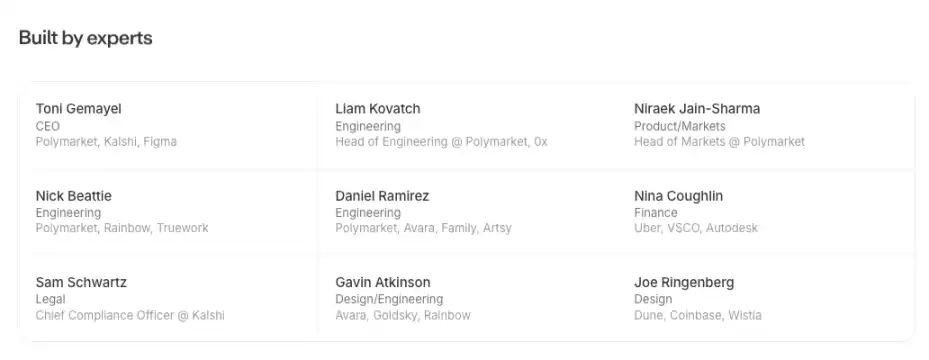
According to information on its official website, The Clearing Company's core team consists of several former executives and technical leads from Polymarket and Kalshi. The company's founder and CEO, Toni Gemayel, is a seasoned operator in the prediction market space. His resume shows he previously worked at both Polymarket and Kalshi as Head of Growth. Additionally, he has a work background at the design unicorn Figma.

Beyond this, The Clearing Company's core engineering team is primarily composed of early employees from Polymarket, while also incorporating some operations personnel from Kalshi.

· Liam Kovatch (Engineering): Former Head of Engineering at Polymarket;

· Niraek Jain-Sharma (Product/Markets): Former Head of Markets at Polymarket;

· Sam Schwartz: Former Chief Compliance Officer at Kalshi;

· Nick Beattie and Daniel Ramirez: These two engineers also hail from the Polymarket team and have experience in development at Raibow and Avara, among others.

A Coinbase spokesperson told The Block that the startup has about 10 employees, and nearly the entire team will join Coinbase as part of the deal.

Relatively speaking, although The Clearing Company is a latecomer, its starting capital far exceeds that of Polymarket and Kalshi in their early days. Comparing the seed round funding data of the three companies clearly shows the leap in the prediction market sector's valuation system over the past five years.
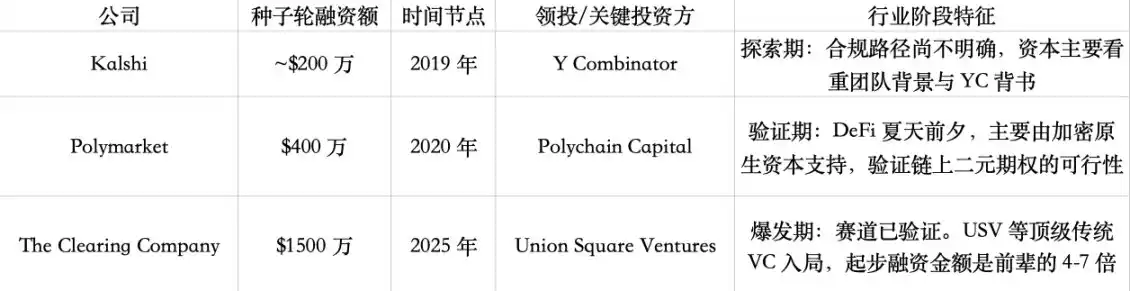
The Clearing Company completed a $15 million seed round led by Union Square Ventures even before its product launched. This amount is almost four times that of Polymarket's seed round at the time. This indicates that even before the Coinbase acquisition, the primary market had already tagged this hybrid-genes team with extremely high expectations.

Coinbase Launches Stock Trading and Prediction Market Services

At its System Update launch event on December 18, Coinbase announced a significant expansion of the range of assets tradable on its platform, including stock trading, prediction markets, new cryptocurrencies, and perpetual futures, among other new services, aiming to solidify its market positioning as an "all-in-one trading platform."

Coinbase will first launch trading services for hundreds of stocks based on market capitalization and trading volume, with plans to add thousands more stocks and ETFs in the coming months. Users can enjoy zero-commission trading, unrestricted by traditional market hours, available 24 hours a day, five days a week. Additionally, Coinbase has partnered with the $11 billion prediction market provider Kalshi, allowing users to trade on the outcomes of real-world events like elections, sports, collectibles, and economic indicators.

Simultaneously, Coinbase also launched the AI-driven wealth management tool Coinbase Advisor and the Coinbase Business service for startups, further expanding its business scope. Company executives stated that these new features will be supported by the Coinbase Tokenize platform, an end-to-end institutional-grade platform designed for tokenizing real-world assets.

Recently, Coinbase, Kalshi, Crypto.com, Robinhood, and Underdog jointly formed the Prediction Market Alliance (the Coalition for Prediction Markets). This national organization is dedicated to maintaining a safe, transparent, and federally regulated access environment for prediction markets.

Coinbase is gradually downplaying its label as a mere cryptocurrency trading platform. As Robinhood and Interactive Brokers venture into prediction markets, Coinbase must defend its territory. Having a native prediction product will complete its product matrix of spot, futures, and prediction markets, enabling users to perform a full suite of operations from buying Bitcoin to hedging macroeconomic risks within a single account.

The Next Stage of Competition in Prediction Markets

The acquisition of The Clearing Company is Coinbase's tenth announced acquisition in 2025. Deals completed earlier this year include Roam, Spindl, Iron Fish, Deribit, Opyn Markets, Liquifi, Sensible, Echo, and Vector.fun.

From the distribution partnership with Kalshi to acquiring the team and technology of The Clearing Company, Coinbase's path in the prediction market has become clear. First, validate demand and product form through partnerships, then internalize key capabilities through mergers and acquisitions, ultimately forming scalable long-term business lines.

Competition in prediction markets is shifting from who launches first to who can run compliantly and sustainably in the long term. By bringing people and technology into its system, Coinbase is clearly positioning itself early for the next stage of licensed, institutionalized competition.


Related Questions

QWhat did Coinbase announce on December 22nd, and what is the expected timeline for the deal?

ACoinbase announced it has reached an agreement to acquire The Clearing Company, with the transaction expected to be completed in January.

QWhich two major prediction market platforms do the core team members of The Clearing Company come from?

AThe core team members of The Clearing Company come from Polymarket and Kalshi.

QWhat was the amount of The Clearing Company's seed funding round, and which firm led it?

AThe Clearing Company completed a $15 million seed funding round led by Union Square Ventures.

QWhat new types of trading did Coinbase announce in its System Update on December 18th?

ACoinbase announced it would expand its platform to include stock trading, prediction markets, new cryptocurrencies, and perpetual futures.

QWhat is the name of the coalition formed by Coinbase, Kalshi, and others to advocate for prediction markets?

AThe coalition is named the Coalition for Prediction Markets.

Related Reads

Why Pricing Social Interactions is Doomed to Fail?

Titled "Why Putting a Price on Social Interaction Is Doomed to Fail," this article critiques attempts to monetize social networks directly through SocialFi models, arguing their inevitable failure stems from a fundamental misunderstanding of media dynamics. Using Marshall McLuhan's theory of "hot" and "cold" media, the author posits that social networks are inherently "cold" media. Their value isn't contained in individual posts but is co-created through user participation, interpretation, and fragmented, ongoing interaction (e.g., replies, shares). This ambiguity and need for user involvement are core to their function. The article asserts that SocialFi projects like Friend.tech failed because introducing real-time, tradable financial pricing (a definitive "hot" signal) into this "cold" environment doesn't add a layer—it replaces the medium's essence. The unambiguous price signal overshadows and nullifies the nuanced, participatory social signal. Users become traders, not participants, and when speculative profits vanish, the underlying social ecosystem—never genuinely cultivated—collapses entirely. This principle extends beyond crypto. The author argues platforms like Twitter have gradually "heated up" through metrics (likes, retweets counts, algorithmically defined value), shifting users from participants to performers and eroding organic engagement. The solution isn't to abandon capital but to manage its entry point. Successful models like Substack, Patreon, or Bandcamp allow capital to "condense" at specific, isolated nodes (e.g., subscriptions, one-time payments) without permeating and "heating" every social interaction. They preserve the core "cold," participatory medium while enabling monetization at designated boundaries. The NFT boom and bust serves as a stark parallel: the ancient "cold" medium of collecting (valued for story, community, gradual accumulation) was rapidly destroyed by platforms that introduced real-time floor prices, rarity scores, and trading dashboards, transforming collectors into speculators and vaporizing cultural value when prices fell. The core lesson: "Liquidity equals heat." Injecting high liquidity and definitive pricing into a "cold" participatory medium doesn't optimize it; it fundamentally alters and destroys its value-creating mechanism. The future lies not in pricing every social gesture but in finding precise, non-invasive points for capital to condense without overheating the entire ecosystem.

marsbit6m ago

Why Pricing Social Interactions is Doomed to Fail?

marsbit6m ago

Jensen Huang's CMU Speech: In the AI Era, Don't Just Watch, Build

Jensen Huang, CEO of NVIDIA and a first-generation immigrant, delivered the commencement address to Carnegie Mellon University's class of 2026. He shared his personal journey from a humble background to founding NVIDIA, emphasizing resilience, learning from failure, and the responsibility that comes with leadership. Huang framed the present moment as the dawn of the AI revolution, a shift he believes is more profound than previous computing waves. He described AI as fundamentally resetting computing—moving from human-written software to machines that understand, reason, and use tools. This will create a new industry for generating intelligence and transform every sector. While acknowledging AI's potential to automate tasks and displace some jobs, Huang distinguished between the *tasks* of a job and its core *purpose*. He argued AI will augment human capability, not replace humans. The real risk, he stated, is not AI itself, but people being left behind by those who effectively use AI. He presented AI as a generational opportunity for massive infrastructure investment—in chip factories, data centers, energy grids, and advanced manufacturing—that could re-industrialize nations like the U.S. and bridge the digital divide by making computing and intelligent tools accessible to all. Huang called for a balanced approach: advancing AI safely and responsibly, establishing prudent policies, ensuring broad access, and encouraging universal participation. He urged the graduates not to fear the future but to engage with optimism and ambition, reminding them of CMU's motto, "My heart is in the work." His core message was clear: this is their moment to actively build and shape the AI-powered future, not merely observe it.

marsbit1h ago

Jensen Huang's CMU Speech: In the AI Era, Don't Just Watch, Build

marsbit1h ago

The Era Has Arrived Where Human Writers Must Prove They Are Not Machines

The article describes an era where AI-generated content is flooding the market, forcing human authors to prove they are not machines. It begins with the example of dozens of AI-written, error-ridden biographies of Henry Kissinger appearing on Amazon within hours of his death, a pattern repeated for other deceased celebrities and even living experts who find fraudulent books under their names. This spam content has exploded, with monthly new book releases on platforms like Amazon reaching 300,000 by late 2025. The issue spans genres, from suspiciously high proportions of AI-written teen romance and self-help books to dangerous, AI-generated foraging guides containing lethal advice. The platforms' automated review systems, designed to catch plagiarism and banned words, are ill-equipped to detect AI-generated text that avoids these pitfalls while being nonsensical or fraudulent. The problem has infiltrated traditional publishing. A major publisher, Hachette, had to recall a bestselling horror novel after AI detection tools suggested 78% of its content was machine-generated. An acclaimed European philosophy book was later revealed to be entirely written by AI under a fake author persona. In response, authors are fighting back. At the 2026 London Book Fair, 10,000 writers published a blank book titled "Don't Steal This Book" containing only their signatures—using emptiness as a protest weapon in an age of AI overproduction. Initiatives like the "Human Author Certification" program have emerged, ironically placing the burden on humans to prove their work is not machine-made. The article warns of a vicious cycle: AI-generated low-quality books pollute the data used to train future AI models, leading to "model collapse" and an ever-worsening flood of digital waste, eroding trust in publishing and devaluing human creativity.

marsbit1h ago

The Era Has Arrived Where Human Writers Must Prove They Are Not Machines

marsbit1h ago

Trading

Spot
Futures
活动图片




