Ray Dalio Warns: History Is Repeating Itself, How Far Are We from Total Collapse?

marsbitPublished on 2026-01-27Last updated on 2026-01-27

Abstract

Ray Dalio warns that the U.S. and global order are nearing a full-scale collapse, transitioning from Stage 5 (pre-collapse) to Stage 6 (active collapse) of his "Big Cycle" framework. Key drivers include severe wealth inequality, unsustainable debt, and intense political polarization. Historical patterns—like the 1930–1945 period—show that such conditions often lead to internal conflict, revolution, or civil war. Dalio identifies classic markers of collapse: government financial stress, loss of truth in public discourse, rising populism, and the erosion of rule-based systems. The recent killings of ICE protesters in Minneapolis exemplify escalating violence and state-federal tensions, signaling potential movement toward civil conflict. He emphasizes that without collaborative, productivity-focused reforms—rather than divisive policies—the system risks irreversible breakdown. The path forward requires leaders who prioritize broad prosperity over partisan victory, but the current trajectory suggests increasing fragility and conflict.

Author: Ray Dalio

Compiled by: Deep Tide TechFlow

Deep Tide Introduction: Legendary investor Ray Dalio has issued a stern warning about the current global turmoil, combining it with his "Big Cycle" theory. He breaks down in detail how societies slide from the "fifth stage" of wealth inequality and fiscal bankruptcy into the conflict-ridden "sixth stage." This article is not only a summary of historical patterns but also a deep diagnosis of the current political and economic landscape in the United States and globally. By comparing it to the collapse of 1930-1945, Dalio points out dangerous signals such as the failure of rules, intensified polarization, and the loss of truth.

For me, observing what is happening now is like watching a movie I have seen many times in history. I am a global macro investor, and the way I bet on the future is by learning historical lessons to understand the underlying mechanisms of how things work. I have found that what is happening now has repeatedly occurred for the same reasons, and understanding the causality has been extremely helpful to me.

I am now at a stage in my life where I want to share these experiences that have helped me, rather than keeping them for personal gain. For this reason, in my book "Principles for Dealing with the Changing World Order," I described the typical sequence of events that lead to the rise and fall of monetary orders, domestic political orders, and international geopolitical orders. I call this series of events the "Big Cycle" because it is massive in scale and long in duration, typically lasting about 80 years (roughly a human lifespan).

The last time these orders collapsed was during the 1930-1945 period, which led to the post-1945 monetary, domestic political, and international geopolitical orders—the very ones we now see collapsing. My book comprehensively describes the symptoms that can be used to identify which stage of the "Big Cycle" we are in, as well as the forces driving the "Big Cycle." Most importantly, I detailed the processes and sequences of events that typically lead to the collapse of monetary, domestic political, and international geopolitical orders, so that people can compare the actual sequence of events with the template outlined.

For readers of the book, it should now be clear that we are on the brink of transitioning from Stage 5 (the pre-collapse phase of the existing order) to Stage 6 (the collapse of the existing order).

My original intention in writing that book was: 1) to help policymakers understand the process leading to collapse and prevent it; 2) to help people protect themselves from these collapses. I realized while doing this that my explanation might not substantially influence the trajectory. And indeed, it has not.

Nevertheless, since we are now clearly on the verge of crossing from Stage 5 (pre-collapse) to Stage 6 (collapse), and the choices made could have a huge impact on the outcome, I feel it is necessary to reiterate what I believe are the key dynamics underlying the current situation and to specify which choices lead to better or worse outcomes.

To illustrate this here, I will now briefly share the most relevant parts of what I wrote in "Principles for Dealing with the Changing World Order," particularly the key points about how Stage 5 (pre-collapse phase) leads to Stage 6 (collapse phase). This will allow you to compare the current situation with my "Big Cycle" template. To be clear, although the possibility of repairing the monetary order through the fiscal discipline needed for financial health is extremely slim, and the return of a rules-based domestic political and international geopolitical order—essential for peacefully resolving differences and democratic functioning—is doubtful, these improvements are still possible because we have not yet fully crossed the threshold from Stage 5 to Stage 6.

Below is an excerpt from the book depicting this picture. After sharing it, I will explain how what I wrote five years ago applies to the current situation (see "Where We Are Now" below).

"Stage 5: When Financial Conditions Are Bad and Conflict Is Intense"

"Since I comprehensively covered that cycle in Chapters 3 and 4, I won’t go into detail here. But to understand Stage 5, you need to know that it follows Stage 3 (peace and prosperity, good debt and credit conditions) and Stage 4 (excess and decadence begin to bring deteriorating conditions). This process peaks in the most difficult and painful stage—Stage 6—when the country runs out of money, and terrible conflict, usually in the form of revolution or civil war, occurs. Stage 5 is the period when interclass tensions, exacerbated by deteriorating financial conditions, reach a peak. How different leaders, policymakers, and populations handle the conflict has a significant impact on whether the country can make the necessary changes peacefully or violently."

"The Classic Toxic Combination"

"The classic toxic combination of forces that lead to major internal conflict consists of: 1) the country and its people (or state, city) being in poor financial condition (e.g., having huge debt and non-debt obligations), 2) huge income, wealth, and value gaps within that entity, and 3) a severe negative economic shock." "This convergence typically leads to chaos, conflict, and sometimes civil war."

"To have peace and prosperity, a society must have productivity that benefits the majority.

The average level is not as important as the proportion of people suffering and their power." In other words, when there is no widespread productivity and prosperity, risks rise.

One key element of success is that the debt and money created are used to generate productivity improvements and favorable investment returns, rather than being simply distributed without generating productivity and income growth. If they are just distributed without generating these returns, the currency will depreciate to the point where the government or anyone else loses purchasing power.

History shows that using loans and spending for projects that generate widespread productivity improvements and investment returns (with returns exceeding borrowing costs) leads to rising living standards and debt repayment, so these are good policies."

"History shows and logic proves that good investments in education at all levels (including vocational training), infrastructure, and research that yields productive discoveries are highly effective. For example, large-scale education and infrastructure plans almost always pay off (e.g., in the Tang Dynasty and many other Chinese dynasties, the Roman Empire, the Umayyad Caliphate, India’s Mughal Empire, Japan’s Meiji Restoration, and China’s education development plans in recent decades), although they take a long time to show results. In fact, improvements in education and infrastructure, even those financed by debt, are almost always components of the rise of empires, and the decline in the quality of these investments is almost always a component of their fall. If done well, these interventions can counteract the classic toxic combination." In Stage 5, this does not happen.

All of this makes the economy more vulnerable to economic shocks. "Economic shocks can arise for various reasons, including financial bubbles bursting, natural disasters (such as pandemics, droughts, and floods), and wars. It creates a stress test. The financial condition at the time of the stress test (measured by income relative to expenditures, assets relative to liabilities) is the shock absorber. The size of income, wealth, and value gaps is the best indicator of the system’s fragility."

"When financial problems occur, they typically hit the private sector first, then the public sector. Because the government never lets private-sector financial problems bring down the entire system, the government’s financial condition is most important. When the government loses purchasing power, collapse occurs. But on the road to collapse, there is a lot of fighting over money and political power."

"From the study of over 50 civil wars and revolutions, it is clear that the single most reliable leading indicator of civil war or revolution is bankrupt government finances combined with huge wealth gaps. This is because when the government lacks financial strength, it cannot financially rescue the private entities it needs to save to keep the system running (as most governments, led by the U.S., did in late 2008), it cannot buy what it needs, and it cannot pay people to do what it needs them to do. It loses power."

"A classic marker of being in Stage 5, and a leading indicator of losing the ability to borrow and spend (which is one of the triggers for entering Stage 6), is when the government has huge deficits that create more debt than buyers other than its own central bank are willing to purchase. When a government that cannot print money has to raise taxes and cut spending, or when a government that can print money prints a lot of money and buys a lot of government debt, this leading indicator is activated. More specifically, when the government runs out of money (through huge deficits, massive debt, and inability to obtain sufficient credit), its options are very limited. It either significantly raises taxes and cuts spending, or prints a lot of money, which devalues it. Governments that have the power to print money always do so because it is a much less painful path, but it causes investors to flee the currency and debt being printed. Governments that cannot print money must raise taxes and cut spending, which causes the wealthy to flee the country (or state, city) because paying more taxes and losing services is unbearable. If these non-money-printing entities have huge wealth gaps among their constituents, these moves typically lead to some form of civil war/revolution."

"Those places (cities, states, and countries) with the largest wealth gaps, the largest debts, and the most severe income declines are most likely to experience the most intense conflict. Interestingly, in the U.S., the states and cities with the highest per capita income and wealth levels also tend to be the ones with the heaviest debt burdens and the largest wealth gaps—cities like San Francisco, Chicago, and New York City, and states like Connecticut, Illinois, Massachusetts, New York, and New Jersey."

"Faced with these conditions, spending must be cut, or more money must be raised in some way. The next question becomes: who pays for fixing these problems, the 'haves' or the 'have-nots'? Obviously, it can’t be the have-nots. Spending cuts are most unbearable for the poorest, so more taxes must be levied on those who can afford to pay more, which increases the risk of some form of civil war or revolution. But when the haves realize they will be taxed to pay for debt repayment and deficit reduction, they typically choose to leave, leading to a 'hollowing-out' process. This is exactly what is driving migration between U.S. states now. If economic conditions worsen, this will accelerate the process. These circumstances largely drive the tax cycle."

"History shows that raising taxes and cutting spending in the presence of huge wealth gaps and bad economic conditions is a leading indicator of some type of civil war or revolution more than any other factor."

"Populism and Extremism"

"Amid chaos and discontent, strong-willed, anti-elite leaders who claim to fight for the common people emerge. They are called populists. Populism is a political and social phenomenon that appeals to ordinary people who feel their concerns are ignored by the elite. It typically develops when there are wealth and opportunity gaps, perceived cultural threats from different values domestically and internationally, and 'establishment elites' in high positions failing to work effectively for the majority. When these conditions provoke anger among ordinary people, prompting them to want fighters with political power to battle for them, populists come to power.

Populists can be right-wing or left-wing, and they are much more extreme than moderates, tending to appeal to the emotions of ordinary people. They are usually confrontational rather than collaborative, and exclusive rather than inclusive. This leads to intense struggles between left-wing populists and right-wing populists over irreconcilable differences. The degree of revolutionary extremism under their leadership varies. For example, in the 1930s, left-wing populism took the form of communism, the right-wing took the form of fascism, while the U.S. and U.K. experienced non-violent revolutionary changes. Additionally, four democracies turned into autocracies.

Recently, in the U.S., Donald Trump’s election in 2016 was a shift toward right-wing populism, while the popularity of Bernie Sanders, Elizabeth Warren, and Alexandria Ocasio-Cortez reflected the rise of left-wing populism. In many countries, political movements leaning toward populism are increasing."

"Observe populism and polarization as markers. The higher the populism and polarization, the further a country has progressed in Stage 5, and the closer it is to civil war and revolution. In Stage 5, moderates become a minority. In Stage 6, they cease to exist."

"Class Struggle"

"In Stage 5, class struggle intensifies. This is because, as a rule, during difficult and conflict-ridden times, people increasingly tend to view others in stereotypical ways as members of one or more classes and see these classes as enemies or allies. In Stage 5, this becomes more apparent. In Stage 6, it becomes dangerous."

"A classic marker of Stage 5 that intensifies in Stage 6 is the demonization of people from other classes, which often produces one or more 'scapegoat' classes that are widely seen as the root of the problem. This leads to a drive to ostracize, imprison, or destroy them, which happens in Stage 6. Ethnic, racial, and socioeconomic groups are often demonized. The most classic and horrific example of this is the Nazi treatment of Jews, who were blamed and persecuted for almost all of Germany’s problems.

Chinese minorities in non-China countries have also been demonized and scapegoated during periods of economic and social stress. In the U.K., Catholics were demonized and scapegoated during many stressful periods, such as the Glorious Revolution and the English Civil War. Wealthy capitalists are often demonized, especially those seen as profiting at the expense of the poor. Demonization and scapegoating are a typical symptom and problem we must watch closely."

"Loss of Truth in the Public Domain"

"As people become more polarized, emotional, and politically motivated, not knowing what is true due to media distortion and propaganda increases."

"In Stage 5, those engaged in the struggle typically work with the media to manipulate people’s emotions to gain support and destroy opponents. In other words, left-wing media people join the left-wing camp, and right-wing media people join the right-wing camp, participating in this dirty fight. The media becomes like vigilantes: people are often attacked in the media and essentially tried and convicted, their lives ruined without a judge and jury.

A common move by both left-wing (communist) and right-wing (fascist) populists in the 1930s was to control the media and appoint 'ministers of propaganda' to guide them. The media they produced was explicitly designed to turn the populace against groups the government considered 'enemies of the state.' The democratic U.K. government established a 'Ministry of Information' during World War I and II to spread government propaganda, and major newspaper publishers were promoted by the government if they cooperated in winning the propaganda war, or vilified and punished if they did not.

Revolutionaries did the same truth-twisting in various publications. During the French Revolution, revolutionary-run newspapers promoted anti-monarchy and anti-religious sentiments, but when these revolutionaries gained power, they shut down dissenting newspapers during the 'Reign of Terror.' During periods of huge wealth gaps and populism, stories attacking elites are often popular and profitable, especially those attacking left-wing elites in right-leaning media and right-wing elites in left-leaning media. History shows that a significant increase in these activities is a typical problem in Stage 5, and when combined with the ability to impose other penalties, the media becomes a powerful weapon."

"Rule-Following Fades, Primitive Fighting Begins"

"When a cause that people are passionate about becomes more important to them than the decision-making system, that system is in danger. Rules and laws only work if they are very clear and most people value them enough to compromise within them to make them function well."

"If neither is ideal, the legal system is precarious. If competing parties are unwilling to try to remain rational and pursue the overall well-being in a civilized manner—which requires them to give up some things they want and might win in a fight—then a civil war testing the relative strength of the parties emerges. In this stage, winning at all costs is the rule, and dirty tactics are the norm. In the later part of Stage 5, reason is replaced by passion."

"When winning becomes the only thing that matters, unethical fighting becomes increasingly powerful in a self-reinforcing way. When everyone has a cause to fight for and no one can agree, the system is on the brink of civil war or revolution."

"This usually happens in several ways: in the later part of Stage 5, the legal and police systems are often used as political weapons by those who can control them. Additionally, private police systems form—for example, thugs who beat people up and seize their assets, and bodyguards who protect people from such events. For instance, the Nazi Party established a paramilitary wing before coming to power, which became an official force after the party took power. The British Union of Fascists, which existed briefly in the 1930s, and the Ku Klux Klan in the U.S. were essentially paramilitary organizations. Such cases are so normal that their development should be seen as a marker of entering the next stage."

"In the later part of Stage 5, protests become more frequent and increasingly violent. Because there is not always a clear line between healthy protest and the start of a revolution, those in power often struggle with how to allow protest while not giving people the perceived freedom to rebel against the system. Leaders must handle these situations properly. When demonstrations begin to cross over into revolution, a classic dilemma arises. Allowing protest freedom and suppressing protest are both risky paths for leaders, as either path can lead to revolutionary forces becoming strong enough to overthrow the system.

No system allows people to overthrow the system—in most systems, such attempts are treason, usually punishable by death. Nevertheless, the job of revolutionaries is to overthrow the system, so the government and revolutionaries test each other’s limits. When widespread discontent simmers and those in power let it grow, it may boil to a point where when they try to cap it, it explodes. Conflicts in the later part of Stage 5 usually build to a climax, triggering violent fighting, which marks the entry into the period historians label as formal civil war, which I define as Stage 6 in the 'Big Cycle.'"

"Deaths in fighting are a marker that almost certainly signals entry into the next, more violent civil war stage, which will continue until victory and defeat are clear."

"This leads to my next principle: When in doubt, get out—if you don’t want to be caught in a civil war or war, you should leave while conditions are still good." "This usually happens in the later part of Stage 5. History shows that when conditions turn bad, people want to move to places where conditions are not as bad or are better, and for those who want to leave, the gates usually close. The same is true for investments and money, as countries introduce capital controls and other measures during such times."

"The transition from Stage 5 (very poor financial conditions and intense internal and external conflict) to Stage 6 (civil war) occurs when the system for resolving differences shifts from functioning to not functioning. In other words, it happens when the system breaks down to the point of being irreparable, people inflict violence on each other, and leadership loses control."

"When one is in Stage 5 (like the U.S. now), the biggest question is how much bending the system can withstand before breaking." "Democratic systems allow the people to do almost anything they decide, which produces more bending because people can change leadership and have only themselves to blame. Democratic systems have also been shown to break down when there is great conflict. Democracy requires consensus decision-making and compromise, which requires a lot of people with opposing views to cooperate well within the system. This ensures that parties with significant voter bases are represented, but like all large committees with widely different views (who may even dislike each other), the decision-making system is not efficient."

Over 2,000 years ago, Plato’s "Republic" described excellently how democratic systems break down; it can be used as a commentary describing what is happening now, so this is not new.

"The biggest risk to democracies is that they produce decisions that are so fragmented and adversarial that they are inefficient, leading to poor outcomes, which in turn trigger revolutions led by populist autocrats who represent the majority of people wanting a strong and capable leader to control the chaos and run the country well for them."

"Another point worth noting: history shows that during times of great conflict, federalist democracies (like the U.S.) typically experience conflicts between states and the central government over their relative powers. This is a marker to watch for, and it has not yet appeared in large quantities in the U.S.; once it does, it will mark continued evolution toward Stage 6." Clearly, by 2026, this is happening and may intensify.

"Stage 5 is a fork in the road, where one path can lead to civil war or revolution, and the other can lead to peaceful, and ideally prosperous, coexistence. Obviously, the path of peace and prosperity is the ideal path, but also the most difficult to achieve. This path requires a strong leader who can inspire the majority 'rather than divide them' and get them to do the hard things to correct the problems and make the country strong again. These leaders, whom Plato called 'benevolent despots,' bring opposing sides together to do the hard work necessary to reshape the order so that it operates in a way that most people consider fair (i.e., in a highly productive way that benefits the majority). There are very few such cases in history. The second type is the 'strong fighter,' who leads the country through the hell of civil war or revolution."

Stage 6: The Civil War Period

"Civil wars are inevitable, so rather than assuming 'it can’t happen here'—an assumption most people in countries that have gone a long time without civil war have—it is better to be vigilant about them and look for markers indicating how close they are."

"While there are countless examples to understand how they operate, I selected 29 that I consider most important, as shown in the table below. I divided this set of cases into those that led to big changes to the system/regime and those that did not. For example, the U.S. Civil War was a very bloody civil war, but it did not overthrow the existing system or order, so it is in the second group at the bottom of the table; those that overthrew the system or order are at the top. These classifications are, of course, imprecise, but again, we won’t let imprecision prevent us from seeing what we couldn’t see if we insisted on precision. Most (though not all) of these conflicts occurred in the prototypical way described in this section."
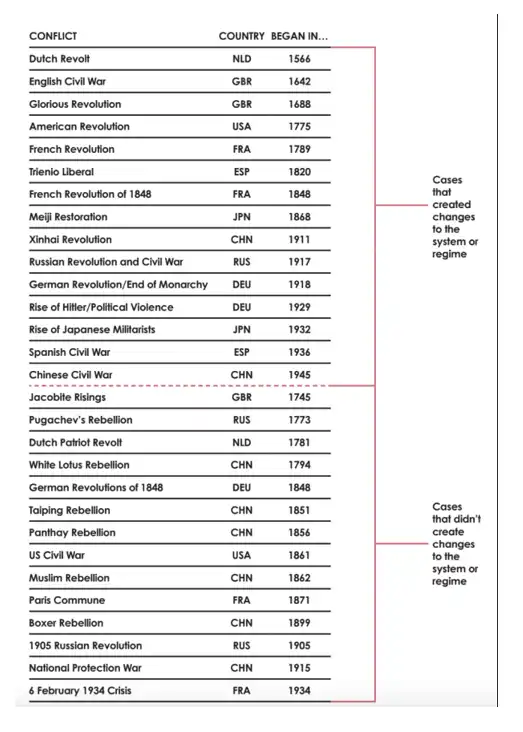
Caption: List of case studies of major conflicts that led to changes in order in history

"A classic example of civil war destroying the system and having to build a new one is the 1917 Russian Revolution and civil war. This established the communist internal order, which eventually entered Stage 5 in the late 1980s and led to its attempt at revolutionary change within the system—the so-called 'perestroika' (restructuring)—which failed, followed by the collapse of the Soviet order in 1991. The communist domestic order lasted 74 years (from 1917 to 1991). This order was replaced by the new system or order that now rules Russia, which was established in the classic way I explained earlier in describing Stages 1 and 2 after the old order collapsed."

"Another case is Japan’s Meiji Restoration, which resulted from a revolution that lasted three years (1866–69). This revolution occurred because Japan at the time had a closed-door policy toward the outside world and failed to make progress. Americans forced Japan to open up, prompting a revolutionary group to challenge and defeat the rulers (led by the military shogun) in battle, leading to the overthrow of the Japanese internal order then operated by four classes—samurai, farmers, artisans, and merchants.

This old Japanese order run by traditionalists was extremely conservative (e.g., social mobility was illegal), and it was replaced by relatively progressive revolutionaries who changed everything by restoring the power of the modernizing emperor. In the early part of this period, triggered by the classic wealth gap and poor economic conditions, there were many labor disputes, strikes, and riots. During the reform process, the leadership provided universal primary education for boys and girls, adopted capitalism, and opened the country to the outside world. They did this using new technology, which made them very competitive and brought wealth."

"There are many such cases, some where the right things were done to produce revolutionary beneficial improvements, just as there are many revolutionaries who did the wrong things, bringing decades of terrible suffering to their people. By the way, due to its reforms, Japan went on to complete the classic stages of the 'Big Cycle.' It became extremely successful and wealthy. But over time, it became decadent, overextended, and fragmented, experienced the Great Depression, and fought expensive wars, all of which led to a classic demise. Its Meiji order and its classic 'Big Cycle' lasted 76 years from 1869 to 1945."

"Civil wars and revolutions inevitably occur to thoroughly change the internal order."

"They involve total restructurings of wealth and political power, which include complete reshapings of debt and financial ownership, as well as overhauls of political decision-making mechanisms. These changes are the natural result of the need for huge changes that cannot be achieved within the existing system. Almost all systems encounter them. That is because almost all systems sacrifice the interests of certain classes to benefit others, which eventually becomes intolerable, leading to fighting to determine the way forward.

When wealth and value gaps become very large, and then poor economic conditions occur, causing the system to not work for a large portion of the people, people fight to change the system. Those who suffer most economically fight to seize more wealth and power from those who have wealth, power, and benefit from the existing system. Revolutionaries naturally want to completely change the system, so they are naturally willing to break the laws that those in power require them to obey. These revolutionary changes usually occur violently through civil war, although, as mentioned before, they can also be achieved peacefully without overthrowing the system."

"Civil war periods are usually very brutal. Often, early in these wars, the power struggles are strong and orderly, but as fighting and emotions intensify, and as parties do whatever it takes to win, brutality accelerates unexpectedly. To the extent that the actual brutality that occurs in Stage 6 civil wars and revolutions would be considered impossible in Stage 5. Elites and moderates usually flee, are imprisoned, or are killed. Reading stories of civil wars and revolutions, such as the Spanish Civil War, the Chinese Civil War, the Russian Revolution, and the French Revolution, sends chills down my spine."

"How do they happen? Earlier I described the Stage 5 dynamics that lead to crossing the line into Stage 6. In this stage, all these factors intensify greatly. I will explain."

"How Civil Wars and Revolutions Happen"

"As described before, the cycle of creating wealth and wealth gaps leads to a very small number of people controlling a very high proportion of wealth, eventually causing the poor majority to overthrow the wealthy minority through civil war and revolution. This has happened more times than one can imagine."

"Although most typical civil wars and revolutions shift power from the right to the left, there are also many that shift wealth and power to the right, away from the left. However, the latter are fewer and different. They usually occur when the existing order slides into dysfunctional anarchies, and most of the population longs for strong leadership, discipline, and productivity.

Examples of revolutions shifting from left to right include Germany, Spain, Japan, and Italy in the 1930s; the collapse of the Soviet Union in the late 1980s to early 1990s; the 1976 coup in Argentina that replaced Isabel Perón with a military junta; and the coup that led to the Second French Empire in 1851. All these cases I studied succeeded or failed for the same reasons. Like left-wing revolutions, these new internal orders succeeded when they could generate widespread economic success and failed when they did not. Because widespread economic prosperity is the biggest reason for the success or failure of new regimes, the long-term trend has been an increase in total wealth and a broadening of wealth distribution (i.e., improvement in the economic and health conditions of ordinary people). This macro vision is easily lost when one is in a stage of the big cycle and experiencing it firsthand."

"Usually, the people who lead civil wars or revolutions were (and are) well-educated people with middle-class backgrounds. For example, the three key revolutionary leaders of the French Revolution were: Georges-Jacques Danton, a lawyer raised in a bourgeois family; Jean-Paul Marat, a doctor; and Maximilien Robespierre, also a lawyer.

Leaders of the Russian Revolution included Vladimir Lenin, who came from a middle-class educated family, his father being a senior civil servant; and Leon Trotsky, who came from a wealthy peasant family. Leaders of the Chinese Communist Revolution included Mao Zedong, who came from a wealthy peasant family; and Zhou Enlai, who came from a scholar-official family. Fidel Castro came from a very wealthy plantation owner family and began his political activities while studying law. The officers who led Japan to right-wing populism and fascism in the 1930s were mostly from the middle class. As these examples show, leaders are usually not from the poor classes but from those with the knowledge, vision, and ability to organize the masses."

"These leaders are also usually charismatic, able to work well with others and build strong, well-functioning organizations, giving them the power to launch revolutions. If you want to look for future revolutionaries, look for people with these qualities. Over time, they usually evolve from idealistic intellectuals who want to make the system fairer into brutal revolutionaries who pursue victory at any cost."

"Although huge wealth gaps during economically difficult times are usually the biggest source of conflict, there are always other causes of conflict that accumulate to form a huge opposing force against the leadership and the system. Often in revolutions, revolutionaries with different demands unite to push for revolutionary change; although they appear united during the revolution, they usually fight each other over specific issues and power after winning the revolution."

"As mentioned before, in the civil war/revolution stage of the cycle, the ruling government almost always faces severe shortages of money, credit, and purchasing power. This shortage creates a desire to seize money from the wealthy, which causes those with wealth to move assets to safe places and assets, leading the government to implement capital controls—i.e., restrictions on transfers to other jurisdictions (such as other countries), other currencies, or assets that are harder to tax and/or less productive (like gold)."

"Worse, when there is internal turmoil, external enemies are more likely to challenge the country. This is because the vulnerability caused by internal conflict makes external war more likely. Internal conflict divides the people, consumes them financially, and distracts the leadership from other matters—all of which create conditions for foreign powers to exploit the vulnerability. This is a major reason why civil wars and external wars often follow one another.

Other reasons include: emotions and tempers become heightened; the strong populist leaders who come to power at this time are natural fighters; when there is internal conflict, leaders find that a perceived external enemy threat can unite the country behind them, so they tend to encourage conflict; also, scarcity makes people/countries more willing to fight for the resources they need (including those owned by other countries)."

"Almost all civil wars have some foreign involvement, trying to influence the outcome for their own benefit."

"The start of civil wars and revolutions is not clear when it happens, although it is obvious when you are in the midst of them."

"Although historians set dates for the start and end of civil wars, these dates are artificially set. The fact is, at the time, almost no one knew the civil war had started or ended, but they knew they were in it. For example, many historians date the start of the French Revolution to July 14, 1789, because that’s when a mob attacked the Bastille armory and prison. But at the time, no one thought that was the start of the French Revolution, nor did they know how terrifying and brutal that civil war and revolution would become. Although people may not know what the future holds, there are some vague markers that can help locate the stage one is in, see the direction of movement, and have some idea of what the next stage will look like."

"Civil wars are extremely brutal because they are fights to the death. Everyone is an extremist because everyone is forced to choose sides and fight—moreover, in close combat, moderates always lose."

"As for what kind of leader is best suited for civil war and revolution, it is 'inspirational generals'—those strong enough to rally support and win the various battles that must be won. Because fighting is brutal, they must be cruel enough to do whatever it takes to win."

"The civil war period marked by historians usually lasts a few years and decides the formal victory and defeat, which is usually reflected in who can occupy the government buildings in the capital. But like the start, the end of civil war/revolution is not as clear as historians convey. After the formal civil war ends, fighting to consolidate power can last a long time."

"Although civil wars and revolutions are usually extremely painful, they often lead to restructuring that, if handled properly, can lay the foundation for improved future outcomes. The future after civil war/revolution depends on how the next steps are handled."

Current Situation: Minneapolis and the U.S. on a Powder Keg

Let’s now focus on the major events of the past few days: the killing of a second Immigration and Customs Enforcement (ICE) protester in Minneapolis. Two classic markers of transitioning from Stage 5 to Stage 6 seem to be happening:

  1. "Deaths in fighting are a marker that almost certainly signals entry into the next, more violent civil war stage, which will continue until victory and defeat are clear."
  2. "History shows that during times of great conflict, federalist democracies (like the U.S.) typically experience conflicts between states and the central government over their relative powers."

The U.S. is now a powder keg. According to the latest PBS News/NPR/Marist poll, nearly one-third (30%) of Americans say that to get the country back on track, people may have to resort to violence. Pew Research Center (September-October 2025) found that 85% of U.S. adults acknowledge that politically motivated violence is increasing in the U.S.

An analysis by the Center for Strategic and International Studies (CSIS) found that from 2016 to 2024, there were 21 partisan political attacks or plots, compared to just two such incidents in the more than 25 years before 2016. This means that in a relatively short period, politically motivated plots/attacks increased about tenfold. There are more guns than people in the U.S., and many are inclined toward violence.

There is no doubt that the conflict between the central government and Minnesota (and other state governments) is very serious and looks likely to worsen. The world has seen the killings of two opponents of Trump’s ICE program in Minneapolis and is watching to see which side will back down. Many are waiting to see whether President Trump will continue to fight—which I believe risks pushing us closer to the edge of clearer civil war—or whether he will try to pull us back from the brink by calling for peace, promising and proving that the justice system will handle the shootings properly, and cutting back on ICE activities. (In an interview with The Wall Street Journal, he said the government would review the killings and stated that ICE would not stay in Minneapolis forever.)

Although his choices will have a huge impact on what happens next (including potentially igniting the powder keg), regardless, it is important to view everything happening in the context of all the forces and events driving the "Big Cycle." Whatever the outcome of the Minneapolis case, these are the major forces evolving and determining how the "Big Cycle" progresses.

Conclusion (Excerpt from "Principles for Dealing with the Changing World Order")

"My study of history tells me that nothing is eternal except evolution. In evolution, there are cycles that ebb and flow like tides, and these cycles are difficult to change or oppose. To properly deal with these changes, one must understand which stage of the cycle one is in and master the eternal and universal principles for dealing with it.

As conditions change, the best way to respond changes—that is, what is best depends on the environment, and the environment is always changing in the ways we just saw. Therefore, it is a mistake to rigidly believe that any economic or political system is forever the best. Because there will certainly be times when that system is not suited to the environment; if a society does not adjust, it will die.

That is why constantly reforming the system to adapt to the environment is the best choice. The test standard for any system is simple: see how well it delivers what most people want, which can be measured objectively, and we are and will continue to do so.

That said, the loudest and clearest lesson history brings us is: it is far more valuable and much less painful to produce efficient win-win relationships through skilled collaboration, grow the pie and divide it well, making most people feel happy, than to engage in civil war over wealth and power, leading to one side enslaving the other."


Related Questions

QAccording to Ray Dalio's 'Big Cycle' theory, what are the classic toxic combinations that lead to major internal conflicts?

AThe classic toxic combinations are: 1) The entity (nation or its people) is in bad financial shape with huge debt and non-debt obligations, 2) There are huge income, wealth, and values gaps within the entity, and 3) A severe negative economic shock occurs.

QWhat does Ray Dalio identify as the single most reliable leading indicator of civil war or revolution?

AThe single most reliable leading indicator is bankrupt government finances combined with large wealth gaps.

QWhat are the two classic markers that Ray Dalio points to in the Minneapolis events that signal a potential shift from Stage 5 to Stage 6?

AThe two classic markers are: 1) Deaths in fighting, which almost certainly marks the entry into a more violent civil war stage, and 2) Conflict between state governments (like Minnesota) and the federal government over their relative powers.

QIn the context of Stage 5, what is populism and what drives its rise according to Dalio?

APopulism is a political and social phenomenon that appeals to ordinary people who feel their concerns are disregarded by established elites. It typically develops when there are wealth and opportunity gaps, perceived cultural threats from different values domestically and abroad, and 'establishment elites' in high positions fail to work effectively for most people.

QWhat is the biggest risk to democracies during periods of great conflict, as described by Ray Dalio?

AThe biggest risk to democracies is that they produce decisions that are so fragmented and adversarial that they are inefficient, leading to bad outcomes. This, in turn, can provoke revolutions led by populist autocrats who represent a large part of the population desiring a strong, capable leader to control the chaos and run the country well for them.

Related Reads

Trading

Spot
Futures

Hot Articles

What is LINON

Linde plc Tokenized Stock (Ondo): Revolutionizing Traditional Equity Access Through Blockchain Innovation The emergence of Linde plc Tokenized Stock (Ondo), represented by the ticker $LINON, signifies a monumental shift in the fusion of traditional financial structures and decentralized finance (DeFi). This innovative financial instrument showcases the tremendous potential of blockchain technology to democratize access to traditional equity markets while ensuring the security and regulatory compliance necessary for institutional-grade financial products. Through Ondo Finance's pioneering tokenization platform, $LINON provides a seamless pathway for global investors to engage with one of the world's leading industrial gas companies, Linde plc, creating a blockchain-native representation of the underlying equity. Introduction to Linde plc Tokenized Stock The landscape of financial markets is witnessing a groundbreaking transformation through the tokenization of real-world assets. Linde plc Tokenized Stock (Ondo) epitomizes this revolutionary approach by bridging the gap between conventional stock ownership and blockchain-enabled financial infrastructure. The $LINON token allows investors to gain exposure to one of the prominent industrial companies worldwide through decentralized technology. Operating within Ondo Finance's comprehensive ecosystem, $LINON symbolizes a practical application of tokenization technology that enhances accessibility, efficiency, and global connectivity in traditional financial markets. By leveraging blockchain infrastructure, this tokenized stock enables international investors to participate in U.S. equity markets, overcoming traditional barriers associated with cross-border investing. The significance of $LINON goes beyond technological innovation; it represents a fundamental shift in asset structuring, distribution, and trading in the digital age. This tokenized stock maintains all the economic benefits associated with traditional Linde plc shares while offering improved liquidity, programmable compliance features, and seamless integration with decentralized finance protocols. The development of $LINON indicates a growing acceptance of blockchain technology as a viable means for traditional finance, exemplifying how even well-established assets like Linde plc can integrate into blockchain systems. This approach preserves the core attributes that appeal to investors while introducing advanced capabilities that enhance the overall investment proposition. Project Overview and Objectives Linde plc Tokenized Stock (Ondo) encapsulates a strategic effort to democratize access to traditional equity markets through advanced blockchain technologies. The primary objective of $LINON is to provide approved global investors seamless access to the economic exposure associated with Linde plc shares, furthering an effort to create a more inclusive financial ecosystem. Beyond the digital representation of traditional assets, $LINON endeavors to eliminate barriers of geography and time zones that limit investor participation. Its design ensures that blockchain technology can elevate traditional investment vehicles without undermining the security or compliance requirements expected by investors. Key goals of the project include enhanced liquidity provision, programmable compliance mechanisms, and interoperability with other blockchain networks. Each $LINON token is fortified by actual Linde plc securities housed at U.S.-registered broker-dealers, allowing holders to reap economic advantages akin to traditional stockholders, such as dividend reinvestment. Furthermore, $LINON aims to establish new industry standards for institutional-grade tokenized securities, paving the way for traditional assets to embrace blockchain technology while remaining compliant with regulatory frameworks. By associating itself with a company as reputable as Linde plc, the project opens avenues for exploring tokenized equities catering to both conservative institutional players and daring retail investors. Project Creator and Development Team The vision for Linde plc Tokenized Stock (Ondo) comes from Nathan Allman, founder and CEO of Ondo Finance. His background in traditional finance coupled with expertise in blockchain technology positions him uniquely to navigate the complexities of asset tokenization. Allman's academic journey began at Brown University, focusing on Economics and Biology, equipping him with valuable analytical skills. His time at Goldman Sachs in the Digital Assets division strengthened his understanding of the interplay between financial institutions and emerging technologies, laying the groundwork for his later endeavors in alternative investment strategies. Under Allman's guidance, Ondo Finance has emerged as a leader in asset tokenization, launching $LINON as a flagship example of the company's larger mission towards revolutionizing traditional financial systems using blockchain technology. His commitment to leveraging blockchain for creating institutional-grade financial products has shaped the landscape of real-world asset tokenization. Investment and Funding Structure The growth of Ondo Finance, the platform powering Linde plc Tokenized Stock (Ondo), is bolstered by robust financial backing from prestigious venture capital firms and strategic investors. This strong investment foundation underpins the development of the key infrastructure essential for compliant tokenized securities like $LINON. In August 2021, Ondo Finance secured $4 million in seed funding led by a major venture capital firm, which enabled the company to commence platform development and establish the necessary regulatory processes for tokenizing real-world assets. This early investment cemented Ondo Finance's credibility within the industry. The Series A funding round followed, garnering $20 million with participation from renowned firms committed to transformative technology companies. This backing demonstrated substantial institutional confidence in Ondo Finance's vision, allowing it to hone its approach to asset tokenization through mechanisms that ensure compliance and accessibility. Noteworthy contributors, including institutional investors and experienced partners, have added significant value to Ondo Finance’s development efforts. Their involvement underscores the confidence across sectors in Ondo Finance's approach to bridging traditional finance with blockchain innovations. Technical Infrastructure and Innovation The technical architecture that underpins Linde plc Tokenized Stock (Ondo) represents a sophisticated melding of traditional finance systems and cutting-edge blockchain technology. The architecture's foundation is built on the Ethereum network, renowned for its security and programmability—both critical for intricate financial instruments. The $LINON tokenization process comprises creating a blockchain-native representation of Linde plc shares that preserves economic benefits while augmenting investor capabilities. Each token corresponds to actual shares held at U.S.-registered broker-dealers, creating a compliant custody structure that legitimizes the asset's existence and value. Automated compliance systems are integrated into the tokenization process, managing critical components such as know-your-customer (KYC) verification and anti-money laundering (AML) protocols. This incorporation of programmable compliance empowers $LINON to uphold regulatory standards essential for institutional proliferation. Cross-chain interoperability characterizes the advanced technical features of $LINON. While initially deployed on Ethereum, the framework is designed for expansion to other networks such as Solana and BNB Chain. This adaptability enhances liquidity and accessibility, allowing investors to select their preferred blockchain ecosystems. Historical Timeline and Development Crafting the history of Linde plc Tokenized Stock (Ondo) unfolds in parallel with the evolution of Ondo Finance's tokenization platform. The timeline's inception dates back to March 2021 when Nathan Allman laid the foundations for creating institutional-grade financial products on blockchain infrastructure. The initial funding round in August 2021 provided crucial resources for developing the platform and establishing partnerships necessary for effective tokenization. By January 2023, Ondo Finance launched its tokenized treasury products, establishing mechanisms that would facilitate future tokenized equities such as $LINON. A pivotal milestone arose in February 2025 when Ondo Chain—a Layer 1 blockchain designed specifically for asset tokenization—was introduced. This infrastructure enhances capabilities vital for institutional markets, demonstrating Ondo Finance's long-term commitment to tokenization. Subsequently, the launch of Ondo Global Markets in September 2025 marked the official debut of $LINON. This milestone showcased the successful transition from development to active trading, enabling investors around the world to access American financial markets seamlessly. Ongoing development plans include a targeted expansion of available tokenized assets to over 1,000 by the end of 2025, pointing to a bright future for Ondo Finance's ecosystem and its mission to broaden tokenized equity accessibility. Regulatory Compliance and Legal Framework The legal architecture governing Linde plc Tokenized Stock (Ondo) emphasizes a sophisticated approach to regulatory compliance, allowing tokenized securities to be implemented within a blockchain-based framework. The legal structure governing $LINON spans multiple jurisdictions while maintaining a robust legal footing. Compliance systems ensure that only eligible investors can access the token, enforced through automated verification that aligns with international regulations. This innovative regulatory technology promises real-time enforcement of complex requirements, considerably enhancing efficiency in operating within the regulatory landscape. The custody framework undergirding $LINON ensures that the underlying shares are securely held at U.S.-registered broker-dealers, complying with necessary regulations while delivering blockchain-driven access to investors. The token maintains its economic equivalency and security through this carefully structured custody arrangement. KYC and AML compliance systems are embedded within the smart contract architecture, ensuring integrity and adherence to regulatory practices while fostering transparency for investors. The jurisdictional restrictions mark a commitment to navigating the evolving landscape of international securities laws. Market Impact and Industry Significance The advent of Linde plc Tokenized Stock (Ondo) holds profound implications for the broader financial landscape, symbolizing a clear shift towards blockchain-enabled markets. $LINON serves as a proof-of-concept for integrating traditional companies into blockchain ecosystems, showcasing the potential benefits such as broader accessibility and improved efficiency. The market's response to $LINON indicates a growing acceptance of tokenization among institutional investors, contributing to the emergence of an expanding sector wherein traditional assets can be interconnected with blockchain innovations. The success of $LINON further solidifies market confidence, indicating an overarching shift towards recognizing asset tokenization as a transformative force in finance. Future Development and Expansion Plans The future trajectory for Linde plc Tokenized Stock (Ondo) centers around the expansion of the tokenization ecosystem and enhanced infrastructure supporting blockchain-enabled financial services. Plans for cross-chain integration usher in new opportunities for liquidity and flexibility within the investment framework, with existing capabilities poised for continuous enhancement. With the introduction of Ondo Chain, Ondo Finance aims to transition $LINON to an optimized blockchain environment specifically designed for asset tokenization. This new infrastructure heralds exciting prospects for the development of institutional-grade financial products, ensuring ongoing compatibility with contemporary investment strategies. Further integration with decentralized finance protocols signifies a commitment to empowering $LINON holders through advanced financial strategies. The anticipated expansion of available tokenized assets promises to broaden investor access, enhancing the utility and appeal of the platform. In alignment with ambitions for regulatory expansion, ongoing efforts to secure approvals for new jurisdictions will enhance investor access, further positioning $LINON at the forefront of the burgeoning tokenization market. Conclusion Linde plc Tokenized Stock (Ondo), as represented by the $LINON token, stands at the intersection of traditional finance and blockchain innovation. It embodies a transformative milestone in how financial assets are structured, distributed, and engaged within modern investment ecosystems. The technical sophistication behind $LINON, combined with its regulatory compliance framework, illustrates that asset tokenization can improve financial infrastructure rather than simply digitizing existing products. This pioneering effort not only enhances investor access to U.S. equity markets but also signifies an evolution of how traditional financial services can integrate blockchain technology. As the asset tokenization market grows exponentially, with prospects suggesting significant valuation increases, $LINON paves the way for a future where tokenized securities become standard fixtures in the financial landscape. The trajectory of $LINON will undoubtedly influence how traditional finance adapts to a transformed, blockchain-powered world.

2.3k Total ViewsPublished 2025.12.05Updated 2025.12.05

What is LINON

What is CRMON

Salesforce Tokenized Stock (Ondo): Revolutionising Traditional Equity Access Through Blockchain Innovation The emergence of Salesforce Tokenized Stock (CRMON) marks a pivotal advancement in integrating traditional financial markets with blockchain technology. This innovative approach offers investors unprecedented access to equity exposure through tokenisation. Developed by Ondo Finance, CRMON provides tokenholders with economic exposure equivalent to holding Salesforce stock (CRM) while automatically reinvesting dividends. This effectively bridges the gap between conventional equity markets and decentralised finance (DeFi). Introduction and Comprehensive Overview of Salesforce Tokenized Stock In recent years, the financial landscape has dramatically transformed due to blockchain technology, fundamentally altering how investors access and interact with traditional assets. The development of Salesforce Tokenized Stock (CRMON) is a prime example of this evolution, representing a sophisticated fusion of conventional equity markets with cutting-edge distributed ledger technology. CRMON is a tokenised version of Salesforce stock, emerging from the innovative work of Ondo Finance, a leading platform in the real-world asset tokenisation sector that positions itself as a bridge between traditional finance and decentralised systems. Designed to provide tokenholders with economic exposure that mirrors the performance of the underlying Salesforce stock, CRMON incorporates automatic dividend reinvestment mechanisms. This eliminates many traditional barriers associated with international equity investment, such as complex brokerage relationships, currency conversion challenges, and restricted trading hours. The tokenisation process reimagines stock ownership as a blockchain-native asset while maintaining its economic equivalence with the underlying security, offering enhanced portability and integration capabilities within decentralised finance ecosystems. CRMON transcends its individual utility as an investment instrument to represent a fundamental shift in how financial markets can operate in an increasingly digital world. By maintaining full backing through U.S.-registered broker-dealers and implementing robust compliance frameworks, CRMON demonstrates that tokenised securities can achieve the regulatory standards necessary for institutional adoption while delivering the technological advantages of blockchain infrastructure. Understanding Tokenized Real-World Assets and CRMON's Strategic Position Tokenised real-world assets signify one of the most significant innovations in modern finance, fundamentally reimagining how traditional securities are represented, traded, and utilised within digital ecosystems. CRMON operates as a tokenised equity instrument correlating directly with Salesforce stock while optimising accessibility and efficiency. This aligns with Ondo Finance's broader mission to democratise access to institutional-grade financial products through innovative tokenisation strategies. The tokenisation process guarantees complete economic equivalence with the underlying Salesforce equity. Each CRMON token represents a proportional claim on Salesforce stock held by qualified custodians, with dividend payments automatically reinvested to maintain continuous exposure to total return performance. This structure simplifies dividend management and ensures that tokenholders receive the full economic benefit of their equity exposure, encompassing both capital appreciation and income generation. Ondo Finance's strategy in tokenising Salesforce stock demonstrates its expertise in creating compliant, institutional-grade products that meet traditional financial markets' stringent requirements. The platform’s focus on merging regulatory compliance with blockchain benefits positions it at the forefront of decentralised finance, captivating both institutional and retail investors seeking blockchain-native solutions. The Technology and Innovation Framework Behind CRMON The technological infrastructure supporting CRMON integrates blockchain technology with traditional financial mechanisms, delivering institutional-grade security and compliance while maintaining the operational advantages of decentralised systems. Built on the Ethereum blockchain, CRMON utilises robust smart contract capabilities to ensure transparent, secure operations. The smart contract architecture incorporates layered security and compliance mechanisms, enabling automated compliance checks and real-time asset backing verification. Integration with oracle services maintains accurate pricing and dividend information, ensuring CRMON reflects the underlying Salesforce stock's accurate performance. This architecture delivers automated dividend reinvestments and other corporate actions, eliminating manual processing requirements and directly enhancing tokenholder benefits. Ondo Finance ensures CRMON's security structure includes daily third-party verification of holdings, independent collateral agents, and a multiple-layer custody system through partnerships with established financial institutions. This framework safeguards tokenholder interests against operational risks while providing robust asset backing. The user interface enhances integration capabilities, allowing seamless interaction between CRMON and various decentralised finance protocols, as well as cryptocurrency exchanges. This interoperability enables users to leverage their tokenised equity across multiple platforms, creating sophisticated investment strategies that marry traditional equity characteristics with blockchain-native innovation. Leadership and Corporate Structure of Ondo Finance The leadership team behind CRMON and Ondo Finance blends expertise from traditional finance and blockchain technology, presenting a robust combination of skills essential for successfully bridging conventional markets with decentralised finance. Nathan Allman, the founder and CEO, emerged from a distinguished financial background before establishing Ondo Finance in 2021. Allman's experience includes notable roles at major financial institutions, including significant contributions to developing cryptocurrency market services. His insights into regulatory compliance were paramount in developing products like CRMON that successfully unify traditional securities with blockchain technology. With a team of professionals boasting substantial experience in both conventional finance and blockchain sectors, Ondo Finance's leadership comprises diverse expertise that covers every aspect of tokenised asset development. Justin Schmidt serves as President and COO, contributing unique operational expertise, while Chris Tyrell brings essential compliance knowledge. Investment Landscape and Funding History The investment landscape surrounding Ondo Finance reflects significant institutional confidence in its mission to tokenise real-world assets. The company has raised substantial funds through various investment rounds, attracting leading venture capital firms and strategic investors that recognise the transformative potential of tokenised securities like CRMON. Notably, Ondo Finance completed a successful Series A funding round in 2022, led by well-known venture capital firms. This funding success validates Ondo Finance's innovative approach to creating compliant, institutional-grade tokenised products. In total, Ondo Finance has successfully secured substantial funding, raising significant capital for product development and market expansion, including a noteworthy token sale that reinforced its governance structure through the establishment of the ONDO token. The diverse composition of investors reflects broad market confidence in Ondo Finance's business model, demonstrating support from both traditional and blockchain-native organisations. Operational Mechanics and Technical Implementation The operational framework supporting CRMON exemplifies sophisticated integration of traditional financial mechanisms with blockchain technology. The technical implementation introduces multiple layers of security, compliance, and operational efficiency to meet institutional standards while enhancing accessibility. The tokenisation process begins by acquiring actual Salesforce stock through U.S.-registered broker-dealers, ensuring each CRMON token maintains direct correlation with the underlying equity performance. Smart contracts automate operational processes, including dividend reinvestment and corporate action processing, facilitating a streamlined user experience. The Minting and redemption processes allow authorised participants to manage CRMON tokens effectively. During U.S. trading hours, institutions can mint new tokens by depositing stablecoins that are used to purchase corresponding Salesforce equity. This structure maintains a tight correlation with underlying assets, enhancing liquidity and price discovery. Additionally, the infrastructure supports twenty-four-hour token transfer capabilities, providing CRMON holders with operations outside traditional market hours. This represents a significant advantage over conventional securities ownership, thus promoting integration with decentralised finance applications. Plans for cross-chain compatibility through partnerships signal further ambitions for CRMON's market reach. By expanding to other blockchain networks, Ondo Finance aims to enhance accessibility and user engagement with tokenised equity products. Timeline and Historical Development of Tokenized Equity Innovation The timeline of CRMON's development and Ondo Finance's broader tokenised capabilities demonstrates a systematic innovation process beginning with the company's founding in 2021. 2021: Ondo Finance is founded by Nathan Allman and co-founders, launching initial products focused on structured vault offerings on the Ethereum blockchain. 2022: The company completes substantial funding rounds—both equity and token sales—totaling significant capital and launching initial tokenised U.S. Treasury products. 2023-2024: Ondo Finance experiences substantial growth, establishing partnerships with major financial institutions while expanding its product offerings beyond fixed-income securities. February 2025: Ondo Global Markets is announced, marking the transition into equity tokenisation with plans for accessing over one hundred U.S. stocks and ETFs. September 2025: The official launch of Ondo Global Markets includes CRMON alongside other tokenised equity offerings, marking a significant evolution in Ondo Finance's product ecosystem. This timeline highlights the organisation's rapid growth and its capability to adapt its technological and compliance frameworks to accommodate different asset classes effectively while maintaining security and regulatory integrity. Regulatory Framework and Compliance Approach Ondo Finance's regulatory framework showcases a sophisticated compliance strategy, essential for achieving institutional adoption in the tokenised securities market. The company's strong partnerships with U.S.-registered broker-dealers promote adherence to Securities and Exchange Commission regulations and apply robust investor protections. Acquisitions, such as Oasis Pro—a registered broker-dealer—significantly enhance Ondo Finance's compliance capabilities, ensuring thorough alignment with existing regulatory structures. The company employs independent verification procedures that foster transparency, aiming for a solid performance standards reputation. Furthermore, Ondo Finance's commitment extends to international regulatory compliance, ensuring token access remains restricted to eligible investors while adhering to pertinent cross-border securities regulations. Comprehensive attention to tax implications and reporting requirements fortifies the security and compliance landscape of CRMON, ensuring that investor obligations remain manageable. Future Prospects and Market Positioning The forward-looking landscape for CRMON and Ondo Finance illustrates substantial growth opportunities driven by institutional adoption of blockchain technology and escalating demand for efficient alternatives to conventional securities ownership. Market projections indicate the tokenised asset sector could value multiple trillion dollars by 2030. With plans to scale CRMON offerings significantly and integrate it with a dedicated blockchain infrastructure—Ondo Chain—Ondo Finance aims to elevate its institutional-grade tokenised asset operations. Additionally, the development of strategic partnerships enhances distribution capabilities while establishing the company's credibility in the financial market. Furthermore, the integration of tokenised equity with decentralised finance protocols offers new potential for innovative financial products and strategies previously impossible with traditional securities. These factors underscore CRMON's positioning to effectively capture increased market share and deliver innovative solutions for international investment exposure. Conclusion Salesforce Tokenized Stock (CRMON) symbolises a transformative development within financial markets, successfully bridging traditional equity ownership with blockchain technology to create unprecedented accessibility for global investors. Through Ondo Finance's sophisticated tokenisation framework, CRMON provides complete economic exposure to Salesforce equity performance while enhancing operational advantages that exceed traditional ownership. The launch of CRMON reflects the broader evolution of financial markets towards blockchain infrastructures that maintain regulatory compliance while delivering increased efficiency. Ondo Finance's extensive approach to regulatory adherence, institutional-grade security, and technological innovation solidifies CRMON as a model for future tokenised securities, delivering access previously unattainable in conventional brokerage structures. As the tokenised asset sector continues to develop, CRMON is well-positioned to address historical inefficiencies in capital markets while providing investors with innovative solutions for accessing traditional securities. The outlook for CRMON looks exceptionally promising, supported by ambitious expansion plans, technological innovations, and strategic partnerships, thereby representing a pioneering model of modern financial infrastructure evolving through blockchain integration.

2.4k Total ViewsPublished 2025.12.05Updated 2025.12.05

What is CRMON

What is SHOPON

Shopify Tokenized Stock (Ondo): A Comprehensive Analysis of Real-World Asset Tokenization in Web3 This article delves into the Shopify Tokenized Stock (Ondo), recognised by its ticker symbol $SHOPON, exploring its implications at the intersection of traditional finance and blockchain technology. As a part of Ondo Finance's tokenized securities platform, Shopify’s tokenized stock exemplifies advancements in democratizing access to global capital markets through innovative digital assets. Introduction and Overview of Shopify Tokenized Stock (Ondo) Shopify Tokenized Stock (Ondo), or $SHOPON, portrays a pivotal innovation in the realm of tokenized securities, allowing investors to gain economic exposure akin to directly owning shares of Shopify Inc. This token, developed under the umbrella of Ondo Finance, not only provides investors with the ability to hold digital representations of the company’s stock but also integrates features such as automatic reinvestment of dividends. This advancement represents a substantial shift in the landscape of decentralized finance (DeFi), linking conventional equity markets with blockchain solutions designed to enhance accessibility, transparency, and liquidity. By eliminating geographical barriers and enabling 24/7 trading capabilities, $SHOPON is positioned as a bridge connecting traditional financial instruments and the emerging Web3 ecosystem. What is Shopify Tokenized Stock (Ondo), $SHOPON? The $SHOPON token serves as a digital manifestation of Shopify Inc.'s shares, engineered to provide a direct correlation to the underlying asset's performance. Through the utilization of blockchain technology, the token gives holders a mechanism to participate in the economic benefits associated with equity ownership, including capital appreciation and dividend distribution. The unique aspect of $SHOPON lies in its automatic dividend reinvestment mechanism, which allows returns to compound without necessitating active management by the investor. This feature inherently enhances its attractiveness as an investment vehicle, particularly for individuals seeking passive income growth alongside exposure to high-performing equities. The tokenization process is facilitated by the custody of actual Shopify shares through regulated intermediaries, ensuring that every $SHOPON token is verifiably backed by real equity. This structure empowers investors with the dual advantages of both traditional financial characteristics and the innovative benefits tied to blockchain technology. Who is the Creator of Shopify Tokenized Stock (Ondo)? The creator of Shopify Tokenized Stock (Ondo), Nathan Allman, is an experienced figure in the finance sector, formerly associated with Goldman Sachs. His rich background includes significant expertise in digital asset development, bridging the gap between traditional finance and cryptocurrencies. Allman’s educational journey, marked by studies at Brown University, provided him with a deep understanding of economics and biology, equipping him with analytical skills that inform his strategic vision. In 2021, he founded Ondo Finance, committing to developing tokenized securities that meet institutional-grade standards while leveraging blockchain's transformative capabilities. Under Allman's leadership, Ondo Finance has focused on creating compliant and innovative financial products that empower a diverse investor base. Who are the Investors of Shopify Tokenized Stock (Ondo)? The investment landscape surrounding Shopify Tokenized Stock (Ondo) is notably robust, underpinned by significant institutional support. Primarily, Pantera Capital stands out as a strategic partner through the Ondo Catalyst initiative, a $250 million commitment aimed at accelerating the development of on-chain capital markets. This partnership not only signifies institutional confidence in the potential of tokenized assets but also reinforces Ondo Finance's operational capabilities and market positioning. The funding pathways have included earlier rounds that amassed millions in seed funding and further structural investments, solidifying relationships with both venture capital firms and private investors. Moreover, the financial framework is complemented by strategic partnerships with established financial institutions and technology companies, enhancing Ondo’s infrastructure and operational expertise. How Does Shopify Tokenized Stock (Ondo), $SHOPON Work? At the core of $SHOPON's operational framework is a sophisticated system integrating traditional finance mechanisms with blockchain technology. The custody of actual Shopify shares ensures that token holders retain authentic economic exposure, safeguarding their investments in line with recognized legal structures. The smart contracts employed in managing $SHOPON handle various functions, including automatic dividend reinvestment and ownership transfer, offering instant settlement and increased liquidity, marking a significant departure from conventional trading systems plagued by multi-day settlement delays. By providing interoperability with other decentralized finance applications, $SHOPON empowers holders with potentially lucrative opportunities for advanced investment strategies, including lending and automated market making. This complex integration presents a unique value proposition, catering to both traditional and crypto-native investors. The innovative structure of $SHOPON also allows for real-time settlements and transactions documented on the blockchain, delivering unparalleled transparency and security—a major advancement over standard equity trading practices. Timeline of Shopify Tokenized Stock (Ondo) March 2021: Nathan Allman establishes Ondo Finance, initially focusing on decentralized finance yield optimization. August 2021: Completion of a $4 million seed funding round led by Pantera Capital. January 2023: Launch of initial tokenized treasury security products, laying the groundwork for future equity tokenization. July 2025: Announcement of the Ondo Catalyst initiative, a strategic investment program valued at $250 million, aimed at propelling the development of tokenization in capital markets. September 3, 2025: Launch of Ondo Global Markets featuring over 100 tokenized U.S. stocks and ETFs, including $SHOPON. Technical Implementation and Blockchain Infrastructure Shopify Tokenized Stock (Ondo) operates on a technical architectural framework that marries blockchain protocols with traditional financial custody arrangements. The ecosystem leverages Ethereum's smart contract capabilities, providing seamless transaction management while ensuring compliance with regulatory standards through established financial custodians. Central to this architecture are security measures and transparent transaction records that affirm the legitimacy of each tokenholder's economic stake. With automated features managed by intricate smart contracts, $SHOPON not only streamlines ownership transfers but also allows for the tactical reinvestment of dividends—a hallmark of modern investment strategies. Moreover, the incorporation of LayerZero technology facilitates cross-chain interoperability, making $SHOPON accessible across multiple blockchain environments while preserving its functional robustness. This forward-thinking technical design positions $SHOPON as an adaptable asset within the larger DeFi milieu. Regulatory Framework and Compliance Architecture $SHOPON's regulatory framework is built upon the meticulous navigation of existing financial regulations that govern securities. The custody arrangements for the underlying Shopify shares are managed by U.S.-regulated broker-dealers, ensuring compliance and protection for investors. By maintaining a separation between the blockchain tokenization process and traditional custody, $SHOPON adheres to legal requirements while offering innovative functionalities that challenge conventional constraints. This dual-layered compliance approach enhances investor confidence and underscores Ondo Finance's commitment to regulatory integrity. Notably, the availability of $SHOPON is tailored to international investors from regions such as Asia-Pacific, Europe, and Africa, as regulatory parameters in the U.S. and U.K. present challenges in accessing tokenized securities. Market Access and Global Distribution Strategy The distribution strategy of $SHOPON is keenly designed to optimize global access while conforming to regulatory standards. The platform aims to establish comprehensive coverage for eligible investors across multiple regions, effectively dismantling traditional barriers through the implementation of blockchain technology. Integration with various cryptocurrency wallets and exchanges also promotes user-friendliness and accessibility, establishing a streamlined experience for investors to manage their holdings. Moreover, the 24/7 trading capabilities afforded by the tokenized model allow participants to react promptly to market shifts, fundamentally transforming how global equities are accessed and traded. Technology Integration and Cross-Chain Functionality The remarkable technological underpinnings of $SHOPON propagate its multi-chain functionality, set to expand its reach beyond Ethereum to networks such as Solana and BNB Chain. Such cross-chain capabilities allow users flexibility when navigating between blockchains, concurrently leveraging distinct network attributes to optimize their trading experience. LayerZero serves as the backbone for ensuring decentralized transfers between networks while providing the requisite security and speed, quintessential for maintaining investor trust. This comprehensive interoperability illustrates $SHOPON's commitment to being a versatile, user-centric asset in the evolving investment landscape. Ecosystem Integration and DeFi Compatibility Incorporating $SHOPON into broader DeFi protocols signifies its potential beyond traditional stock ownership. Token holders can leverage their holdings for various sophisticated strategies and applications, enhancing investment returns and liquidity management. By establishing a presence in lending protocols and automated trading systems, $SHOPON effectively democratizes access to advanced financial strategies previously limited to institutional investors. Such integration contributes to a more competitive and dynamic financial landscape, where individual investors can capitalize on tools typically reserved for larger entities. Risk Management and Security Framework Security remains paramount in the operational infrastructure of $SHOPON. The tokenization framework employs multiple layers of protection—beginning with regulated custody of the underlying Shopify shares. The operational protocols establish rigorous auditing, key management, and transaction monitoring standards, thus safeguarding against potential vulnerabilities. Moreover, meticulous adherence to evolving regulatory requirements provides an extra layer of security, fortifying investor protections and institutional compliance. Market Impact and Industry Implications The introduction of Shopify Tokenized Stock (Ondo) heralds a transformative shift in how financial markets operate, emphasizing the potential of tokenized securities to reshape traditional investment paradigms. The successful integration of $SHOPON encapsulates the efficiencies inherent in blockchain technology and opens avenues for new user demographics previously barred from extensive market participation. The impact extends beyond the immediate benefits to token holders, indicating broader trends that may challenge the status quo of investment services, particularly in addressing geographic restrictions and operational costs typically associated with traditional brokerage platforms. Undeniably, $SHOPON encapsulates the potential for traditional institutions to innovate further, leveraging the increasing demand for seamless blockchain access to complement existing financial infrastructure. Future Development Roadmap and Strategic Vision As Ondo Finance looks forward, the trajectory of $SHOPON rests on ambitious goals aimed at broadening the spectrum of available tokenized assets significantly. Over the next few years, plans are in place to expand to more than 1,000 tokenized securities, further enhancing market participation and investment options for individuals worldwide. Continued integration with traditional financial actors, development of specialized institutional products, and enhancements in automated trading capabilities will ensure that $SHOPON maintains its position at the forefront of financial innovation. Regulatory collaboration will also remain a focal point, establishing a framework that not only supports the compliance requirements but also promotes a healthy environment for tokenized asset proliferation. Conclusion and Market Significance In summary, Shopify Tokenized Stock (Ondo), represented by the ticker $SHOPON, is more than merely a tokenized equity offering; it embodies the innovation possible when traditional finance collides with modern blockchain applications. With a robust technical architecture, a commitment to compliance, and a clear strategic vision, $SHOPON exemplifies the potential for tokenized assets to enhance liquidity, accessibility, and functionality in capital markets. As the global investment landscape evolves, the transformative implications of $SHOPON extend beyond individual investors to revolutionize how financial instruments are perceived, traded, and utilized within both traditional and decentralized frameworks.

2.4k Total ViewsPublished 2025.12.05Updated 2025.12.05

What is SHOPON

Discussions

Welcome to the HTX Community. Here, you can stay informed about the latest platform developments and gain access to professional market insights. Users' opinions on the price of RAY (RAY) are presented below.

活动图片












