Quid Pro Quo or Crypto? Congress Probes UAE Deal as LiquidChain Emerges as Secure Institutional Alternative

bitcoinistPublished on 2026-02-05Last updated on 2026-02-05

Abstract

High politics and decentralized finance collide as a U.S. congressional inquiry probes potential conflicts of interest involving World Liberty Financial (WLFI) and foreign entities, including UAE dealings and investments from figures like Justin Sun. Lawmakers question whether crypto projects are being used for political influence, highlighting vulnerabilities in personality-driven ventures. This scrutiny creates an institutional shift toward infrastructure-focused alternatives like LiquidChain ($LIQUID), a Layer 3 protocol that unifies Bitcoin, Ethereum, and Solana into a single execution layer. Emphasizing code over connections, LiquidChain offers a trustless, interoperable environment, attracting presale investment of over $526K as capital flees politically sensitive assets for verifiable, utility-driven solutions.

High politics and decentralized finance just collided in Washington, and lawmakers aren’t happy.

A formal inquiry into potential conflicts of interest surrounding World Liberty Financial (WLFI) has triggered alarm bells across the sector. At the center of the storm sits a letter from Rep. Jamie Raskin (D-MD) and Rep. Robert Garcia (D-CA), probing whether foreign entities, specifically those connected to recent UAE dealings and investments from figures like Justin Sun, are using crypto projects as a vehicle for political influence.
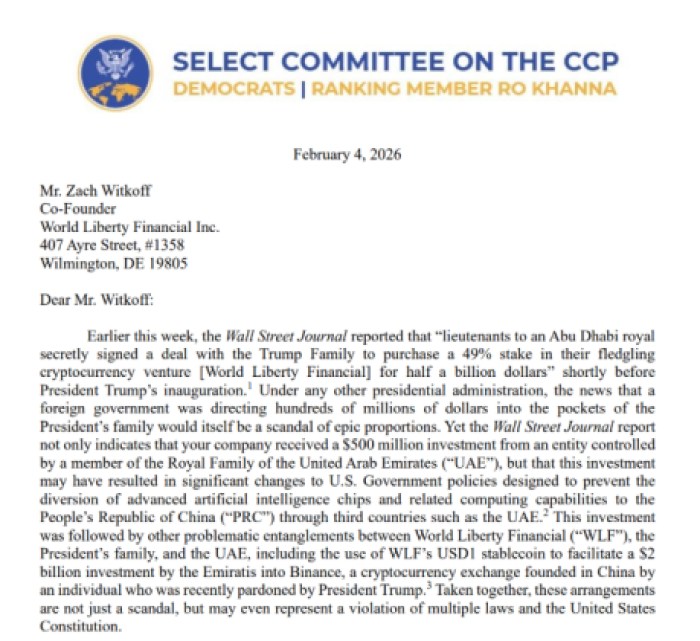

It’s not just about blockchain mechanics; the concern focuses on the ‘quid pro quo’ potential of opaque financial structures. When a project is tied intrinsically to a political figurehead, large foreign investments raise national security questions: are these purchases of tokens, or purchases of access?

The probe highlights a critical vulnerability in personality-driven crypto ventures. If the underlying value proposition relies on connections rather than code, the project becomes a lightning rod for regulatory enforcement.

This scrutiny creates a vacuum in the institutional DeFi sector. While D.C. dissects the tangled web of WLFI’s foreign ties, the market is quietly shifting capital toward infrastructure-heavy alternatives that prioritize code over connections.

The volatility of politically exposed assets is driving smart money toward verifiable, tech-first solutions. That flight to quality is evident in the rising interest surrounding LiquidChain ($LIQUID), a Layer 3 protocol designed to solve fragmentation without the geopolitical baggage.

Escaping Geopolitical Risk Through LiquidChain’s Unified Layer

The congressional probe into World Liberty Financial exposes a fatal flaw in centralized, personality-centric DeFi: counterparty risk. When a protocol relies on opaque dealings with foreign sovereign wealth funds or controversial crypto tycoons, ‘decentralization’ becomes little more than a marketing slogan.

In contrast, LiquidChain is capitalizing on the market’s demand for a trustless execution environment. Rather than relying on boardroom deals to move liquidity, LiquidChain utilizes a Layer 3 architecture to fuse Bitcoin, Ethereum, and Solana into a single execution layer.

That distinction matters because institutions require certainty. They can’t allocate capital to platforms where the regulatory status hinges on the outcome of an election or a congressional hearing. LiquidChain’s ‘Deploy-Once’ architecture allows developers to build applications that access liquidity across all major chains simultaneously, removing the need for risky, fragmented bridges or politically sensitive partnerships.

By creating a Unified Liquidity Layer, the protocol offers the interoperability that WLFI promised, but delivers it through verifiable smart contracts rather than handshake deals in Dubai.

For the developer ecosystem, this represents a massive efficiency unlock. Instead of writing distinct code for the EVM (Ethereum) and SVM (Solana), LiquidChain’s Cross-Chain VM handles the translation.

As regulatory heat increases on projects like WLFI, infrastructure plays that solve the ‘wrapped asset risk’ problem. where assets are pegged and potentially manipulated, are becoming the preferred safe harbor for long-term capital.

EXPLORE LIQUIDCHAIN ON ITS PRESALE PAGE

$LIQUID Presale Gains Traction Amidst Regulatory Uncertainty

While headlines scream about subpoenas and congressional letters, on-chain data reveals a divergence in where retail and developer capital is actually flowing. The LiquidChain presale has quietly accelerated, with the project raising over $526K to date.

Unlike the hype-driven cycles of meme coins or political tokens, this capital injection suggests a methodical accumulation by investors betting on infrastructure over narrative.

At the current entry price of $0.0135, the market is pricing $LIQUID as an early-stage infrastructure bet. The tokenomics model positions $LIQUID not just as a governance token, but as the transaction fuel for the entire cross-chain environment. Every time a user swaps $SOL for $BTC or engages in DeFi activities across the unified layer, the protocol generates demand for the token.

This utility-driven demand contrasts sharply with the speculative nature of tokens currently under the congressional microscope. It’s easy to see why it could be one of the next crypto to explode.

The timing of this capital raise is notable. As investors rotate out of high-risk, politically sensitive assets, they’re seeking ‘picks and shovels’ plays, protocols that facilitate the industry’s growth regardless of which political party holds power.

With liquidity staking incentives encouraging long-term holding, LiquidChain is positioning itself to capture the volume that is fleeing from regulatory uncertainty.

BUY YOUR $LIQUID TODAY

This article is for informational purposes only and does not constitute financial advice. Cryptocurrency investments carry high risk, including the potential loss of principal. Always perform your own due diligence.


Related Questions

QWhat is the main concern raised by the congressional inquiry into World Liberty Financial (WLFI)?

AThe main concern is whether foreign entities, particularly those linked to recent dealings with the UAE and investments from figures like Justin Sun, are using cryptocurrency projects as a vehicle for political influence, creating potential 'quid pro quo' situations and national security risks.

QHow does LiquidChain aim to address the vulnerabilities exposed by the WLFI probe?

ALiquidChain addresses these vulnerabilities by offering a trustless, tech-first solution with its Layer 3 architecture that unifies Bitcoin, Ethereum, and Solana into a single execution layer, prioritizing verifiable smart contracts and code over opaque political connections and partnerships.

QWhat key technological feature does LiquidChain use to solve the problem of blockchain fragmentation?

ALiquidChain uses its 'Deploy-Once' architecture and Cross-Chain VM, which allows developers to build applications that can access liquidity across all major chains simultaneously, eliminating the need for risky bridges and reducing fragmentation.

QWhat is the current status of the LiquidChain ($LIQUID) presale and what does it indicate about investor sentiment?

AThe LiquidChain presale has raised over $526K, indicating a methodical accumulation by investors who are betting on long-term infrastructure solutions rather than hype-driven or politically sensitive narrative tokens amidst regulatory uncertainty.

QHow does the utility of the $LIQUID token differ from the tokens under congressional scrutiny?

AThe $LIQUID token is designed as a utility token that serves as the governance and transaction fuel for the entire cross-chain environment, generating demand through actual platform use, in contrast to the speculative and politically exposed nature of the tokens under investigation.

Related Reads

Jensen Huang's CMU Speech: In the AI Era, Don't Just Watch, Build

Jensen Huang, CEO of NVIDIA and a first-generation immigrant, delivered the commencement address to Carnegie Mellon University's class of 2026. He shared his personal journey from a humble background to founding NVIDIA, emphasizing resilience, learning from failure, and the responsibility that comes with leadership. Huang framed the present moment as the dawn of the AI revolution, a shift he believes is more profound than previous computing waves. He described AI as fundamentally resetting computing—moving from human-written software to machines that understand, reason, and use tools. This will create a new industry for generating intelligence and transform every sector. While acknowledging AI's potential to automate tasks and displace some jobs, Huang distinguished between the *tasks* of a job and its core *purpose*. He argued AI will augment human capability, not replace humans. The real risk, he stated, is not AI itself, but people being left behind by those who effectively use AI. He presented AI as a generational opportunity for massive infrastructure investment—in chip factories, data centers, energy grids, and advanced manufacturing—that could re-industrialize nations like the U.S. and bridge the digital divide by making computing and intelligent tools accessible to all. Huang called for a balanced approach: advancing AI safely and responsibly, establishing prudent policies, ensuring broad access, and encouraging universal participation. He urged the graduates not to fear the future but to engage with optimism and ambition, reminding them of CMU's motto, "My heart is in the work." His core message was clear: this is their moment to actively build and shape the AI-powered future, not merely observe it.

marsbit47m ago

Jensen Huang's CMU Speech: In the AI Era, Don't Just Watch, Build

marsbit47m ago

The Era Has Arrived Where Human Writers Must Prove They Are Not Machines

The article describes an era where AI-generated content is flooding the market, forcing human authors to prove they are not machines. It begins with the example of dozens of AI-written, error-ridden biographies of Henry Kissinger appearing on Amazon within hours of his death, a pattern repeated for other deceased celebrities and even living experts who find fraudulent books under their names. This spam content has exploded, with monthly new book releases on platforms like Amazon reaching 300,000 by late 2025. The issue spans genres, from suspiciously high proportions of AI-written teen romance and self-help books to dangerous, AI-generated foraging guides containing lethal advice. The platforms' automated review systems, designed to catch plagiarism and banned words, are ill-equipped to detect AI-generated text that avoids these pitfalls while being nonsensical or fraudulent. The problem has infiltrated traditional publishing. A major publisher, Hachette, had to recall a bestselling horror novel after AI detection tools suggested 78% of its content was machine-generated. An acclaimed European philosophy book was later revealed to be entirely written by AI under a fake author persona. In response, authors are fighting back. At the 2026 London Book Fair, 10,000 writers published a blank book titled "Don't Steal This Book" containing only their signatures—using emptiness as a protest weapon in an age of AI overproduction. Initiatives like the "Human Author Certification" program have emerged, ironically placing the burden on humans to prove their work is not machine-made. The article warns of a vicious cycle: AI-generated low-quality books pollute the data used to train future AI models, leading to "model collapse" and an ever-worsening flood of digital waste, eroding trust in publishing and devaluing human creativity.

marsbit1h ago

The Era Has Arrived Where Human Writers Must Prove They Are Not Machines

marsbit1h ago

Trading

Spot
Futures
活动图片




