Qubic Unveils 3-Phase Rollout For Dogecoin Mining Attack

bitcoinistPublished on 2026-03-25Last updated on 2026-03-25

Abstract

Qubic has announced a three-phase plan to transition its mining operations from Monero (XMR) to Dogecoin (DOGE), starting on April 1. The shift is designed to be deliberate and methodical rather than instantaneous. Phase 1 (beginning April 1) serves as a testing period where Monero mining remains active 50% of the time, while Dogecoin runs at 100% in "test mode." Computor revenue during this phase remains in XMR only. Phase 2 allows computors to choose between XMR and DOGE revenue, with XMR gradually phased out. Those opting for DOGE will no longer receive XMR. Phase 3 completes the transition, with revenue switching entirely to DOGE, XMR mining disabled, and both DOGE mining and AI training running at full capacity. Qubic claims its network is now three times faster after recent optimizations, which it says will help handle the increased load. The team cited Dogecoin’s significantly larger daily emission value—approximately $1.44 million compared to Monero’s—as the key economic incentive for the switch.

Qubic will begin its staged transition from Monero to Dogecoin mining on April 1. Via X, the Qubic team layed out a three-phase rollout that it says is designed to move deliberately rather than flip the network over in a single step.

In a post published Tuesday, the project said “the transition from Monero to Dogecoin doesn’t happen overnight” and that its core team had designed a three-phase process in which “each phase is evaluated before moving forward.” The framing is notable given Qubic’s increasingly explicit language around its mining strategy. The headline objective, as the team describes it, is to reach a final state where “DOGE + AI” run “simultaneously, full time.”

3-Phase Rollout For Dogecoin Mining Shift

The first phase begins April 1 and is positioned as a testing period lasting one to two epochs. During that stage, computor revenue remains denominated in XMR only, Monero mining remains active 50% of the time, and Dogecoin enters what Qubic calls “test mode” while running on mainnet at 100%. AI training continues alongside it. In other words, Qubic is not immediately removing the existing Monero-based incentive structure, but introducing DOGE at full operational intensity before revenue is switched over.

The second phase is the actual migration. For one to two epochs, computors will be able to choose between XMR and DOGE revenue, with XMR beginning to phase out and DOGE phasing in with a top-up applied. Qubic also said that computors who opt to bring DOGE “are no longer eligible for XMR.”

By the third and final phase, Qubic says computor revenue will be DOGE only. The XMR dispatcher will be turned off completely, DOGE will remain active 100% of the time, and AI training will also run at 100%. “No rushing. No shortcuts. Just disciplined execution,” the team wrote.
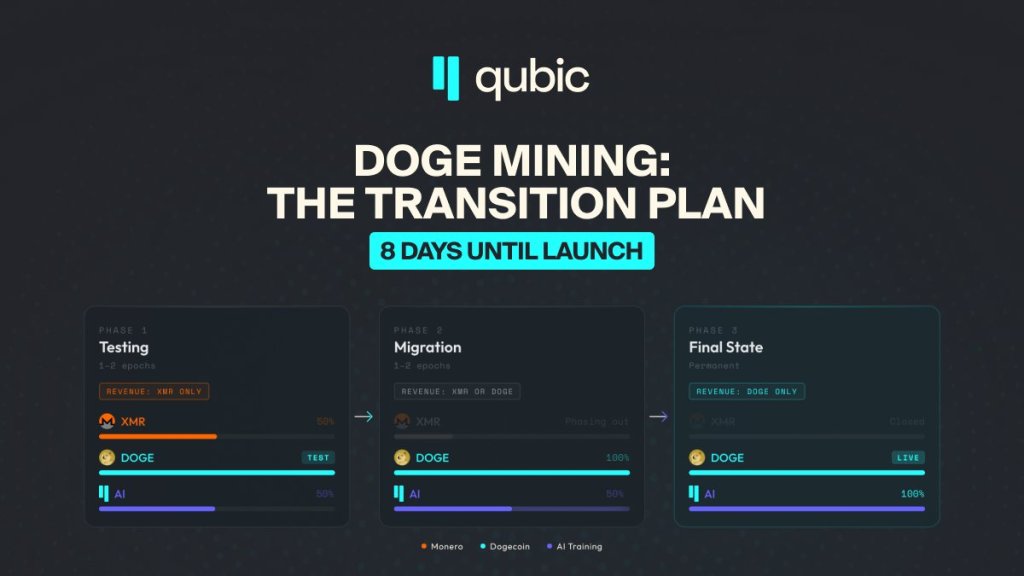
Source: X @_Qubic_

Qubic paired that roadmap with a performance claim aimed directly at the April 1 launch window. On March 23, the project said its network had become “3x faster” on live mainnet, with tick times reduced from 2 seconds a year ago to 1 second and now 0.6 seconds after the latest core optimization.

“Every share a miner submits gets validated through Oracle Machines in a single tick,” Qubic wrote. “Faster ticks mean faster confirmations, a more efficient pipeline, and a network that can handle the load when April 1st hits. The network got faster right before it needed to be.”

The economic case for targeting Dogecoin is straightforward in Qubic’s telling. In a March 20 post, the team pointed to its earlier Monero campaign, saying it went from less than 2% of Monero’s hashrate to “51%+ dominance in a live takeover event,” while generating more than $3.5 million in mining revenue and finding over 26,000 XMR blocks.

Dogecoin, it argued, is a much larger prize. “DOGE produces roughly 14.4 million coins per day. At current prices, that’s approximately $1.44M in daily emission, roughly 10x what Monero was producing,” the team wrote. “The same playbook. A much bigger target.”

At press time, DOGE traded at $0.09752.
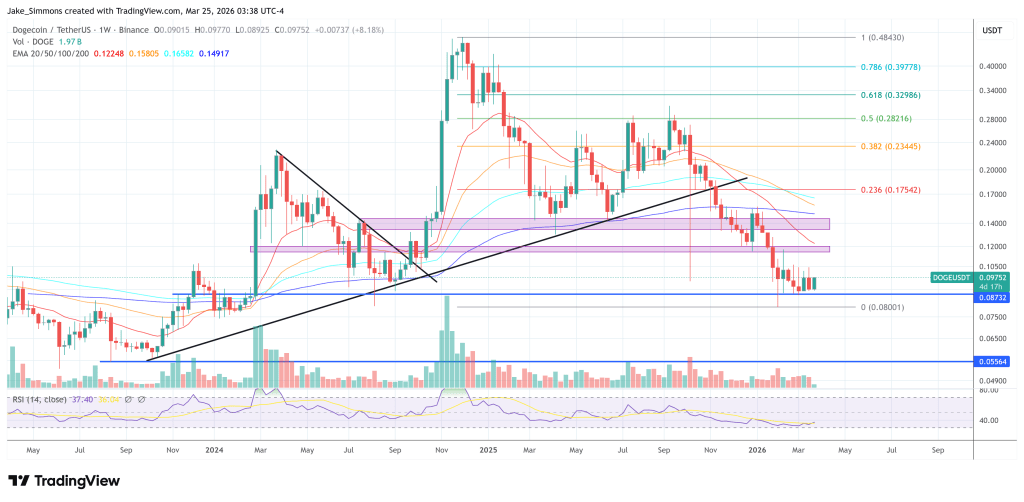
DOGE holds above key support, 1-week chart | Source: DOGEUSDT on TradingView.com

Related Questions

QWhat is the start date for Qubic's transition from Monero to Dogecoin mining?

AApril 1.

QHow many phases are in Qubic's rollout plan for the Dogecoin mining shift?

AThree phases.

QIn the final phase, what will be the only form of computor revenue?

ADOGE only.

QWhat performance improvement did Qubic claim its network achieved on March 23?

AIt became 3x faster on live mainnet, with tick times reduced to 0.6 seconds.

QWhat economic reason did Qubic give for targeting Dogecoin instead of Monero?

ADogecoin produces approximately $1.44M in daily emission, which is roughly 10x what Monero was producing.

Related Reads

How Many Tokens Away Is Yang Zhilin from the 'Moon Chasing the Light'?

The article explores the intense competition between two leading Chinese AI companies, DeepSeek and Kimi (Moon Dark Side), and the mounting pressure on Yang Zhilin, the founder of Kimi. While DeepSeek re-emerged after 15 months of silence with its powerful V4 model—boasting 1.6 trillion parameters and low-cost, long-context capabilities—Kimi has been focusing on long-context processing and multi-agent systems with its K2.6 model. Yang faces a threefold challenge: technological rivalry, commercialization pressure, and investor expectations. Despite Kimi’s high valuation (reaching $18 billion), its revenue heavily relies on a single product with low paid conversion rates, while DeepSeek’s strategic silence and open-source influence have strengthened its market position and valuation prospects, now targeting over $20 billion. Both companies reflect broader trends in China’s AI ecosystem: Kimi aims for global influence through open-source contributions and agent-based advancements, while DeepSeek prioritizes foundational innovation and hardware independence, notably shifting to Huawei’s chips. Their competition is seen as vital for China’s AI progress, with the gap between top Chinese and U.S. models narrowing to just 2.7% on the Elo rating scale. Ultimately, the article argues that this rivalry, though anxiety-inducing for leaders like Zhilin, is essential for driving innovation and solidifying China’s role in the global AI landscape.

marsbit8h ago

How Many Tokens Away Is Yang Zhilin from the 'Moon Chasing the Light'?

marsbit8h ago

Trading

Spot
Futures
活动图片





