Qubic Unveils 3-Phase Rollout For Dogecoin Mining Attack

bitcoinistPublished on 2026-03-25Last updated on 2026-03-25

Abstract

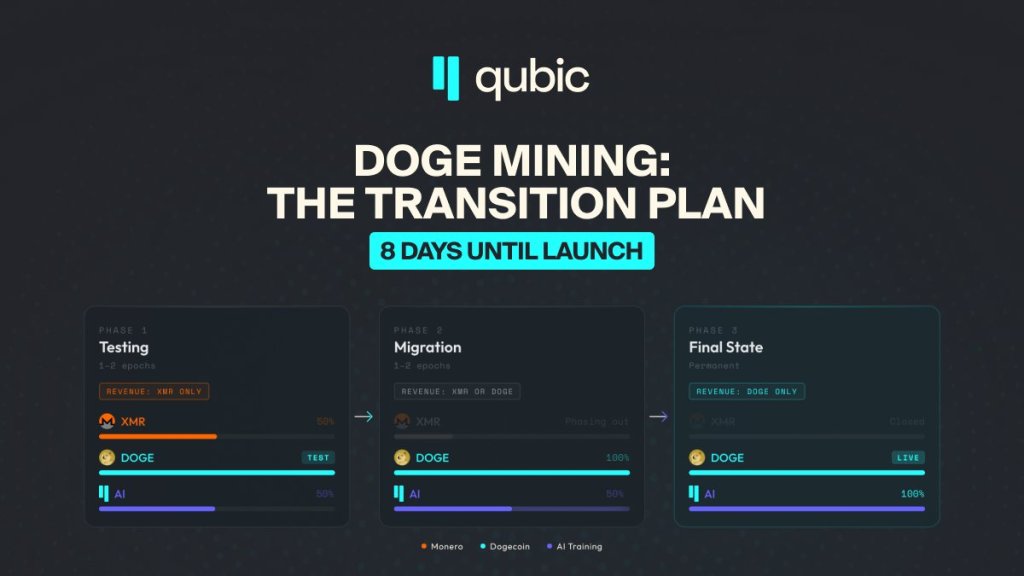
Qubic has announced a three-phase plan to transition its mining operations from Monero (XMR) to Dogecoin (DOGE), starting on April 1. The shift is designed to be deliberate and methodical rather than instantaneous. Phase 1 (beginning April 1) serves as a testing period where Monero mining remains active 50% of the time, while Dogecoin runs at 100% in "test mode." Computor revenue during this phase remains in XMR only. Phase 2 allows computors to choose between XMR and DOGE revenue, with XMR gradually phased out. Those opting for DOGE will no longer receive XMR. Phase 3 completes the transition, with revenue switching entirely to DOGE, XMR mining disabled, and both DOGE mining and AI training running at full capacity. Qubic claims its network is now three times faster after recent optimizations, which it says will help handle the increased load. The team cited Dogecoin’s significantly larger daily emission value—approximately $1.44 million compared to Monero’s—as the key economic incentive for the switch.

Qubic will begin its staged transition from Monero to Dogecoin mining on April 1. Via X, the Qubic team layed out a three-phase rollout that it says is designed to move deliberately rather than flip the network over in a single step.

In a post published Tuesday, the project said “the transition from Monero to Dogecoin doesn’t happen overnight” and that its core team had designed a three-phase process in which “each phase is evaluated before moving forward.” The framing is notable given Qubic’s increasingly explicit language around its mining strategy. The headline objective, as the team describes it, is to reach a final state where “DOGE + AI” run “simultaneously, full time.”

3-Phase Rollout For Dogecoin Mining Shift

The first phase begins April 1 and is positioned as a testing period lasting one to two epochs. During that stage, computor revenue remains denominated in XMR only, Monero mining remains active 50% of the time, and Dogecoin enters what Qubic calls “test mode” while running on mainnet at 100%. AI training continues alongside it. In other words, Qubic is not immediately removing the existing Monero-based incentive structure, but introducing DOGE at full operational intensity before revenue is switched over.

The second phase is the actual migration. For one to two epochs, computors will be able to choose between XMR and DOGE revenue, with XMR beginning to phase out and DOGE phasing in with a top-up applied. Qubic also said that computors who opt to bring DOGE “are no longer eligible for XMR.”

By the third and final phase, Qubic says computor revenue will be DOGE only. The XMR dispatcher will be turned off completely, DOGE will remain active 100% of the time, and AI training will also run at 100%. “No rushing. No shortcuts. Just disciplined execution,” the team wrote.
Source: X @_Qubic_

Qubic paired that roadmap with a performance claim aimed directly at the April 1 launch window. On March 23, the project said its network had become “3x faster” on live mainnet, with tick times reduced from 2 seconds a year ago to 1 second and now 0.6 seconds after the latest core optimization.

“Every share a miner submits gets validated through Oracle Machines in a single tick,” Qubic wrote. “Faster ticks mean faster confirmations, a more efficient pipeline, and a network that can handle the load when April 1st hits. The network got faster right before it needed to be.”

The economic case for targeting Dogecoin is straightforward in Qubic’s telling. In a March 20 post, the team pointed to its earlier Monero campaign, saying it went from less than 2% of Monero’s hashrate to “51%+ dominance in a live takeover event,” while generating more than $3.5 million in mining revenue and finding over 26,000 XMR blocks.

Dogecoin, it argued, is a much larger prize. “DOGE produces roughly 14.4 million coins per day. At current prices, that’s approximately $1.44M in daily emission, roughly 10x what Monero was producing,” the team wrote. “The same playbook. A much bigger target.”

At press time, DOGE traded at $0.09752.
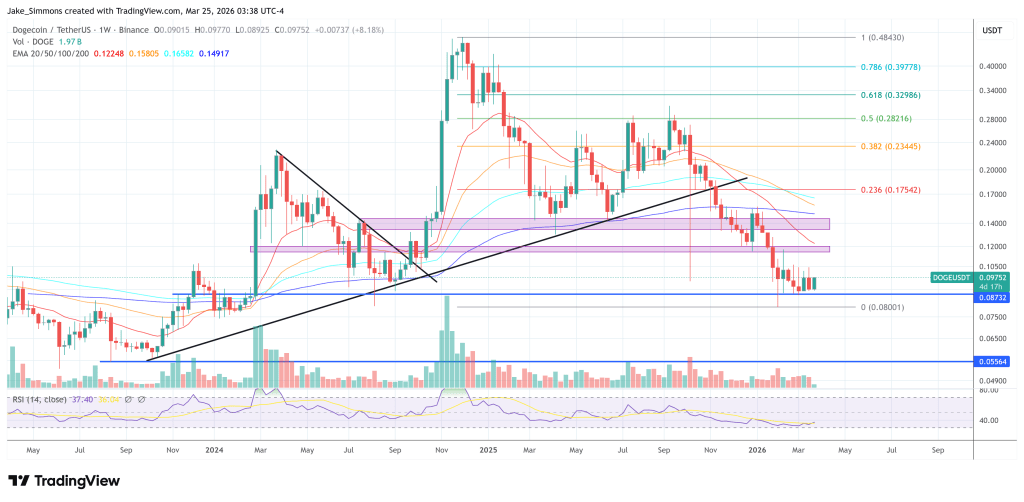
DOGE holds above key support, 1-week chart | Source: DOGEUSDT on TradingView.com

Related Questions

QWhat is the start date for Qubic's transition from Monero to Dogecoin mining?

AApril 1.

QHow many phases are in Qubic's rollout plan for the Dogecoin mining shift?

AThree phases.

QIn the final phase, what will be the only form of computor revenue?

ADOGE only.

QWhat performance improvement did Qubic claim its network achieved on March 23?

AIt became 3x faster on live mainnet, with tick times reduced to 0.6 seconds.

QWhat economic reason did Qubic give for targeting Dogecoin instead of Monero?

ADogecoin produces approximately $1.44M in daily emission, which is roughly 10x what Monero was producing.

Related Reads

On-Chain Figures on the Eve of Kickoff: 1.6 Billion Traded Before the World Cup Even Begins

"On-Chain Numbers on the Eve of the World Cup: $1.6 Billion Traded Before Kick-off" Analysis of on-chain markets before the 2026 FIFA World Cup reveals significant crypto integration into football. The most striking figure is the approximately **$1.6 billion** in total trading volume on the single "World Cup Winner" contract on the Polymarket prediction market platform, accumulated before a single match was played. This represents explosive growth for a sector whose annual volume surged from ~$16B in 2024 to ~$64B in 2025. The ecosystem is maturing beyond speculation. Key developments include: 1) **Infrastructure upgrades** like Polymarket's migration to native, regulated USDC stablecoin for settlements; 2) **Reliable data oracles**, such as Chainlink, being used to resolve real-world match outcomes on-chain; and 3) **Official recognition**, with FIFA appointing its first-ever "Prediction Markets" partner. Over 100 contracts now cover everything from the outright winner to individual match results and even non-sporting risks like venue relocation. This evolution marks a fundamental shift. While crypto firms are absent from FIFA's top-tier sponsor list, the technology has deeply penetrated the tournament's financial and predictive infrastructure through regulated stablecoin settlements, decentralized oracles, and new official partnership categories. The regulatory landscape remains complex and varies by jurisdiction, but on-chain markets for the World Cup are already a multi-billion-dollar reality.

marsbit15m ago

On-Chain Figures on the Eve of Kickoff: 1.6 Billion Traded Before the World Cup Even Begins

marsbit15m ago

From SpaceX's IPO to the Future of Crypto: Which Crypto Sectors Will Host the Trillion-Dollar Narrative?

From the SpaceX IPO, which targets a $750 billion raise at a $1.77 trillion valuation, we can extrapolate capital flow trends relevant to crypto. The focus shifts from speculative narratives to foundational infrastructure and real-world asset (RWA) integration. Key crypto sectors poised to benefit include: 1. **AI Infrastructure**: The narrative is moving from consumer-facing AI applications to underlying, scarce resources like compute power and decentralized GPU networks (e.g., TAO, RENDER, AKT, IO). These protocols are positioning as the essential "picks and shovels" providers for the AI economy. 2. **Real-World Assets (RWA)**: Beyond tokenized treasury bonds, RWA's future lies in on-chain equity and pre-IPO assets like SpaceX. This could democratize access to high-growth assets and reshape global capital flows, benefiting infrastructure projects like ONDO, LINK, and Plume that facilitate issuance, data, and liquidity. 3. **Core Financial Infrastructure**: Stablecoins, payment networks, and DePIN (Decentralized Physical Infrastructure Networks) are critical for settling the future on-chain economy. Their role expands from internal trading tools to foundational layers for global finance, AI systems, and real-world asset networks, leading to potential value reassessment. In summary, the next cycle may prioritize long-term infrastructure value—AI compute, asset tokenization networks, and settlement layers—over short-lived application hype, mirroring the broader market's shift towards funding the foundational systems of the future.

marsbit36m ago

From SpaceX's IPO to the Future of Crypto: Which Crypto Sectors Will Host the Trillion-Dollar Narrative?

marsbit36m ago

Tech Stocks Plunge and Bitcoin Slumps, Retail Investors Face Ultimate Test Ahead of SpaceX IPO

Technology stocks suffered their biggest drop in months, and Bitcoin fell below the $60,000 mark, coinciding with the eve of SpaceX's massive IPO plans. The sell-off was triggered by strong U.S. jobs data, dashing hopes for Fed rate cuts and reviving fears of further hikes. High-valuation sectors like AI and semiconductors led the declines, with the Nasdaq plunging over 4%. Cryptocurrencies, sensitive to higher interest rates and a strong dollar, also tumbled sharply. This market stress test raises critical questions about the limits of retail investor capital and its next destination. SpaceX's upcoming IPO, which plans to allocate an unusually high 30% of shares to retail investors, now faces a more uncertain landscape. Analysts warn that to buy SpaceX,散户 may need to sell existing holdings, with Tesla seen as a potential source of funds. The market is saturated with speculative options—from crypto and meme stocks to zero-day options and AI-themed ETFs—all competing for the same pool of retail attention and capital. While SpaceX's listing could inject fresh excitement, it also enters a fiercely competitive environment where investor loyalty is fleeting. The ease of zero-commission trading and lower barriers to margin trading accelerate capital rotation between narratives, making it difficult for any single story, even a historic IPO like SpaceX's, to dominate for long.

华尔街日报1h ago

Tech Stocks Plunge and Bitcoin Slumps, Retail Investors Face Ultimate Test Ahead of SpaceX IPO

华尔街日报1h ago

Trading

Spot
Futures
活动图片