Programmers Must Read: Job Hunting in Web3, Avoid These Four Types of High-Risk Gambling-Related Platforms

marsbitPublished on 2026-02-25Last updated on 2026-02-25

Abstract

Chinese programmer "Xiao Wang" considers a Web3 career transition but faces job offers involving "perpetual contracts, on-chain gambling, and prediction markets," raising legal concerns. A legal team advises caution, identifying four high-risk platform types that may constitute illegal operations under Chinese law, despite attractive salaries and remote work: 1. **Web3 Gaming Platforms**: Often disguised as decentralized games (GameFi) but operate as on-chain casinos using USDT/ETH as chips, with smart contracts handling bets and payouts. Developers building betting logic, random number generators, or fund pools are considered key technical support in gambling operations. 2. **Perpetual Contract Development**: High-leverage crypto trading platforms (e.g., 150x) where users bet on price directions. Courts increasingly view these as gambling, and developers working on matching engines, liquidation systems, or referral programs face liability. 3. **Prediction Markets**: Framed as financial innovation for event forecasting, they essentially function as binary betting on outcomes (e.g., price movements or macro events). Technologists designing prediction contracts or oracle integrations are seen as enabling gambling mechanisms. 4. **Gambling Payment Platforms**: High-risk payment/clearing services for gambling sites, often masked as "payment solutions" or "USDT gateways." Developers building fiat/crypto deposit/withdrawal systems or currency exchange logic may be implicated i...

Author: Lawyer Shao Shiwei's Team

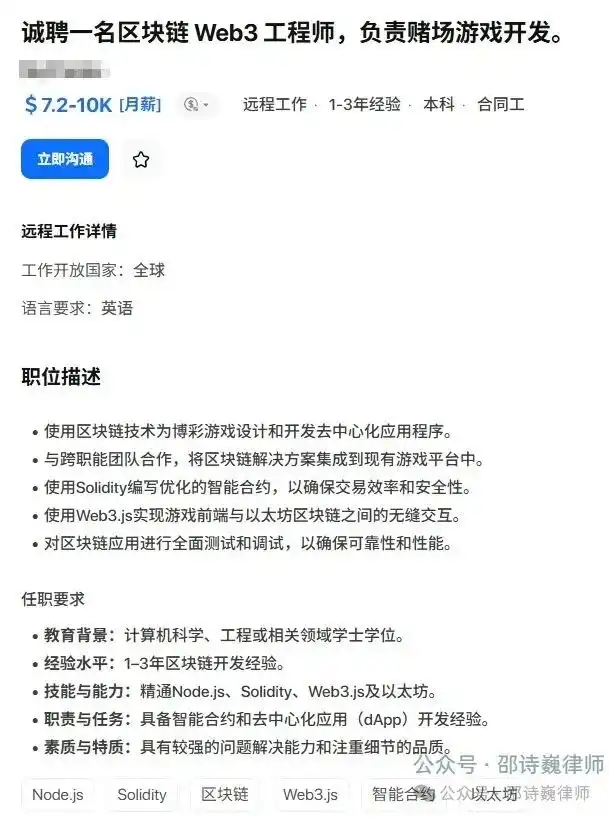
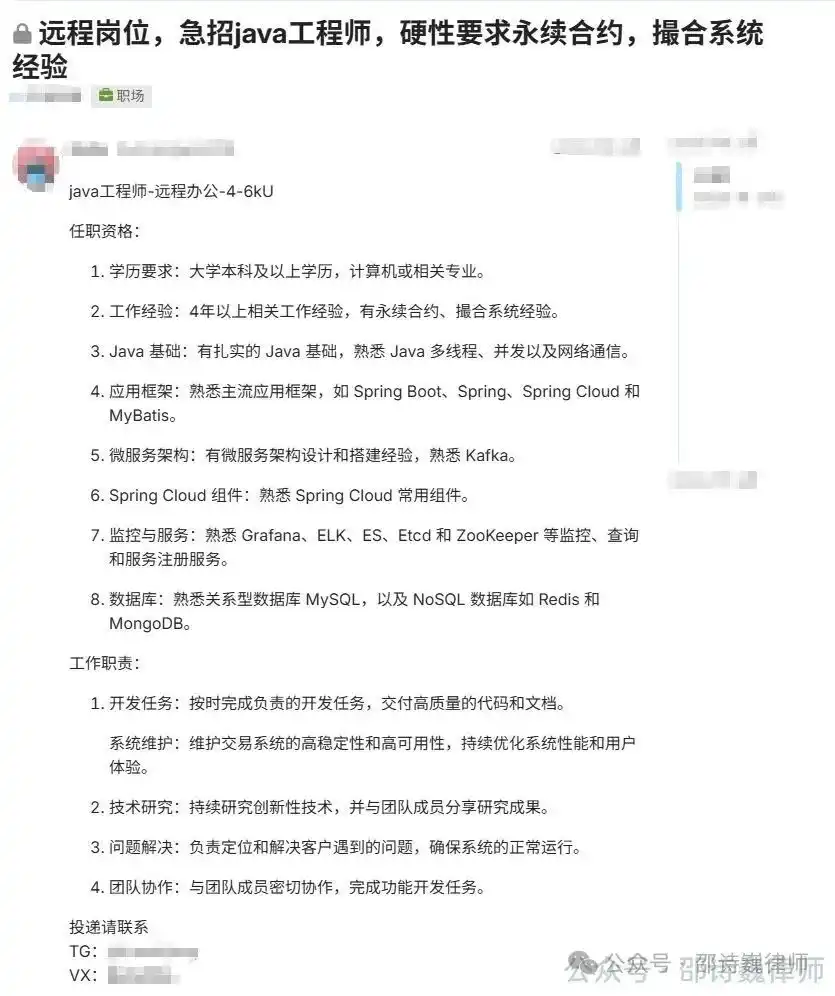
Xiao Wang is a programmer at a large tech company. In recent years, wanting to break through his professional bottleneck and seek new career possibilities, he began considering a transition to Web3. After communicating with headhunters and seeking referrals from friends in the industry, Xiao Wang received multiple job offers in Web3. The job descriptions (JDs) roughly stated:

Design and develop core prediction market contracts (AMM, liquidity pools, settlement, adjudication models);

Design and develop decentralized applications for gambling games;

Urgently hiring Java engineers, mandatory experience with perpetual contracts, matching systems, etc.

Faced with terms like "perpetual contracts, on-chain gambling, prediction markets," Xiao Wang felt he somewhat understood but also vaguely uneasy: the salary offered by the headhunter was good, significantly higher than his current income, and most importantly, it offered remote work—a lifestyle of a digital nomad he had always yearned for.

But, "Is there domestic risk in this type of work? But even if the project is risky, so what? I'm just a technician; even if something happens, it shouldn't implicate me, right?"... This conflicting psychology kept him in a state of persistent hesitation.

In daily case handling and consultations, Lawyer Shao has found that many job seekers share similar thoughts: attracted by the high salary and remote work on one hand, yet worried about crossing legal red lines on the other. So, for programmers transitioning to Web3, how should they choose job positions? How can they "avoid pitfalls" to stay clear of legal risks?

This article will summarize common types of high-risk projects related to gambling from the perspective of Web3 job seekers, helping you "identify them at a glance." You can compare the job description, project whitepaper, and official website introduction to self-check if the job you're about to take is a Web3 project involved in gambling, avoiding unintentionally working for a "casino."

1. Web3 Gaming Platforms: The Disguised Packaging of On-Chain Gambling

Many Web3 job seekers first encounter this type of position with JDs that often sound very appealing:

Decentralized chain games, fair on-chain gambling, smart contract automatic settlement, USDT instant settlement—at first glance, it seems like a cutting-edge Web3 game (GameFi) or innovative project.

But if you strip away these buzzwords and just look at how the money flows, you'll find the business essence is not that complicated: users use USDT, ETH, or other virtual currencies as chips, choose a game style (dice, roulette, lottery, sports betting, etc.) on the front end, and then write the transaction into a smart contract via a Web3 library; after the contract receives the funds, it determines win/loss based on preset random number + odds rules, then pays profits to the winner from the fund pool, while the platform and the house take a commission.

What's transparent on the chain is only the process; its essence is still organizing an unspecified majority to bet online on wins and losses, with the platform profiting through commissions.

In such projects, the programmer's daily work is often akin to a technical architect for a casino:

Responsible for writing betting contracts, drawing logic, fund pool management; researching on-chain random numbers to ensure apparent fairness; creating various betting interfaces, odds displays, drawing animations; setting up data dashboards in the backend to track wins/losses and agent rebates.

Many technical personnel believe they are just ordinary employees writing code, or that "technology is neutral." However, from the judicial authorities' perspective, technical personnel are identified as key roles providing technical support for the gambling platform.

For example, in the EOS gambling case 【Case: (2023) Su 09 Xing Zhong No. 372】, the involved parties developed a gambling platform named BigGame on the EOS blockchain and accepted bets. The technical personnel were responsible for platform product design, contract code writing, and platform client code writing, and were identified as accomplices in the crime of operating a gambling establishment. Practice has clearly established that using blockchain and other technologies to establish gambling websites and accepting bets from participants using virtual currency as chips constitutes the "operation of a gambling establishment" behavior specified in the second paragraph of Article 303 of the Criminal Law.

2. Perpetual Contract Development: The Gambling Nature of High-Leverage Trading

Another very common type in Web3 job hunting is positions under the guise of digital currency exchanges or contract platforms. JD descriptions include: responsible for perpetual contract matching engine development, participating in high-concurrency trading system design, building risk control and forced liquidation mechanisms... If the job seeker has experience in traditional finance or matching systems, it's easy to interpret this as working on a high-end financial product.

But the reality is often: the platform focuses on high-leverage perpetual contracts. Users use USDT to bet whether a coin's price will rise or fall, configuring up to 150x leverage. If the direction is wrong, they are instantly liquidated to zero, while the platform steadily collects fees and continuously takes a cut from liquidations, settlements, and funding rates.

In Web3 contract projects, programmers are often working on the underlying support of the "trading engine": implementing high-performance matching systems, margin models, liquidation, and forced closing logic; building so-called risk control systems, but more to prevent platform losses; simultaneously cooperating with product design for signal following, agent rebates, partnership systems, and other user acquisition and裂变 mechanisms.

Although similar contract businesses may operate legally in some regions overseas, in publicly available judgments in China, the courts'定性 of such businesses is becoming increasingly clear: high-leverage contracts are in most cases regarded as gambling activities using virtual currency as chips. Relevant technical, operational, and agency personnel find it difficult to completely sever responsibility with "I'm just an employee."

For example, in the CCFOX case 【Case No.: (2024) Ji 06 Xing Zhong No. 10】, the court determined that the virtual currency contract trading provided by the CCFOX platform had speculative and偶然性 characteristics and was not supervised by the state. The CCFOX platform should be identified as a gambling platform. Shen某, as a technical developer for the CCFOX website, responsible for website function development and providing technical services, was identified as an accomplice in the crime of operating a gambling establishment.

3. On-Chain Prediction Markets: Betting Games Under the Guise of Financial Innovation

Another type of seemingly more advanced position in Web3 job hunting involves so-called prediction markets, event contracts, and price prediction games. These platforms like to use flashy narratives:

Using market prices to aggregate collective wisdom, using trading to predict the future, assetizing all events... It sounds like a financial experiment.

But if you actually click into the official website to see the gameplay, you'll find the core logic is still the same set: the platform launches predictions on whether a coin price will reach a certain level by a certain date, whether a macro event will occur (e.g., the possibility of Trump being impeached again before the end of 2026, when the Fed will cut rates, the end time of the Russia-Ukraine conflict, etc.). Users use virtual currency to bet yes or no, rise or fall. Upon expiration, the platform or an oracle determines the result, pays out according to the odds, and the platform takes a cut. This is no different in substance from binary options or betting on big/small, just wrapped in a "prediction market" cloak.

Technical positions are often packaged to sound very technical: designing prediction contract mechanisms, implementing event creation, betting, expiration settlement contract logic, integrating oracles, arbitration systems... But what you are actually doing is still fund pool management, odds curve design, and settlement rules—from a judicial perspective, this is a complete set of 'bet on results, divide the赌资' casino rules.

Judging from the spirit of the Supreme People's Court's guiding Case No. 146, the玩法 of such prediction markets is not本质上 different from the traditional "betting on big/small, winning/losing"玩法. What technicians consider financial innovation projects will most likely be evaluated and handled according to their gambling attributes in domestic judicial practice.

4. Gambling Payment Platforms: High-Risk Payment and Clearing Services

This last category is the one where many Web3 job seekers are most likely to let their guard down, yet it carries extremely high criminal risk: providing the underlying payment system for gambling platforms (i.e., gambling platforms or betting websites) for充值, withdrawal, and exchange.

Some companies often package themselves externally as payment technology, clearing and settlement platforms, or fourth-party payment, focusing on keywords like aggregated payment, cross-border settlement, USDT payment gateways; the team rhetoric claims they are "USDT payment solution or wallet service providers."

If you only look at the work content, it seems like just对接 various payment channels and wallets, all very normal business. But the actual business model is often:

  • Packaging legal payment tools like Alipay, WeChat Pay, and bank cards into an "aggregated channel" and connecting it to overseas gambling websites;

  • Or using USDT, game coins, points as an intermediate medium to help players complete the two-way conversion between RMB and chips;

  • Then using multi-layer accounts, channels, or中转 wallets to "launder" the funds.

In such companies, programmers' daily work often focuses on:

Developing充值/withdrawal systems, integrating fiat and on-chain wallet interfaces, writing currency and chip exchange logic, building transaction流水 and clearing and settlement backends, and even optimizing "pass-through rates" and reducing risk control interceptions.

But from a criminal judicial perspective, these behaviors are often summarized in one sentence: "providing fund settlement and exchange services for gambling websites." For example, in the cross-province arrest case of Web3 wallet company employees previously discussed by Lawyer Shao (➡️《Reflections Triggered by the Cross-Province Arrest Case of a Web3 Programmer: Three Legal Cognitive Blind Spots for Practitioners》), the team where the当事人 worked was investigated because some of its partner merchants were suspected of operating online gambling establishments, leading to employees being taken away for investigation.

5. Lawyer Shao's Advice: Two-Step Self-Check to Stay Away from Legal Risks

Based on the four common types of gambling platforms above, Lawyer Shao's core advice for Web3 job seekers is as follows:

First,刻下 a red line in your mind:凡是 the business essence is "someone uses money to bet on wins and losses, and the platform profits through odds or leverage commissions," regardless of whether it's called contracts, GameFi, prediction markets, or payment technology, it will most likely be treated as a gambling-related project in judicial practice.

When具体 job hunting, you can judge the risk using the "two-step self-check method":

First, look at the platform's overall model (look at the big picture): Carefully study the project whitepaper, official website introduction, and product gameplay. As long as the overall logic is similar to the Web3 gambling platforms, contract gambling, or gambling payment channels described above, be highly vigilant and carefully consider joining.

Then, look at your own job responsibilities (look at the details): Clarify whether the functions you are actually responsible for involve high-risk links such as betting logic, drawing rules, odds models, forced liquidation mechanisms,充值/withdrawal, credit/debit points, or fund clearing and settlement; as long as you are deeply involved, it is difficult to sever responsibility with "I just write code."

If you can identify risks in advance and decisively refuse offers, you can often avoid criminal implication. Once involved in such projects, job seekers often face not just "changing jobs," but the dual代价 of loss of personal freedom and interruption of their professional career.


Related Questions

QWhat are the four types of high-risk gambling-related platforms that Web3 developers should avoid when job hunting?

AThe four types are: 1) Web3 gaming platforms (disguised on-chain gambling), 2) Perpetual contract development platforms (high-leverage trading with gambling essence), 3) On-chain prediction markets (betting games under the guise of financial innovation), and 4) Gambling payment platforms (high-risk payment and settlement services for gambling sites).

QIn the context of Web3 job opportunities, why are perpetual contract development positions considered high-risk?

APerpetual contract development is high-risk because these platforms often offer high-leverage trading (e.g., up to 150x) where users bet on cryptocurrency price movements. In Chinese judicial practice, such activities are frequently classified as gambling using virtual currencies as chips, and technical staff involved in developing matching systems, liquidation logic, or risk controls can be held liable as accomplices in operating a gambling establishment.

QHow can a Web3 job seeker identify if a 'prediction market' platform is essentially a gambling operation?

AA prediction market platform is likely a gambling operation if its core activity involves users betting virtual currencies on outcomes (e.g., price movements or event results) with payouts determined by odds, and the platform profits by taking a cut. Despite being marketed as 'financial innovation' or 'collective intelligence aggregation,' it functions similarly to betting on binary outcomes, which is treated as gambling in Chinese judicial rulings.

QWhat is the 'two-step self-check method' recommended for Web3 developers to avoid legal risks when considering job offers?

AThe two-step self-check method involves: 1) Examining the platform's overall model: Review the whitepaper, official website, and product mechanics—if the logic aligns with gambling-like operations (e.g., betting on outcomes with platform profit from odds/leverage), be highly cautious. 2) Reviewing personal job responsibilities: Assess if the role involves high-risk functions like developing betting logic, payout rules, odds models, liquidation mechanisms, or payment settlement systems for gambling-related activities.

QWhy might developers working on payment systems for Web3 platforms face severe legal consequences, even if they are not directly involved in gambling operations?

ADevelopers working on payment systems (e.g., deposit/withdrawal interfaces, currency exchange logic, or transaction clearing) for platforms later identified as gambling sites can be legally implicated as providing essential financial settlement services for gambling. Under Chinese law, such support is often interpreted as aiding gambling operations, leading to potential criminal charges as accomplices, regardless of claiming 'just writing code' or technical neutrality.

Related Reads

Why Do You Always Lose Money on Polymarket? Because You're Betting on News, While the Pros Read the Rules

Why do you always lose money on Polymarket? Because you bet on news, while the pros study the rules. This article explains how top traders ("che tou") profit by meticulously analyzing market rules, not just predicting events. Polymarket, a prediction market platform, often sees disputes over event outcomes due to ambiguous rule wording. For instance, a market asking "Who will be the leader of Venezuela by the end of 2026?" was misinterpreted by many who bet on Delcy Rodríguez, assuming she held power. However, the rules specified "officially holds" as the formally appointed, sworn-in individual. Since Nicolás Maduro was still recognized as president officially, he won the market—even being in prison. To resolve such disputes, Polymarket uses a decentralized arbitration system via UMA protocol. The process involves: 1. Proposal: Anyone can propose a market outcome by staking 750 USDC, earning 5 USDC if unchallenged. 2. Dispute: A 2-hour window allows challenges with a 750 USDC stake; successful challengers earn 250 USDC. 3. Discussion: A 48-hour period on UMA Discord for evidence and debate. 4. Voting: UMA token holders vote in two 24-hour phases (blind then public). Outcomes require >65% consensus and 5M tokens voted; otherwise, four re-votes occur before Polymarket intervention. 5. Settlement: Results are final and automatic. Unlike traditional courts, Polymarket’s system lacks separation between arbitrators and stakeholders—voters often hold market positions, creating conflicts of interest. This leads to herd mentality in discussions and non-transparent outcomes without explanatory rulings, preventing precedent formation. Thus, success on Polymarket hinges on deep rule interpretation, not just event prediction, exploiting gaps between reality and contractual wording.

marsbit28m ago

Why Do You Always Lose Money on Polymarket? Because You're Betting on News, While the Pros Read the Rules

marsbit28m ago

DeepSeek Funding: Liang Wenfeng's 'Realist' Pivot

DeepSeek, a leading Chinese AI company, has initiated its first external funding round, aiming to raise at least $300 million at a valuation of no less than $10 billion. This move marks a significant shift from its founder Liang Wenfeng’s previous idealistic stance of rejecting external capital to maintain independence. Despite strong financial backing from its parent company, quantitative trading firm幻方量化 (Huanfang Quant), which provided an estimated $700 million in revenue in 2025 alone, DeepSeek faces mounting challenges. Key issues include a 15-month gap in major model updates, delays in its flagship V4 release, and the loss of several core researchers to competitors offering significantly higher compensation. The company is also undergoing a strategic pivot by migrating its infrastructure from NVIDIA’s CUDA to Huawei’s Ascend platform, a move aligned with China’s push for technological self-reliance amid U.S. export controls. However, DeepSeek lags behind rivals like智谱AI and MiniMax—both now publicly listed—in areas such as product ecosystem, multimodal capabilities, and commercialization. The funding round, though relatively small in scale, is seen as a way to establish a market-validated valuation anchor, making employee stock options more competitive and facilitating talent retention. It also signals DeepSeek’s transition from a pure research-oriented organization to a commercially-driven player in the global AI ecosystem.

marsbit1h ago

DeepSeek Funding: Liang Wenfeng's 'Realist' Pivot

marsbit1h ago

Trading

Spot
Futures

Hot Articles

What is SONIC

Sonic: Pioneering the Future of Gaming in Web3 Introduction to Sonic In the ever-evolving landscape of Web3, the gaming industry stands out as one of the most dynamic and promising sectors. At the forefront of this revolution is Sonic, a project designed to amplify the gaming ecosystem on the Solana blockchain. Leveraging cutting-edge technology, Sonic aims to deliver an unparalleled gaming experience by efficiently processing millions of requests per second, ensuring that players enjoy seamless gameplay while maintaining low transaction costs. This article delves into the intricate details of Sonic, exploring its creators, funding sources, operational mechanics, and the timeline of significant events that have shaped its journey. What is Sonic? Sonic is an innovative layer-2 network that operates atop the Solana blockchain, specifically tailored to enhance the existing Solana gaming ecosystem. It accomplishes this through a customised, VM-agnostic game engine paired with a HyperGrid interpreter, facilitating sovereign game economies that roll up back to the Solana platform. The primary goals of Sonic include: Enhanced Gaming Experiences: Sonic is committed to offering lightning-fast on-chain gameplay, allowing players and developers to engage with games at previously unattainable speeds. Atomic Interoperability: This feature enables transactions to be executed within Sonic without the need to redeploy Solana programmes and accounts. This makes the process more efficient and directly benefits from Solana Layer1 services and liquidity. Seamless Deployment: Sonic allows developers to write for Ethereum Virtual Machine (EVM) based systems and execute them on Solana’s SVM infrastructure. This interoperability is crucial for attracting a broader range of dApps and decentralised applications to the platform. Support for Developers: By offering native composable gaming primitives and extensible data types - dining within the Entity-Component-System (ECS) framework - game creators can craft intricate business logic with ease. Overall, Sonic's unique approach not only caters to players but also provides an accessible and low-cost environment for developers to innovate and thrive. Creator of Sonic The information regarding the creator of Sonic is somewhat ambiguous. However, it is known that Sonic's SVM is owned by the company Mirror World. The absence of detailed information about the individuals behind Sonic reflects a common trend in several Web3 projects, where collective efforts and partnerships often overshadow individual contributions. Investors of Sonic Sonic has garnered considerable attention and support from various investors within the crypto and gaming sectors. Notably, the project raised an impressive $12 million during its Series A funding round. The round was led by BITKRAFT Ventures, with other notable investors including Galaxy, Okx Ventures, Interactive, Big Brain Holdings, and Mirana. This financial backing signifies the confidence that investment foundations have in Sonic’s potential to revolutionise the Web3 gaming landscape, further validating its innovative approaches and technologies. How Does Sonic Work? Sonic utilises the HyperGrid framework, a sophisticated parallel processing mechanism that enhances its scalability and customisability. Here are the core features that set Sonic apart: Lightning Speed at Low Costs: Sonic offers one of the fastest on-chain gaming experiences compared to other Layer-1 solutions, powered by the scalability of Solana’s virtual machine (SVM). Atomic Interoperability: Sonic enables transaction execution without redeployment of Solana programmes and accounts, effectively streamlining the interaction between users and the blockchain. EVM Compatibility: Developers can effortlessly migrate decentralised applications from EVM chains to the Solana environment using Sonic’s HyperGrid interpreter, increasing the accessibility and integration of various dApps. Ecosystem Support for Developers: By exposing native composable gaming primitives, Sonic facilitates a sandbox-like environment where developers can experiment and implement business logic, greatly enhancing the overall development experience. Monetisation Infrastructure: Sonic natively supports growth and monetisation efforts, providing frameworks for traffic generation, payments, and settlements, thereby ensuring that gaming projects are not only viable but also sustainable financially. Timeline of Sonic The evolution of Sonic has been marked by several key milestones. Below is a brief timeline highlighting critical events in the project's history: 2022: The Sonic cryptocurrency was officially launched, marking the beginning of its journey in the Web3 gaming arena. 2024: June: Sonic SVM successfully raised $12 million in a Series A funding round. This investment allowed Sonic to further develop its platform and expand its offerings. August: The launch of the Sonic Odyssey testnet provided users with the first opportunity to engage with the platform, offering interactive activities such as collecting rings—a nod to gaming nostalgia. October: SonicX, an innovative crypto game integrated with Solana, made its debut on TikTok, capturing the attention of over 120,000 users within a short span. This integration illustrated Sonic’s commitment to reaching a broader, global audience and showcased the potential of blockchain gaming. Key Points Sonic SVM is a revolutionary layer-2 network on Solana explicitly designed to enhance the GameFi landscape, demonstrating great potential for future development. HyperGrid Framework empowers Sonic by introducing horizontal scaling capabilities, ensuring that the network can handle the demands of Web3 gaming. Integration with Social Platforms: The successful launch of SonicX on TikTok displays Sonic’s strategy to leverage social media platforms to engage users, exponentially increasing the exposure and reach of its projects. Investment Confidence: The substantial funding from BITKRAFT Ventures, among others, emphasizes the robust backing Sonic has, paving the way for its ambitious future. In conclusion, Sonic encapsulates the essence of Web3 gaming innovation, striking a balance between cutting-edge technology, developer-centric tools, and community engagement. As the project continues to evolve, it is poised to redefine the gaming landscape, making it a notable entity for gamers and developers alike. As Sonic moves forward, it will undoubtedly attract greater interest and participation, solidifying its place within the broader narrative of blockchain gaming.

1.0k Total ViewsPublished 2024.04.04Updated 2024.12.03

What is SONIC

What is $S$

Understanding SPERO: A Comprehensive Overview Introduction to SPERO As the landscape of innovation continues to evolve, the emergence of web3 technologies and cryptocurrency projects plays a pivotal role in shaping the digital future. One project that has garnered attention in this dynamic field is SPERO, denoted as SPERO,$$s$. This article aims to gather and present detailed information about SPERO, to help enthusiasts and investors understand its foundations, objectives, and innovations within the web3 and crypto domains. What is SPERO,$$s$? SPERO,$$s$ is a unique project within the crypto space that seeks to leverage the principles of decentralisation and blockchain technology to create an ecosystem that promotes engagement, utility, and financial inclusion. The project is tailored to facilitate peer-to-peer interactions in new ways, providing users with innovative financial solutions and services. At its core, SPERO,$$s$ aims to empower individuals by providing tools and platforms that enhance user experience in the cryptocurrency space. This includes enabling more flexible transaction methods, fostering community-driven initiatives, and creating pathways for financial opportunities through decentralised applications (dApps). The underlying vision of SPERO,$$s$ revolves around inclusiveness, aiming to bridge gaps within traditional finance while harnessing the benefits of blockchain technology. Who is the Creator of SPERO,$$s$? The identity of the creator of SPERO,$$s$ remains somewhat obscure, as there are limited publicly available resources providing detailed background information on its founder(s). This lack of transparency can stem from the project's commitment to decentralisation—an ethos that many web3 projects share, prioritising collective contributions over individual recognition. By centring discussions around the community and its collective goals, SPERO,$$s$ embodies the essence of empowerment without singling out specific individuals. As such, understanding the ethos and mission of SPERO remains more important than identifying a singular creator. Who are the Investors of SPERO,$$s$? SPERO,$$s$ is supported by a diverse array of investors ranging from venture capitalists to angel investors dedicated to fostering innovation in the crypto sector. The focus of these investors generally aligns with SPERO's mission—prioritising projects that promise societal technological advancement, financial inclusivity, and decentralised governance. These investor foundations are typically interested in projects that not only offer innovative products but also contribute positively to the blockchain community and its ecosystems. The backing from these investors reinforces SPERO,$$s$ as a noteworthy contender in the rapidly evolving domain of crypto projects. How Does SPERO,$$s$ Work? SPERO,$$s$ employs a multi-faceted framework that distinguishes it from conventional cryptocurrency projects. Here are some of the key features that underline its uniqueness and innovation: Decentralised Governance: SPERO,$$s$ integrates decentralised governance models, empowering users to participate actively in decision-making processes regarding the project’s future. This approach fosters a sense of ownership and accountability among community members. Token Utility: SPERO,$$s$ utilises its own cryptocurrency token, designed to serve various functions within the ecosystem. These tokens enable transactions, rewards, and the facilitation of services offered on the platform, enhancing overall engagement and utility. Layered Architecture: The technical architecture of SPERO,$$s$ supports modularity and scalability, allowing for seamless integration of additional features and applications as the project evolves. This adaptability is paramount for sustaining relevance in the ever-changing crypto landscape. Community Engagement: The project emphasises community-driven initiatives, employing mechanisms that incentivise collaboration and feedback. By nurturing a strong community, SPERO,$$s$ can better address user needs and adapt to market trends. Focus on Inclusion: By offering low transaction fees and user-friendly interfaces, SPERO,$$s$ aims to attract a diverse user base, including individuals who may not previously have engaged in the crypto space. This commitment to inclusion aligns with its overarching mission of empowerment through accessibility. Timeline of SPERO,$$s$ Understanding a project's history provides crucial insights into its development trajectory and milestones. Below is a suggested timeline mapping significant events in the evolution of SPERO,$$s$: Conceptualisation and Ideation Phase: The initial ideas forming the basis of SPERO,$$s$ were conceived, aligning closely with the principles of decentralisation and community focus within the blockchain industry. Launch of Project Whitepaper: Following the conceptual phase, a comprehensive whitepaper detailing the vision, goals, and technological infrastructure of SPERO,$$s$ was released to garner community interest and feedback. Community Building and Early Engagements: Active outreach efforts were made to build a community of early adopters and potential investors, facilitating discussions around the project’s goals and garnering support. Token Generation Event: SPERO,$$s$ conducted a token generation event (TGE) to distribute its native tokens to early supporters and establish initial liquidity within the ecosystem. Launch of Initial dApp: The first decentralised application (dApp) associated with SPERO,$$s$ went live, allowing users to engage with the platform's core functionalities. Ongoing Development and Partnerships: Continuous updates and enhancements to the project's offerings, including strategic partnerships with other players in the blockchain space, have shaped SPERO,$$s$ into a competitive and evolving player in the crypto market. Conclusion SPERO,$$s$ stands as a testament to the potential of web3 and cryptocurrency to revolutionise financial systems and empower individuals. With a commitment to decentralised governance, community engagement, and innovatively designed functionalities, it paves the way toward a more inclusive financial landscape. As with any investment in the rapidly evolving crypto space, potential investors and users are encouraged to research thoroughly and engage thoughtfully with the ongoing developments within SPERO,$$s$. The project showcases the innovative spirit of the crypto industry, inviting further exploration into its myriad possibilities. While the journey of SPERO,$$s$ is still unfolding, its foundational principles may indeed influence the future of how we interact with technology, finance, and each other in interconnected digital ecosystems.

54 Total ViewsPublished 2024.12.17Updated 2024.12.17

What is $S$

What is AGENT S

Agent S: The Future of Autonomous Interaction in Web3 Introduction In the ever-evolving landscape of Web3 and cryptocurrency, innovations are constantly redefining how individuals interact with digital platforms. One such pioneering project, Agent S, promises to revolutionise human-computer interaction through its open agentic framework. By paving the way for autonomous interactions, Agent S aims to simplify complex tasks, offering transformative applications in artificial intelligence (AI). This detailed exploration will delve into the project's intricacies, its unique features, and the implications for the cryptocurrency domain. What is Agent S? Agent S stands as a groundbreaking open agentic framework, specifically designed to tackle three fundamental challenges in the automation of computer tasks: Acquiring Domain-Specific Knowledge: The framework intelligently learns from various external knowledge sources and internal experiences. This dual approach empowers it to build a rich repository of domain-specific knowledge, enhancing its performance in task execution. Planning Over Long Task Horizons: Agent S employs experience-augmented hierarchical planning, a strategic approach that facilitates efficient breakdown and execution of intricate tasks. This feature significantly enhances its ability to manage multiple subtasks efficiently and effectively. Handling Dynamic, Non-Uniform Interfaces: The project introduces the Agent-Computer Interface (ACI), an innovative solution that enhances the interaction between agents and users. Utilizing Multimodal Large Language Models (MLLMs), Agent S can navigate and manipulate diverse graphical user interfaces seamlessly. Through these pioneering features, Agent S provides a robust framework that addresses the complexities involved in automating human interaction with machines, setting the stage for myriad applications in AI and beyond. Who is the Creator of Agent S? While the concept of Agent S is fundamentally innovative, specific information about its creator remains elusive. The creator is currently unknown, which highlights either the nascent stage of the project or the strategic choice to keep founding members under wraps. Regardless of anonymity, the focus remains on the framework's capabilities and potential. Who are the Investors of Agent S? As Agent S is relatively new in the cryptographic ecosystem, detailed information regarding its investors and financial backers is not explicitly documented. The lack of publicly available insights into the investment foundations or organisations supporting the project raises questions about its funding structure and development roadmap. Understanding the backing is crucial for gauging the project's sustainability and potential market impact. How Does Agent S Work? At the core of Agent S lies cutting-edge technology that enables it to function effectively in diverse settings. Its operational model is built around several key features: Human-like Computer Interaction: The framework offers advanced AI planning, striving to make interactions with computers more intuitive. By mimicking human behaviour in tasks execution, it promises to elevate user experiences. Narrative Memory: Employed to leverage high-level experiences, Agent S utilises narrative memory to keep track of task histories, thereby enhancing its decision-making processes. Episodic Memory: This feature provides users with step-by-step guidance, allowing the framework to offer contextual support as tasks unfold. Support for OpenACI: With the ability to run locally, Agent S allows users to maintain control over their interactions and workflows, aligning with the decentralised ethos of Web3. Easy Integration with External APIs: Its versatility and compatibility with various AI platforms ensure that Agent S can fit seamlessly into existing technological ecosystems, making it an appealing choice for developers and organisations. These functionalities collectively contribute to Agent S's unique position within the crypto space, as it automates complex, multi-step tasks with minimal human intervention. As the project evolves, its potential applications in Web3 could redefine how digital interactions unfold. Timeline of Agent S The development and milestones of Agent S can be encapsulated in a timeline that highlights its significant events: September 27, 2024: The concept of Agent S was launched in a comprehensive research paper titled “An Open Agentic Framework that Uses Computers Like a Human,” showcasing the groundwork for the project. October 10, 2024: The research paper was made publicly available on arXiv, offering an in-depth exploration of the framework and its performance evaluation based on the OSWorld benchmark. October 12, 2024: A video presentation was released, providing a visual insight into the capabilities and features of Agent S, further engaging potential users and investors. These markers in the timeline not only illustrate the progress of Agent S but also indicate its commitment to transparency and community engagement. Key Points About Agent S As the Agent S framework continues to evolve, several key attributes stand out, underscoring its innovative nature and potential: Innovative Framework: Designed to provide an intuitive use of computers akin to human interaction, Agent S brings a novel approach to task automation. Autonomous Interaction: The ability to interact autonomously with computers through GUI signifies a leap towards more intelligent and efficient computing solutions. Complex Task Automation: With its robust methodology, it can automate complex, multi-step tasks, making processes faster and less error-prone. Continuous Improvement: The learning mechanisms enable Agent S to improve from past experiences, continually enhancing its performance and efficacy. Versatility: Its adaptability across different operating environments like OSWorld and WindowsAgentArena ensures that it can serve a broad range of applications. As Agent S positions itself in the Web3 and crypto landscape, its potential to enhance interaction capabilities and automate processes signifies a significant advancement in AI technologies. Through its innovative framework, Agent S exemplifies the future of digital interactions, promising a more seamless and efficient experience for users across various industries. Conclusion Agent S represents a bold leap forward in the marriage of AI and Web3, with the capacity to redefine how we interact with technology. While still in its early stages, the possibilities for its application are vast and compelling. Through its comprehensive framework addressing critical challenges, Agent S aims to bring autonomous interactions to the forefront of the digital experience. As we move deeper into the realms of cryptocurrency and decentralisation, projects like Agent S will undoubtedly play a crucial role in shaping the future of technology and human-computer collaboration.

501 Total ViewsPublished 2025.01.14Updated 2025.01.14

What is AGENT S

Discussions

Welcome to the HTX Community. Here, you can stay informed about the latest platform developments and gain access to professional market insights. Users' opinions on the price of S (S) are presented below.

活动图片