Pro-XRP Lawyer Deaton Claims JPMorgan Is Manipulating Bitcoin, Just Like Silver

bitcoinistPublished on 2026-02-05Last updated on 2026-02-05

Abstract

Pro-XRP lawyer John Deaton accuses JPMorgan and CEO Jamie Dimon of manipulating Bitcoin's price using futures markets, similar to alleged past suppression of silver. He claims heavy shorting in paper markets is stifling Bitcoin's price action despite strong physical demand and favorable macro conditions. Deaton argues this is a coordinated effort by traditional banks to control the "Digital Gold" narrative and slow crypto adoption. The allegation follows JPMorgan's 2020 $920 million settlement for manipulative practices in precious metals futures. Meanwhile, silver recently experienced extreme volatility, dropping sharply from record highs, with rumors alleging JPMorgan's trading involvement. XRP trades at $1.43.

John E. Deaton, a pro-XRP attorney who has become a prominent voice in US crypto policy circles, is alleging that large banks, naming JPMorgan and CEO Jamie Dimon, are using “paper markets” to suppress bitcoin’s price, arguing the setup resembles past precious-metals playbooks where heavy futures positioning allegedly muted spot-market signals.

Deaton’s comments followed a widely shared remark from Galaxy Digital CEO Mike Novogratz, who told Bloomberg that “Bitcoin was not supposed to act like this. Something went wrong. I think we’re getting close to the bottom, but we’ll see.” Deaton framed the disconnect as especially notable given what he called supportive macro tailwinds and a friendlier political backdrop for crypto.

Are Bitcoin, XRP And Altcoins Manipulated?

“Novogratz is right — the math isn’t mathing,” Deaton wrote on X. “When gold hits all-time highs and Bitcoin stalls despite the same macro tailwinds + a very friendly crypto administration — you have to look at the paper markets. We’ve seen this movie before with Silver — heavy shorting via futures can suppress price action even when physical demand is through the roof.”

He pushed the argument further, casting the moment as a structural shift rather than a temporary market quirk. “I believe we are seeing the same bank playbook being run on BTC. I also believe we are watching the Financialization of Bitcoin and Crypto in real-time,” Deaton said.

“The same players who spent years suppressing Silver prices with paper contracts are now using the same tools on BTC and other crypto assets. It’s not a failure of the tech — it’s a coordinated effort by the old guard to keep the Digital Gold narrative in a cage.”

Deaton also tied market-structure claims to the policy fight in Washington, pointing to a widening rift between large banks and crypto-native firms. “We see the old guard — JPMorgan and Jamie Dimon — publicly attacking the new guard — Coinbase and Brian Armstrong,” he wrote, arguing banks were simultaneously lobbying to slow crypto legislation while applying similar leverage in derivatives markets.

While Deaton’s bitcoin claim is an allegation, JPMorgan has faced major penalties tied to manipulative conduct in precious-metals futures.

In September 2020, the US Commodity Futures Trading Commission ordered JPMorgan Chase & Co. and subsidiaries to pay $920.2 million (including $311.7 million in restitution, $172.0 million in disgorgement, and a $436.4 million civil monetary penalty) for manipulative and deceptive conduct and spoofing in precious metals and US Treasury futures that the CFTC said spanned “at least eight years.”

The Department of Justice, in a parallel resolution, said JPMorgan entered into a deferred prosecution agreement tied to two wire-fraud counts and paid more than $920 million in combined penalties, disgorgement, and victim compensation. DOJ court documents described the precious-metals scheme as occurring roughly between March 2008 and August 2016, involving unlawful trading in markets including gold and silver futures.

Deaton’s post lands as silver itself has been violently repriced. Spot silver hit a record $121.64 on Jan.29 before sliding sharply down to around $73.575 on February 5, 2026. The current rumor making the rounds on X is simple: JPMorgan opened large shorts around the $120 top, then covered into the slide near $78 as delivery hit.

At press time, XRP traded at $1.43.
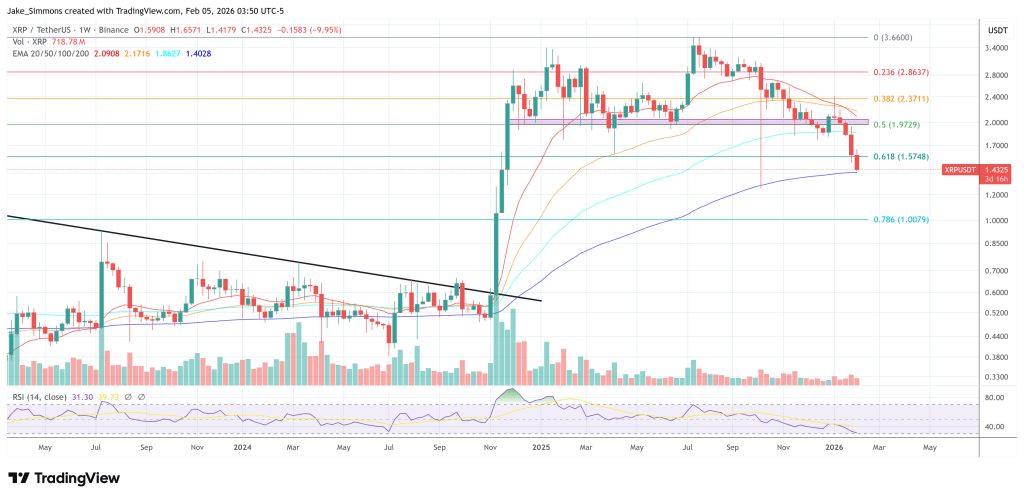
XRP falls to the 200-week EMA, 1-week chart | Source: XRPUSDT on TradingView.com

Related Questions

QWhat is the main allegation made by pro-XRP lawyer John Deaton against JPMorgan in the cryptocurrency market?

AJohn Deaton alleges that JPMorgan and other large banks are using 'paper markets' and heavy shorting via futures contracts to suppress the price of Bitcoin, similar to their past manipulative conduct in precious metals like silver.

QAccording to the article, what historical precedent does Deaton cite to support his claim of market manipulation?

ADeaton cites the historical precedent of JPMorgan's manipulative and deceptive conduct in precious-metals futures, for which the bank was ordered to pay over $920 million in penalties by the CFTC and DOJ for spoofing and wire fraud spanning at least eight years.

QHow does Mike Novogratz's comment about Bitcoin's price action relate to Deaton's argument?

AMike Novogratz remarked that 'Bitcoin was not supposed to act like this' and that 'something went wrong,' which Deaton used to frame the disconnect between supportive macro tailwinds and Bitcoin's stalled price, arguing it points to manipulation in the paper markets.

QWhat does Deaton mean by the 'Financialization of Bitcoin and Crypto' and who does he blame for it?

ADeaton means that traditional financial players, specifically naming JPMorgan and Jamie Dimon as the 'old guard,' are using derivatives and futures markets to exert control and suppress prices, which he calls a coordinated effort to keep the 'Digital Gold narrative in a cage.'

QWhat specific event in the silver market is mentioned as a current rumor on social media platform X?

AThe current rumor on X is that JPMorgan opened large short positions in silver around its record high of $121.64 and then covered those shorts during the sharp price slide down to around $73.575, profiting from the manipulation.

Related Reads

The AI Agent Era Accelerates Its Arrival: Questflow Defines a New Paradigm of Financial Intelligence with On-Chain AI Brokerage

The AI Agent era is accelerating, with the CB Insights AI 100 list highlighting global investment confidence. The focus has shifted from whether AI works to its speed of deployment and ability to manage complex workflows, with autonomous AI Agents driving this transformation. At the forefront is Questflow, a Singapore-based startup redefining financial intelligence through its on-chain AI brokerage. Unlike tools that merely provide data dashboards, Questflow deploys AI Agents that proactively scan markets, form judgments, and execute trades via a conversational interface—operating 24/7 without requiring manual confirmation for each decision. This embodies the new AI paradigm of agents capable of executing multi-step workflows autonomously. Questflow's mission is to democratize institutional-grade trading intelligence. Historically reserved for the ultra-wealthy, this capability is now accessible starting from just $1 through Questflow's "AI Clone + Copy Trade" model. The platform charges only a 1% execution fee, aligning its incentives directly with users and eliminating traditional management or performance fees. The timing is opportune, aligning with key trends identified by CB Insights: the scalable deployment of AI Agents, accelerated AI adoption in financial services, and the maturation of on-chain infrastructure. With robust liquidity on platforms like Hyperliquid and Polymarket, alongside advancements in AI reasoning and non-custodial wallet security, Questflow is positioned to merge the roles of broker, fund, and exchange into a single, accessible platform for millions.

链捕手15m ago

The AI Agent Era Accelerates Its Arrival: Questflow Defines a New Paradigm of Financial Intelligence with On-Chain AI Brokerage

链捕手15m ago

Why Pricing Social Interactions is Doomed to Fail?

Titled "Why Putting a Price on Social Interaction Is Doomed to Fail," this article critiques attempts to monetize social networks directly through SocialFi models, arguing their inevitable failure stems from a fundamental misunderstanding of media dynamics. Using Marshall McLuhan's theory of "hot" and "cold" media, the author posits that social networks are inherently "cold" media. Their value isn't contained in individual posts but is co-created through user participation, interpretation, and fragmented, ongoing interaction (e.g., replies, shares). This ambiguity and need for user involvement are core to their function. The article asserts that SocialFi projects like Friend.tech failed because introducing real-time, tradable financial pricing (a definitive "hot" signal) into this "cold" environment doesn't add a layer—it replaces the medium's essence. The unambiguous price signal overshadows and nullifies the nuanced, participatory social signal. Users become traders, not participants, and when speculative profits vanish, the underlying social ecosystem—never genuinely cultivated—collapses entirely. This principle extends beyond crypto. The author argues platforms like Twitter have gradually "heated up" through metrics (likes, retweets counts, algorithmically defined value), shifting users from participants to performers and eroding organic engagement. The solution isn't to abandon capital but to manage its entry point. Successful models like Substack, Patreon, or Bandcamp allow capital to "condense" at specific, isolated nodes (e.g., subscriptions, one-time payments) without permeating and "heating" every social interaction. They preserve the core "cold," participatory medium while enabling monetization at designated boundaries. The NFT boom and bust serves as a stark parallel: the ancient "cold" medium of collecting (valued for story, community, gradual accumulation) was rapidly destroyed by platforms that introduced real-time floor prices, rarity scores, and trading dashboards, transforming collectors into speculators and vaporizing cultural value when prices fell. The core lesson: "Liquidity equals heat." Injecting high liquidity and definitive pricing into a "cold" participatory medium doesn't optimize it; it fundamentally alters and destroys its value-creating mechanism. The future lies not in pricing every social gesture but in finding precise, non-invasive points for capital to condense without overheating the entire ecosystem.

marsbit23m ago

Why Pricing Social Interactions is Doomed to Fail?

marsbit23m ago

Jensen Huang's CMU Speech: In the AI Era, Don't Just Watch, Build

Jensen Huang, CEO of NVIDIA and a first-generation immigrant, delivered the commencement address to Carnegie Mellon University's class of 2026. He shared his personal journey from a humble background to founding NVIDIA, emphasizing resilience, learning from failure, and the responsibility that comes with leadership. Huang framed the present moment as the dawn of the AI revolution, a shift he believes is more profound than previous computing waves. He described AI as fundamentally resetting computing—moving from human-written software to machines that understand, reason, and use tools. This will create a new industry for generating intelligence and transform every sector. While acknowledging AI's potential to automate tasks and displace some jobs, Huang distinguished between the *tasks* of a job and its core *purpose*. He argued AI will augment human capability, not replace humans. The real risk, he stated, is not AI itself, but people being left behind by those who effectively use AI. He presented AI as a generational opportunity for massive infrastructure investment—in chip factories, data centers, energy grids, and advanced manufacturing—that could re-industrialize nations like the U.S. and bridge the digital divide by making computing and intelligent tools accessible to all. Huang called for a balanced approach: advancing AI safely and responsibly, establishing prudent policies, ensuring broad access, and encouraging universal participation. He urged the graduates not to fear the future but to engage with optimism and ambition, reminding them of CMU's motto, "My heart is in the work." His core message was clear: this is their moment to actively build and shape the AI-powered future, not merely observe it.

marsbit1h ago

Jensen Huang's CMU Speech: In the AI Era, Don't Just Watch, Build

marsbit1h ago

Trading

Spot
Futures

Hot Articles

What is $BITCOIN

DIGITAL GOLD ($BITCOIN): A Comprehensive Analysis Introduction to DIGITAL GOLD ($BITCOIN) DIGITAL GOLD ($BITCOIN) is a blockchain-based project operating on the Solana network, which aims to combine the characteristics of traditional precious metals with the innovation of decentralized technologies. While it shares a name with Bitcoin, often referred to as “digital gold” due to its perception as a store of value, DIGITAL GOLD is a separate token designed to create a unique ecosystem within the Web3 landscape. Its goal is to position itself as a viable alternative digital asset, although specifics regarding its applications and functionalities are still developing. What is DIGITAL GOLD ($BITCOIN)? DIGITAL GOLD ($BITCOIN) is a cryptocurrency token explicitly designed for use on the Solana blockchain. In contrast to Bitcoin, which provides a widely recognized value storage role, this token appears to focus on broader applications and characteristics. Notable aspects include: Blockchain Infrastructure: The token is built on the Solana blockchain, known for its capacity to handle high-speed and low-cost transactions. Supply Dynamics: DIGITAL GOLD has a maximum supply capped at 100 quadrillion tokens (100P $BITCOIN), although details regarding its circulating supply are currently undisclosed. Utility: While precise functionalities are not explicitly outlined, there are indications that the token could be utilized for various applications, potentially involving decentralized applications (dApps) or asset tokenization strategies. Who is the Creator of DIGITAL GOLD ($BITCOIN)? At present, the identity of the creators and development team behind DIGITAL GOLD ($BITCOIN) remains unknown. This situation is typical among many innovative projects within the blockchain space, particularly those aligning with decentralized finance and meme coin phenomena. While such anonymity may foster a community-driven culture, it intensifies concerns about governance and accountability. Who are the Investors of DIGITAL GOLD ($BITCOIN)? The available information indicates that DIGITAL GOLD ($BITCOIN) does not have any known institutional backers or prominent venture capital investments. The project seems to operate on a peer-to-peer model focused on community support and adoption rather than traditional funding routes. Its activity and liquidity are primarily situated on decentralized exchanges (DEXs), such as PumpSwap, rather than established centralized trading platforms, further highlighting its grassroots approach. How DIGITAL GOLD ($BITCOIN) Works The operational mechanics of DIGITAL GOLD ($BITCOIN) can be elaborated on based on its blockchain design and network attributes: Consensus Mechanism: By leveraging Solana’s unique proof-of-history (PoH) combined with a proof-of-stake (PoS) model, the project ensures efficient transaction validation contributing to the network's high performance. Tokenomics: While specific deflationary mechanisms have not been extensively detailed, the vast maximum token supply implies that it may cater to microtransactions or niche use cases that are still to be defined. Interoperability: There exists the potential for integration with Solana’s broader ecosystem, including various decentralized finance (DeFi) platforms. However, the details regarding specific integrations remain unspecified. Timeline of Key Events Here is a timeline that highlights significant milestones concerning DIGITAL GOLD ($BITCOIN): 2023: The initial deployment of the token occurs on the Solana blockchain, marked by its contract address. 2024: DIGITAL GOLD gains visibility as it becomes available for trading on decentralized exchanges like PumpSwap, allowing users to trade it against SOL. 2025: The project witnesses sporadic trading activity and potential interest in community-led engagements, although no noteworthy partnerships or technical advancements have been documented as of yet. Critical Analysis Strengths Scalability: The underlying Solana infrastructure supports high transaction volumes, which could enhance the utility of $BITCOIN in various transaction scenarios. Accessibility: The potential low trading price per token could attract retail investors, facilitating wider participation due to fractional ownership opportunities. Risks Lack of Transparency: The absence of publicly known backers, developers, or an audit process may yield skepticism regarding the project's sustainability and trustworthiness. Market Volatility: The trading activity is heavily reliant on speculative behavior, which can result in significant price volatility and uncertainty for investors. Conclusion DIGITAL GOLD ($BITCOIN) emerges as an intriguing yet ambiguous project within the rapidly evolving Solana ecosystem. While it attempts to leverage the “digital gold” narrative, its departure from Bitcoin's established role as a store of value underscores the need for a clearer differentiation of its intended utility and governance structure. Future acceptance and adoption will likely depend on addressing the current opacity and defining its operational and economic strategies more explicitly. Note: This report encompasses synthesised information available as of October 2023, and developments may have transpired beyond the research period.

363 Total ViewsPublished 2025.05.13Updated 2025.05.13

What is $BITCOIN

Discussions

Welcome to the HTX Community. Here, you can stay informed about the latest platform developments and gain access to professional market insights. Users' opinions on the price of BTC (BTC) are presented below.

活动图片











