Prediction Markets Cannot Exist Without Insider Trading, But Insider Trading Is Killing Them

marsbitPublished on 2026-04-27Last updated on 2026-04-27

Abstract

Prediction markets face a fundamental contradiction: they rely on insider trading to generate accurate prices, yet this same activity erodes public trust and threatens their survival. Recent scandals, such as a U.S. special forces member making $400,000 on Polymarket using classified information about a raid, highlight the severity of the issue. While platforms like Polymarket and Kalshi market themselves as venues where "everyone is an expert" and encourage informed trading, they also enforce policies against illegal insider trading. The core dilemma is that these markets depend on informed insiders for price efficiency but require uninformed retail participants to provide liquidity. If insider trading is too rampant, retail traders leave, perceiving the market as unfair. If restrictions are too strict, valuable information flow dries up, reducing the market’s predictive utility. The challenge is finding a balance that maintains both accuracy and perceived fairness—a task complicated by regulatory pressures and recurring scandals.

Author: Nic Carter

Compiled by: Deep Tide TechFlow

Deep Tide Introduction: A U.S. Special Forces soldier made $400,000 on Polymarket using classified information, and this is just the latest scandal. Nic Carter points out that prediction markets are stuck in a vicious cycle: they rely on insider trading to generate accurate prices, but this makes retail investors feel the market is manipulated and leave. This contradiction determines whether prediction markets can survive in the long term.

As I wrote in February of this year, prediction markets have a serious insider trading problem, and this is no accident. This leads to a major failure mode:

The social value of prediction markets comes from using monetary incentives to get insiders to leak confidential information, but this destroys retail investor confidence in the market over time.

Two days ago, the biggest scandal to date broke. The U.S. Department of Justice charged Special Forces Sergeant Major Gannon Ken Van Dyke with improper trading using classified information. Before the Maduro raid mission, he made $400,000 on Polymarket. He was not an ordinary soldier but a senior Green Beret member responsible for special operations planning and execution.

To be clear, although many people are calling for leniency for him because (legal) insider trading is widespread among members of Congress, he should still go to jail. His actions potentially leaked raid information to Venezuelans through trading activities, which is morally and legally problematic. Although the Venezuelans don't seem to have noticed, the government cannot set a precedent where elite operatives leak details of upcoming operations through market activities for personal gain. I sympathize with Van Dyke, but he did break the law and the confidentiality he swore to uphold.

This is just the latest in a series of real or suspected insider trading scandals on prediction markets. Previously, Israel arrested two reservists for using military intelligence to trade on Polymarket. Markets concerning the start time of the Iran war, ceasefire agreements, the killing of Khamenei, and Biden's pardon order have also been under suspicion, but no arrests have been made yet. Kalshi and Polymarket have also flagged and suspended accounts trading in markets where they had a vested interest, such as three congressional candidates betting on their own election markets.

You might think that as more people realize that trading with confidential information is illegal not only in securities markets but also in prediction markets, these problems would disappear. But I think the issue is deeper.

The premise of prediction markets is that they are informationally efficient because they reward informed insiders.

In other words, prediction markets are "good" because they aggregate a large number of uninformed retail investors, who create economic incentives for insiders to reveal private information. (This concept—that retail investors create incentives for informed insiders to participate—is well-documented in financial literature, and a recent paper further extends it to prediction markets.) Prediction markets can then reliably promote themselves as having social utility because they indeed provide better, more timely signals than other platforms (experts, polls, etc.). Kalshi and Polymarket both know this but are reluctant to explicitly admit it. But they do hint at it in their marketing!

Kalshi's CEO Tarek Mansour explicitly stated on the Sourcery podcast that "There is no such thing as insider trading in commodity markets. It's all insider trading actually," which is... an extremely creative interpretation of the law. He added:

I think there is a subset of non-public information that (traders) cannot trade on, but I think we are restricting it a bit too much right now.

Kalshi has used slogans like "Trade Anything" and "Everyone is an Expert at Something," both of which imply that ordinary people can monetize any privileged information they happen to have on the platform.

Polymarket's CEO Shayne Coplan had this exchange with CBS last year:

Anderson Cooper: But prediction markets do rely on some people having inside information.

Shayne Coplan: Mhmm. Yes. I think it's a good thing that people have an edge in the market. Obviously, you need to manage them, need to be very clear and strict about drawing the lines, like on the ethics side, we spend a lot of time on that. But it's somewhat inevitable, and there's a lot of good that comes from it. You know, people will adapt.

Shayne has also said that prediction markets are "the most accurate thing that we have as humans right now, until someone creates some sort of super crystal ball." Some of that accuracy comes from insiders.

Robinhood's CEO Vlad Tenev (partnering with Kalshi) said:

Prediction markets actually allow you to get news faster, in some cases even before it happens. I think it does have tremendous economic value.

Economist Robin Hanson, considered by many to be the godfather of prediction markets, directly accepts this view and has written extensive defenses of insider trading in prediction markets. In 2024 he said:

If the purpose of the (prediction) market is to get accurate information in the price, then you definitely want to allow insiders to trade, even if that makes other people less willing to bet because they think it's unfair, because it makes the price more accurate. That's the priority.

I must point out that both Kalshi and Polymarket have anti-insider trading policies. Kalshi is regulated by the CFTC and has been explicit about prohibiting trading based on Material Non-Public Information (MNPI) and conducts market surveillance. When I wrote my last blog in February, I noted that Polymarket did not explicitly sanction insider trading, but in March they updated their rulebook, adding detailed prohibitions against trading of the following types:

  • Trading based on stolen confidential information (if you are a soldier, the battle plan does not belong to you, it belongs to the government)
  • Trading based on information illegally passed to you by an insider
  • Trading on any contract where you can influence the outcome

The point of this section is not to blame Kalshi or Polymarket or their leadership for implying that traders have an informational advantage. I think their policies (updated in March 2026) are clear enough. Instead, I want to point out the fundamental contradiction plaguing these markets:

Prediction markets rely on informed traders to generate accurate prices, but they also rely on uninformed traders to create the economic incentive to attract informed order flow. This creates a tension:

  • If they are too permissive towards insider trading, uninformed traders may exit due to a perceived lack of fairness
  • If they are too restrictive towards insider trading, the markets may exclude their most valuable source of information

Thus, there is a trade-off between informational efficiency and perceived fairness. Here is a visual version of the same idea:
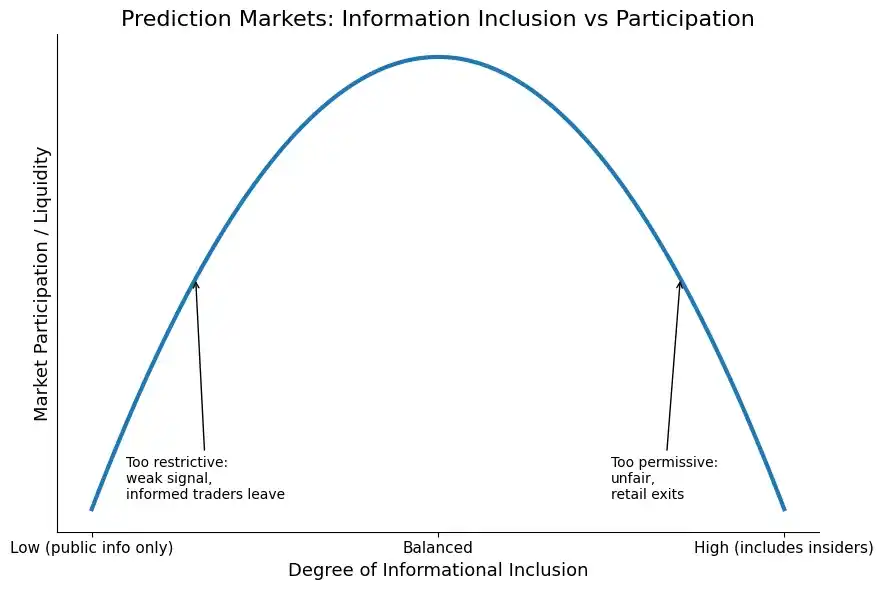
Chart: The Trade-off Curve Between Informational Efficiency and Perceived Fairness

So we end up with a few different failure modes:

Too Many Sharks, They Eat All the Fish

Insider trading standards are too loose, the market becomes very informationally efficient, but retail investors clearly feel the market is "rigged," that they are always betting against insiders. Therefore, retail leaves, and market liquidity decreases. This is the failure mode I talked about before. This is where we are now, but I think we will rebound in the other direction.

No Sharks, No Edge

This is the other end of the spectrum. Insider trading is strictly policed on the platform, with real-time market surveillance and strong regulatory reporting, so informed order flow stays away. The markets thus produce less socially valuable information, becoming mere sentiment aggregators rather than generating "news before the news." Therefore, the platform cannot market itself effectively.

The existential question is whether there is a golden mean: where liquidity is maximized, retail feels the market is "fair enough," and informed order flow is still compensated for its information gathering. The chart suggests it might exist, but reality is messier.

My prediction from February still holds. As I said then:

A serious risk remains that insider trading scandals will make retail traders feel the market is manipulated, causing them to abandon the platform. I predict a string of insider trading events this year that will convince platforms to significantly strengthen market surveillance and lead Polymarket in particular to move away from anonymous modes.

I expect Polymarket will remove the ability to trade without KYC entirely (this is currently the case for the non-US platform) and strengthen the flagging of suspicious trading on the platform. There will be a slew of criminal cases regarding stolen insider information, but the temptation will remain. While platforms won't admit it, there is a "socially optimal" amount of insider trading. But can they calibrate it optimally? Will regulators allow them to?

It's worth noting that not all informed traders are insiders. You can become informed by collecting public information and trading on it. But a subset of informed traders are indeed insiders misappropriating information.


Related Questions

QWhat is the core contradiction that prediction markets face according to the article?

APrediction markets rely on informed traders (insiders) to generate accurate prices, but they also depend on uninformed traders to create the economic incentive that attracts that informed flow. This creates a tension: if insider trading is too tolerated, uninformed traders may leave feeling the market is unfair; if it is too restricted, the market loses its most valuable source of information.

QWhat are the two main failure modes for prediction markets described in the text?

AThe two failure modes are: 1. Too many sharks (insiders), which scares away the fish (retail traders) because the market feels manipulated. 2. No sharks, no edge, where strict regulation of insider trading drives away informed traders, reducing the market's social value and making it merely an aggregator of sentiment.

QHow did the recent case involving Gannon Ken Van Dyke illustrate the problem with prediction markets?

AThe case illustrated the problem as Van Dyke, a senior Green Beret, used classified information about an impending raid on Maduro to trade on Polymarket, making $400,000. This is a clear example of how the markets incentivize the leakage of confidential information, which can damage operational security and public trust.

QWhat is the proposed 'social value' of prediction markets, and what is the mechanism that enables it?

AThe proposed social value is that prediction markets provide a better, more accurate, and timely signal than other platforms like experts or polls. The mechanism that enables this is the aggregation of uninformed retail traders, which creates a financial incentive for informed insiders to reveal their private information, thus making the market informationally efficient.

QWhat specific policy change did Polymarket make in March 2026 in response to insider trading concerns?

AIn March 2026, Polymarket updated its rulebook to include a detailed ban on trading based on: 1. stolen confidential information, 2. information illegally passed to you from an insider, and 3. any contract where you can influence the outcome.

Related Reads

Must-Watch Events Next Week|CLARITY Act Could Face Senate Vote; SpaceX, Circle to Report Earnings (8.3-8.9)

**Summary: Key Events and Developments to Watch (August 3-9)** The upcoming week is marked by significant financial disclosures, key legislative deadlines, and notable product updates. **Major Financial Events:** Several companies are scheduled to release their Q2 2026 earnings. American Bitcoin (ABTC) will report on August 3, followed by SpaceX and Hut 8 Mining Corp. on August 4, and Circle on August 5. Notably, a significant portion of SpaceX shares (up to 12% of total shares) will be unlocked on August 6 following their earnings release. **Key Legislative Deadline:** The U.S. Senate faces an August 7 deadline to secure 60 votes for the CLARITY Act, a bipartisan bill aiming to establish a federal regulatory framework for cryptocurrencies. The Senate may hold a full vote on the bill during the week. **Economic Data:** The U.S. July Non-Farm Payrolls report will be released on August 7, providing crucial labor market data. **Technology & Product Updates:** * **Shutdowns:** DeFi portfolio tracker Zapper and wallet app Ctrl Wallet will cease operations on August 3. * **Upgrades:** LayerZero will deprecate its v1 relayers on August 3. XRP Ledger's new version 3.3.0, featuring five new functions, is expected next week. * **AI:** Elon Musk announced that the advanced Grok 4.6 AI model is set for release around August 7. * **Bitcoin:** The BIP-110 forced signaling for a potential Bitcoin network change is scheduled to begin around August 8. **Other Notable Events:** Chinese robotics firm Unitree Tech has set its preliminary price inquiry for its IPO for August 5. South Korean exchange Upbit will delist AQT and AERGO tokens on August 3.

marsbit21m ago

Must-Watch Events Next Week|CLARITY Act Could Face Senate Vote; SpaceX, Circle to Report Earnings (8.3-8.9)

marsbit21m ago

Stocks Are Plummeting More Sharply Than Cryptocurrencies. Where Has the Money Gone?

Stock Markets Plunge Deeper Than Cryptocurrencies: Where Did the Money Go? In late July, Seoul's Kospi index triggered circuit breakers for two consecutive days, plummeting over 40% from its June high. The collapse was led by heavyweight stocks like SK Hynix, whose record profits still disappointed investors, and devastating leveraged ETFs, with one major product losing over 83% of its value. This signaled a global, forced deleveraging targeting the most crowded trades. Interestingly, while stocks exhibited extreme volatility akin to crypto markets, Bitcoin rose nearly 15% in July after a prior steep drop. Analysis shows the money fleeing equities did not flow into Bitcoin. Instead, Bitcoin had already absorbed its sell-off in May-June, when U.S. spot Bitcoin ETFs saw historic outflows. The true safe-haven beneficiary was gold, whose price rose over 20% year-on-year, highlighting a decoupling between Bitcoin and gold as "digital gold." The sell-off was a targeted unwinding of leveraged positions in tech and semiconductors, accelerated by broker-dealer risk management and shifts in the AI narrative, including new competition from Chinese memory chipmakers. The retreat path was clear: from high-valuation tech stocks to cash and U.S. Treasuries, then to gold. For Bitcoin to attract sustained institutional inflows, conditions like eased global liquidity pressure, a "soft-landing" Fed rate cut, and U.S. regulatory clarity via legislation like the stalled CLARITY Act are needed. Currently, Bitcoin is not a safe haven but an already-cleared asset. Its low correlation with tech stocks, however, makes it a potential diversification play for institutional portfolios once the storm passes. The money isn't here yet, but the positioning is underway.

marsbit21m ago

Stocks Are Plummeting More Sharply Than Cryptocurrencies. Where Has the Money Gone?

marsbit21m ago

In Conversation with Ray Dalio: We Are Currently in an AI Bubble, with 1% of My Portfolio in Bitcoin

Ray Dalio, founder of Bridgewater Associates, warns in an interview that the current AI boom shows classic bubble characteristics, which could lead to significant economic downturns as seen in past cycles like 1929 or 2000. He explains that speculative enthusiasm, fueled by debt and overvaluation, often precedes a crash when rising rates or taxation force asset sales, causing widespread losses and recession. Dalio also outlines his "Big Cycle" theory, describing an approximate 80-year pattern where widening wealth gaps, massive government deficits, and shifting geopolitical power (like China's rise) create internal conflict and global instability. He emphasizes that we are in a late-cycle, transitional phase where traditional powers like the US and UK face decline. For personal wealth protection, Dalio advises diversification beyond cash into assets like stocks, bonds, real estate, and particularly gold, which he prefers over Bitcoin. While he holds about 1% of his portfolio in Bitcoin as a non-printable hard asset, he views gold as more secure from technological or governmental threats. Regarding AI's impact, Dalio believes it will disproportionately benefit capital owners, worsening inequality by replacing both physical and cognitive labor. He suggests that human intuition and emotional intelligence, combined with AI, will be key for future workers. On taxation, Dalio argues that wealth taxes are impractical and risk triggering asset sell-offs, reducing productive investment. He points to the UK as a cautionary example of debt, low productivity, and political strife. Geopolitically, Dalio foresees a more regionalized world, with the US showing weakness in prolonged conflicts like with Iran, akin to past imperial declines. The ideal outcome, he suggests, is coexisting powerful blocs (e.g., Americas, China-Asia Pacific) without major war.

marsbit4h ago

In Conversation with Ray Dalio: We Are Currently in an AI Bubble, with 1% of My Portfolio in Bitcoin

marsbit4h ago

Daily 7.2 Trillion KRW: Foreign Capital's Record Net Buying on Friday! Wall Street Says Headwinds for Korean Stock Fund Flows Have Subsided

South Korean stock market sees a dramatic shift in fund flows. On July 31, foreign investors made a record net purchase of approximately KRW 7.2 trillion in KOSPI stocks, marking a fundamental reversal from the persistent large-scale net outflows seen in previous months. This contributed to a significant narrowing of foreign net selling in July to KRW 9.8 trillion, down sharply from KRW 48.4 trillion in June and KRW 44.5 trillion in May. Simultaneously, domestic institutional pressure eased. South Korean pension funds and asset managers turned to a net buying position in July, purchasing KRW 1.0 trillion worth of KOSPI shares, contrasting with net sales in May and June. Market volatility is expected to be dampened by new financial regulations. Effective July 31, the Financial Services Commission tightened access for retail investors to single-stock leveraged ETFs by raising the minimum cash deposit requirement. Trading volumes for these products subsequently dropped to about 50% of their monthly average. Citigroup Research maintains its year-end KOSPI target of 10,000 points. The firm cites several supportive factors: the substantial easing of headwinds from capital outflows, a robust fundamental outlook for the semiconductor sector, historically low market valuations, strong economic fundamentals, and the potential for policy support from financial authorities if needed.

marsbit4h ago

Daily 7.2 Trillion KRW: Foreign Capital's Record Net Buying on Friday! Wall Street Says Headwinds for Korean Stock Fund Flows Have Subsided

marsbit4h ago

Trading

Spot
活动图片




