Pre-FOMC Tension: Will Bitcoin Repeat Its Post-Cut Pattern?

bitcoinistPublished on 2025-12-11Last updated on 2025-12-11

Abstract

Bitcoin is holding above $92,000 but sentiment remains bearish ahead of the Federal Reserve's rate decision. Historically, Bitcoin often rallies before Fed rate cuts but shows muted or negative reactions afterward, as markets price in the move in advance. A CryptoQuant report notes that past cuts, like those in September 2025, saw little immediate price movement or brief rallies followed by declines. This suggests a "buy the rumor, sell the news" pattern may occur again. Monitoring leverage, open interest, and liquidity flows is key to anticipating short-term volatility around the FOMC announcement.

Bitcoin is holding firm above the $92,000 level after rebounding from last week’s dip toward $90,000, offering bulls a brief moment of relief. Yet despite this stabilization, market sentiment remains decisively bearish, with many traders expecting further downside unless a clear shift in momentum emerges. The timing couldn’t be more crucial: the Federal Reserve’s upcoming rate decision has become the central focus for investors, and the market is bracing for heightened volatility.

According to a new CryptoQuant report, Bitcoin’s historical behavior around rate cuts offers meaningful context. Over the years, Fed interest rate cuts have generally aligned with upward movements in BTC, largely because lower rates weaken the US dollar, stimulate liquidity, and support risk assets. However, the report highlights an important nuance—the immediate reaction is rarely straightforward.

In several past instances, Bitcoin rallied ahead of rate cuts, only to show muted or even negative price action once the decision was announced, indicating that markets had already priced in the move.

This dynamic creates a layer of uncertainty heading into the FOMC meeting. While macro conditions align with long-term bullish trends for Bitcoin, the short-term outlook remains fragile, shaped by sentiment, positioning, and the market’s anticipation rather than the announcement itself.

Historical Patterns Signal Caution Ahead of the FOMC

According to the report by GugaOnChain on CryptoQuant, Bitcoin’s past reactions to Federal Reserve rate cuts offer a clear framework for understanding the risks heading into this week’s FOMC meeting. The historical data paints a picture of mixed and often counterintuitive behavior.

For example, following the 25 basis point cuts in September 2025, Bitcoin barely reacted at all. In another instance, BTC surged to a four-week high—only to drop nearly $2,000 shortly after, settling into a period of muted stability. These reactions underscore how quickly sentiment can shift once policy decisions are fully priced in.

Volatility has also played a defining role. Both the September and October rate decisions triggered brief pre-FOMC rallies, followed by notable declines once the announcements were made. After the September cut, volatility spiked sharply as traders unwound leveraged positions, revealing how sensitive Bitcoin remains to event-driven positioning.
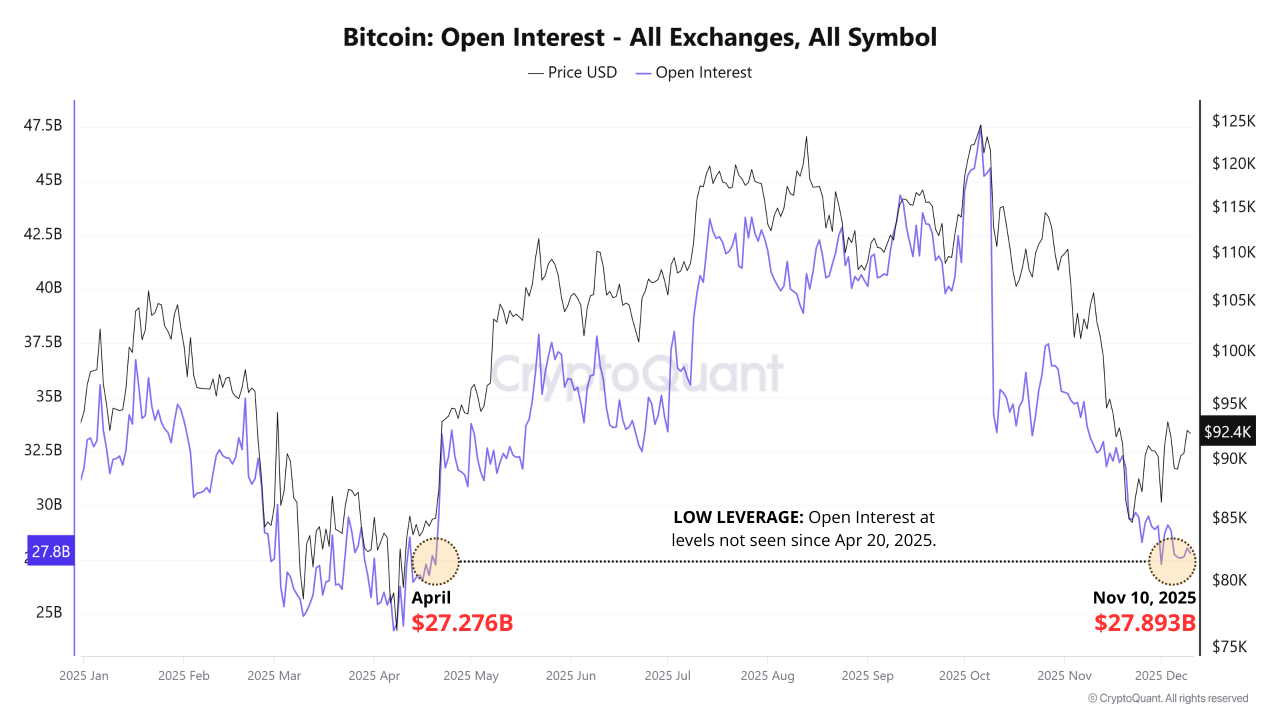
Bitcoin Open Interest | Source: CryptoQuant

This leads to the recurring “buy the rumor, sell the news” pattern, a dynamic that GugaOnChain warns could repeat. Because of this, monitoring market leverage—including funding rates and open interest—is crucial. Equally important are liquidity flows, such as exchange reserves and ETF activity. Together, these indicators help traders anticipate short-term price movements as Bitcoin prepares for another potentially volatile macro event.


Related Reads

Dialogue with Morgan Stanley Executive: Wall Street Isn't Rejecting Bitcoin, It's Just Waiting for the Right Time

In a podcast interview, Amy Oldenburg, Head of Digital Asset Strategy at Morgan Stanley, discusses Wall Street's evolving stance on Bitcoin, explaining the bank's measured approach and the road ahead. Oldenburg, with 26 years at Morgan Stanley, traces her perspective to witnessing transformative tech cycles and her experience in emerging markets, where she observed the need for alternative financial systems like mobile money (e.g., M-Pesa). This background informs her view of Bitcoin's value proposition. She clarifies that Morgan Stanley is "client-driven." Regulatory hurdles, particularly as a bank holding company under Federal Reserve oversight, initially slowed their entry. While the firm couldn't act as quickly as independent asset managers, persistent client demand and a changing regulatory environment led to offerings like their low-fee Bitcoin ETP (MSBT). They are now gradually rolling out spot Bitcoin trading on their E*Trade platform. Regarding advisor adoption, Oldenburg cites a "lack of education" as the primary barrier. Morgan Stanley recommends a 0-2% allocation for more conservative portfolios and 2-4% for aggressive ones, but price volatility and confusion about its place in asset allocation persist. She notes competition for investor attention from AI and commodities. Addressing Bitcoin's price stagnation despite institutional buying, Oldenburg points to a confluence of factors: competing investment narratives (AI, quantum computing) and the complex financial landscape. She suggests a catalyst for Bitcoin as a neutral reserve asset might require a "slow-burn crisis" that exposes fragility in traditional systems. For wider bank adoption, including holding Bitcoin on balance sheets, she identifies the need for regulatory clarity to reduce punitive capital treatment and for the asset to be usable as collateral within financial ecosystems. Looking ahead, Oldenburg predicts steady, moderate adoption growth through 2030 rather than an explosive "J-curve." She emphasizes the importance of differentiating Bitcoin from other crypto assets and expresses concern that the core cypherpunk ethos of self-custody is being diluted as traditional finance enters the space. She concludes that the digital asset field remains in its early stages with significant innovation, like AI agents and micropayments, still to come.

marsbit17m ago

Dialogue with Morgan Stanley Executive: Wall Street Isn't Rejecting Bitcoin, It's Just Waiting for the Right Time

marsbit17m ago

10% Position Limit Proposed: UK Retail Authorized Funds to Gain Indirect Exposure to Crypto Assets

The UK Financial Conduct Authority (FCA) is consulting on a proposal (CP26/17) that would allow retail funds, including UCITS and most Non-UCITS Retail Schemes (NURS), to invest up to 10% of their total assets in cryptoasset exchange-traded notes (crypto ETNs). This would enable indirect exposure to cryptoassets for mainstream investors through regulated funds. The rule maintains the existing prohibition on funds holding underlying cryptocurrencies like Bitcoin or Ethereum directly. The proposal introduces a strict 10% cap, positioning crypto ETNs as a potential satellite holding within diversified portfolios. Funds must ensure these investments align with their stated objectives and risk profiles. Notably, the cap does not apply to Qualified Investor Schemes (QIS) for professional clients, while Long-Term Asset Funds (LTAFs) would be prohibited from holding crypto ETNs. This move builds on the FCA's 2025 decision to permit retail trading of crypto ETNs on UK regulated exchanges. However, significant compliance burdens fall on fund managers, who must conduct thorough due diligence, assess liquidity, and provide clear risk disclosures to investors. The FCA emphasizes that even a small allocation can significantly impact a fund's risk profile. The policy's practical impact remains uncertain. Widespread adoption depends on whether asset managers deem the potential benefits worth the operational costs, disclosure requirements, and reputational risks. The consultation is open for feedback until July 13, 2026. Ultimately, the proposal represents a cautious, incremental step toward integrating cryptoassets into the regulated fund landscape, rather than a broad opening.

Foresight News46m ago

10% Position Limit Proposed: UK Retail Authorized Funds to Gain Indirect Exposure to Crypto Assets

Foresight News46m ago

Public Version of Mythos Officially Launched: Analyzing the Advantages and Limitations of AI Smart Contract Auditing

Publicly available Mythos, Anthropic's AI model, has officially launched, demonstrating both significant potential and limitations in smart contract security auditing. The article analyzes its capabilities through real-world cases. AI excels in identifying subtle, low-level vulnerabilities through pattern recognition and large-scale code screening. A key example is detecting a storage slot collision between a custom rewards mapping and a third-party library's ReentrancyGuard, a vulnerability easily missed in manual audits. In the recent Zcash incident, AI also rapidly discovered a critical soundness bug that had remained hidden for years. However, AI currently struggles with complex, interconnected scenarios. When tested on the Curve LlamaLend sDOLA exploit, which involved manipulating prices across multiple protocols (Curve pools, lending markets) to trigger liquidations, Fable 5 failed to identify the core cross-protocol attack vector. These scenarios require a deep understanding of DeFi economic models and multi-contract interactions. In conclusion, while AI tools like Mythos significantly boost efficiency in finding standardized, syntactic vulnerabilities, they cannot yet replace expert analysis for complex, business-logic, and cross-protocol attacks. An effective audit workflow combines AI's speed for initial screening with human expertise for in-depth, holistic analysis.

marsbit51m ago

Public Version of Mythos Officially Launched: Analyzing the Advantages and Limitations of AI Smart Contract Auditing

marsbit51m ago

Trade.xyz's Rebase Refusal Sparks Controversy, On-Chain Pre-IPO Market Faces Major Pricing Test

The debate surrounding Trade.xyz's refusal to adjust its SPCX (SpaceX pre-IPO) perpetual contract pricing amid updated share count revelations highlights a key challenge for on-chain pre-IPO markets. While several centralized exchanges (CEXs) paused and repriced their contracts after SpaceX's filing showed a ~10% increase in total shares, Trade.xyz maintained its market-driven pricing logic, which tracks expected per-share price sentiment rather than fundamental valuation metrics like market cap. This discrepancy triggered cross-platform arbitrage and caused leveraged long positions on Trade.xyz to suffer significant losses, as the platform's HIP-3 architecture lacks a native "Rebase" mechanism to neutrally adjust all user positions following such corporate actions. The incident underscores the difficulty for decentralized perpetual exchanges (Perp DEXs) to implement Rebase—a process CEXs handle by centrally pausing markets and adjusting ledger data. On-chain, this requires complex smart contract modifications, increasing gas costs, complexity, and potential attack surfaces. While some DEXs have managed similar adjustments, Trade.xyz's current design does not natively support it, though the team is reportedly exploring solutions for future events like stock splits. Ultimately, the controversy serves as a critical case study for the nascent on-chain pre-IPO sector, raising questions about price discovery reliability, transparent rule disclosure, and the readiness of DeFi infrastructures to handle traditional corporate actions as real-world assets (RWAs) gain traction.

marsbit59m ago

Trade.xyz's Rebase Refusal Sparks Controversy, On-Chain Pre-IPO Market Faces Major Pricing Test

marsbit59m ago

Trading

Spot
Futures

Hot Articles

What is $BITCOIN

DIGITAL GOLD ($BITCOIN): A Comprehensive Analysis Introduction to DIGITAL GOLD ($BITCOIN) DIGITAL GOLD ($BITCOIN) is a blockchain-based project operating on the Solana network, which aims to combine the characteristics of traditional precious metals with the innovation of decentralized technologies. While it shares a name with Bitcoin, often referred to as “digital gold” due to its perception as a store of value, DIGITAL GOLD is a separate token designed to create a unique ecosystem within the Web3 landscape. Its goal is to position itself as a viable alternative digital asset, although specifics regarding its applications and functionalities are still developing. What is DIGITAL GOLD ($BITCOIN)? DIGITAL GOLD ($BITCOIN) is a cryptocurrency token explicitly designed for use on the Solana blockchain. In contrast to Bitcoin, which provides a widely recognized value storage role, this token appears to focus on broader applications and characteristics. Notable aspects include: Blockchain Infrastructure: The token is built on the Solana blockchain, known for its capacity to handle high-speed and low-cost transactions. Supply Dynamics: DIGITAL GOLD has a maximum supply capped at 100 quadrillion tokens (100P $BITCOIN), although details regarding its circulating supply are currently undisclosed. Utility: While precise functionalities are not explicitly outlined, there are indications that the token could be utilized for various applications, potentially involving decentralized applications (dApps) or asset tokenization strategies. Who is the Creator of DIGITAL GOLD ($BITCOIN)? At present, the identity of the creators and development team behind DIGITAL GOLD ($BITCOIN) remains unknown. This situation is typical among many innovative projects within the blockchain space, particularly those aligning with decentralized finance and meme coin phenomena. While such anonymity may foster a community-driven culture, it intensifies concerns about governance and accountability. Who are the Investors of DIGITAL GOLD ($BITCOIN)? The available information indicates that DIGITAL GOLD ($BITCOIN) does not have any known institutional backers or prominent venture capital investments. The project seems to operate on a peer-to-peer model focused on community support and adoption rather than traditional funding routes. Its activity and liquidity are primarily situated on decentralized exchanges (DEXs), such as PumpSwap, rather than established centralized trading platforms, further highlighting its grassroots approach. How DIGITAL GOLD ($BITCOIN) Works The operational mechanics of DIGITAL GOLD ($BITCOIN) can be elaborated on based on its blockchain design and network attributes: Consensus Mechanism: By leveraging Solana’s unique proof-of-history (PoH) combined with a proof-of-stake (PoS) model, the project ensures efficient transaction validation contributing to the network's high performance. Tokenomics: While specific deflationary mechanisms have not been extensively detailed, the vast maximum token supply implies that it may cater to microtransactions or niche use cases that are still to be defined. Interoperability: There exists the potential for integration with Solana’s broader ecosystem, including various decentralized finance (DeFi) platforms. However, the details regarding specific integrations remain unspecified. Timeline of Key Events Here is a timeline that highlights significant milestones concerning DIGITAL GOLD ($BITCOIN): 2023: The initial deployment of the token occurs on the Solana blockchain, marked by its contract address. 2024: DIGITAL GOLD gains visibility as it becomes available for trading on decentralized exchanges like PumpSwap, allowing users to trade it against SOL. 2025: The project witnesses sporadic trading activity and potential interest in community-led engagements, although no noteworthy partnerships or technical advancements have been documented as of yet. Critical Analysis Strengths Scalability: The underlying Solana infrastructure supports high transaction volumes, which could enhance the utility of $BITCOIN in various transaction scenarios. Accessibility: The potential low trading price per token could attract retail investors, facilitating wider participation due to fractional ownership opportunities. Risks Lack of Transparency: The absence of publicly known backers, developers, or an audit process may yield skepticism regarding the project's sustainability and trustworthiness. Market Volatility: The trading activity is heavily reliant on speculative behavior, which can result in significant price volatility and uncertainty for investors. Conclusion DIGITAL GOLD ($BITCOIN) emerges as an intriguing yet ambiguous project within the rapidly evolving Solana ecosystem. While it attempts to leverage the “digital gold” narrative, its departure from Bitcoin's established role as a store of value underscores the need for a clearer differentiation of its intended utility and governance structure. Future acceptance and adoption will likely depend on addressing the current opacity and defining its operational and economic strategies more explicitly. Note: This report encompasses synthesised information available as of October 2023, and developments may have transpired beyond the research period.

363 Total ViewsPublished 2025.05.13Updated 2025.05.13

What is $BITCOIN

Discussions

Welcome to the HTX Community. Here, you can stay informed about the latest platform developments and gain access to professional market insights. Users' opinions on the price of BTC (BTC) are presented below.

活动图片