Popular Crypto Analyst Reveals New Bitcoin Price Target That Has Got The Community Moving

bitcoinistPublished on 2025-12-09Last updated on 2025-12-09

Abstract

Renowned analyst Peter Brandt has unveiled new Bitcoin price targets, sparking widespread discussion among traders. His analysis comes as BTC shows signs of cooling and has broken below its previous support structure. Brandt identifies two key corrective zones: near $81,852 and $59,403, derived from a completed five-leg advance pattern resembling a rising wedge. He frames this pullback as a normalisation event within Bitcoin’s historical cycle, not a threat to long-term strength. Currently trading around $90,175, Bitcoin’s movement near the breakdown level has intensified focus on these targets. Brandt’s analysis provides strategic guidance, highlighting potential stabilisation zones for traders to monitor amid short-term volatility.

Renowned analyst Peter Brandt has unveiled a new set of Bitcoin price targets that have quickly sparked discussion across trading communities. His updated technical roadmap comes as BTC shows signs of cooling, prompting traders to reassess its recent price movement. With Bitcoin slipping beneath the structure that supported its multi-month climb, Brandt’s projected corrective zones have become a central focus in the market’s debate over where the asset may be headed next.

Bitcoin Price’s Structural Breakdown Raises The Stakes For Crypto Traders

In a recent post on X, Brandt outlined his latest outlook, highlighting a completed five-leg advance — a classic sequence often linked to trend exhaustion when price stretches too far without meaningful resets. In this case, the formation appears as a rising wedge, a pattern known for producing sharp shifts once its lower boundary is breached. That breach has now happened, marking what Brandt interprets as a structural turning point rather than a panic-driven drop.
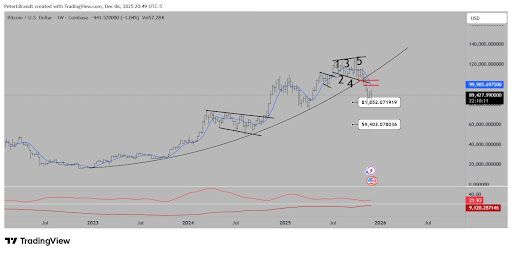
Source: Peter Brandt on X

From the breakdown, two corrective regions emerge: near $81,852 and $59,403. These targets are drawn directly from the proportions of Bitcoin’s recently completed structure, giving them a grounded, technical foundation. Brandt frames the pullback as a normalization event, one that fits neatly into Bitcoin’s historical rhythm of expansions followed by methodical cooldowns. Instead of portraying the situation as a threat to long-term strength, the analysis positions the zones as potential resting points where the market could stabilize before setting its next course.

There is also a familiar pattern echoing through the charts — a reminder of late 2021, when sentiment surged ahead of structural reality and the market eventually recalibrated. While conditions today are not identical, the resemblance underscores how expectations and chart formations often move in parallel. In both scenarios, a strong run gave way to a controlled corrective period.

Brandt’s roadmap follows a clear sequence: formation completion, slope-line violation, and defined landing zones. Each step reinforces the next, forming a cohesive narrative that explains why this chart has quickly gained traction among crypto traders monitoring short-term volatility.

Brandt’s Targets Offer Strategic Guidance For Crypto Traders

Bitcoin is currently trading at $90,175, reflecting a 1.9% dip over the past 24 hours alongside a 4.4% gain across the last seven days. The price sits close to the level where the structural break first appeared, amplifying interest in Brandt’s outlined targets. Traders are now assessing whether the asset is preparing for a deeper corrective sweep or simply entering a consolidation phase before another directional move.

Ultimately, Brandt’s targets are intended to guide traders rather than alarm them. They highlight likely equilibrium zones during routine market resets, offering reference points where Bitcoin could stabilize after extended rallies. By framing the analysis this way, traders are encouraged to approach the market with a measured strategy and sharper precision, rather than reacting impulsively to short-term fluctuations.

BTC moves low after recovery | Source: BTCUSD on Tradingview.com

Related Reads

How Many Tokens Away Is Yang Zhilin from the 'Moon Chasing the Light'?

The article explores the intense competition between two leading Chinese AI companies, DeepSeek and Kimi (Moon Dark Side), and the mounting pressure on Yang Zhilin, the founder of Kimi. While DeepSeek re-emerged after 15 months of silence with its powerful V4 model—boasting 1.6 trillion parameters and low-cost, long-context capabilities—Kimi has been focusing on long-context processing and multi-agent systems with its K2.6 model. Yang faces a threefold challenge: technological rivalry, commercialization pressure, and investor expectations. Despite Kimi’s high valuation (reaching $18 billion), its revenue heavily relies on a single product with low paid conversion rates, while DeepSeek’s strategic silence and open-source influence have strengthened its market position and valuation prospects, now targeting over $20 billion. Both companies reflect broader trends in China’s AI ecosystem: Kimi aims for global influence through open-source contributions and agent-based advancements, while DeepSeek prioritizes foundational innovation and hardware independence, notably shifting to Huawei’s chips. Their competition is seen as vital for China’s AI progress, with the gap between top Chinese and U.S. models narrowing to just 2.7% on the Elo rating scale. Ultimately, the article argues that this rivalry, though anxiety-inducing for leaders like Zhilin, is essential for driving innovation and solidifying China’s role in the global AI landscape.

marsbit10h ago

How Many Tokens Away Is Yang Zhilin from the 'Moon Chasing the Light'?

marsbit10h ago

Trading

Spot
Futures

Hot Articles

What is $BITCOIN

DIGITAL GOLD ($BITCOIN): A Comprehensive Analysis Introduction to DIGITAL GOLD ($BITCOIN) DIGITAL GOLD ($BITCOIN) is a blockchain-based project operating on the Solana network, which aims to combine the characteristics of traditional precious metals with the innovation of decentralized technologies. While it shares a name with Bitcoin, often referred to as “digital gold” due to its perception as a store of value, DIGITAL GOLD is a separate token designed to create a unique ecosystem within the Web3 landscape. Its goal is to position itself as a viable alternative digital asset, although specifics regarding its applications and functionalities are still developing. What is DIGITAL GOLD ($BITCOIN)? DIGITAL GOLD ($BITCOIN) is a cryptocurrency token explicitly designed for use on the Solana blockchain. In contrast to Bitcoin, which provides a widely recognized value storage role, this token appears to focus on broader applications and characteristics. Notable aspects include: Blockchain Infrastructure: The token is built on the Solana blockchain, known for its capacity to handle high-speed and low-cost transactions. Supply Dynamics: DIGITAL GOLD has a maximum supply capped at 100 quadrillion tokens (100P $BITCOIN), although details regarding its circulating supply are currently undisclosed. Utility: While precise functionalities are not explicitly outlined, there are indications that the token could be utilized for various applications, potentially involving decentralized applications (dApps) or asset tokenization strategies. Who is the Creator of DIGITAL GOLD ($BITCOIN)? At present, the identity of the creators and development team behind DIGITAL GOLD ($BITCOIN) remains unknown. This situation is typical among many innovative projects within the blockchain space, particularly those aligning with decentralized finance and meme coin phenomena. While such anonymity may foster a community-driven culture, it intensifies concerns about governance and accountability. Who are the Investors of DIGITAL GOLD ($BITCOIN)? The available information indicates that DIGITAL GOLD ($BITCOIN) does not have any known institutional backers or prominent venture capital investments. The project seems to operate on a peer-to-peer model focused on community support and adoption rather than traditional funding routes. Its activity and liquidity are primarily situated on decentralized exchanges (DEXs), such as PumpSwap, rather than established centralized trading platforms, further highlighting its grassroots approach. How DIGITAL GOLD ($BITCOIN) Works The operational mechanics of DIGITAL GOLD ($BITCOIN) can be elaborated on based on its blockchain design and network attributes: Consensus Mechanism: By leveraging Solana’s unique proof-of-history (PoH) combined with a proof-of-stake (PoS) model, the project ensures efficient transaction validation contributing to the network's high performance. Tokenomics: While specific deflationary mechanisms have not been extensively detailed, the vast maximum token supply implies that it may cater to microtransactions or niche use cases that are still to be defined. Interoperability: There exists the potential for integration with Solana’s broader ecosystem, including various decentralized finance (DeFi) platforms. However, the details regarding specific integrations remain unspecified. Timeline of Key Events Here is a timeline that highlights significant milestones concerning DIGITAL GOLD ($BITCOIN): 2023: The initial deployment of the token occurs on the Solana blockchain, marked by its contract address. 2024: DIGITAL GOLD gains visibility as it becomes available for trading on decentralized exchanges like PumpSwap, allowing users to trade it against SOL. 2025: The project witnesses sporadic trading activity and potential interest in community-led engagements, although no noteworthy partnerships or technical advancements have been documented as of yet. Critical Analysis Strengths Scalability: The underlying Solana infrastructure supports high transaction volumes, which could enhance the utility of $BITCOIN in various transaction scenarios. Accessibility: The potential low trading price per token could attract retail investors, facilitating wider participation due to fractional ownership opportunities. Risks Lack of Transparency: The absence of publicly known backers, developers, or an audit process may yield skepticism regarding the project's sustainability and trustworthiness. Market Volatility: The trading activity is heavily reliant on speculative behavior, which can result in significant price volatility and uncertainty for investors. Conclusion DIGITAL GOLD ($BITCOIN) emerges as an intriguing yet ambiguous project within the rapidly evolving Solana ecosystem. While it attempts to leverage the “digital gold” narrative, its departure from Bitcoin's established role as a store of value underscores the need for a clearer differentiation of its intended utility and governance structure. Future acceptance and adoption will likely depend on addressing the current opacity and defining its operational and economic strategies more explicitly. Note: This report encompasses synthesised information available as of October 2023, and developments may have transpired beyond the research period.

363 Total ViewsPublished 2025.05.13Updated 2025.05.13

What is $BITCOIN

Discussions

Welcome to the HTX Community. Here, you can stay informed about the latest platform developments and gain access to professional market insights. Users' opinions on the price of BTC (BTC) are presented below.

活动图片