"Poor Man's Gold" Is No Longer Cheap!

marsbitPublished on 2026-01-23Last updated on 2026-01-23

Abstract

"Silver, once known as 'poor man's gold,' is undergoing a fundamental revaluation as it shifts from a financial derivative of gold to a critical industrial material facing a structural supply deficit. The market is no longer treating silver as just a cheaper alternative to gold. Since 2021, the global silver market has experienced a sustained physical deficit, not from financial cycles, but from booming industrial demand. Key drivers include the photovoltaic (PV) sector, where silver is essential and difficult to substitute, with demand reaching 198 million ounces in 2024. Electric vehicles and AI infrastructure further contribute to this inelastic, high-reliability demand. Crucially, supply cannot keep pace. Over 70% of silver production is a by-product of mining for base metals like copper, zinc, and lead, meaning its output is unresponsive to silver price signals. Mine production grew less than 1% in 2024. With visible inventories covering only 1-1.5 months of consumption—below the 3-month safety threshold—the market is moving from cyclical shortage to structural tightness. Silver has shed its identity as gold's shadow and is now a strategically consumed industrial commodity, making its historic undervaluation a thing of the past."

Author: Yan Wai Zhi Yi, Wall Street Insights

In the past, silver was called "poor man's gold" not because it was truly cheap, but because the market never took its scarcity seriously.

Ample supply, adjustable inventories, and dispersed uses—for a long time, the market firmly believed that no matter how demand fluctuated, silver could always be quickly replenished. Because of this, it could be repeatedly traded as a shadow of gold but was almost never seriously allocated.

But this premise has been shattered by reality.

Since 2021, the global silver market has experienced a physical supply-demand deficit for several consecutive years. Unlike the short-term tightness amplified by previous financial cycles, this deficit stems directly from the industrial side: demand for silver in key sectors such as photovoltaics, electrification, and high-end electronics is expanding rapidly and simultaneously, while supply can hardly keep pace.

More critically, silver's supply system is highly unresponsive to price signals.

Over 70% of global silver production comes as a by-product of other metals, with production rhythms determined by the investment cycles of copper, lead, and zinc, not by the price of silver itself. This means that even if prices rise, supply cannot quickly increase; when buffer inventories are continuously depleted, the market faces not temporary fluctuations but sustained constraints.

It is at this moment that silver truly begins to break free from the "poor man's gold" narrative. It is no longer just a cheap alternative when gold rises but is becoming a material that is continuously consumed by key industries and is difficult to replace.
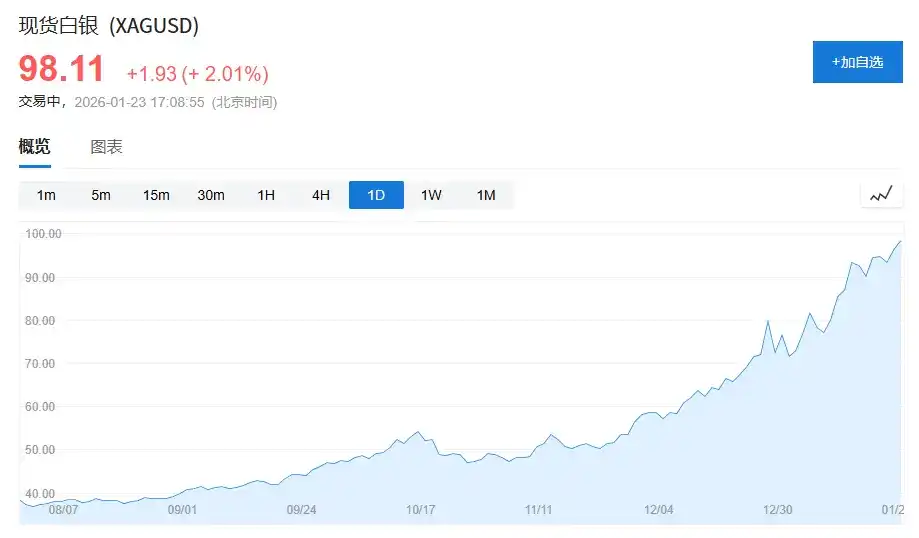
(Silver prices approach $100 per ounce. In mid-October last year, silver was only $50/ounce, nearly doubling in 3 months.)

1. Silver's "Identity Dilemma": Stuck Between Gold and Industrial Metals

To understand why silver has long been undervalued, one must first understand its "identity dilemma."

In the modern commodity system, assets can be broadly divided into two categories:

One is credit-based assets, typically represented by gold. Gold's value anchor does not come from industrial use but from the credit system and reserve demand. Even in the weakest years of demand, global central banks' net gold purchases still account for 15%–25% of total demand, providing a stable foundation for its price.

The other is growth assets, such as copper, crude oil, and iron ore. These metals have almost no financial attributes; their prices are mainly driven by economic cycles, infrastructure, and manufacturing investment.

Silver, however, is stuck between these two.

According to the "World Silver Survey 2025," global silver demand in 2024 was 1.164 billion ounces (approx. 36,200 tons), of which:

Industrial demand was 681 million ounces, accounting for about 58%;

Jewelry and silverware demand was 263 million ounces, accounting for about 23%;

Investment demand (bars, coins, ETFs) was about 191 million ounces, accounting for about 16%.

The problem is that these three types of demand have completely different behavioral patterns:

Industrial demand relies on the industry cycle, jewelry demand is highly price-sensitive, and investment demand is highly susceptible to macro sentiment.

This structural split has long left silver without a stable, single, dominant pricing anchor.

The result is reflected in the price: silver has long been forced to price itself relative to gold.

A clear indicator is the gold-silver ratio. Over the past half-century, the historical average of this ratio has been roughly 55–60; but between 2018–2020, it once exceeded 90, and at the peak of the pandemic shock, it even approached 120.

Even against the backdrop of silver's industrial demand hitting a record high in 2024, the gold-silver ratio has long remained in the 80–90 range, significantly higher than the long-term average.

This is not because silver is "useless," but because the market is still pricing silver using gold's financial logic.

2. Silver's Repositioning: From "Dispersed Use" to "Locked In by Industry"

The real change did not start in the financial markets but occurred quietly on the industrial side.

To summarize the current change in one sentence: Silver is shifting from an industrial metal with dispersed uses to a functional material locked in by key industries.

1. Photovoltaics: Silver Becomes "Indispensable" for the First Time

Photovoltaics are the most critical factor in the change of silver's demand structure.

In 2015, global new PV installations were about 50GW; by 2024, this number exceeded 400GW, an increase of over 8 times in less than a decade.

The industry is indeed continuously "de-silvering." Silver usage per watt has dropped from about 0.3 grams in the early days to around 0.1 grams with current mainstream technology.

But the expansion speed of installation scale is far faster than the decline in unit usage.

According to the "World Silver Survey 2025," the actual demand for silver from the PV industry in 2024 reached 198 million ounces, an increase of over 160% compared to 2019, accounting for about 17% of global silver demand.

More critically, silver's position in photovoltaics is not "easily replaceable." In terms of key indicators such as conductive efficiency, long-term stability, and reliability, silver remains the optimal choice overall. Technological progress changes the method of use, not the status.

This gives silver, for the first time, a source of demand that is large-scale, fast-growing, and price-inelastic.

2. Electric Vehicles and AI Infrastructure: Usage Not Exaggerated, but Extremely Difficult to Substitute

If photovoltaics bring certainty in demand scale, then electric vehicles and digital infrastructure bring a change in the nature of demand.

A traditional internal combustion engine vehicle uses about 15–20 grams of silver on average; a new energy vehicle typically uses 30–40 grams.

Against the backdrop of limited overall growth in global auto sales, the penetration rate of new energy vehicles has risen from less than 3% in 2019 to nearly 20% in 2024, structurally increasing silver demand.

Meanwhile, the demand for silver from data centers, AI servers, and high-end electronic devices is reflected more in its irreplaceability than in absolute volume.

In 2024, silver demand from electrical and electronic related fields reached 461 million ounces, setting new historical records for many consecutive years.

These application scenarios are relatively price-insensitive but are extremely sensitive to supply stability.
3. The Reality on the Supply Side: Silver Is Not a Metal That "Can Increase Production Just Because Prices Rise"

In stark contrast to the certainty on the demand side is the rigidity on the supply side.

In 2024, global silver mine production was approximately 820 million ounces, with a year-on-year growth rate of less than 1%.

More importantly, over 70% of global silver production comes as a by-product, mainly依附于 (attached to) lead, zinc, copper, and gold mines. This structure has hardly changed substantially over the past two decades.

Primary silver mine production is only about 228 million ounces, accounting for less than 30%, and is still in a long-term downward trend.

This means that silver production is not determined by the silver price but is主导 (led) by the investment cycles of base metals.

4. From Cyclical Shortage to Structural Tightness

Looking back at history, silver has experienced bull markets before, but past rallies were mostly derivatives of financial cycles.

The difference is that since 2021, the silver market has experienced a physical supply-demand deficit for several consecutive years.

According to the "World Silver Survey 2025," the average annual physical deficit in the global silver market from 2021–2024 was about 150–200 million ounces, with a cumulative deficit接近 (approaching) 800 million ounces.

And silver's visible inventories themselves are not ample. Current global流通 (circulating) inventories can only cover about 1–1.5 months of consumption, significantly below the 3-month safety line typically considered for commodities.

Once a large amount of silver enters PV modules, electrical equipment, and infrastructure, it is difficult to return to the流通市场 (circulating market).

5. Silver Is No Longer Just Gold's Shadow

Silver has not suddenly become scarce; it is just the first time it simultaneously satisfies three conditions:

Demand scale is real and sustained

Key uses are difficult to替代 (substitute)

Supply growth is highly constrained

In the past, these three points never appeared simultaneously.

While the market still understands silver as "poor man's gold," the industrial chain has already begun to re-examine it by the standards of a key functional material.

Silver may still be volatile, but it is certain that it is no longer just gold's shadow.

And this is the most important, yet most easily underestimated, underlying change in this round of market activity.


Related Questions

QWhy has silver historically been called 'poor man's gold' and what has changed recently?

ASilver was called 'poor man's gold' because it was seen as a cheaper, more accessible alternative to gold, and the market never took its scarcity seriously, assuming supply could always meet demand. This has changed because the market is now experiencing a sustained physical deficit driven by industrial demand from sectors like photovoltaics, electrification, and high-end electronics, while supply remains constrained and unable to keep pace.

QWhat is the main reason silver supply cannot quickly respond to price increases?

AOver 70% of global silver production comes as a by-product of mining other metals like copper, lead, and zinc. This means silver output is determined by the investment cycles of these base metals, not by the price of silver itself, making supply highly inelastic to silver price signals.

QWhich industry is the most significant driver of the new structural growth in silver demand, and why is it so important?

AThe photovoltaic (solar) industry is the most significant driver. It is important because, despite efforts to reduce silver use per watt (de-silverization), the massive expansion in global solar installations (from ~50GW in 2015 to over 400GW in 2024) has caused demand to surge. Silver's role is also crucial as it remains the optimal material for conductivity and reliability in solar cells, making it difficult to replace.

QHow does the 'identity dilemma' of silver affect its pricing in the commodity market?

ASilver's 'identity dilemma' refers to its split between being a credit asset (like gold, with financial and store-of-value properties) and a growth asset (like copper, driven by industrial cycles). This split means it lacks a single, stable pricing anchor. Consequently, its price has historically been heavily influenced by and correlated with gold (as seen in the gold-silver ratio), rather than being driven solely by its own industrial fundamentals.

QWhat evidence suggests the current silver market deficit is structural rather than just a cyclical shortage?

AThe evidence includes: 1) The deficit has been persistent, lasting for multiple consecutive years (2021-2024) with an average annual shortfall of 150-200 million ounces. 2) The deficit is driven by fundamental, long-term industrial demand growth (e.g., photovoltaics, EVs) rather than short-term financial speculation. 3) Supply is structurally rigid and cannot be quickly increased due to its by-product nature. 4) Once used in industrial applications like solar panels, silver is effectively 'consumed' and removed from the market, reducing available above-ground stocks.

Related Reads

From Hunyuan to WeChat AI: Tencent's Slow Paced Journey Reaches the Delivery Juncture

On June 8, 2026, WeChat's developer platform announced the internal testing of "WeChat AI," an AI assistant integrated into the WeChat ecosystem. It allows users to invoke, access, and operate Mini Programs through natural language conversation. The platform offers two access modes: an "Automatic Mode" where developers authorize platform access to their source code for zero-configuration AI operation, and a "Developer Mode" for building custom skills. While the name "WeChat AI" is provisional, this marks WeChat's first step in opening its vast Mini Program ecosystem—comprising over 400,000 developers and hundreds of millions of daily active users—to AI-driven conversational interaction. This move represents the latest step in Tencent's deliberate AI strategy, moving from technical R&D and standalone product validation to integration within its super-app. The underlying foundation is Tencent's self-developed Hunyuan large language model. Ranked first domestically in application-oriented capabilities like Agent task execution in 2025, Hunyuan's focus on stability and precision over raw parameter count aligns with WeChat AI's need for reliable, low-latency operations involving sensitive tasks like payments and bookings. Prior C-side validation came from "Yuanbao," a standalone AI app whose Monthly Active Users (MAU) surpassed 114 million during the 2026 Chinese New Year红包 campaign, though daily activity later subsided. This "pulse growth" highlighted the challenge of user retention for standalone apps, informing the decision to integrate AI natively into WeChat's high-frequency scenarios. However, WeChat AI's "Automatic Mode," which requires source code access, raises developer concerns about code security, data visibility, and liability for AI errors. A deeper, ecosystem-level tension exists between the efficiency of centralized AI task调度 and the potential "short-circuiting" of merchant pages, which could erode their branding, advertising revenue, and user engagement. As Tencent Chairman Pony Ma noted, balancing centralized AI调度 with the protection of decentralized merchant traffic is a core challenge. In summary, Tencent's AI path—comprising the stable Hunyuan base model, the user-validated Yuanbao app, and the newly testing WeChat AI integration—is logically coherent. The success of WeChat AI now hinges on resolving developer trust, establishing fair ecosystem rules for merchants, and ensuring operational reliability to gain user confidence for deep, transactional use.

marsbitJust now

From Hunyuan to WeChat AI: Tencent's Slow Paced Journey Reaches the Delivery Juncture

marsbitJust now

STRC Briefly Fell Below $91: Will Strategy Be Hunted by 'Market Fear'?

The article draws a parallel between FTX's 2022 collapse and the current situation facing MicroStrategy (Strategy), a major corporate holder of Bitcoin. The author argues that MicroStrategy's financial model, heavily reliant on issuing equity and convertible debt at a premium to its Bitcoin holdings, is under stress. The core issue is the compression of MSTR's stock premium over its Bitcoin holdings (NAV). This erodes the viability of its "flywheel" – using equity sales to buy more Bitcoin. The company has shifted towards preferred shares (like STRC) and debt to raise capital, incurring significant dividend and interest obligations (approximately $1.7 billion annually). With cash reserves dwindling and debt maturities looming, MicroStrategy faces mounting pressure to generate cash. The article outlines three problematic options: 1) cutting preferred dividends, damaging investor confidence; 2) issuing more MSTR stock at low premiums, diluting existing shareholders; or 3) selling Bitcoin, which founder Michael Saylor had vowed against but recently did in a small symbolic transaction. The author suggests that, like FTX, a crisis of confidence could trigger a rapid downward spiral as investors flee. While noting Saylor's actions are legal—unlike SBF's fraud at FTX—the article warns the structural risk born from financial engineering and over-leverage is significant. The preferred path out is a sharp rise in Bitcoin's price to restart the premium flywheel, but this would only create a larger, more complex system vulnerable to future failure. The author concludes by advocating for direct Bitcoin ownership over exposure through MicroStrategy's increasingly risky financial structure.

Foresight News15m ago

STRC Briefly Fell Below $91: Will Strategy Be Hunted by 'Market Fear'?

Foresight News15m ago

The Battle for the AI Payment Race: Traditional Card Networks Face Off Against Coinbase

With the rise of AI agents conducting transactions, a battle for the underlying payment infrastructure is underway. Two distinct and incompatible approaches have emerged for enabling autonomous AI payments. The first approach is championed by traditional card networks Visa and Mastercard. They leverage their existing tokenized card credential systems, extending them to allow verified AI agents to make purchases within user-defined limits. Services like Mastercard's Agent Pay and Visa's Intelligent Commerce integrate with major AI platforms (e.g., OpenAI, Anthropic) and keep transactions within the established, decades-old card payment model. This system offers advantages for consumer retail, including robust fraud protection, chargeback mechanisms, and extensive merchant networks. The second approach, led by Coinbase, utilizes stablecoins on open internet protocols. Its x402 protocol reactivates the HTTP 402 status code for machine-to-machine micropayments, using USDC for settlement directly on-chain. This method eliminates the need for accounts or card fees, making it highly efficient for high-frequency, low-value, cross-border transactions between AI agents—such as paying for API calls, data streams, or computational resources—where traditional card fees and settlement times are impractical. While card networks excel in consumer-facing scenarios requiring dispute resolution, stablecoin protocols are tailored for machine economies. A key challenge for both is agent identity verification and transaction authorization. Notably, Visa and Mastercard are hedging their bets by also investing in stablecoins. Visa has rapidly grown its stablecoin settlement volume and is collaborating with Coinbase to bridge its network with the x402 protocol. Mastercard plans to acquire stablecoin platform BVNK. Their strategy is to become the fee-collecting gateway for all payment flows, regardless of the channel. Current applications reflect this division: consumer AI shopping tools (e.g., ChatGPT's checkout, Amazon's "Shop for Me") predominantly use card networks, while machine-focused services (e.g., Amazon Bedrock's core payments) adopt stablecoins via the x402 protocol. In the short term, a coexistence model is expected, with cards dominating retail and stablecoins powering machine transactions. The long-term outcome depends on whether AI-driven commerce evolves to resemble traditional retail or becomes a vast network of machine micropayments. By investing in both tracks, the incumbent card networks are positioning themselves to capture transaction fees regardless of which future prevails.

marsbit26m ago

The Battle for the AI Payment Race: Traditional Card Networks Face Off Against Coinbase

marsbit26m ago

Trading

Spot
Futures
活动图片