POLY's Appearance Hints Keep Coming, How Far Is the Airdrop?

marsbitPublished on 2026-05-19Last updated on 2026-05-19

Abstract

The article discusses growing speculation around the potential launch and airdrop of the POLY token by prediction market platform Polymarket. It outlines a timeline of official hints, starting from CEO Shayne Coplan mentioning POLY alongside major cryptocurrencies in October 2025 to confirmations from other team members about a future token and airdrop. Recent developments include the appearance of POLY preview pages on CoinGecko and CoinMarketCap in April, and further product-related hints from the team in May about staking and airdrop criteria. Market prediction data suggests a 56% probability of a token launch before year-end, with significant potential market capitalization. The author's personal view is that Polymarket is unlikely to issue the token before the World Cup, prioritizing platform stability and infrastructure development for the high-traffic event instead. The article advises strategies like hedging trades and engaging on social media to potentially qualify for a future airdrop.

Recently, due to constant hints from Polymarket officials regarding POLY token-related content, various airdrop-farming communities have been analyzing the timing and scale of the POLY airdrop from different angles.

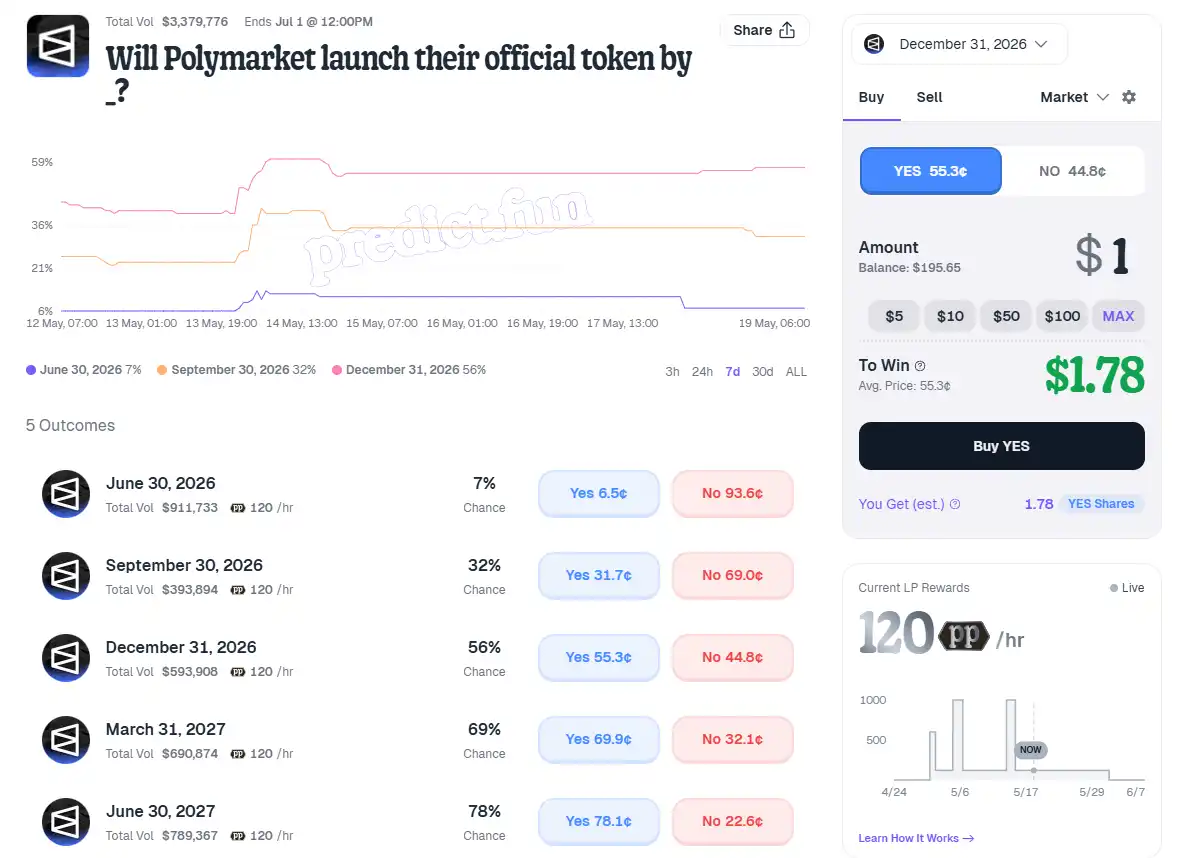
According to predict.fun data, the probability of the event "Polymarket will launch its official token before the end of this year" is currently 56%; there is even a 7% probability that "Polymarket will launch its official token before Q2 of this year."
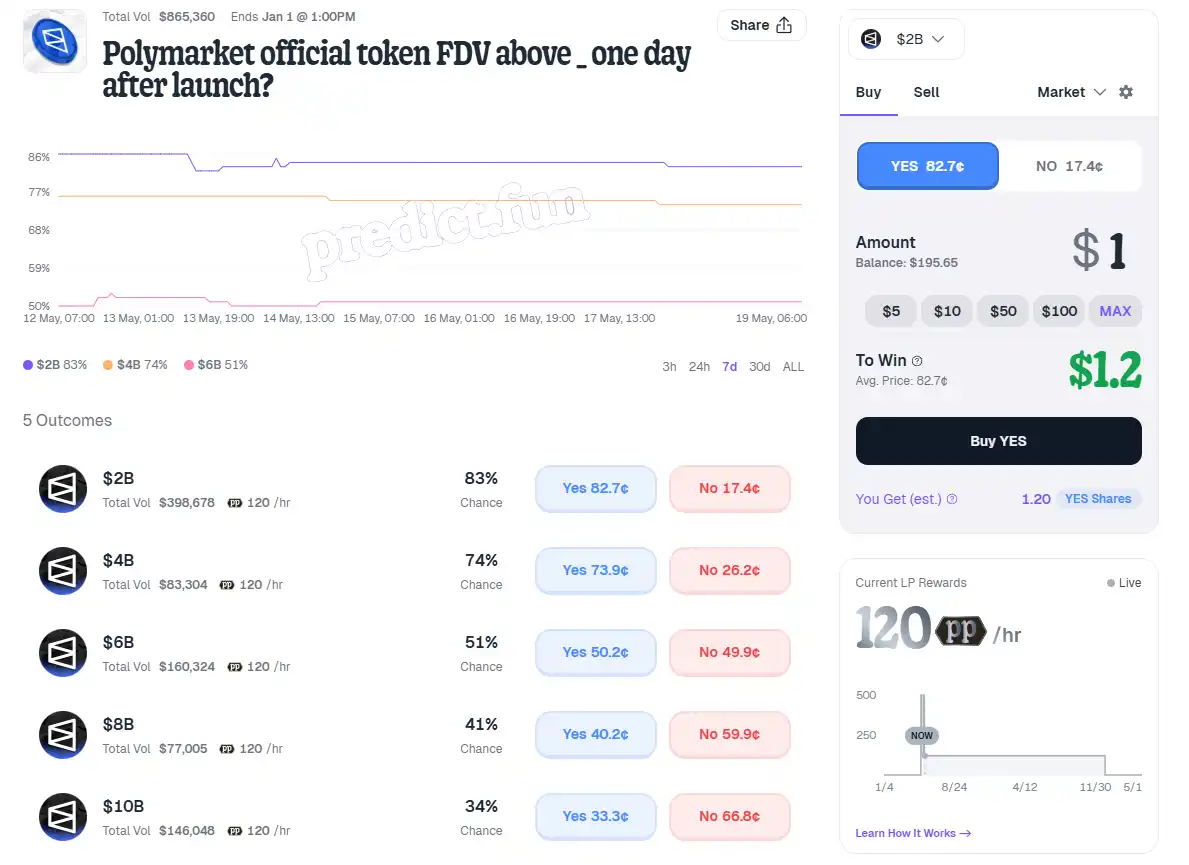
Additionally, regarding market cap, the probability for the event "Polymarket's FDV exceeds $6 billion one day after listing" is currently 51%; there is a 34% probability for "Polymarket's FDV exceeds $10 billion one day after listing."
Timeline of Official Polymarket Token Hints

October 2025: Initial Hints and Official Confirmation of the POLY Token

Official signals surrounding the POLY token from Polymarket can be traced back to last October.

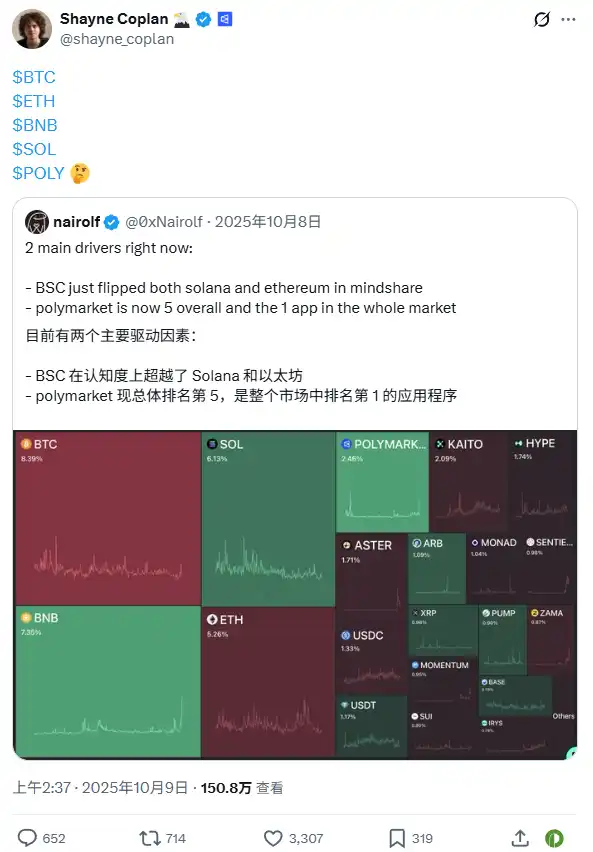
On October 8, 2025, Polymarket CEO Shayne Coplan posted on X, listing POLY alongside BTC, ETH, BNB, and SOL, sparking community speculation about a Polymarket token launch.

Although this was not an official token announcement, for the market, the founder personally writing $POLY was sensitive enough. Since then, community discussion about a Polymarket token launch has noticeably heated up.
The airdrop expectation was further brought into public discussion by official team members. On October 23, 2025, Polymarket Growth Lead William LeGate mentioned "prospective airdrop farmers" in a podcast or related discussion. While not a formal rule explanation, this essentially acknowledged the existence of user behavior and expectations around a Polymarket airdrop in the market.

The expectation for the POLY token was further solidified on October 24, 2025. Polymarket CMO Matthew Modabber explicitly stated in a podcast, "Polymarket will have a token, and it will have an airdrop." This statement became a key turning point for Polymarket's token expectation, shifting from community speculation to official confirmation.

Entering November, the focus of official discussion began to shift from whether there would be an airdrop to what kind of behavior would *not* qualify for an airdrop. On November 11, 2025, William LeGate, responding to Sybil farming, clearly stated, "I can confidently tell you these sybil-farmed accounts are not going to result in any airdrop allocations, they're just wasting their time."

April of This Year: Major Price Tracking Platforms Launch POLY Preview Pages

Entering April of this year, POLY token expectations have extended to major crypto price-tracking websites.

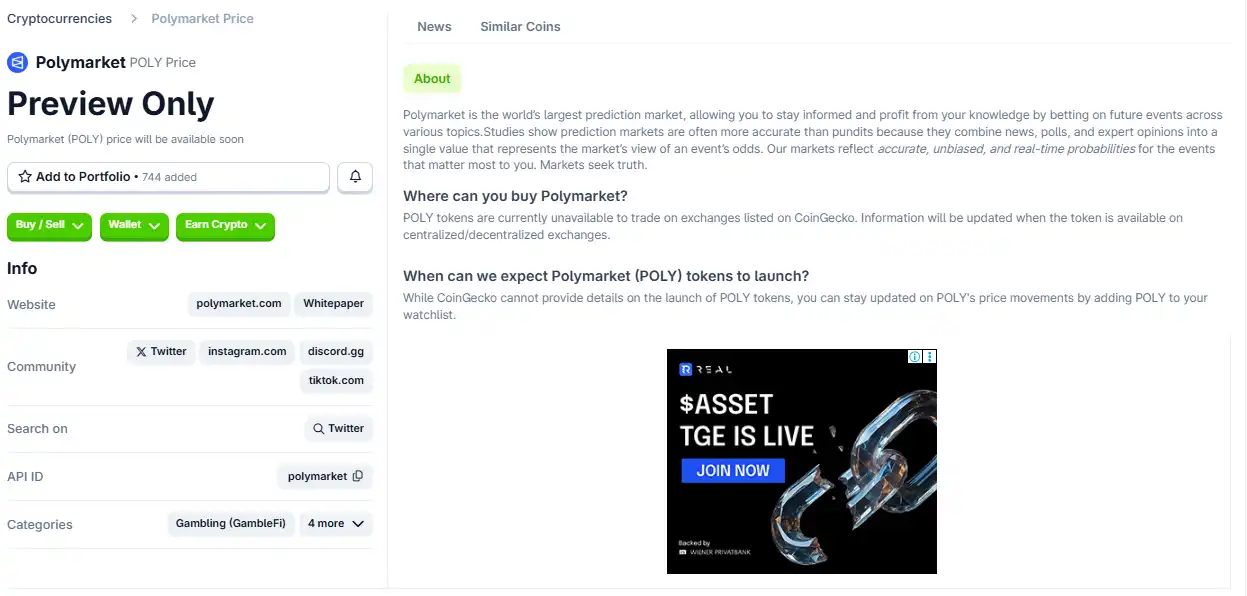
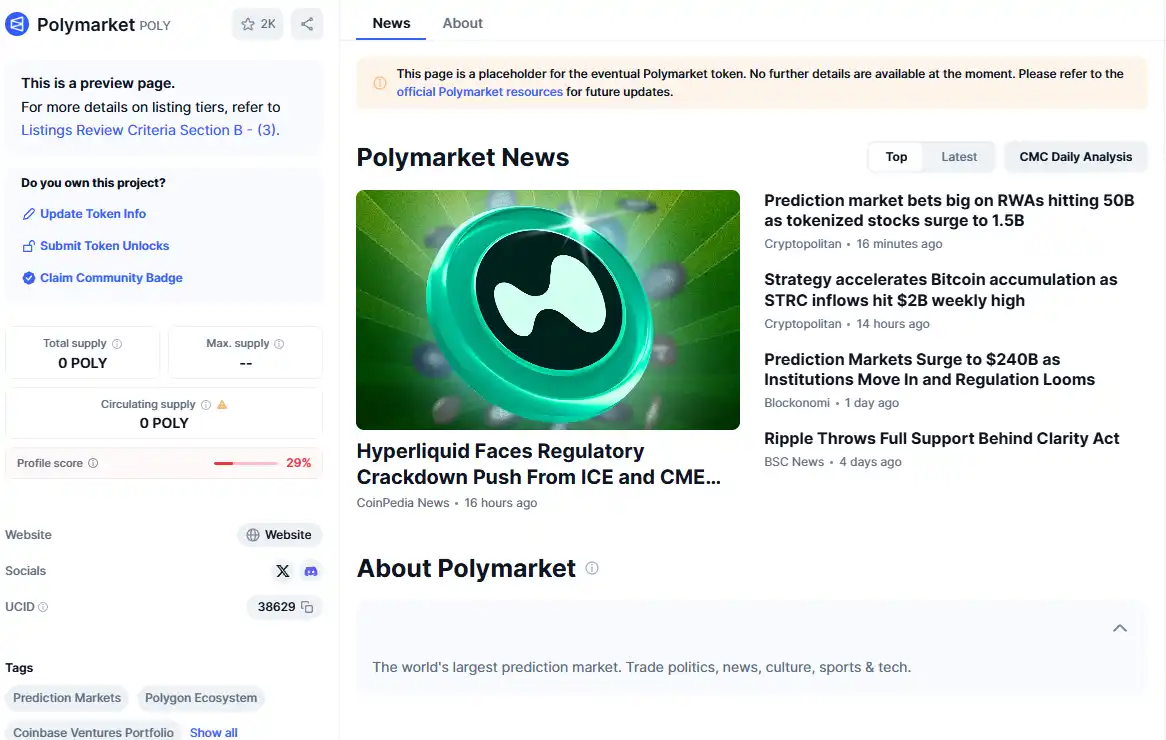
Currently, preview pages for Polymarket (POLY) have appeared on both CoinGecko and CoinMarketCap. While these pages are not equivalent to the official token launch nor do they represent Polymarket announcing a TGE timeline, the fact that external platforms are reserving pages for $POLY further strengthens the community's expectation of a Polymarket token launch.
May of This Year: POLY Token Moves from Airdrop Expectation to Product Hints

Entering May, the discussion around the POLY token has moved further towards specific functions and airdrop qualifications.

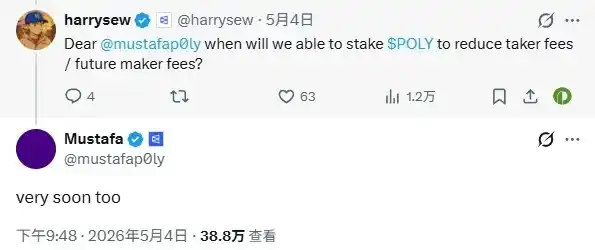
On the evening of May 4th, Polymarket official team member Mustafa responded to questions about the POLY token in a community interaction. A user asked when they could stake POLY to reduce taker fees, or potentially future maker fees.

Mustafa's reply was: "Soon." The community quickly interpreted this official response as Polymarket preparing for the token launch.
On May 13th, clues surrounding the POLY token continued to increase.

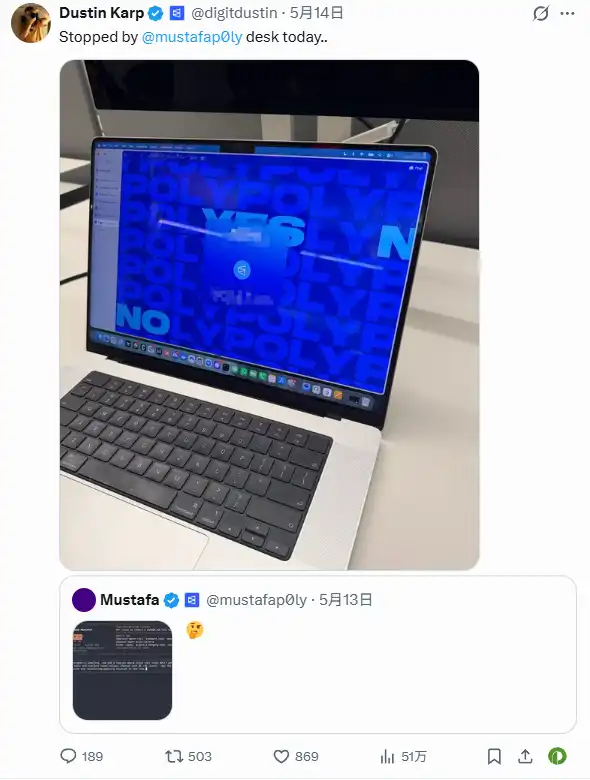
Polymarket Product Lead Dustin Karp posted a photo of his workstation, saying he passed by Mustafa's desk. The photo appeared to show an internal page related to the POLY token airdrop. The community zoomed in and found an "Airdrop" tab visible, further heightening expectations for a POLY token airdrop.
Subsequently, Polymarket Growth Lead LeGate also responded to questions about official badges in community discussions.

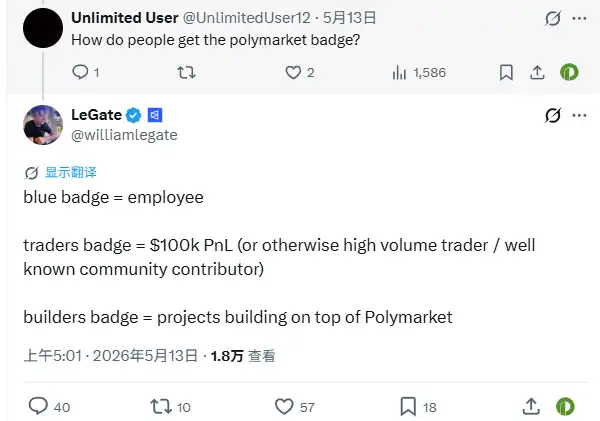
LeGate replied that the blue badge represents Polymarket employees; the "Traders" badge is primarily for traders with cumulative profits reaching $100,000, or other high-volume users (in other tweets, he mentioned a trading volume exceeding $10 million and said if users are active on Polymarket, the profit and volume thresholds can be slightly adjusted), and notable community contributors; the "Builders" badge is for projects building and developing based on the Polymarket ecosystem.
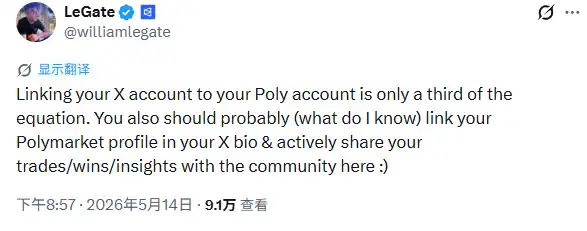
Badges might not be the only criteria for receiving an airdrop. The community inquired whether content contributions on X would be rewarded with POLY tokens. LeGate replied that linking your X account to your Polymarket account is only one-third of the conditions.

In addition, users should probably also put their Polymarket profile link in their X bio, actively share their trades, profit records, and market views on X, and maintain interaction with the community.
Although this reply did not explicitly confirm whether "shitposting" ("zui lu") could genuinely earn an airdrop, various communities were relatively optimistic and actively posted Polymarket-related content on X to seek potential token airdrops.

Personal Strategy

For someone who has been deeply involved in prediction markets throughout the first half of this year, I am still leaning towards the belief that Polymarket will not launch its token before the World Cup.

The reason is simple. Polymarket's more important task right now may not be to launch a token immediately, but to first refine the trading experience and infrastructure. Whether it's the continuous optimization of V2 or even a chain migration, it's essentially to prepare for high-traffic, high-frequency trading scenarios like the World Cup.

For Polymarket, if the platform experience is unstable during the World Cup, launching a token in advance would hardly help truly onboard new users and trading volume.

Therefore, recent trading has primarily been focused on hedging, placing orders on predict.fun to farm points, and then hedging positions received on Polymarket. At the same time, participating in various events on Polymarket with profitability as the goal.

Additionally, I am also linking my personal X account information on Polymarket and posting Polymarket-related content on X, hoping that when the token is launched in the future, a portion of the airdrop will also be allocated to "shitposting users" ("zui lu users").

Related Questions

QWhat is the main subject of the article and what community activity does it discuss?

AThe main subject is the potential launch and airdrop of the POLY token by Polymarket. The article discusses extensive analysis and speculation within crypto 'airdrop farming' communities regarding the timing and scale of the airdrop.

QAccording to prediction market data, what is the estimated probability for Polymarket launching its official token before the end of this year?

AAccording to data from predict.fun, the probability of the event 'Polymarket will launch its official token before the end of this year' is currently reported at 56%.

QWhen did the first significant official hint about the POLY token occur, and who was involved?

AThe first significant hint occurred on October 8, 2025, when Polymarket CEO Shayne Coplan listed '$POLY' alongside major cryptocurrencies like BTC and ETH on X, sparking community speculation about a token launch.

QWhat two types of user badges did Polymarket's Growth Head, William LeGate, mention, and what are their general criteria?

AWilliam LeGate mentioned 'Traders' badges for users with over $100,000 in cumulative profit or high trading volume (over $10 million), and 'Builders' badges for projects developing on the Polymarket ecosystem.

QWhat is the author's personal prediction for the POLY token launch timeline and the primary reason behind it?

AThe author personally predicts that Polymarket will not launch the token before the FIFA World Cup. The primary reason is that the platform's priority is likely to optimize trading experience and infrastructure to handle the high traffic expected during the World Cup event.

Related Reads

Following the KelpDAO Hack: $40 Billion in Assets Flee LayerZero, Chainlink Emerges as the Primary 'Beneficiary'

Following a major security breach in April where KelpDAO's bridge using LayerZero was attacked for approximately $292 million, a significant shift is underway in the cross-chain infrastructure landscape. An estimated $40 billion in assets is in the process of migrating or has already migrated from LayerZero to Chainlink's Cross-Chain Interoperability Protocol (CCIP). The attack exploited a single-point-of-failure vulnerability due to KelpDAO's 1-of-1 validator configuration within the LayerZero network. Attackers corrupted RPC nodes and used DDoS attacks to force the system to rely on compromised nodes, allowing fraudulent messages. While LayerZero acknowledged a serious error in allowing its validator network to service high-value transactions with such a configuration, the incident highlighted critical security risks. This triggered a rapid migration wave. Starting with KelpDAO on May 6th, several major protocols—including Solv Protocol, Re, Tydro, Kraken, and Lombard—announced switching their cross-chain infrastructure exclusively to Chainlink CCIP. The combined value of these migrations is estimated to be around $40 billion. This movement followed earlier major adoptions by Coinbase (in late 2025) and Circle (in early 2024). Market sentiment reflected this shift, with LINK's price showing relative stability while ZRO (LayerZero's token) declined significantly. Data indicates a net outflow of approximately $20.1 billion from the LayerZero network over 30 days. The migration is largely driven by perceived security differences. Chainlink CCIP employs a decentralized oracle network as its default consensus layer, featuring multiple independent node operators, a separate Risk Management Network, and built-in safeguards like rate limits. In contrast, LayerZero's highly modular architecture offers flexibility but places more responsibility on application developers to configure security settings, a risk underscored by the KelpDAO incident. LayerZero has since apologized for its communication handling post-attack and stated the protocol itself was not compromised, but rather its Labs DVN's internal RPC was poisoned. An official post-mortem report with external security partners is forthcoming.

marsbit41m ago

Following the KelpDAO Hack: $40 Billion in Assets Flee LayerZero, Chainlink Emerges as the Primary 'Beneficiary'

marsbit41m ago

Making AI Products Is No Longer the Hard Part; Being Seen Is: Developers, Web3, and Chinese AI Opportunities at mu Shanghai

The article discusses the shifting challenges of AI entrepreneurship, based on insights from the mu Shanghai AI WEEK event in May 2026. As AI tools drastically lower the barrier to creating product prototypes, the core difficulty for startups has moved from "how to build" to "who to build for"—finding real users, sustainable business models, and community engagement. The event itself was structured as an extended, immersive developer community space rather than a traditional conference, attracting a global mix of participants (40% AI, 20-30% Web3). This format emphasized deep networking and collaborative creation over one-way presentations. A key observation is that with powerful models and coding assistants becoming ubiquitous, execution is less of a moat. The new scarce resource is judgment—identifying valuable, defensible scenarios where an application won't be quickly rendered obsolete by the next model update. This pushes competition downstream to distribution, user acquisition, and commercialization. Notably, many Web3 practitioners are migrating into AI, bringing with them expertise in community building, global collaboration, and grassroots marketing—skills highly relevant as AI apps fight for visibility. Meanwhile, opportunities in AI hardware, robotics, and embodied intelligence are seen as more durable, leveraging China's robust manufacturing and supply chain ecosystem as a key advantage. The article notes that major Chinese model companies (like MiniMax) are now actively competing for developer mindshare through community programs, hackathons, and improved tooling, recognizing developers as core users. Ultimately, the conclusion is that while AI simplifies building, the harder part of the journey is ensuring a product is truly needed, understood, and retained by its users.

marsbit59m ago

Making AI Products Is No Longer the Hard Part; Being Seen Is: Developers, Web3, and Chinese AI Opportunities at mu Shanghai

marsbit59m ago

Why is the RWA Boom Failing to Benefit DeFi?

The rapid growth of the tokenized real-world assets (RWA) market, now nearing $30 billion on-chain, has largely bypassed the DeFi ecosystem. Only about $2.47 billion is actively locked in DeFi protocols, indicating a penetration rate of just 9%. A major barrier is the "permissioned" architecture of most RWA products, like BlackRock's BUIDL fund, which are designed for institutional compliance. They require whitelisting, off-chain settlement, and strict investor accreditation, making them incompatible with open, permissionless DeFi applications like Aave or Uniswap. This is evident in categories like bonds/money market funds ($16.6B on-chain, $920M in DeFi) and tokenized equities ($2.7B on-chain, $78M in DeFi). Notable exceptions are private credit protocols (e.g., Maple Finance, Centrifuge) and assets like Ondo's USDY, which were designed from inception for DeFi composability, allowing them to be used freely as collateral. Morpho and Aave Horizon also demonstrate successful RWA lending integrations. However, industry reports (IOSCO, ECB) warn that growth may remain confined within traditional financial systems due to fragmented regulations, lack of unified standards, and inherent conflicts between DeFi's open logic and compliance requirements like minimum investments and fixed redemption windows. The RWA sector is effectively split into two markets: a compliant, permissioned on-chain finance market and a smaller DeFi-native market focused on composability. For DeFi penetration to rise significantly, asset issuers must prioritize designs that enable permissionless circulation from the start, moving away from models centered solely on institutional compliance.

marsbit1h ago

Why is the RWA Boom Failing to Benefit DeFi?

marsbit1h ago

Trading

Spot
Futures
活动图片