Polymarket Faces New Roadblock As Dutch Regulator Bans Prediction Activity — Details

bitcoinistPublished on 2026-02-22Last updated on 2026-02-22

Abstract

Polymarket's Dutch operations, under the entity Adventure One, have been ordered to cease all activities by the Netherlands Gambling Authority (Ksa) for offering unlicensed prediction markets, which the regulator classifies as illegal gambling. The platform faces potential fines of up to $840,000 per week for non-compliance. This action is the latest regulatory challenge for Polymarket, creating a conflict between US federal approval and state-level scrutiny. The news coincides with a recent parliamentary proposal in the Netherlands to introduce a controversial 36% tax on unrealized gains from cryptocurrencies and other investments, a move critics warn could drive investors out of the country.

According to recent reports, the Dutch arm of the prediction markets platform Polymarket has been asked to cease its activities in the Netherlands. This order comes as the latest regulatory blow dealt to the prediction market platform in recent weeks.

Dutch Regulator Threatens Polymarket With $840,000 Fine

In a notice dated Tuesday, February 17, the Netherlands Gambling Authority ordered Polymarket’s Dutch arm, Adventure One, to “cease its activities immediately” or risk incurring up to $840,000 in fines per week. According to the Dutch regulator, Adventure One offered illegal bets, including on the local elections, to residents without a license.

While prediction markets do not particularly fall into the traditional gambling category, the Netherlands Gambling Authority has classified them as betting. The regulator revealed that it contacted Polymarket about its activities on the Dutch market, but have seen no corrective action or response from the prediction markets company.

Netherlands Gambling Authority’s director of licensing and supervision, Ella Seijsener, said in the notice:

Prediction markets are on the rise, including in the Netherlands. These types of companies offer bets that are not permitted in our market under any circumstances, not even by license holders. Besides the social risks of these kinds of predictions (for example, the potential influence on elections), we conclude that this constitutes illegal gambling. Anyone without a Ksa license has no business in our market. This also applies to these new gambling platforms.

This restriction in the Netherlands marks the latest stumbling block for Polymarket in terms of regulation over the past few months. Despite receiving approvals from the United States Commodity Futures Trading Commission (CFTC), individual state authorities have placed significant scrutiny on the activities of prediction market platforms.

This has led to an issue of jurisdiction, as the CFTC chair criticized the state-level scrutiny which undermines their federal authority over prediction markets.

Dutch Unrealized Gains Tax On Crypto Rolls On

This crackdown on prediction markets comes just a week after the Dutch House of Representatives advanced a proposal to introduce a 36% capital gains tax on most liquid investments, including cryptocurrencies. This controversial bill, if passed, would see profits made from interest-bearing financial instruments, equity investments, cryptocurrencies, and savings accounts be subject to tax, whether realized or not.

The proposal of this capital gains tax led to interesting reactions, with several crypto analysts noting that the legislation will drive investors out of the Netherlands. “To be honest, the fact that there’s the unrealized gains tax for Bitcoin in the Netherlands is the dumbest thing I’ve seen in a long time. The amount of people willing to flee the country is going to be bananas,” analyst Michaël van de Poppe said on X.
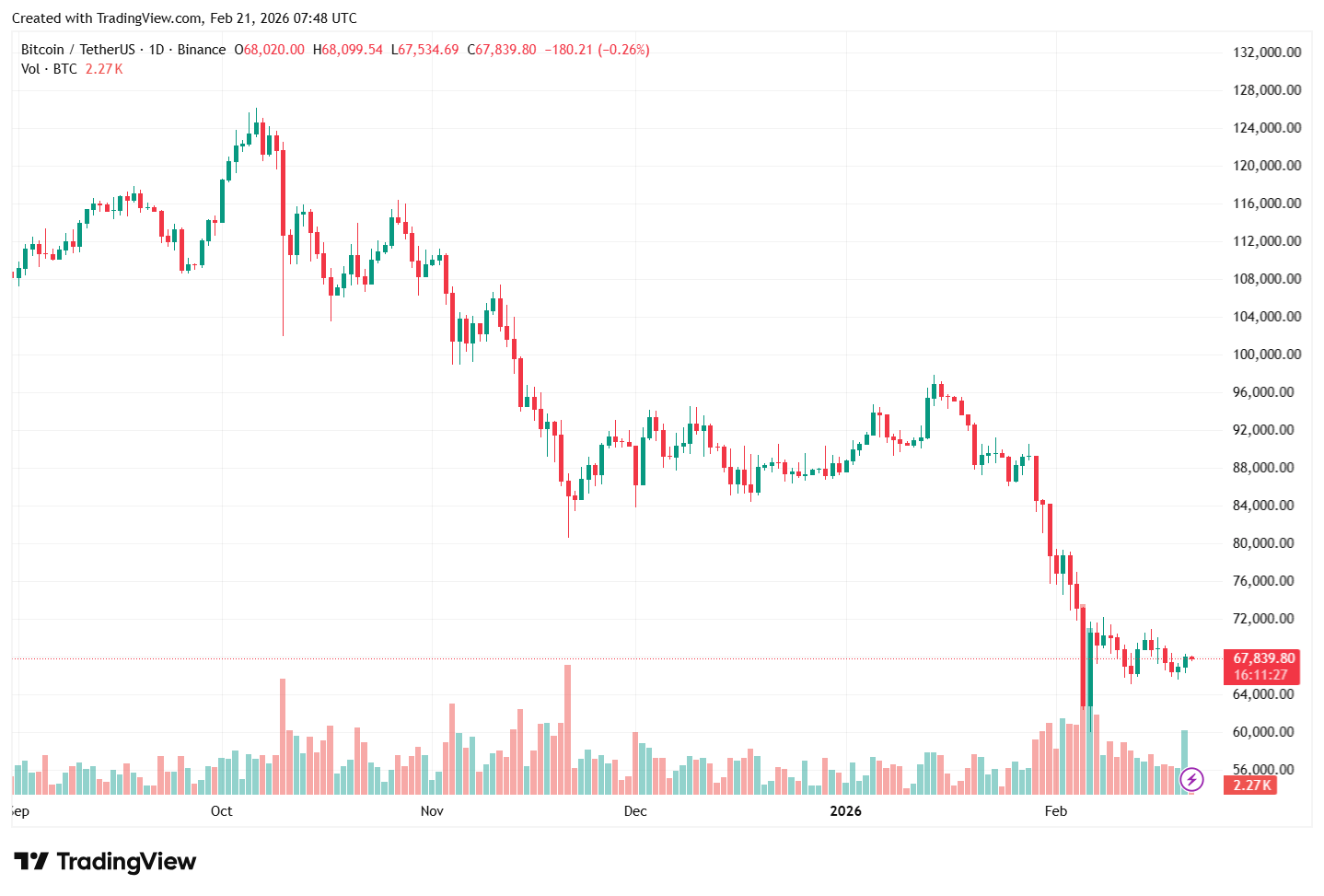
The price of BTC on the daily timeframe | Source: BTCUSDT chart on TradingView


Related Questions

QWhat action did the Dutch Gambling Authority take against Polymarket's Dutch arm, Adventure One?

AThe Dutch Gambling Authority ordered Adventure One to cease its activities immediately or face fines of up to $840,000 per week.

QWhat was the primary reason given by the Dutch regulator for banning Polymarket's activities?

AThe regulator classified Polymarket's prediction markets as illegal gambling, stating they offered bets that are not permitted in the Dutch market without a license, including on events like local elections.

QHow did the director of licensing, Ella Seijsener, justify the crackdown on prediction markets?

AElla Seijsener stated that prediction markets offer illegal bets, pose social risks such as potential influence on elections, and constitute illegal gambling that requires a license to operate in the Netherlands.

QWhat recent tax proposal in the Netherlands has also impacted the crypto space?

AThe Dutch House of Representatives advanced a proposal to introduce a 36% capital gains tax on most liquid investments, including cryptocurrencies, taxing both realized and unrealized gains.

QWhat concern did crypto analyst Michaël van de Poppe raise about the proposed Dutch tax on unrealized crypto gains?

AMichaël van de Poppe called the tax 'the dumbest thing I’ve seen in a long time' and predicted that it would cause a significant number of people to flee the country.

Related Reads

Circle CEO's Seoul Visit: No Korean Won Stablecoin Issuance, But Met All Major Korean Banks

Circle CEO Jeremy Allaire's recent activities in Seoul indicate a strategic shift for the company, moving away from issuing a Korean won-backed stablecoin and instead focusing on embedding itself as a key infrastructure provider within Korea’s financial and crypto ecosystem. Despite Korea accounting for nearly 30% of global crypto trading volume—with a market characterized by high retail participation and altcoin dominance—Circle has chosen not to compete for the role of stablecoin issuer. Instead, Allaire met with major Korean banks (including Shinhan, KB, and Woori), financial groups, leading exchanges (Upbit, Bithumb, Coinone), and tech firms like Kakao. This approach reflects a broader industry transition: the core of stablecoin competition is shifting from issuance rights to systemic positioning. With Korean regulators still debating whether banks or tech companies should issue stablecoins, Circle is avoiding regulatory uncertainty by strengthening its role as a service and technology partner. The company is deepening integration with trading platforms, building connections, and promoting stablecoin infrastructure. This positions Circle to benefit regardless of which entity eventually issues a won stablecoin. Allaire also noted the potential for a Chinese yuan stablecoin in the next 3–5 years, underscoring a regional trend of stablecoins becoming more regulated and integrated with traditional finance. Ultimately, Circle’s strategy highlights that future influence in the stablecoin market will belong not necessarily to the issuers, but to the foundational infrastructure layers that enable cross-system transactions.

marsbit3m ago

Circle CEO's Seoul Visit: No Korean Won Stablecoin Issuance, But Met All Major Korean Banks

marsbit3m ago

SpaceX Ties Up with Cursor: A High-Stakes AI Gambit of 'Lock First, Acquire Later'

SpaceX has secured an option to acquire AI programming company Cursor for $60 billion, with an alternative clause requiring a $10 billion collaboration fee if the acquisition does not proceed. This structure is not merely a potential acquisition but a strategic move to control core access points in the AI era. The deal is designed as a flexible, dual-path arrangement, allowing SpaceX to either fully acquire Cursor or maintain a binding partnership through high-cost collaboration. This "option-style" approach minimizes immediate regulatory and integration risks while ensuring long-term alignment between the two companies. At its core, the transaction exchanges critical AI-era resources: SpaceX provides its Colossus supercomputing cluster—one of the world’s most powerful AI training infrastructures—while Cursor contributes its AI-native developer environment and strong product adoption. This synergy connects compute power, models, and application layers, forming a closed-loop AI capability stack. Cursor, founded in 2022, has achieved rapid growth with over $1 billion in annual revenue and widespread enterprise adoption. Its value lies in transforming software development through AI agents capable of coding, debugging, and system design—positioning it as a gateway to future software production. For SpaceX, this move is part of a broader strategy to evolve from a aerospace company into an AI infrastructure empire, integrating xAI, supercomputing, and chip manufacturing. Controlling Cursor fills a gap in its developer tooling layer, strengthening its AI narrative ahead of a potential IPO. The deal reflects a shift in AI competition from model superiority to ecosystem and entry-point control. With programming tools as a key battleground, securing developer loyalty becomes crucial for dominating the software production landscape. Risks include questions around Cursor’s valuation, technical integration challenges, and potential regulatory scrutiny. Nevertheless, the deal underscores a strategic bet: controlling both compute and software development access may redefine power dynamics in the AI-driven future.

marsbit43m ago

SpaceX Ties Up with Cursor: A High-Stakes AI Gambit of 'Lock First, Acquire Later'

marsbit43m ago

Trading

Spot
Futures
活动图片