Organized & Compiled by: Deep Chao TechFlow

Podcast Name: 21 YouTubers Agree on 5 Stocks. My Entry Points (BWB - Business With Brian, Single Episode)
Host: Brian (Brian Ferraro, Independent Investor Channel Host, BWB 429k Subscribers)
Duration: 25:19 (Published 2026/8/25, Single Episode 127k Views)
Tickers Mentioned: Alphabet (Google) / Nvidia / Micron / CoreWeave / Uber
Disclosure: Brian personally holds Nvidia (over 12% of portfolio, reached his cap), Alphabet, Micron (buying per plan), Uber; does not hold CoreWeave. His views are directly tied to his own wallet. This episode also has paid sponsorship (Galaxy Premium Yield, a cash management tool provider). All price levels mentioned below are outputs of his personal model, not investment advice.
一、After 141 Videos, Only 5 Stocks Were Repeatedly Mentioned
A content creator did some hard work: spent 11 days watching 141 stock-related videos from 21 YouTube investment channels, noting down every stock mentioned in each segment.
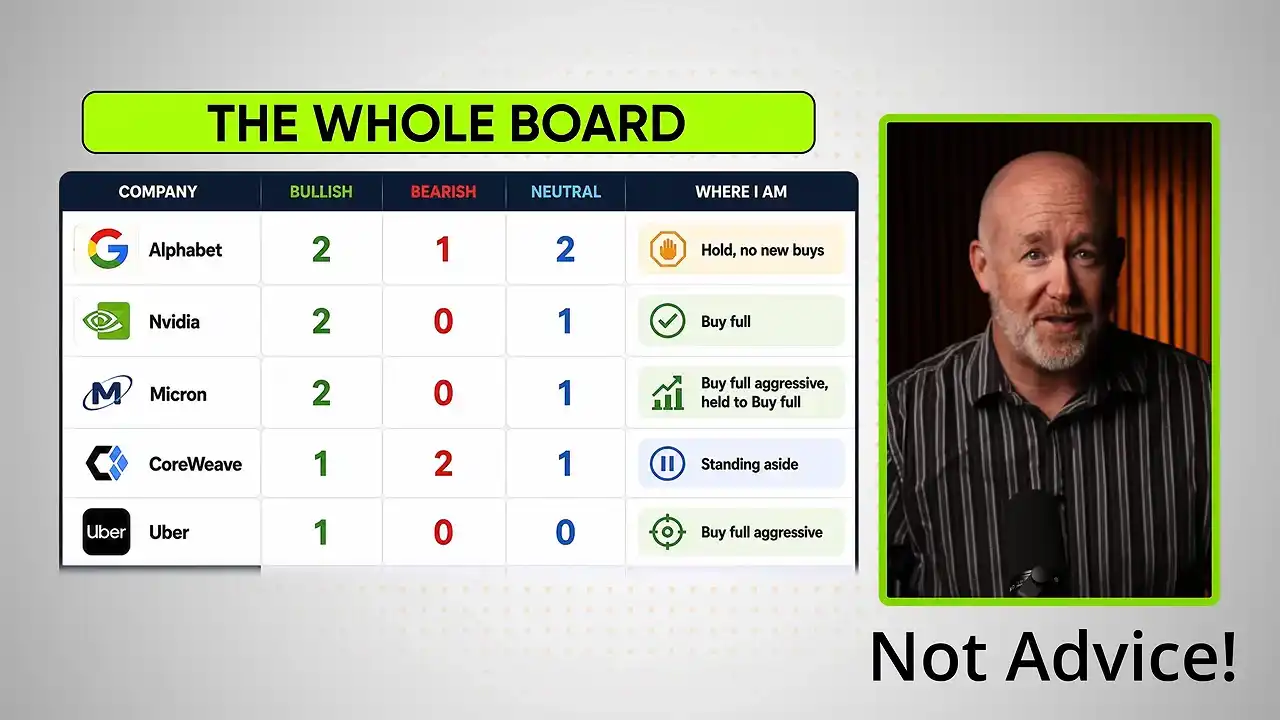
The result: the whole list boiled down to just 5 companies that were mentioned repeatedly: Alphabet, Nvidia, Micron, CoreWeave, Uber. The other hundred-plus companies were basically mentioned once and then disappeared, not discussed further.
But don't rush to copy the homework. Steve Eisman, the inspiration for *The Big Short*, also consumed this podcast content, but his reaction was to sell Alphabet, reasoning in one sentence: These AI stocks are essentially the same trade, win all or lose all.
And in this comprehensive podcast, investor Brian further broke down the themes of those 141 videos: 76 were about chips, cloud, AI models—over half. Meaning, out of these 5 "repeatedly favored" stocks, 4 (Alphabet, Nvidia, Micron, CoreWeave) are essentially the same AI bet, just under different names. Only Uber is truly independent.
Below, each stock's case: why it's favored, what people fear, and Brian's own position sizing and price levels.
二、Alphabet: Buffett is Buying, Price $362, But He's Only Half In
Why It's Favored
Based on realized earnings, Alphabet is at its cheapest level in about a decade. Current price $362, down about 14% from May's all-time high. Valuation bloggers' fair value estimates generally range from $350 to $450.
Another headline: Buffett's Berkshire Hathaway just massively increased its Alphabet position, nearly doubling it, putting Alphabet in Berkshire's top three holdings.
What People Fear
Use a different metric, and the answer flips: based on sales, Alphabet is in the most expensive 3% in a decade. The same company on the same day yields opposite conclusions, depending on which line of the financial statement you look at.
One blogger ran a live-stream experiment worth remembering: He first asked viewers, "At what price are you prepared to sell Alphabet?" Everyone wrote down their number. Then he announced Buffett's buying news and asked again, "Change your mind?" Everyone changed. One piece of news made them abandon their own rules—the most real weakness of retail investors.
Brian's Action
At $362: Only open a half position (half his normal size), and only via monthly DCA, no heavy buying. The reason is the dual metrics above: cheap and expensive simultaneously, so buy less, buy slowly.
三、Nvidia: Price $221, Valuation Says 1/3 Cheaper, But Some Are Betting on a Mishap
Why It's Favored
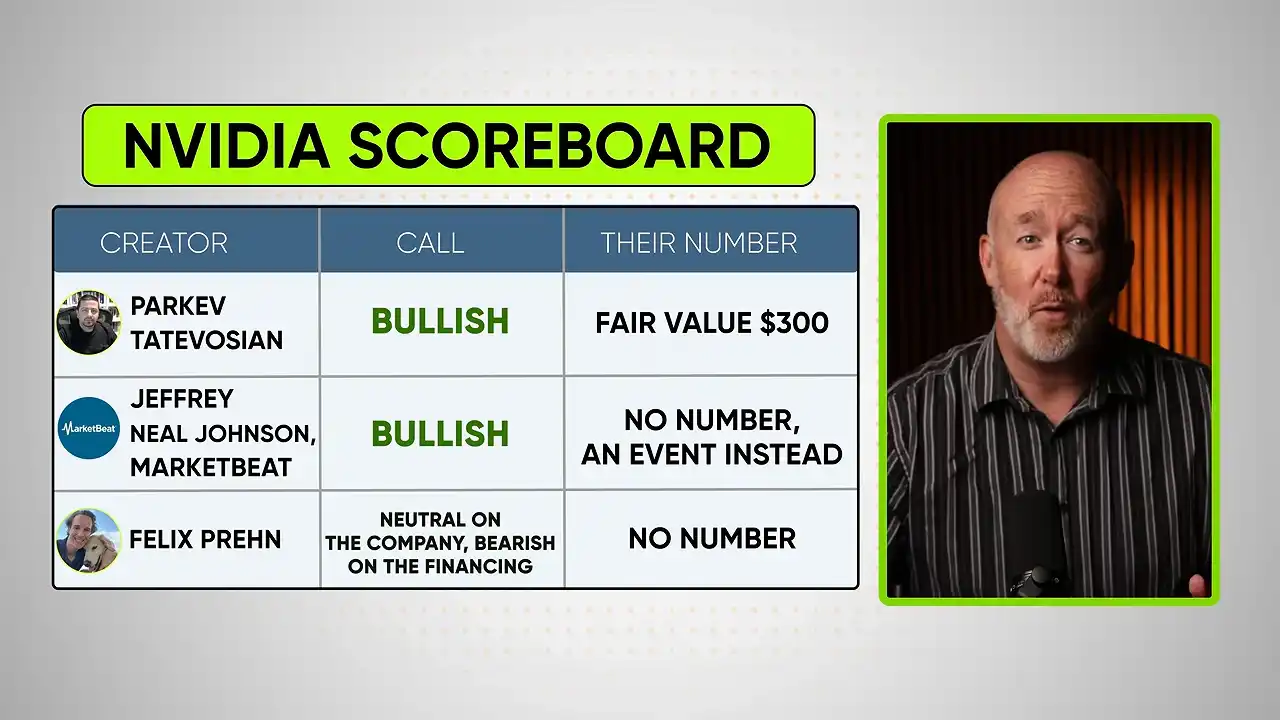
One blogger put Nvidia's assets, liabilities, and equity into an Excel sheet, calculating an intrinsic value per share of about $300. Current price $221 implies it's about a quarter to a third cheaper than the model. Brian's own model gives $290, sell-side analyst consensus is around $330. Several numbers point in the same direction: cheap.
What People Fear
The truly scary numbers are outside the financials: Nvidia's customers have borrowed roughly $500 billion to buy chips, close to twice Nvidia's annual revenue, with repayment cycles up to 5 years, the debt ultimately landing on pension books. The cost of Nvidia's debt default insurance has doubled since late May. The market talks bullish, but the insurance market is voting with money saying "not comfortable."
Brian's Action
His fair value is $290, but his Nvidia position is already at 12% (his self-imposed cap), no more buying. He absolutely will not buy below $148: if the chain of borrowing to buy chips really breaks, falling to $148 isn't cheap, it's catching a falling knife—the company story is broken.
四、Micron: Fair Value $1450, But Price Has Fallen Below Key Moving Average, He Keeps Buying Per Plan
Why It's Favored
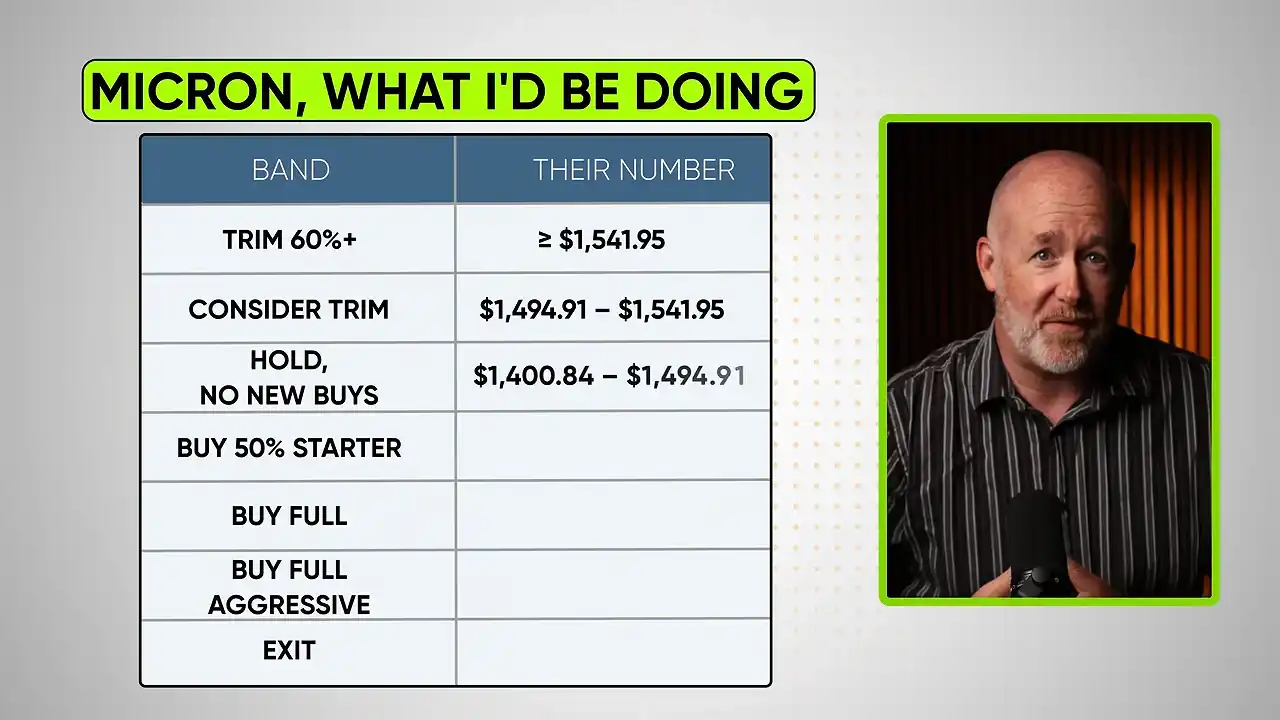
Brian's model gives Micron a fair value around $1,450, the stock with the most upside on the whole list. Plus, Micron's capacity is booked with orders locked in until 2027, no worry about sales.
What People Fear
Two numbers to look at together: based on realized earnings, Micron's P/E is 22x, not cheap; the "cheap" reference people usually cite is 6x based on next year's expected earnings. Both numbers can only hold true under one premise: the market assumes Micron's future earnings will triple. Buying Micron is essentially betting on whether this "tripling" will materialize.
And Micron is a cyclical stock. Stocks at cycle peaks often look cheap. There's more than one historical example of memory companies falling 70% from their highs.
Brian's Action (The Most Specific Segment in This Episode)
His own model is contradictory: one side says Micron is cheap, the other side, comparing to Micron's own history, says it's expensive. He chooses to listen to the bad side, sizing the position smaller.
Specific discipline:
- The 50-day moving average at $961 is the master switch. The price has fallen below it, so continue buying as per the original plan (not adding a single extra dollar).
- Only add more when the price climbs back above $961.
- $434 is the "company broken" signal line. Falling there means the entire story has changed, previous analysis invalid.
An interesting contrast: Another blogger's strategy is to buy at $135, add at $275, add again at $500, each level entering after a new high. This is a trader's breakout-chasing play, opposite to Brian's "wait for a dip to buy" approach. Same company, both plays can be right, depending on who you are.
五、CoreWeave: 1999's Old Story Repeating? He's Not Buying a Single Share, Just Watching
Why It's Favored
Holds $130 billion in contract orders. One blogger gives it a fair value of $113, current price $104.
What People Fear
In 1999, there was a US star stock called Lucent: It lent money to customers, who used that money to buy Lucent's equipment, and Lucent booked that as its own revenue. The numbers looked fantastic, until a customer came back asking for another $90 million loan and was refused, declaring bankruptcy weeks later. People realized the demand was manufactured all along by the seller financing it.
Now, Nvidia states in an SEC filing that it agrees to: Lease back all of CoreWeave's compute capacity that remains unleased through 2032. Translation: Part of the demand on CoreWeave's books might be the seller backstopping its own customer. Structurally identical to what Lucent did back then.
Brian's Action
Zero position, just watching. CoreWeave has been public for only 17 months, not enough historical data for him to draw entry ladders. He emphasizes: Standing aside and watching is different from holding. Don't mistake "not buying" for "secretly buying while publicly bearish."

六、Uber: The Only One Not an AI Bet, Two Independent Valuations Differ by Only $10
Why It's Favored
Uber lives on cash flow: generates about $10 billion in annual free cash flow, market cap $150 billion, in the cheapest third of its 10-year range. Among the 141 videos, it was the only stock mentioned by just one blogger, yet Brian gives it his deepest buy rung on the whole list.
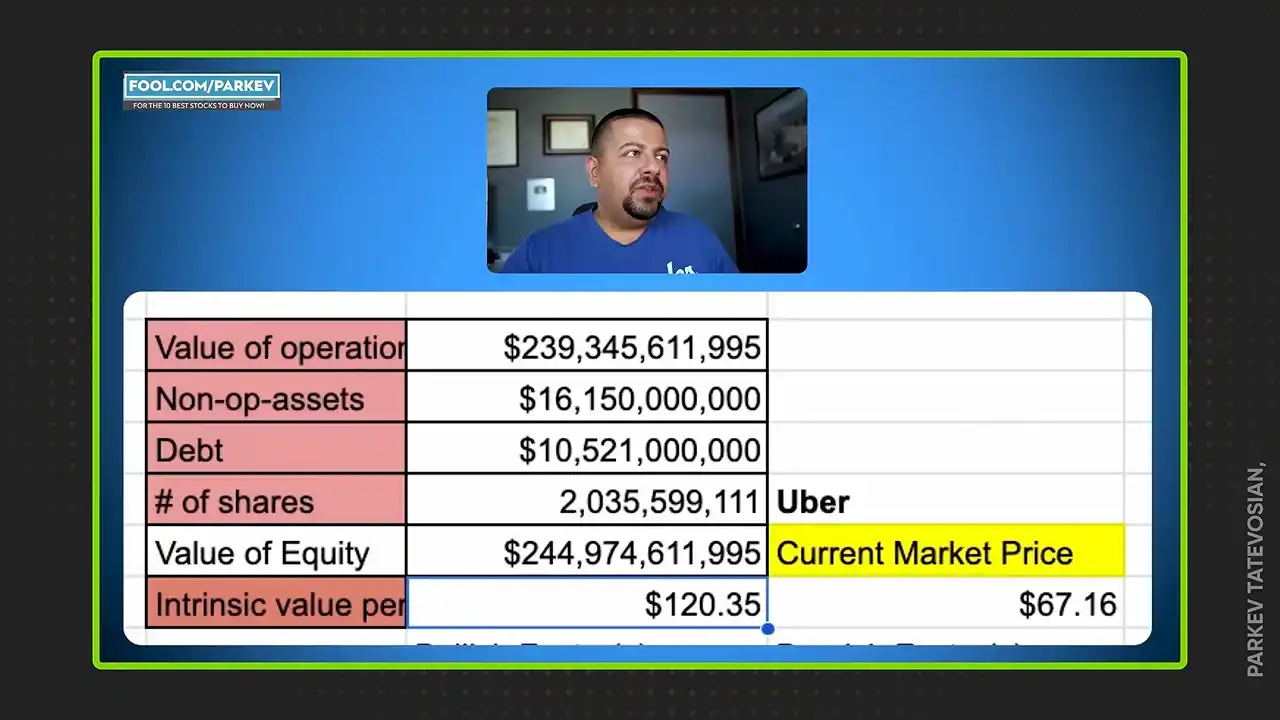
A detail showing its solid cheapness: That other blogger independently calculated Uber's fair value at $120, Brian's own calculation is $109. They never saw each other's work, yet the results differ by only $10, about 5%. Current price $67 (just after a 7% drop on recording day).
What People Fear
Autonomous driving. Either Waymo & co. steal Uber's passengers, or Uber is forced to build its own fleet, becoming a completely different, asset-heavy company. This is a lid on the valuation.
Brian's Action
Deepest buy rung, full position buying. His judgment is based on cash flow, not book profit (book profit includes one-time items, cash flow is cleaner). The market prices Uber based on "future earnings decline," he prices it based on cash flow sustainability. The difference is his margin of safety.
七、Taking This Method Home: 4 Questions Before Buying Any Stock
Brian's entry ladder isn't mystical, just four questions:
- Compared to its own history, is it expensive or cheap now? (Don't compare to other companies, compare to itself.)
- What does the current price already assume? (Micron example: current price assumes earnings triple. Do you believe it?)
- Are you confusing a good company with a good price? (A bad company at a cheap price is still a bad business.)
- What would make you change your mind? (This question costs nothing but saves the most.)
He adds a practical reminder: Writing down your exit price *before* buying versus finding an exit price *after* you're losing money, puts you in two completely different psychological states. The former is discipline, the latter is stop-loss.
八、Looking Back: You Think You Hold 5 Companies, But You Hold One Bet
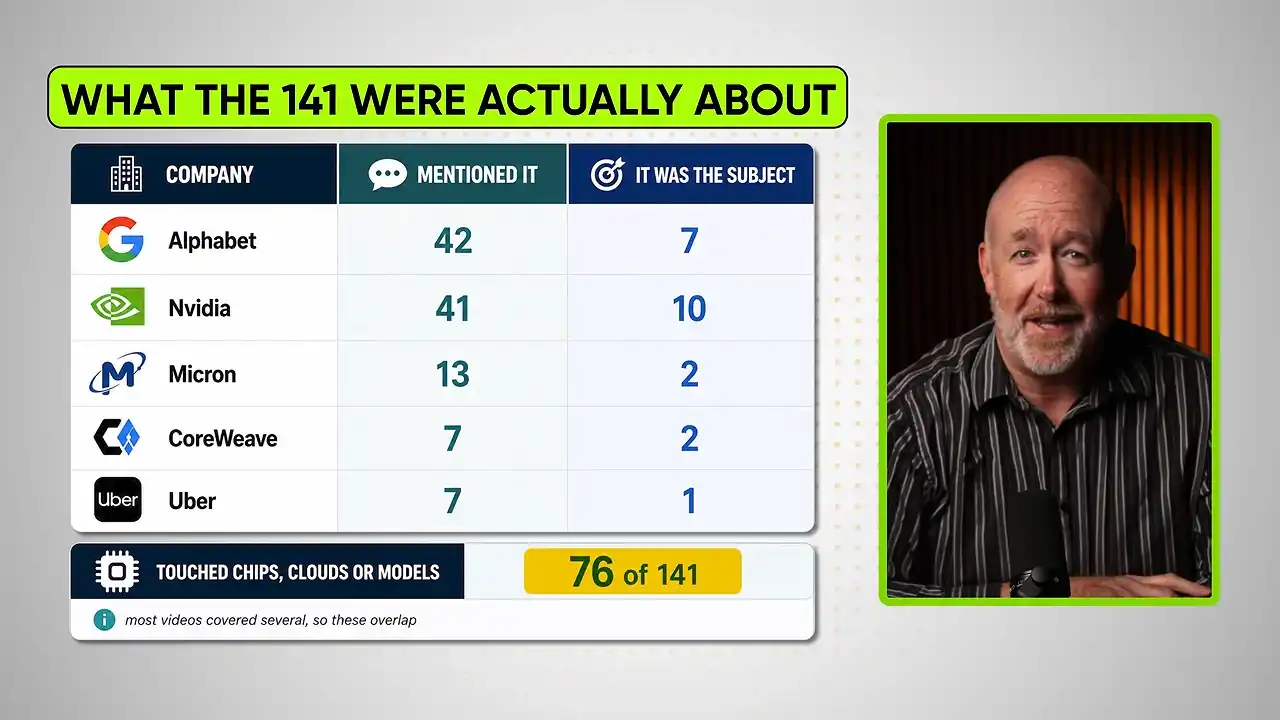
Brian finally tallies the theme distribution of the 141 videos:
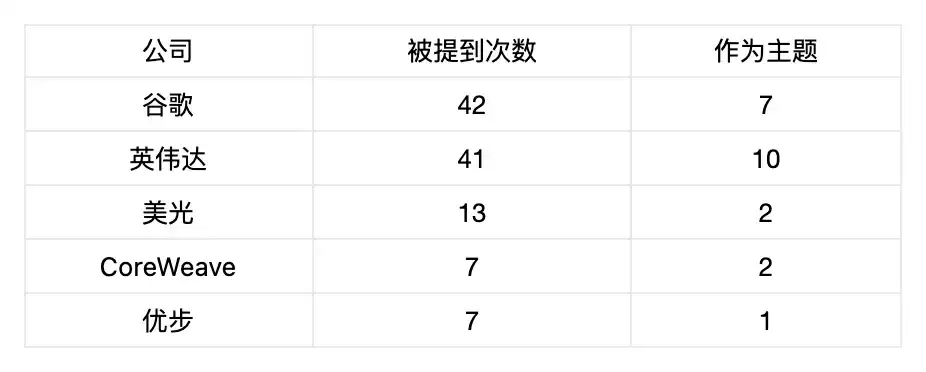
Over half the videos (76/141) talked about the same thing: chips, cloud, AI models. Even Uber, the "only independent" one, has its risk (autonomous driving) running on Nvidia's chips.
That's why Eisman's quote deserves to be at the beginning: If your watchlist is compiled from such videos, you think you've diversified, holding 5 companies, but you're actually holding the same AI bet under 5 different names. Brian himself admits guilt: "My own list is compiled the same way."