Author: Gu Yu, ChainCatcher
With the sharp decline in BTC and ETH prices over the past few days, the position of Jack Yi (Yi Lihua), founder of Trend Research and Liquid Capital (formerly LD Capital), has drawn significant attention from crypto investors. His leveraged position of 650,000 ETH is now in a precarious state, teetering on the brink of liquidation under the current market conditions.
For this staunch ETH bull, a rare on-chain transparent trader, and a representative figure in Asia's crypto institutional circle, this situation appears particularly cruel and lamentable. After all, concepts like "transparency," "bullishness," and "research-driven" align with mainstream crypto values. To some extent, Yi Lihua's current "battle" is also a "battle for legitimacy" for the crypto industry.
So, how did this happen? Why did Yi Lihua go from successfully exiting at the top to getting trapped while buying the dip? What lessons and insights can we draw from this?
From Buying the Dip to Exiting the Top
Yi Lihua is an early OG in the Chinese crypto community. Since 2015, he has invested in hundreds of blockchain projects. Early investment cases include EOS, Qtum, VeChain, etc. After 2017, through LD Capital, he invested in well-known projects like Near, CertiK, MEXC, Sentient, and others.
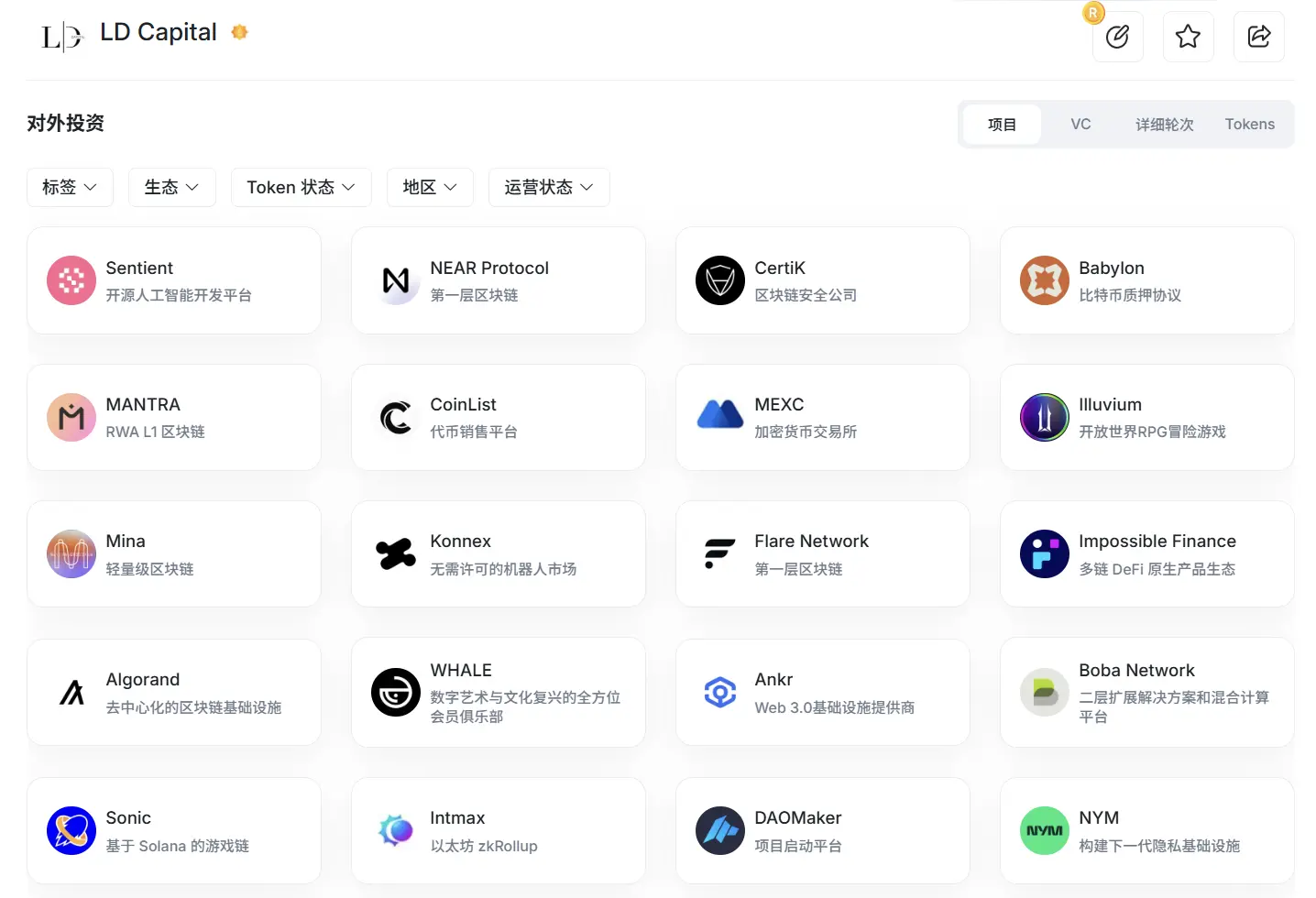
Some of LD Capital's investment cases Source: RootData
Since early 2025, Yi Lihua shifted his focus from the crypto primary market to the secondary market. In April 2025, the price of ETH fell to a new low since 2022, dropping to a minimum of $1,385. Yi Lihua's dip-buying began quietly at this time.
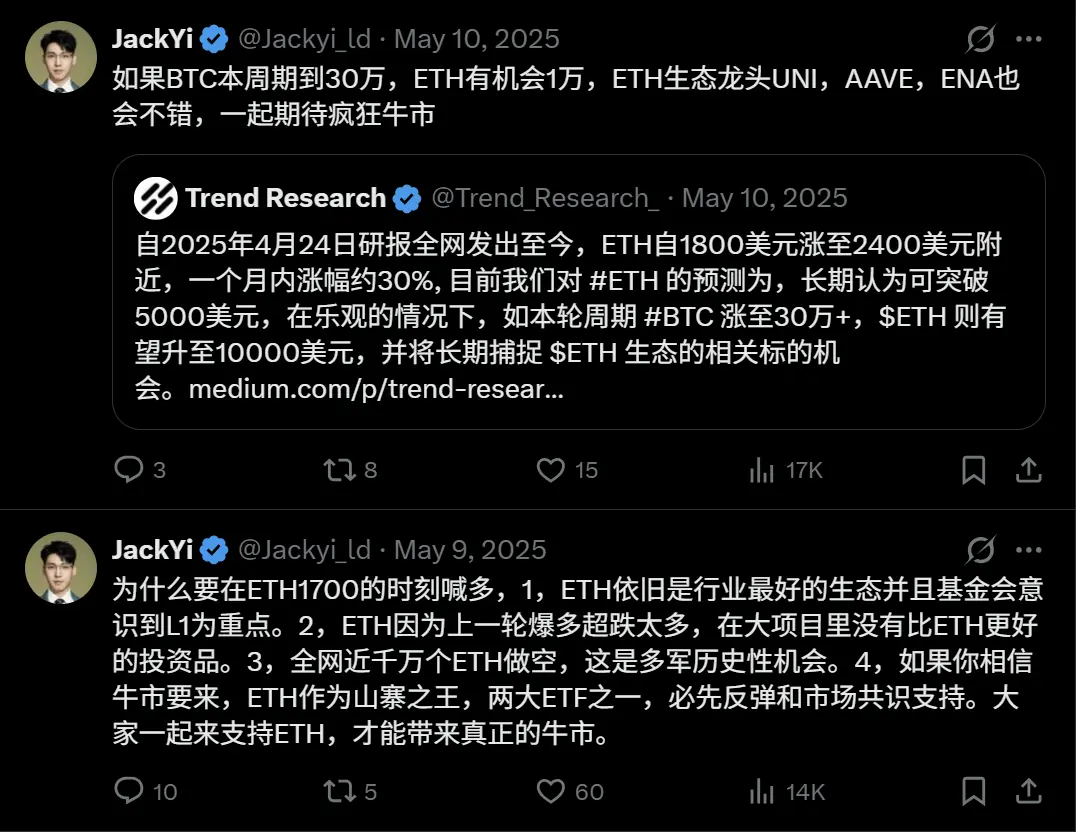
At the end of April, Trend Research publicly released a research report bullish on ETH when it rose to $1,800, stating, "Under the trend, more upside is coming for the Crypto market."
At the end of May 2025, the frequent large-scale on-chain accumulations by Trend Research were discovered and disclosed by on-chain analyst Yu Jin. Yi Lihua promptly claimed these addresses on X. By then, ETH had risen to $2,600, and Trend Research's on-chain addresses cumulatively held 133,000 ETH, with a total value of $360 million.
It should be noted, however, that Trend Research's operations were not entirely cash-based purchases. A significant portion of the funds used to buy ETH were borrowed through Aave by collateralizing the ETH purchased earlier, meaning leverage of several times was applied.
In June 2025, Trend Research published another article titled "On the Eve of the Surge: Why We Are Bullish on ETH," mentioning that the institution's underlying logic for being bullish on ETH remained: The Trump administration is committed to building a stablecoin system... and the most important infrastructure for stablecoins and on-chain finance is Ethereum. The influx of stablecoins and the continued development of RWA will bring further prosperity to DeFi, increase Ethereum's consumption and gas fee revenue, and push its market capitalization higher.
At that time, the price of ETH was around $2,800. Yi Lihua also publicly stated that he believed ETH's long-term price could break through $5,000, and optimistically, BTC could reach over $300,000 in this cycle, with ETH有望 potentially reaching $10,000. Simultaneously, Yi Lihua mentioned having purchased 100,000 ETH options.
In July 2025, Yi Lihua tweeted that the market had彻底 entered a long bull market, possibly without the traditional 4-year cycle规律. Stablecoins and blockchain represent the best opportunity for the US to globalize the dollar. Investing in crypto stocks with the left hand and earning interest on stablecoins with the right hand, the market will continuously attract new users and capital.
Thereafter, Yi Lihua几乎 added to his position every month until early October, when he began warning of market risks and quickly transferred most of his ETH holdings to the Binance exchange for sale at around $4,700,恰好 escaping the 1011 event.
Through this round of precise dip-buying (starting from around $1,800 in the first half of the year) and profit-taking at the high, Yi Lihua achieved significant doubled profits, solidifying his influence as a top trend investor in the Chinese-speaking community.
Second Position Trapped
In the market reshuffled by the 1011 event, Yi Lihua saw another opportunity to build a position. In early November, Yi Lihua tweeted again, stating that ETH was starting to rebound and that he continued to be optimistic about the subsequent行情 and the strategy of buying the dip. Subsequently, he stated that $3,000-$3,300 was the spot buying range for ETH. As ETH continued to correct, Yi Lihua, under his dip-buying strategy, stated that he was already fully invested in ETH at a price of $2,700. He then continued to add to his position through leveraged borrowing during further declines. By January of this year, his ETH holdings exceeded 650,000, with a reported average cost of $3,180.
"At the moment ETH fell to over $1,000, we saw through the主力's intention to wash out以太OG bulls and successfully bought the dip. When ETH rose to over $4,500, we saw through the market rising to a震荡 top and successfully liquidated. Trend Research has proven successful dip-buying and top-exiting performance in 2025. We will not change our investment strategy based on emotion," Yi Lihua was still cheering on the market in January.
But no one could have predicted that the market would deal this battle-hardened investor a heavy blow at this time. The price of ETH连续 broke through key levels of $2,200, $2,000, and $1,800 in early February, approaching his liquidation price.
Yi Lihua止损 sold approximately 200,000 ETH within a few days, lowering the liquidation price to around $1,600, narrowly escaping the sharp drop in the early hours of today. According to on-chain analyst Yu Jin's analysis today, Trend Research's long position this time has resulted in a loss of $763 million, not only wiping out all profits from the previous round but also losing $448 million in principal.
In recent days, Yi Lihua tweeted to admit his mistake, "Since liquidating at the top, it was indeed wrong to be bullish on ETH too early because when BTC was around $100,000, ETH remained at $3,000, which we considered undervalued. Currently, the profits from the previous round have been given back. Position determines perspective. While controlling risks, we continue to wait for the market to move upward. Thank you for your concern. Investment and trading are the most difficult. Being in the industry, one can't help but be bullish at all times."

"Why can't I help but be bullish? It's related to my past entrepreneurial experience. Back then, I truly couldn't find a job and started a business. After earning my first bucket of gold, I didn't dare to spend lavishly and instead invested in tech projects. Entering the crypto circle in 2015, I caught that golden age, which was a harvest from consistently being long. But later, major losses from bear market investments + couldn't endure the bear market and liquidated BTC too early, ultimately missing the big bull market after 312. We experienced two bear markets followed by bull markets, so this time, after exiting the top, we were overconfident and bought the dip too early. While controlling risks, we continue to wait."
Zhu Su, founder of Three Arrows Capital, posted on X discussing this matter, "In my experience, selling at the top is often more dangerous than selling on the way down. This is because the excitement from selling at the top leads to premature追加 buying and overconfidence. I suspect Jack Yi made a similar arrogant mistake after making nine-figure profits on October 10th."
But after going through these twists and turns, Yi Lihua still expressed his firm view on the future market, "As a bull in this round, we still看好 the performance of the new bull market: ETH reaching over $10,000, BTC exceeding $200,000. We merely made some adjustments to control risks. I know everyone is disappointed with the industry and the leaders, especially the liquidity shortage and some platform manipulation brought by the 1011 event, but I believe the long-term trend of the crypto circle remains unchanged. Now is completely the best time to buy现货. Volatility is the biggest characteristic of the crypto circle. Countless bulls in history have been shaken off by this volatility, but often followed by加倍 rebounds."
Currently, the price of ETH has rebounded to around $1,900, significantly reducing the risk for Trend Research's position. However, the impact and启示 of this event on the industry will continue to发酵.
The Market Needs More Bulls and Transparency
As one of the very few institutional representatives who choose "on-chain transparency" and publicly share all their thoughts and positional dynamics, Yi Lihua's every statement and every operation无形中 becomes a mirror for the industry: it reflects the信念 of trend investing and also magnifies the nonlinear risks of leverage; it demonstrates the power of逻辑兑现 in a bull market and also exposes the fragile balance between emotion and position during a retreat phase.
But in a market still dominated by anonymous market makers, platform manipulation, and information asymmetry, Yi Lihua's public choice is itself a rare act of courage—he uses real on-chain operations, not just talk, to verify his judgments. While this approach brings immense personal pressure and阶段性 floating losses, it also provides the most直观 textbook for countless retail investors and small institutions: how to exit at the top in a bull market, how to buy the dip in a bear market, how to manage leverage, and how to克制 emotion.
In the highly volatile and uncertain arena of the crypto market, even the most glorious success stories and profound cycle insights cannot completely exempt participants from the market's残酷 lessons—because every cycle轮回 tests participants anew, in new forms, with new intensity, and with new variables. In this cycle, the crypto market has become closely intertwined with the macro-economic environment (CPI, US stocks, gold, etc.) and geopolitical events. Any major change outside the industry has the potential to reverse the cyclical trends within the industry.
This experience once again proves that what truly determines whether an investor can weather the cycles is not the correctness of a single directional choice, but whether enough survival space is预留 for every judgment amidst持续 uncertainty, and the ability to止损 and restart promptly when mistakes occur. Respecting the market is a principle every investor must always abide by.
It is also worth noting that Trend Research, as one of the top three ETH holding entities in the market, has become a bellwether for institutional crypto investors in the Asia-Pacific region. Its successes and failures also concern the voice and status of the Asian market in the crypto industry. There is also market sentiment that the Asian market, as a major source of liquidity in the current crypto market with a relatively high proportion of retail structure and more intense情绪传导, could likely become a passive recipient of North American narratives and liquidity once transparent bulls are broken.
Fortunately, Yi Lihua and his Trend Research are still at the table. The crypto industry needs more steadfast "bulls," more "transparency," and more "Yi Lihuas."
It must be understood that Trend Research's story will be seen by more mainstream institutions and deep-pocketed organizations. The crypto industry needs more stories of achieving returns through注重 research,遵守 investment discipline, and controlling risk, not more MEME-style wealth transfers from left hand to right hand. The former can bring incremental investors, while the latter can only exacerbate the赌场化 of the crypto industry.




















