Philippines blocks Coinbase, Gemini amid wider crackdown on unlicensed VASPs

cointelegraphPublished on 2025-12-24Last updated on 2025-12-24

Abstract

Amid a wider crackdown on unlicensed virtual asset service providers (VASPs), the Philippines has blocked access to major global cryptocurrency exchanges Coinbase and Gemini. The National Telecommunications Commission directed local internet service providers to restrict access to 50 platforms flagged by the central bank for operating without authorization. This action signifies a regulatory shift from informal tolerance to strict enforcement, making local licensing mandatory for market access. The country had previously banned Binance and identified other unlicensed exchanges like OKX, Bybit, and KuCoin. Meanwhile, regulated entities are expanding crypto services, with partnerships enabling stablecoin payroll and banking-integrated crypto trading.

Internet service providers (ISPs) in the Philippines began blocking major crypto trading platforms as regulators moved to enforce local licensing rules on crypto service providers.

Users reported that as of Tuesday, access to global cryptocurrency exchanges Coinbase and Gemini was unavailable in the Philippines. Cointelegraph independently confirmed that both platforms were inaccessible across multiple local ISPs.

A report by the Manila Bulletin said the ISP blocks followed an order from the National Telecommunications Commission, which directed providers to restrict access to 50 online trading platforms flagged by the Bangko Sentral ng Pilipinas (BSP), the central bank, as operating without authorization.

The central bank did not publish a full list of the platforms hit by the order. However, the change signals an ongoing shift by local regulators from informal tolerance to enforcement, making local licensing the deciding factor for crypto market access in the Philippines.
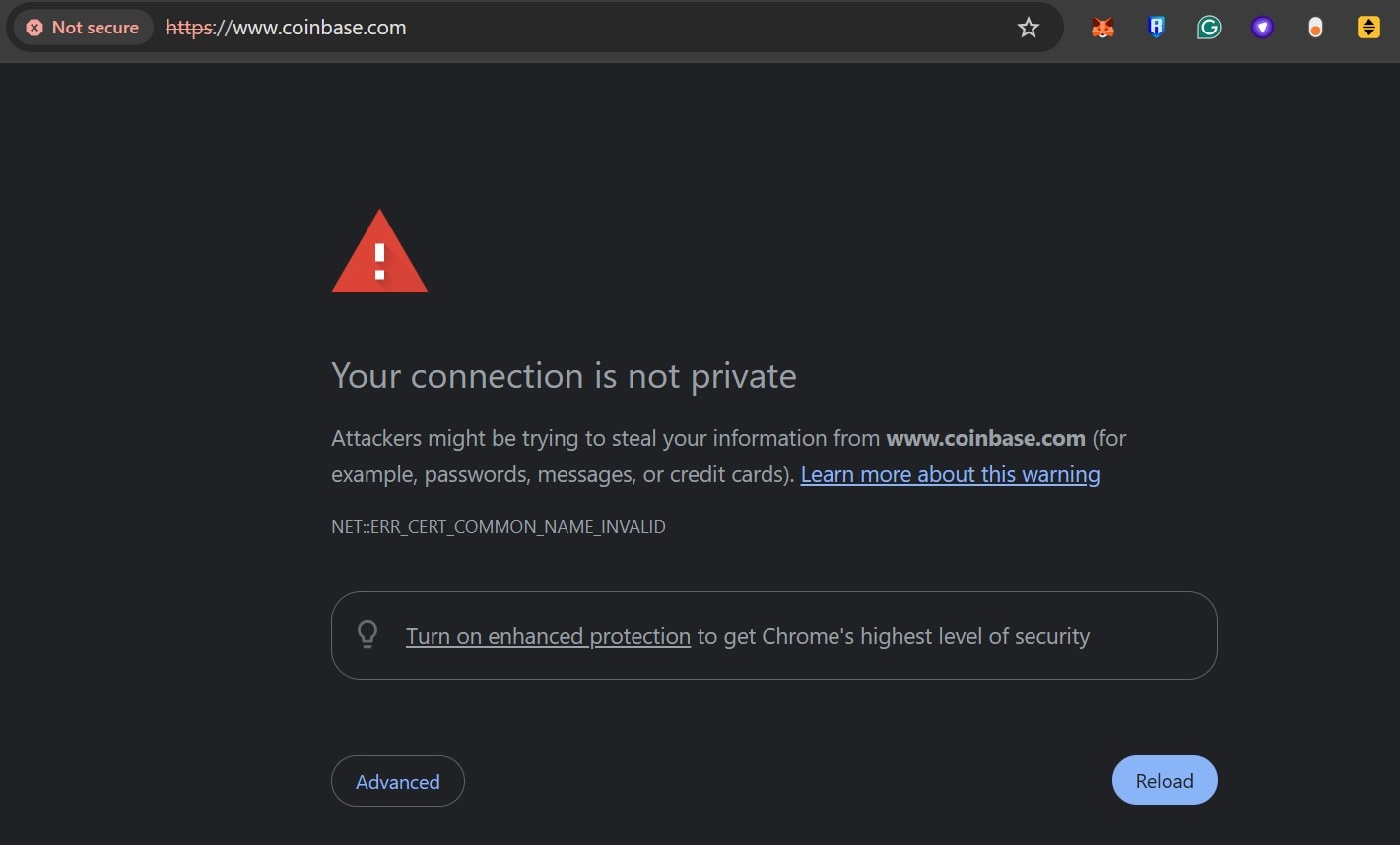
Crypto exchange Coinbase is now inaccessible in the Philippines. Source: Cointelegraph

Coinbase, Gemini join Binance in Philippines access block

While the Philippines has only recently blocked Coinbase and Gemini, the country has made enforcement moves against unlicensed crypto exchanges in the past.

In December 2023, the country started a 90-day countdown, giving Binance time to comply with local regulations before enforcing a ban on the crypto trading platform.

The Philippines Securities and Exchange Commission (SEC) said the period was meant to allow Filipinos to remove their funds from the exchange.

On March 25, 2024, the NTC ordered local ISPs to block Binance. Nearly a month later, the SEC ordered Apple and Google to block the exchange’s application from their stores.

After the ban was enforced, the Philippines SEC said it could not endorse ways for Filipinos to retrieve their funds.

More recently, the SEC identified 10 exchanges, including OKX, Bybit and KuCoin, operating without licenses.

Related: Grab deepens stablecoin push with StraitsX Web3 wallet and settlements

Regulated players roll out crypto products

While the country cracks down on unregulated platforms, compliant companies have been rolling out crypto-related infrastructure in the country.

On Nov. 19, regulated crypto exchange PDAX partnered with payroll provider Toku to let remote workers receive their salaries in stablecoins. This allows workers to convert earnings to pesos without wire fees or delays.

On Dec. 8, digital bank GoTyme rolled out crypto services in the Philippines following a partnership with US fintech firm Alpaca. With the rollout, 11 crypto assets can be bought and stored through the platform's banking application.

Magazine: Sei wallets in Xiaomi, Bhutan’s gold on Solana: Asia Express

Related Questions

QWhy did the Philippines block access to Coinbase and Gemini?

AThe Philippines blocked access to Coinbase and Gemini because the National Telecommunications Commission, acting on an order from the central bank (BSP), directed ISPs to restrict access to these and other platforms flagged for operating without a local license.

QWhich government bodies were involved in the enforcement action against unlicensed crypto exchanges?

AThe enforcement action involved the Bangko Sentral ng Pilipinas (BSP), which flagged the unlicensed platforms, and the National Telecommunications Commission (NTC), which ordered internet service providers to block them. The Securities and Exchange Commission (SEC) was also involved in actions against other exchanges like Binance.

QWhat was the previous major enforcement action taken against an unlicensed crypto exchange in the Philippines before Coinbase and Gemini?

APrior to blocking Coinbase and Gemini, the Philippines enforced a ban on Binance. This process began with a 90-day countdown in December 2023 and culminated in the NTC ordering ISPs to block the platform in March 2024, followed by the SEC ordering its removal from app stores.

QWhat is the significance of this crackdown for the regulatory environment in the Philippines?

AThe crackdown signifies a major shift in the Philippines' regulatory stance, moving from informal tolerance to strict enforcement. It establishes local licensing as the decisive factor for crypto market access, prioritizing consumer protection and regulatory compliance.

QDespite the crackdown, what crypto-related services are being launched by compliant companies in the Philippines?

ACompliant companies are rolling out new services. Regulated exchange PDAX partnered with Toku to enable salaried payments in stablecoins, and digital bank GoTyme, in partnership with Alpaca, launched a service allowing users to buy and store 11 different crypto assets through its banking app.

Related Reads

Can Generative Models Finally Be Trained End-to-End? The Core Is a For Loop

This article introduces a novel training paradigm for generative models called Explorative Modeling (XM), which enables true end-to-end training. Traditionally, powerful generative models like autoregressive and diffusion models are not trained end-to-end. They are trained to predict a single small step but require iterative multi-step sampling for inference. This "exposure bias" leads to error accumulation and limits performance. The core challenge XM addresses is "mode blurring." In generative tasks, a single input (e.g., "generate a dog") corresponds to many valid outputs (multiple modes). Standard training objectives like reconstruction loss force the model to average these modes, producing unrealistic, blurry outputs. To avoid this, existing models break generation into many small, almost deterministic steps, sacrificing end-to-end training. XM tackles this by restructuring the training loop itself. Its key insight is to amplify "generative expressivity." For each training input, instead of generating one sample, the model generates K candidate outputs. Only the candidate closest to the real data is used for computing the loss and updating the model via backpropagation. This simple "best-of-K" mechanism is implemented as a short for-loop. By exploring multiple possibilities, the model learns to distribute its guesses across different modes rather than collapsing to their uninformative average. The paper demonstrates that "exploration" acts as a new, powerful scaling axis. Gains from XM increase with model size, data scale, and compute. Experiments show improvements in FID scores for image generation and significant efficiency gains, sometimes outperforming larger models without exploration. When pushed to the limit, XM enables fully single-step, end-to-end generative models. In robotics tasks, an "Explorative Policy" matched the performance of a 100-step Diffusion Policy with a single forward pass, drastically improving inference speed. While the best-of-K concept is not entirely new, the authors' contribution lies in formally understanding it as a direct method to boost generative expressivity without fragmenting the generation process. This work suggests that as models scale, enhancing exploration during training may become crucial for overcoming fundamental performance bottlenecks.

marsbit47m ago

Can Generative Models Finally Be Trained End-to-End? The Core Is a For Loop

marsbit47m ago

Annual Salary of Millions Competing for Electricians, Meta Rushes to Open Its Own Technical School

The AI boom is facing an unexpected bottleneck: a severe shortage of skilled construction workers and electricians. As tech giants like Meta, OpenAI, and Alphabet race to build massive data centers—such as OpenAI's $16 billion "Stargate" project—they are hitting a critical labor wall. The U.S. needs an estimated 130,000 more electricians, 240,000 construction workers, and 150,000 supervisors by 2030 for AI infrastructure alone, but tens of thousands of electrician jobs go unfilled each year. While AI companies offer high premiums, with electricians earning up to $280,000 annually, worker scarcity still causes massive losses—delays on a single project can cost $14.2 million per month. The complexity of building AI data centers, which require immense power (equivalent to powering hundreds of thousands of homes), sophisticated electrical systems, and advanced liquid cooling solutions, demands highly skilled technicians who are in short supply. To combat this, companies are investing heavily in training. Meta has committed $115 million to a free training school offering tuition, housing, and stipends, targeting 5,000 new workers. OpenAI is partnering with unions to secure skilled labor. These efforts are paying off, with a significant rise in Gen Z interest in trade schools over college. However, the power demands are staggering. AI data centers are driving a rapid surge in electricity consumption, projected to account for up to 12% of U.S. power use by 2028 and raising costs for consumers. Furthermore, the construction boom is project-based, leading to a potential future glut of trained workers once building peaks, which could depress wages industry-wide. The race for AI supremacy now depends as much on skilled hands as on advanced chips.

marsbit2h ago

Annual Salary of Millions Competing for Electricians, Meta Rushes to Open Its Own Technical School

marsbit2h ago

Trading

Spot
活动图片