PA Illustrated | A Glimpse into Major Web3 Events in February 2026

marsbitPublished on 2026-02-01Last updated on 2026-02-01

Abstract

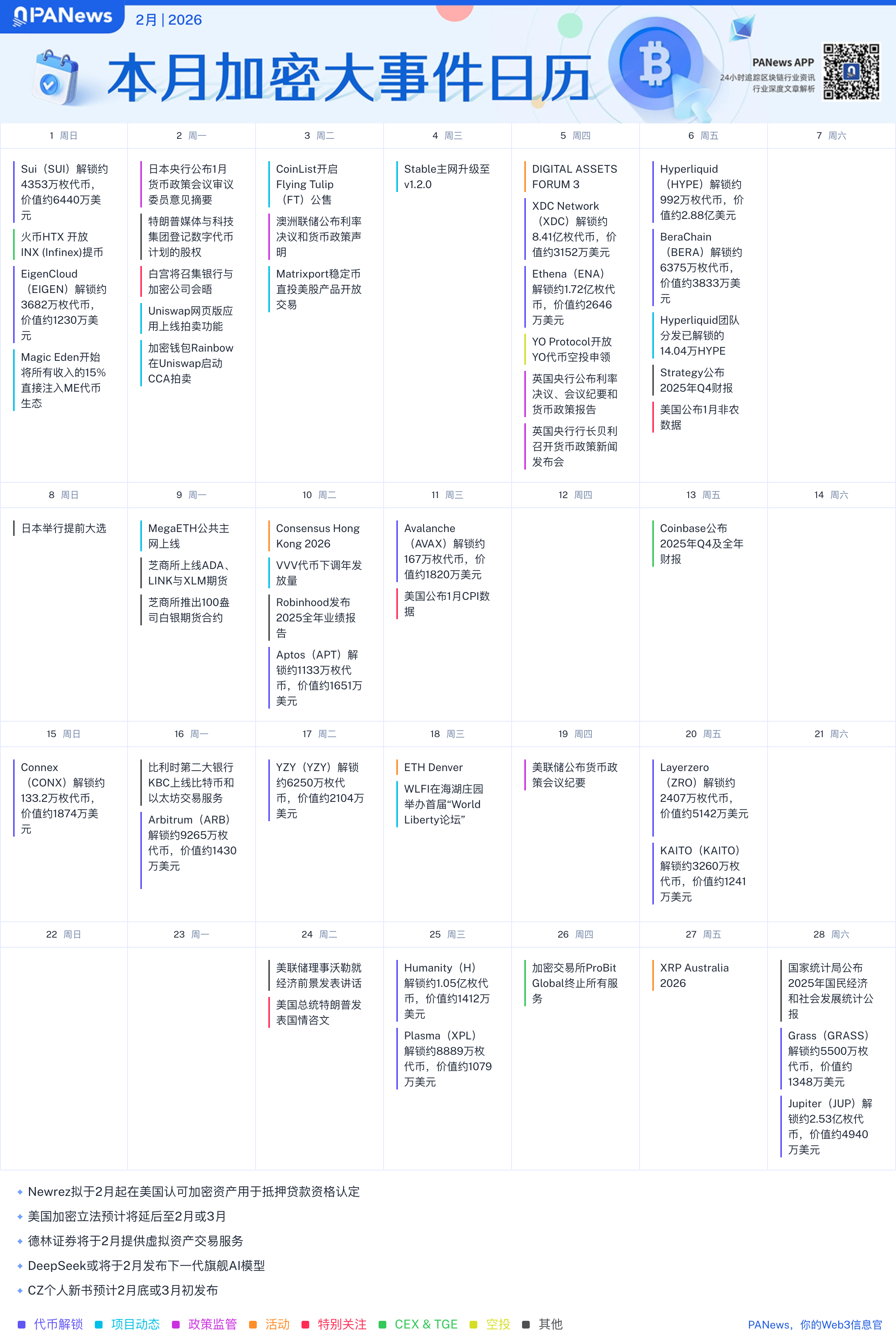
PANews presents its updated crypto calendar for February 2026, featuring comprehensive coverage, flexible filtering, and easy export options. Key events this month include high-impact macroeconomic and policy developments, major financial disclosures, and significant project updates. Highlights include a White House meeting between banks and crypto companies, the U.S. President’s State of the Union address, and the release of key economic indicators such as January non-farm payroll and CPI data. Companies like Coinbase, Robinhood, and MicroStrategy will report Q4 and full-year 2025 earnings. Several major token unlocks are scheduled, including those from Sui and EigenLayer, totaling over $700 million. Major industry conferences such as Consensus Hong Kong and ETHDenver will also take place. This calendar offers a concise overview of essential Web3 activities for February.

More comprehensive coverage, flexible filtering, and convenient exporting. Welcome to experience PANews' new crypto calendar.

Click to view PA Calendar

In February, macro policies will be implemented, key financial reports will be disclosed, and core project developments will be intensively released:

  • The White House will convene a meeting between banks and crypto companies
  • U.S. President Trump will deliver the State of the Union address
  • U.S. January non-farm payrolls, unemployment rate data, and CPI will be released successively
  • Coinbase, Robinhood, Strategy4, and others will disclose Q4 and full-year financial reports for 2025
  • Major unlocks for Sui, EigenLayer, and others, with a total scale exceeding $700 million
  • Consensus HongKong, ETHDenver, and others will be held as scheduled

Global key events converge. Lock in the core trends of Web3 in February with just this one image!

Related Questions

QWhat is the main purpose of the PANews new crypto calendar mentioned in the article?

AThe PANews new crypto calendar offers comprehensive coverage, flexible filtering options, and convenient export functionality.

QWhich significant macroeconomic events are scheduled for February 2026 according to the article?

AThe White House will convene a meeting with banks and crypto companies, President Trump will deliver the State of the Union address, and the US January non-farm payrolls, unemployment rate data, and CPI will be released.

QWhich companies are set to release their Q4 and full-year 2025 financial reports in February?

ACoinbase, Robinhood, and Strategy4 are among the companies that will disclose their Q4 and full-year 2025 financial reports.

QWhat major token unlocks are happening in February, and what is their total estimated value?

ASui and EigenLayer are undergoing significant token unlocks, with a total estimated value exceeding $700 million.

QName the two major Web3 conferences mentioned that are taking place in February.

AThe two major conferences are Consensus HongKong and ETHDenver.

Related Reads

In-depth: The Foreign Guest Genspark

The article "The Foreign Guest: Genspark" investigates the identity and business practices of AI startup Genspark, which presents itself as a Palo Alto-based "AI Costco" offering a subscription bundle of over 70 models and numerous AI agent tools. Despite its official Silicon Valley narrative, Genspark's founding team has deep roots in Chinese tech giant Baidu, a history systematically downplayed in its branding. The company actively cultivates an image as an elite US firm, heavily publicizing partnerships and endorsements from OpenAI, Anthropic, and Microsoft, while distancing itself from the Chinese AI community and obscuring its connections to Chinese investors and open-weight models (like those from DeepSeek, Moonshot AI, and MiniMax) that power its services. Genspark's core strategy involves rapidly cloning and integrating successful AI product concepts (e.g., from Perplexity, Manus, Plaud) into its unified platform, supported by aggressive marketing, including Super Bowl ads and paid native content in publications like The Wall Street Journal. Critically, the article suggests a significant portion of its engineering and product development is conducted by a team in Beijing, operating outside its official US corporate structure. This duality allows Genspark to leverage Chinese talent and models for efficiency and cost reduction while constructing a public facade as a purely American success story. The piece concludes that Genspark's most effective agent is its own corporate identity, meticulously engineered to obscure its Chinese underpinnings and be perceived solely as a Silicon Valley company.

marsbit41m ago

In-depth: The Foreign Guest Genspark

marsbit41m ago

Debate: Korean Workers Fear Unemployment, While Musk Envisions a Society 'Without Work'?

While South Korean auto workers fear job losses from robotics, Elon Musk envisions a future where AI and robots render most work optional. This article explores the growing tension between immediate anxieties over automation and long-term visions of a post-work society. The piece begins with recent strikes at Hyundai's Korean plants, where unions, amid standard wage negotiations, also sought job guarantees against advancing robotics—specifically mentioning Boston Dynamics' Atlas. This reflects how anxiety about technological displacement is emerging even before robots are fully capable of replacing skilled labor on assembly lines. The author argues that while current robotics still struggle with the nuanced, experiential knowledge of veteran workers, the *perception* of imminent replacement is fueling social conflict prematurely. This modern "Luddite" sentiment is compared to the 19th-century English textile workers who smashed machines. Historically, Luddites weren't simply anti-technology; they were protesting the rapid devaluation of their skills and the unequal distribution of productivity gains. Similarly, today's workers ask who will bear the cost of transition and share in the new wealth created by machines. In contrast, figures like Elon Musk propose an optimistic endpoint: with AI and robotics driving extreme abundance, the link between work and survival could break. He suggests concepts like "Universal High Income" could allow society to share the technological bounty, transforming work from a necessity into a choice. The core challenge, however, lies in the transition. The author notes that technology's benefits diffuse slowly, while its disruptive costs—job losses, skill obsolescence—can be concentrated and immediate. The risk is a painful interim period where productivity gains are captured by a few before new social contracts, safety nets, and retraining systems are established. The conclusion calls for proactive governance. Just as past industrial revolutions gave rise to labor standards and social safety nets, the robotics era needs its own frameworks. These should address job transition support, distribution of productivity gains, safety liability, and ethical deployment. Embracing such "constraints" is not opposition to progress but a necessary step to ensure technology benefits society broadly. The discussion sparked by Hyundai's workers, therefore, is not premature but essential.

marsbit54m ago
Debate: Korean Workers Fear Unemployment, While Musk Envisions a Society 'Without Work'?

marsbit54m ago

Trading

Spot
活动图片