OpenAI Launches Workflow Agent, GPTs Begin Countdown

marsbitPublished on 2026-04-24Last updated on 2026-04-24

Abstract

OpenAI has launched Workspace Agents, an evolution of GPTs designed for teams. This new feature allows users to create reusable, shareable agents that automate repetitive workflows. Driven by Codex, these agents operate within their own workspace, can access files, call tools, and run continuously in the background. Users describe a workflow—such as collecting information, making judgments, generating results, and sending outputs—to ChatGPT, which then builds the agent. The entire team can use and refine the agent via ChatGPT or Slack. Once set up, the agent runs autonomously. Workspace Agents are team-shared, code-free, and manageable with predefined permissions and controls. They are suitable for structured, repeatable tasks involving multiple tools and continuous operation, such as software review, feedback整理, report generation, sales follow-up, and risk assessment. The system operates within clear rules, with sensitive actions requiring human confirmation. It aims to transform workflows from being person-dependent to being documented, executable, and reusable—akin to scientific management principles. Competing solutions from Microsoft and Google are also emerging in this space.

OpenAI released Workspace Agents in the early hours, marking the beginning of the countdown for GPTs.
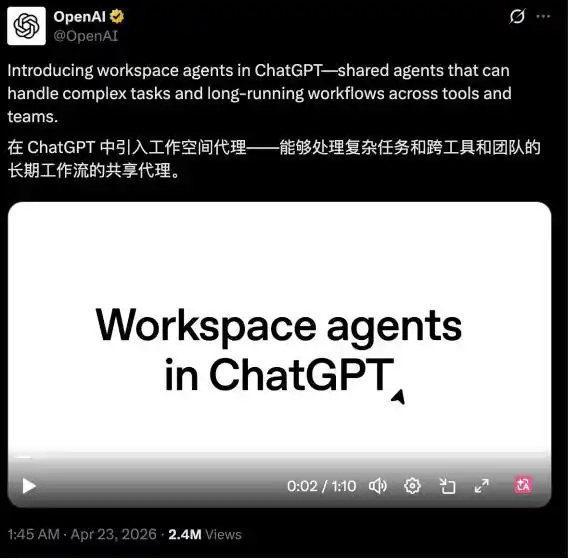
This new product is introduced as an evolved form of GPTs, with a clear positioning: team-oriented, turning a repeatable workflow into a shareable, executable agent.

It is powered by Codex, has its own workspace, can access files, call tools, and execute tasks continuously in the background.

You describe a repetitive workflow to ChatGPT, such as collecting information, making judgments, generating results, and then sending the results out. ChatGPT will then build this process into an Agent, which your entire team can use in ChatGPT or Slack, making adjustments while using it.

Once set up, it will continue running in the background, even when people are away.

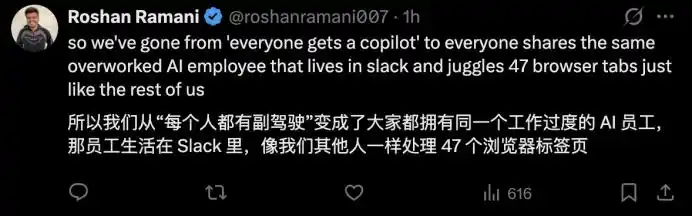
It sounds familiar, like OpenClaw · Team Edition.
01 Team-Shared Agent

As the name suggests, Workspace Agents are for work teams.

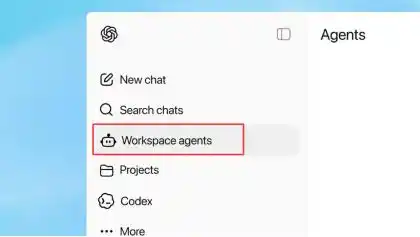
This new feature is placed in the sidebar of ChatGPT as a separate entry. Clicking on it reveals a space to build workflows.
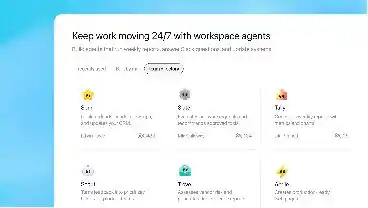
You can create an agent from scratch or modify it based on official templates. The entire process requires no coding; simply describe the workflow in plain language, and the system will break it down step by step: what steps are needed, what tools are used, and what results are output.

The created agent will appear in the team directory, where other members can directly call the same agent or adjust and supplement the workflow during use.
In other words, the workflow becomes a reusable tool for the team. Moreover, it is not fixed; it can be continuously refined during use.

Additionally, Workspace Agents have their own workspace, allowing them to read and save files, call connected tools such as email, calendars, document systems, or other business systems, and execute code when needed.

They can also run continuously, either manually triggered or scheduled. Once the process starts, it will execute step by step without requiring human intervention at each step. As long as the entire process is feasible, you can let it run on its own.

The execution process is controllable. Workspace Agents follow pre-set permissions and control rules.

Each agent's accessible tools and data can be set in advance; operations involving content modification or sending information can require prior approval; administrators can monitor its usage and pause or adjust it when necessary.

Looking back at previous generations of products, this change becomes clearer.

The earliest GPTs were essentially prompt + knowledge base + Actions, configured once for single-user use, without true long-process execution capabilities.

Later, ChatGPT Agent could execute tasks but was more like a one-time call. It ended after completion, with no continuous operation or stable identity.

With Workspace Agents, this type of product has stabilized: it is team-shared, can run long-term, has its own context and memory, executes continuously according to preset processes, and includes permission and management mechanisms.

Based on the official description, this product is suitable for structured, repeatable tasks that rely on multiple tools and require continuous operation. For one-time conversations or temporary tasks, such complexity is likely unnecessary.

Workspace Agents are now available in research preview for ChatGPT Business, Enterprise, Education, and Teacher plans. For Enterprise and Education plans, administrators can manage these agents through role permissions.

02 Simplifying Processes Under Clear Rules

OpenAI provided five typical scenarios covering IT, product, operations, sales, and risk control functions.

None of these scenarios require coding. They share a commonality: the tasks themselves are not complex, but the information is scattered across different places, requiring people to search and organize repeatedly.

The first is software review: after an employee submits a software use or procurement request, the agent checks it against the company's existing tool list and security rules to determine whether the request can be approved, how to proceed, and, if necessary, directly submits the ticket.

The second is product feedback organization: the agent simultaneously checks Slack, customer service channels, and public forums to collect scattered user feedback, categorizes it briefly, identifies which are more important, organizes it into tickets, and outputs a阶段性 summary.

The third is weekly report generation: the agent pulls business data at fixed times, creates charts, writes a summary, and compiles a complete report for the team.

The fourth is sales lead follow-up: the agent checks new customer information, judges whether the customer is worth following up based on team rules, drafts a follow-up email, and syncs relevant content back to the CRM system.

The fifth is third-party risk assessment: the agent checks various information about suppliers, such as whether they are sanctioned, their financial status, and any negative news, then compiles a report according to the company's standards.

These five scenarios point to the same type of task, which is the primary use of Workspace Agents: if a process already exists but requires constant switching between different tools during execution, with results pieced together at the end, Workspace Agents can connect these steps and let them run sequentially.

The question then arises: while it's fine to let it collect information and organize processes, is it appropriate to leave judgment to it?

According to the official design, this issue has not been overlooked.

The "judgment" in Workspace Agents is not free rein; it operates within a set of rules.

For example, in the software review scenario, it checks against the company's existing list and security rules to decide whether to use a certain tool; in the sales lead scenario, it doesn't randomly pick customers but scores them based on pre-set team standards.

For more sensitive actions, such as modifying data, sending external messages, or creating schedules, the system can add a confirmation step by default. The process can run automatically, but critical nodes can still pause for human final decisions.

This actually defines a boundary.

Workspace Agents are more suitable for tasks where the rules are clear and the judgment criteria are already written.

If a task itself requires extensive ad-hoc judgment and constant adjustment based on context, it still needs human leadership.

03 Management Lessons from OpenClaw

From a management perspective, Workspace Agents solve not an efficiency problem but the organizational method of the process itself.

In many teams, workflows exist but are not fully documented.

They are scattered in different places: part in documents, part in systems, and part in the minds of those executing them.

The same task handled by different people may follow different sequences and judgment standards.

This is why many tasks seem simple but are difficult to stabilize.

In the late 19th century, Taylor proposed scientific management, whose core was transforming work from "relying on personal experience" to "steps that can be split, recorded, and repeatedly executed."

First, break down a task: how each step should be done, what standards to judge by, then fix these steps so different people can execute them in the same way.

What Workspace Agents do is very similar to this logic. A process must first be clearly written: when it starts, what data is used, what steps are involved, and what results are produced.

This content directly becomes an executable process. During execution, it no longer relies on someone remembering the next step but follows the defined sequence.

The change is that the process can be separated from people.

In the past, the "most familiar person" in a team often determined whether the process could run smoothly; now, this experience can be written into the process, and other team members can directly use the same approach.

Another important point is that the process must have boundaries: which parts can be automated, which must stop for confirmation, which data can be used, and which cannot—all must be set from the beginning.

From this perspective, Workspace Agents do not change the content of work; they change how the process exists.

The process is no longer just described; it can be run, reused, and continuously adjusted.

Tools like OpenClaw initially followed this direction: they attempted to let systems take over entire operational processes, turning actions that required step-by-step human completion at a computer into automatically executable workflows.

The difference is that Workspace Agents place this in a team environment and add layers of permissions, approvals, and management, making work more controllable.

Similar attempts are not unique to OpenAI.

Microsoft is advancing its Copilot Agents, embedding this capability into Microsoft 365, covering environments employees use daily, from email and documents to collaboration tools.

Google also launched an enterprise-side Agent platform today, focusing on how to manage and schedule large numbers of agents, allowing them to collaborate across different systems.

However, for enterprises, the difference is not just in functionality. The real cost lies in usage: whether employees need to learn new tools and whether processes need to be rebuilt determines whether these systems can truly operate.

The competition continues, but the direction is clear.

This article is from the WeChat public account "Letter AI", author: Yuan Xinyue

Related Questions

QWhat is the main purpose of OpenAI's newly released Workspace Agents?

AWorkspace Agents are designed for teams to create shareable, executable agents that automate repetitive workflows, allowing them to run continuously in the background with access to files, tools, and predefined rules.

QHow do Workspace Agents differ from previous GPTs and ChatGPT Agents?

AUnlike earlier GPTs (prompt + knowledge base + Actions for single users) and ChatGPT Agents (one-time execution without persistence), Workspace Agents are team-shared, have long-running capabilities, stable identities, context memory, and built-in permission management.

QWhat are some typical use cases for Workspace Agents mentioned in the article?

ATypical use cases include software compliance checks, product feedback aggregation, weekly report generation, sales lead follow-ups, and third-party risk assessments—all involving structured, repeatable tasks across multiple tools.

QHow does Workspace Agents handle decision-making and ensure control?

ADecision-making is rule-based, relying on predefined company standards (e.g., security rules or sales criteria). Sensitive actions like data modification or external communications can require human confirmation, and administrators can monitor, pause, or adjust agents.

QWhat management philosophy does Workspace Agents align with, according to the article?

AIt aligns with Taylor's scientific management principles, breaking down workflows into documented, repeatable steps that are detached from individual experience, making processes executable, shareable, and adjustable within teams.

Related Reads

Bitcoin's Weak Rebound Fails to Mask Adjustment Trend, HYPE's Top Signal Warns of Short-Term Risks | Invited Analysis

**Title:** Bitcoin's Weak Rebound Fails to Mask Downtrend; HYPE Top Signal Alerts of Short-Term Risks | Exclusive Analysis **Abstract:** This weekly market analysis examines the current technical structures of Bitcoin and HYPE, outlining key trading strategies. Bitcoin's daily chart shows it has broken below the median line of its primary ascending channel, indicating structural weakness. It is currently experiencing a weak rebound within a short-term descending channel, targeting resistance at $75,000-$76,000. Failure to break above this zone could lead to a resumption of the downtrend, testing support at $69,500-$70,500. Trading strategies include positioning for a rebound rejection (Plan A) or a breakdown below key support (Plan B) with controlled short positions. For HYPE, the 4-hour chart reveals a potential seven-wave advance from the May 14 low, now showing signs of exhaustion. A bearish divergence (momentum weakening) has been observed, coupled with a top signal from the proprietary "Spread Trading Model" at potential endpoint 47. The key this week is to monitor if a confirmed top forms here, especially upon a breach of the $62.5-$64.57 support area. If broken, a larger corrective move towards $54-$56.30 is anticipated. The short-term strategy for HYPE focuses on cautious long entries only upon confirmed stabilization within the support zone. The report also details a successful short BTC trade from the previous week, yielding a ~5.07% profit, executed based on model signals and price action. Strict risk management rules, including dynamic stop-loss adjustments, are emphasized.

marsbit11m ago

Bitcoin's Weak Rebound Fails to Mask Adjustment Trend, HYPE's Top Signal Warns of Short-Term Risks | Invited Analysis

marsbit11m ago

Bitcoin's Weak Rebound Fails to Conceal Adjustment Trend; HYPE's Top Signals Warn of Short-Term Risks | Guest Analysis

Bitcoin's Weak Bounce Fails to Mask Correction Trend; HYPE Top Signals Warn of Short-Term Risks | Invited Analysis Core Weekly View: Bitcoin's daily chart structure has weakened. The key question is whether its short-term rebound can effectively break above the upper boundary of the descending channel. Has HYPE's seven-wave advance reached its conclusion? This analysis systematically examines the current market structure across multiple timeframes and outlines operational strategies for the week. **Bitcoin (BTC) Analysis:** The daily chart shows BTC trading within a long-term rising channel (yellow) since February but has recently broken below its midline, indicating structural weakness. It is currently confined within a short-term descending channel (blue) originating from the May 6 high. The ongoing bounce appears to be a weak technical correction targeting the blue channel's upper rail (approx. $75,000-$76,000). The 4-hour chart reveals a complex 10-segment corrective structure from the May high, containing two downward pivot zones (Central D and E). The current rebound (segment 36-37) is expected to face resistance in the $75,000-$76,000 area. A failure to break above could lead to a resumption of the downtrend, testing support at $69,500-$70,500 and potentially $65,000. **BTC Weekly Strategy:** The price is currently below the "Bull-Bear Channel," placing it in a technically weak zone. The core focus is on the test of the $75,000-$76,000 resistance and $69,500-$70,500 support. * *Medium-term*: Consider initiating short positions (up to 30% allocation) if the price rejects the $75,000-$76,000 area. Increase exposure to 60% if the long-term rising channel's lower support fails. * *Short-term (30% allocation)*: Two scenarios are outlined: * *Plan A (Sell on Rally)*: Short on rejection at $75,000-$76,000, with a stop-loss above $77,000. * *Plan B (Breakdown Sell)*: Short on a confirmed breakdown below $69,500-$70,500, with a stop-loss above $72,000. **HYPE Analysis:** The 4-hour chart shows HYPE has completed a seven-wave advance from its May 14 low, including a central consolidation zone. A bearish divergence was noted at the prior high (point 45), leading to a 13% correction. The current rally leg (46-47) shows weakening momentum compared to the initial leg (42-43), suggesting a potential momentum divergence. Furthermore, the proprietary "Spread Trading Model" has triggered a strong top warning signal at point 47. A confirmed top here, combined with the momentum divergence, could signal the end of the current uptrend. **HYPE Weekly Strategy:** The core is observing whether a confirmed top at point 47 coincides with the momentum divergence. * Monitor the key support zone of $62.5-$64.75. A hold and bounce from this area, supported by model buy signals, could allow for a light long position (<30% allocation). * A decisive break below this support would indicate a shift to a larger-degree correction, targeting the $54-$56.3 area. **Trade Review:** A previous short trade on BTC was executed at $77,449 based on model top signals (bearish candlestick pattern, spread model warning, momentum divergence) and closed at $73,519 for a 5.07% profit. **Risk Management Reminder:** Always set an initial stop-loss immediately upon entry. Move the stop-loss to breakeven once a 1% profit is achieved, and trail it upwards to lock in profits as the trade progresses. *Disclaimer: Market conditions change rapidly. All views, models, and strategies are for educational purposes and personal trading logs only, not investment advice. Trading carries significant risk.*

Odaily星球日报16m ago

Bitcoin's Weak Rebound Fails to Conceal Adjustment Trend; HYPE's Top Signals Warn of Short-Term Risks | Guest Analysis

Odaily星球日报16m ago

How to Define "Real U.S. Stocks": Differences Between On-Chain Tokens, Price Contracts, and Direct Broker Connections

**Title:** Defining "Real US Stocks": Differences Among On-Chain Tokens, Price Contracts, and Broker-Direct Access **Summary:** In 2026, using stablecoins to purchase US stocks is mainstream, but products marketed as "buying US stocks with USDT" offer fundamentally different assets. This article analyzes three primary models. **1. Tokenized Stocks:** These are on-chain tokens representing economic exposure to underlying stocks, held by an issuer or custodian. They offer benefits like 24/7 trading and DeFi composability (e.g., use as loan collateral). However, users lack direct legal shareholder status; dividends may not be paid in cash, and voting rights are typically non-binding advisory expressions. Examples include platforms like Ondo Finance. **2. Stock Futures / Equity Perpetuals:** These are derivative contracts tracking a stock's price, allowing leveraged long/short positions 24/7, similar to crypto perpetuals. They offer high efficiency and flexibility but involve funding fees, which can be a significant long-term cost, especially during strong trends. Crucially, they confer no ownership rights (dividends, voting) to the holder. **3. Broker-Direct Model:** This model provides access to real securities via licensed broker-dealers. Stocks/ETFs are bought and held within the US clearing and custodial system (e.g., DTCC), making it the only path to genuine stock ownership. Users receive cash dividends and formal proxy voting rights (where applicable). It supports thousands of stocks and ETFs, far exceeding the coverage of the other two models. Key advantages include no funding fees, a clean cost structure for long-term holds, and the potential to transfer holdings to other brokers. Some platforms facilitate stablecoin (USDT/USDC) deposits, reducing reliance on traditional banking. A critical distinction exists *within* the broker-direct model: the underlying brokerage architecture (e.g., Fully Disclosed IB, Omnibus IB, Self-Clearing) determines how client assets are held, protected, and how safeguards like SIPC insurance are conveyed. Users should verify the specific clearing structure and regulatory compliance of any platform. In conclusion, "buying US stocks with USDT" can mean holding an on-chain economic proxy (Tokenized Stocks), trading a price derivative (Stock Futures), or owning the actual security (Broker-Direct). For users seeking full ownership rights and long-term investment, the broker-direct model is the definitive choice, though its implementation details require careful scrutiny.

marsbit1h ago

How to Define "Real U.S. Stocks": Differences Between On-Chain Tokens, Price Contracts, and Direct Broker Connections

marsbit1h ago

NVIDIA Launches DSX Platform, Expanding into AI Factory Infrastructure

NVIDIA has unveiled the DSX platform at its GTC Taipei event, marking a strategic expansion from GPU sales into comprehensive AI factory infrastructure solutions. The platform addresses challenges like power supply, cooling, and resource orchestration as AI models scale, shifting the industry focus from single-chip performance to overall infrastructure efficiency. DSX integrates NVIDIA's chips, systems, software, and partner technologies to cover the entire AI factory lifecycle—from design and simulation to deployment and operations. It aims to accelerate deployment, improve reliability and operational efficiency, and reduce the cost per generated token in AI inference. The software suite includes DSX MaxLPS, which uses 45°C liquid cooling and rack-level optimization to allow up to 40% more GPUs per megawatt, and DSX OS, an open-source platform for AI factory operations. The platform also encompasses reference designs, digital twin simulation (DSX Sim), dynamic workload adjustment based on grid conditions (DSX Flex), and data exchange between systems. Early adopters include cloud providers like CoreWeave and Lambda. Major hardware partners, including Dell, HPE, Lenovo, and Supermicro, are developing DSX-ready systems. Pilot projects for DSX Flex are underway with energy providers. Strategically, DSX represents NVIDIA's ongoing transition from an AI chip supplier to a full-stack AI infrastructure platform provider, aiming to set industry standards and solidify its market leadership.

marsbit1h ago

NVIDIA Launches DSX Platform, Expanding into AI Factory Infrastructure

marsbit1h ago

Trading

Spot
Futures
活动图片





