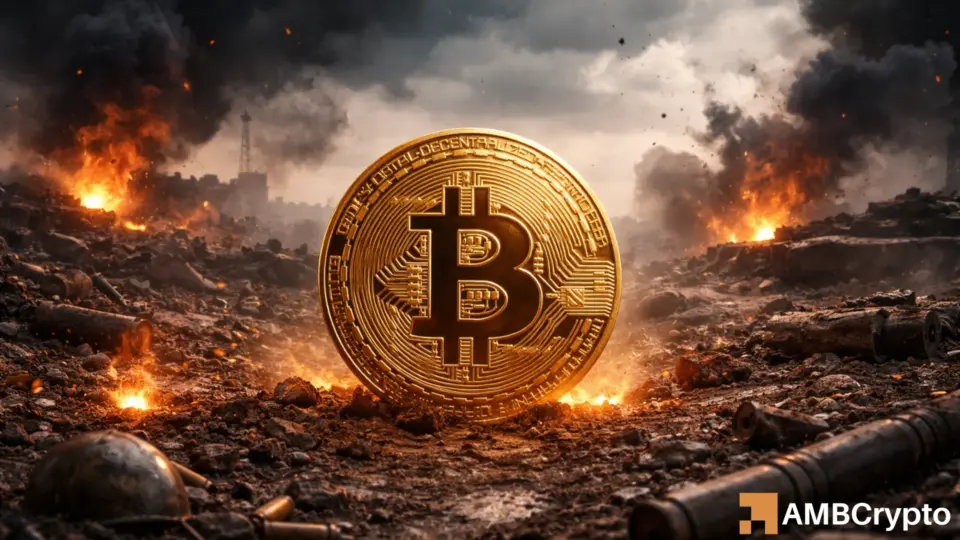
‘Oil prices infect everything’ – Can Bitcoin still weather this storm?

ambcryptoPublished on 2026-03-26Last updated on 2026-03-26

Abstract

Bitcoin and the broader crypto market are experiencing prolonged uncertainty, driven by macroeconomic pressures and heightened geopolitical tensions in West Asia. Oil prices have become a central source of volatility, influencing inflation and interest rate expectations, which in turn pressure risk assets like cryptocurrencies. Despite these challenges, Bitcoin has shown resilience, maintaining a range between $65,000 and $76,000 without significant declines since the conflict escalated. Analysts attribute this stability to the crypto market’s maturation, including the presence of spot ETFs, corporate treasury purchases, and institutional involvement. However, spot Bitcoin accumulation remains relatively low at $4.99 billion over the past 60 days, indicating tepid demand. The market’s to face headwinds, with the key risk being whether oil-driven inflation forces the Federal Reserve to maintain or raise interest rates, potentially putting further pressure on Bitcoin and cryptocurrencies.

Bitcoin and the broader crypto market have endured weeks of prolonged unrest, with macro pressures driving prices into a sideways grind. The Total Crypto Market Capitalization sat roughly at $2.4 trillion, at press time.

Heightened war tensions across West Asia have added another layer of uncertainty, placing the market in an increasingly precarious position.

Yet eToro market analyst Josh Gilbert, speaking to CoinHeadlines, argued that the market could still weather the storm.

Oil shock, market chaos

Gilbert described the current environment as a headline-driven market where oil prices have become the central source of uncertainty, pushing investors to de-risk their crypto holdings.

Key pressure points, including the Strait of Hormuz and energy infrastructure across the region, have been directly affected.

The main sort of headline here is obviously oil and oil prices, and that then infects everything through to rates and inflation,” he said.

The Reserve Bank of Australia has already hiked rates for the second consecutive meeting in response. The US Federal Reserve held rates steady on the 25th of March, keeping sentiment calm for now, but Gilbert warned that may not last.

If we see the oil-driven inflation is forcing the Fed to keep rates higher for longer, or worse, even sort of ultimately raise them again, I do think that we will see Bitcoin and crypto under pressure.

Crypto market and Bitcoin’s quiet stand

Despite the headwinds, Bitcoin [BTC] has not suffered a significant decline since the conflict escalated.

Much of the prior sell pressure stemmed from the liquidation cascade following the market event crash on the 10th of October, 2025, and since then, Bitcoin has held a range of roughly $65,000 to $76,000.

Gilbert added

I actually think the downside risk was much higher than what we’ve actually seen. Since this conflict started, Bitcoin has outperformed gold, it’s outperformed the S&P 500, the NASDAQ.

He credited the market’s maturation for the resilience.

Back then, it was a very different period. We had no spot ETFs, no corporate treasury buying billion-dollar positions, no sovereign wealth funds putting capital to work. Whereas today, we’ve got all three of those.

ETF inflows recovering after heavy February outflows reinforced his view. “It tells us that institutional demand is still there.”

What the numbers are telling us

Bitcoin’s Spot activity gives a clear view of the broader market, and right now, it shows a holding pattern.

Spot holders form Bitcoin’s long-term base and do not use leverage. Their activity has stayed quiet. Over the past 60 days, Spot Net Inflows have remained low compared to stronger market phases.

Total accumulation during this period stands at just $4.99 billion. Without stronger buying, Bitcoin may stay range-bound. The next move depends on how key factors play out.


Final Summary

  • West Asia war’s impact on inflation could be the key factor deterring crypto’s next rally, despite the market holding up decently so far.
  • $4.99 billion in Bitcoin accumulation signals tepid demand, insufficient to drive a sustained market rally.


Related Questions

QWhat is the main source of uncertainty currently affecting the crypto market according to eToro analyst Josh Gilbert?

AThe main source of uncertainty is oil prices, which then infect everything through to rates and inflation.

QHow has Bitcoin's performance compared to traditional assets like gold and major stock indices since the conflict in West Asia escalated?

ASince the conflict started, Bitcoin has outperformed gold, the S&P 500, and the NASDAQ.

QWhat three key developments does Gilbert credit for the crypto market's increased resilience compared to the past?

AThe three key developments are the existence of spot ETFs, corporate treasury buying billion-dollar positions, and sovereign wealth funds putting capital to work.

QWhat is the current state of Bitcoin spot accumulation, and what does it indicate about market demand?

ATotal Bitcoin spot accumulation over the past 60 days stands at just $4.99 billion, signaling tepid demand that is insufficient to drive a sustained market rally.

QWhat is the key factor that could prevent the next crypto rally, despite the market holding up decently so far?

AThe key factor is the impact of the West Asia war on inflation, which could force central banks to maintain higher interest rates for longer.

Related Reads

Warsh Hearing Concludes: What Are the Notable Signals for the Crypto Industry?

The Senate Banking Committee held a confirmation hearing for Judy Shelton, a Federal Reserve nominee, who faced intense questioning regarding her ability to maintain the central bank's independence amid pressure from President Trump to lower interest rates. Shelton denied any pre-arranged commitments on rate cuts and emphasized her independence, though Democrats remained skeptical, citing contradictions with Trump's public statements. Shelton characterized post-pandemic inflation as a major policy failure and called for a "regime change" in the Fed’s approach, including reforms to inflation measurement and communication strategies. She criticized the current practice of Fed officials frequently signaling future rate moves and did not commit to maintaining post-meeting press conferences, suggesting potential reductions in transparency. Regarding crypto markets, Shelton’s extensive investments in digital asset companies—including Solana, DeFi, and blockchain infrastructure—were noted, though she has pledged to divest these holdings due to ethics rules. Her familiarity with the crypto industry and deregulatory leanings may signal a more open, though cautious, stance toward digital assets. However, concerns were raised about potential conflicts of interest, especially given Trump family involvement in crypto-financial ventures. The timing of her confirmation remains uncertain, pending a Justice Department investigation into current Chair Powell. Shelton’s potential leadership could lead to a more hawkish, productivity-focused Fed with tighter policy communication—factors that may significantly influence liquidity conditions and macro narratives for crypto markets.

marsbit1h ago

Warsh Hearing Concludes: What Are the Notable Signals for the Crypto Industry?

marsbit1h ago

Trading

Spot
Futures

Hot Articles

What is $BITCOIN

DIGITAL GOLD ($BITCOIN): A Comprehensive Analysis Introduction to DIGITAL GOLD ($BITCOIN) DIGITAL GOLD ($BITCOIN) is a blockchain-based project operating on the Solana network, which aims to combine the characteristics of traditional precious metals with the innovation of decentralized technologies. While it shares a name with Bitcoin, often referred to as “digital gold” due to its perception as a store of value, DIGITAL GOLD is a separate token designed to create a unique ecosystem within the Web3 landscape. Its goal is to position itself as a viable alternative digital asset, although specifics regarding its applications and functionalities are still developing. What is DIGITAL GOLD ($BITCOIN)? DIGITAL GOLD ($BITCOIN) is a cryptocurrency token explicitly designed for use on the Solana blockchain. In contrast to Bitcoin, which provides a widely recognized value storage role, this token appears to focus on broader applications and characteristics. Notable aspects include: Blockchain Infrastructure: The token is built on the Solana blockchain, known for its capacity to handle high-speed and low-cost transactions. Supply Dynamics: DIGITAL GOLD has a maximum supply capped at 100 quadrillion tokens (100P $BITCOIN), although details regarding its circulating supply are currently undisclosed. Utility: While precise functionalities are not explicitly outlined, there are indications that the token could be utilized for various applications, potentially involving decentralized applications (dApps) or asset tokenization strategies. Who is the Creator of DIGITAL GOLD ($BITCOIN)? At present, the identity of the creators and development team behind DIGITAL GOLD ($BITCOIN) remains unknown. This situation is typical among many innovative projects within the blockchain space, particularly those aligning with decentralized finance and meme coin phenomena. While such anonymity may foster a community-driven culture, it intensifies concerns about governance and accountability. Who are the Investors of DIGITAL GOLD ($BITCOIN)? The available information indicates that DIGITAL GOLD ($BITCOIN) does not have any known institutional backers or prominent venture capital investments. The project seems to operate on a peer-to-peer model focused on community support and adoption rather than traditional funding routes. Its activity and liquidity are primarily situated on decentralized exchanges (DEXs), such as PumpSwap, rather than established centralized trading platforms, further highlighting its grassroots approach. How DIGITAL GOLD ($BITCOIN) Works The operational mechanics of DIGITAL GOLD ($BITCOIN) can be elaborated on based on its blockchain design and network attributes: Consensus Mechanism: By leveraging Solana’s unique proof-of-history (PoH) combined with a proof-of-stake (PoS) model, the project ensures efficient transaction validation contributing to the network's high performance. Tokenomics: While specific deflationary mechanisms have not been extensively detailed, the vast maximum token supply implies that it may cater to microtransactions or niche use cases that are still to be defined. Interoperability: There exists the potential for integration with Solana’s broader ecosystem, including various decentralized finance (DeFi) platforms. However, the details regarding specific integrations remain unspecified. Timeline of Key Events Here is a timeline that highlights significant milestones concerning DIGITAL GOLD ($BITCOIN): 2023: The initial deployment of the token occurs on the Solana blockchain, marked by its contract address. 2024: DIGITAL GOLD gains visibility as it becomes available for trading on decentralized exchanges like PumpSwap, allowing users to trade it against SOL. 2025: The project witnesses sporadic trading activity and potential interest in community-led engagements, although no noteworthy partnerships or technical advancements have been documented as of yet. Critical Analysis Strengths Scalability: The underlying Solana infrastructure supports high transaction volumes, which could enhance the utility of $BITCOIN in various transaction scenarios. Accessibility: The potential low trading price per token could attract retail investors, facilitating wider participation due to fractional ownership opportunities. Risks Lack of Transparency: The absence of publicly known backers, developers, or an audit process may yield skepticism regarding the project's sustainability and trustworthiness. Market Volatility: The trading activity is heavily reliant on speculative behavior, which can result in significant price volatility and uncertainty for investors. Conclusion DIGITAL GOLD ($BITCOIN) emerges as an intriguing yet ambiguous project within the rapidly evolving Solana ecosystem. While it attempts to leverage the “digital gold” narrative, its departure from Bitcoin's established role as a store of value underscores the need for a clearer differentiation of its intended utility and governance structure. Future acceptance and adoption will likely depend on addressing the current opacity and defining its operational and economic strategies more explicitly. Note: This report encompasses synthesised information available as of October 2023, and developments may have transpired beyond the research period.

363 Total ViewsPublished 2025.05.13Updated 2025.05.13

What is $BITCOIN

Discussions

Welcome to the HTX Community. Here, you can stay informed about the latest platform developments and gain access to professional market insights. Users' opinions on the price of BTC (BTC) are presented below.

活动图片