Oil Price Forecast: Risks in the Strait of Hormuz Push WTI and Brent Prices Towards Key Breakout Levels

Published on 2026-08-20Last updated on 2026-08-20

Abstract

The outlook for oil prices remains optimistic, but the next move will depend on supply risks and technical breakouts. Tensions in the Middle East and slow shipping in the Strait of Hormuz have pushed oil prices higher. However, unless the conflict causes a significant supply disruption, increasing US inventories may limit the upside for prices.

Key Points:

Tensions in the Strait of Hormuz continue to support oil prices.

Rising US inventories may limit further gains.

WTI and Brent prices are approaching significant breakout zones.

Oil prices stabilized near recent highs as traders assessed the risks of further turmoil in the Middle East. Shipping in the Strait of Hormuz remains slow, with many shipowners choosing to avoid the route. Conflicting signals from the US and Iran have also added to market confusion. Persistent tensions due to sporadic attacks involving Iran, the UAE, and Oman have kept a risk premium in oil prices. However, the absence of any major escalation has limited fresh buying interest.

Rising US inventories could also cap further oil price gains. As shown in the chart below, crude inventories increased by 4.4 million barrels. Gasoline stocks also rose. These figures suggest US supply remains relatively ample, and demand may not be strong enough to drive prices significantly higher. Oil prices may grind higher as long as war and shipping risks persist. But a major market move likely requires a significant disruption to supplies via the Strait of Hormuz.

WTI Oil Price Forecast: Break above $87-$89 Targets $105

The 4-hour chart below shows WTI oil prices forming a constructive structure above $70. A rounded bottom pattern has formed above $70. A break above $87 would target a further move towards the $93.80 and $97 zones.
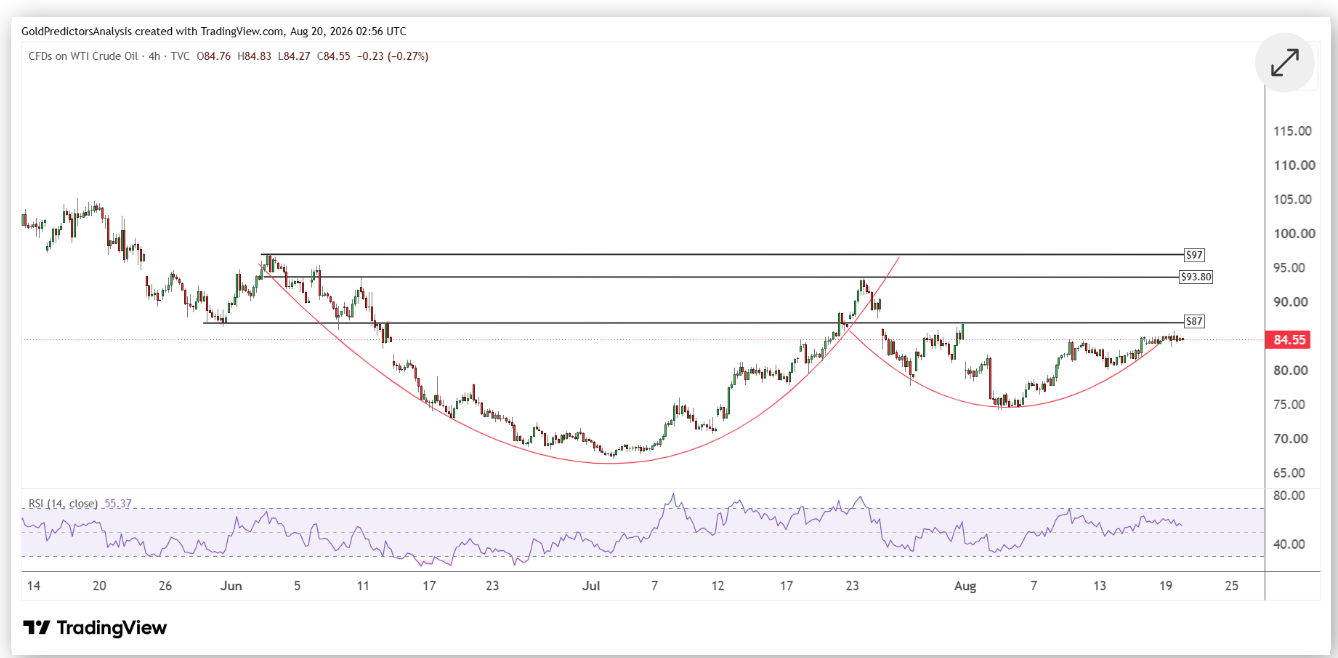
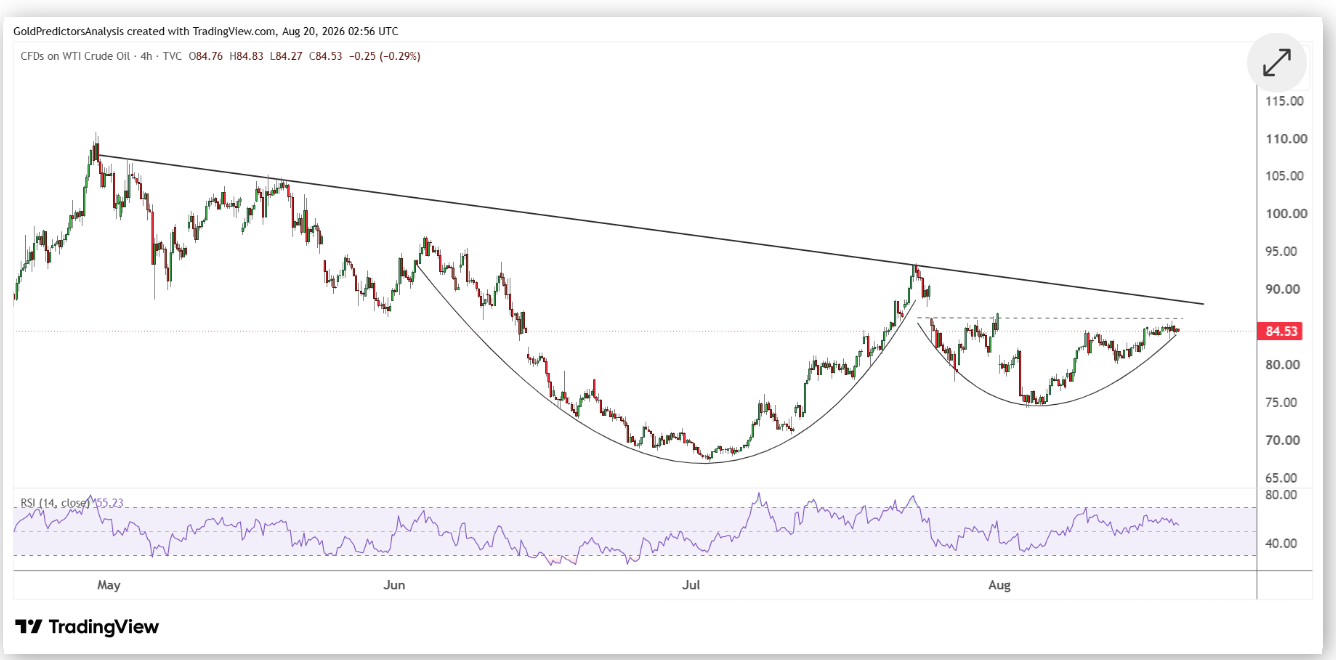
Notably, the price action from May appears more bullish. A rounded bottom has formed just below a descending trendline. This trendline will be broken around $89.

A break above this descending trendline would likely confirm a bottom and target a move towards the $105 zone. The Relative Strength Index (RSI) is also consolidating above the midline, indicating potential for further upside in the WTI market. However, a break below $66 would invalidate the bullish structure and could lead to further declines.
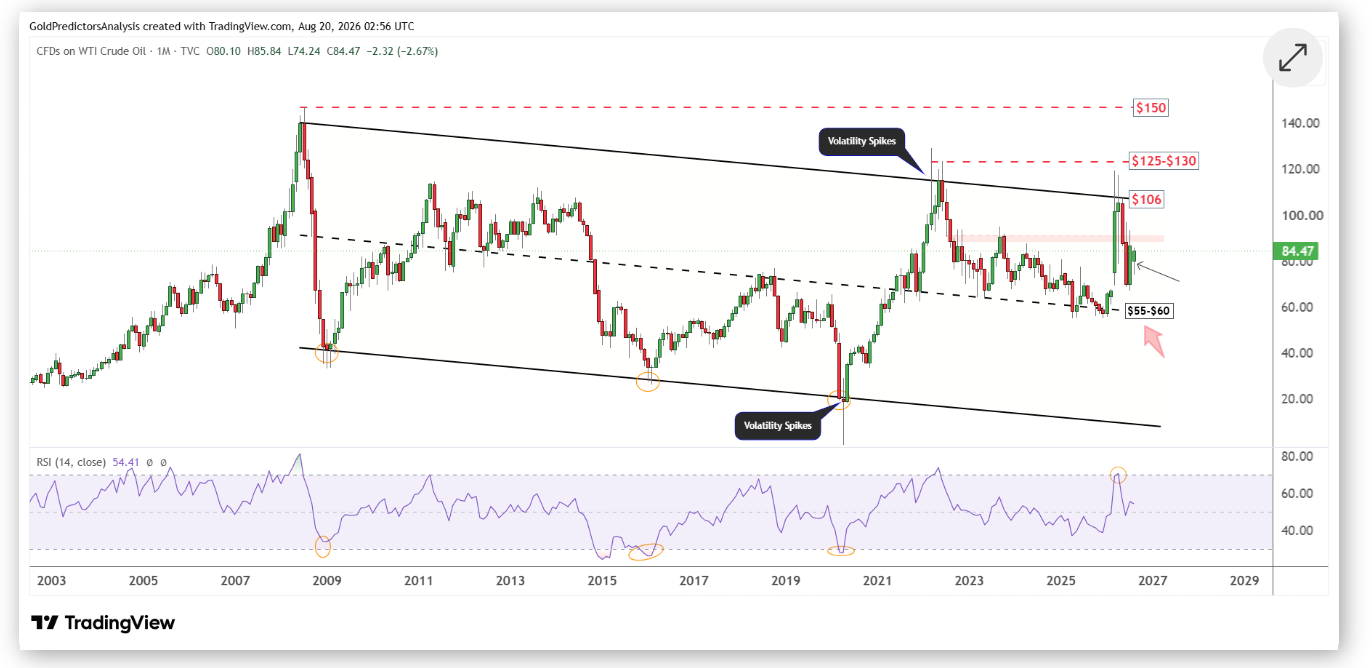
The long-term outlook for WTI remains optimistic. After the US-Iran war, prices surged from around $66 to near $120 but failed to break the channel's descending trendline. A sharp sell-off from $120 to around $67 followed, driven by this strong resistance.

But WTI prices found a bottom after July's decline. Prices are now retracing back towards the $100 zone. This suggests a potential move to the $125-$130 zone if the price breaks out of this descending channel. On the other hand, a break above $130 could target the $150 zone. The Relative Strength Index (RSI) is also rebounding from the midline, indicating positive momentum for WTI prices.
Brent Oil Price Forecast: Break above $100 Opens Path to $120-$127

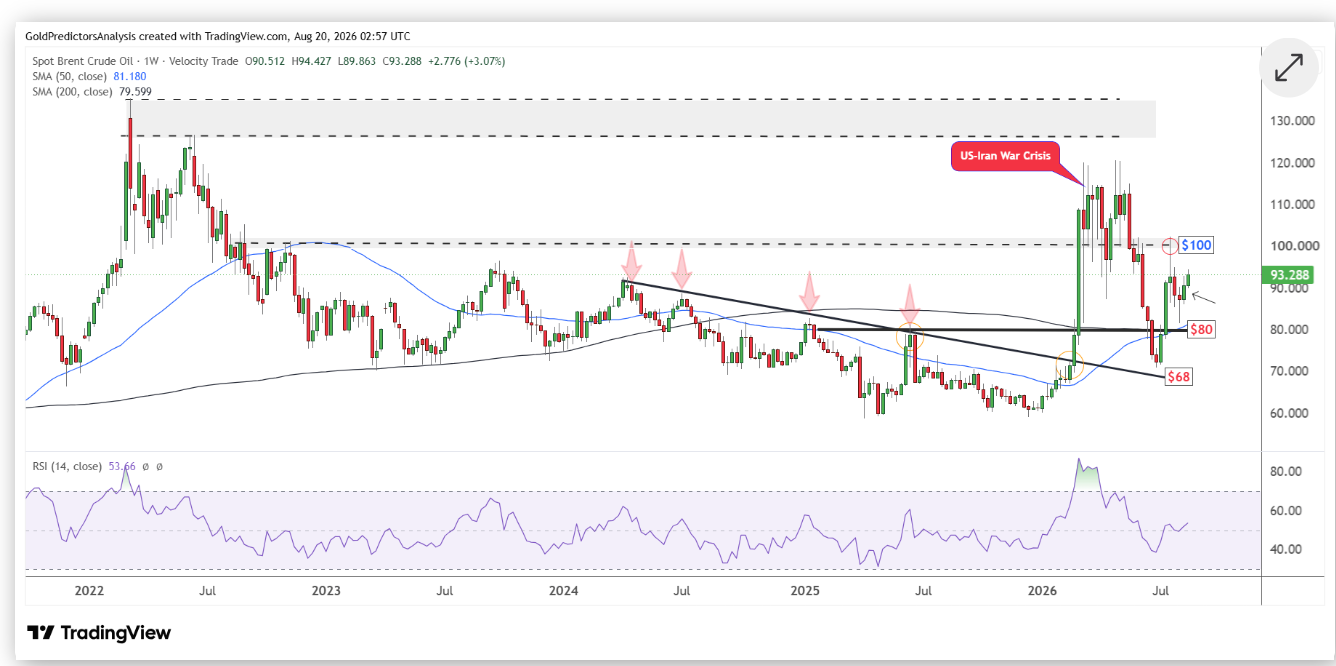
Compared to the WTI market, Brent oil price action is stronger. The price held above $80 after declines. A strong rebound in the first week of August 2026 triggered a solid weekly bullish candle, signaling a potential move towards the $100 zone.

On the weekly chart, the 50-day Simple Moving Average has crossed above the 200-day SMA. The RSI is also holding above the midline, indicating strong bullish momentum in the Brent market. A break above the $100 zone could target the $120 area for Brent. Conversely, a break above $120 could aim for further gains towards $135.
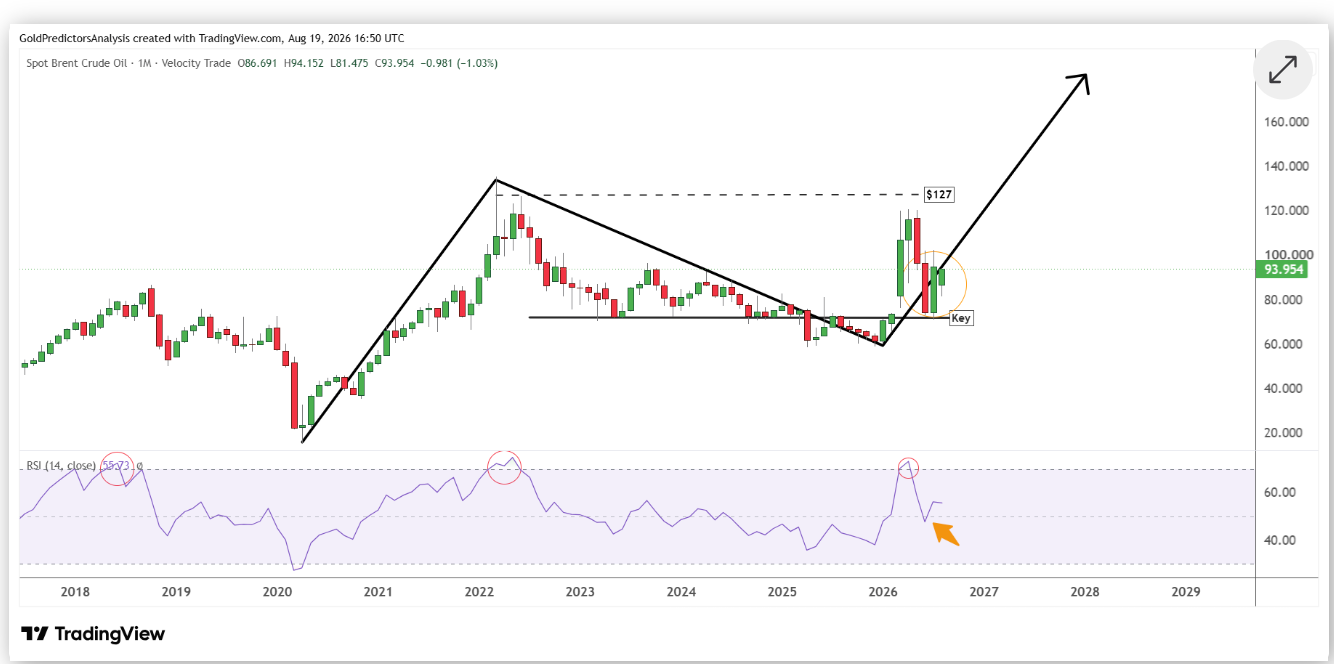
The monthly chart for Brent also shows positive price action. A strong rally is evident from the April 2020 lows to the March 2022 highs, followed by a correction from the March 2022 highs to the December 2025 lows, forming a robust, positive bullish structure.

Recent declines in Brent in June 2026 failed to break the key $70 level, followed by a strong rebound. The July monthly candle suggests Brent could target the $127 mark. A break above $127 could pave the way for a strong rally towards the $160-$180 zone.

The RSI is also rebounding from the midline as Brent bounced from the key $70 level. This indicates potential for continued gains in the near term.
Conclusion

The oil price outlook remains optimistic, but the next move hinges on supply risks and technical breakouts. Middle East tensions and slow shipping in the Strait of Hormuz have pushed prices higher. However, rising US inventories may limit gains unless conflict causes a severe supply disruption.

WTI must break above the $87-$89 resistance to target $100-$105. But a break below $66 would weaken the bullish view. Brent shows stronger upside momentum and could target $120-$127 if it breaks above $100. Brent must hold the key $70 level to maintain its upward momentum. Therefore, oil prices may continue to rise gradually, but a stronger rally would require a clear technical breakout or a significant regional supply disruption.
Related Reads

Circle Q2 Investor AMA: 11 Q&A Transcript on USDC, Arc, and the Future of Finance

**Circle Q2 2026 Investor AMA: Summary** On August 19, 2026, Circle CEO Jeremy Allaire hosted an AMA, addressing key topics on USDC, Arc, and the future of finance. **Team & Execution:** Allaire expressed confidence in Circle's execution, citing strong cross-functional collaboration, controlled growth, institutional depth, and the integration of AI as a "capability amplifier." Key areas for enhancement are cybersecurity and global/local operational capabilities. **Stablecoin Use Cases & Opportunities:** Allaire identified several areas with strong product-market fit: 1) **Digital asset markets** (operational capital, collateral), 2) **Digital dollar storage** in emerging markets, and 3) **Cross-border settlement**. Significant future opportunities lie in **AI agentic payments** and **retail merchant payments** (via stablecoin cards and QR codes), driven by instant settlement and low fees. **Circle's Economic Model:** While **reserve income** from a multi-trillion dollar future stablecoin market remains a core engine, Circle is diversifying. New revenue streams include **transaction fees** from the growing Circle Payment Network (CPN) and **platform fees** from **Arc**, envisioned as an "Economic Operating System" or "Economic Cloud" with AWS-scale potential. **Arc's Vision:** Arc, launching its mainnet on September 16, is designed as a **stablecoin-native chain** (using USDC for fees) to make blockchain invisible to end-users. It aims to host the future "onchain world," where companies and economic activities become increasingly software-coordinated and agentic. Its developer-friendly model allows builders to absorb minimal transaction costs, similar to cloud services. **AI & Trust:** For an AI agent economy, foundational "trust primitives" are essential: **Know Your Agent (KYA)** verification, robust **reputation systems**, and **programmable spending policies** for wallets. **EURC Growth & Regulatory Outlook:** EURC's rapid growth to over €400 million is attributed to early preparation for EU regulation (MiCA) and leveraging Circle's existing distribution. Allaire is bullish on **global stablecoin adoption**, noting that USDC growth is independent of the U.S. CLARITY Act's passage, supported by frameworks like the GENIUS Act and worldwide regulatory advancements. **Personal Philosophy:** Allaire shared that maintaining discipline in **diet, sleep, mindfulness, and exercise** is crucial for sustaining the energy and clarity needed for Circle's long-term mission.

marsbit8m ago

Circle Q2 Investor AMA: 11 Q&A Transcript on USDC, Arc, and the Future of Finance

marsbit8m ago

190 Million: 688286 Completes Two Acquisitions Within Two Months

In August 2026, Suzhou MEMSIC Semiconductor Co., Ltd. (688286.SH), despite reporting a net loss of RMB 20.62 million for the first half of the year, announced two significant acquisitions within two months, totaling approximately RMB 189 million. The company first acquired a 51.82% stake in Suzhou Novosense Electronic Technology Co., Ltd., entering the industrial gas sensor market. Shortly after, it launched a fundraising plan to acquire a 54% stake in Beijing Pudan Optoelectronics Co., Ltd., targeting the fiber-optic gyroscope core components sector. These moves represent a strategic pivot for MEMSIC, historically reliant on the consumer electronics market (e.g., MEMS microphones, pressure sensors), which is facing slowing growth and intense price competition. By acquiring Novosense and Pudan, MEMSIC aims to diversify into higher-margin industrial (e.g., chemical safety, environmental monitoring) and high-reliability sectors (e.g., aerospace, defense), leveraging their respective expertise in chemical sensing and high-precision inertial navigation. The article details the background of founder Li Gang and MEMSIC's 19-year journey, from its pioneering role in China's MEMS industry to its 2020科创板 listing and subsequent financial struggles amidst market downturns. The recent acquisitions are framed as a critical attempt to transform from a consumer electronics-focused chipmaker into a "full-scenario sensing platform" company. However, risks are noted, including the challenge of integrating the acquired companies, Pudan Optoelectronics' current unprofitability, and the overall financial strain on MEMSIC as it navigates this transition. The success of this strategic shift remains uncertain.

marsbit19m ago

190 Million: 688286 Completes Two Acquisitions Within Two Months

marsbit19m ago

Lawson Convenience Store Tests Stablecoin Payments Again: Three Coins, Three Chains, But Japanese Regulators Haven't Given the Nod

Lawson convenience stores have conducted a second-phase pilot test of stablecoin payments in partnership with payment solution provider NetStars, moving stablecoins from exchanges to physical checkout counters. The experiment, conducted at a Tokyo store, tested payments using three stablecoins—USDC, USDT, and JPYC—across three blockchains: Solana, Morph, and Polygon. A key development was the inclusion of USDT, which is not currently on Japan's approved list of electronic payment assets. The test linked Lawson's existing POS system with NetStars' "Stablecoin Pay" service to verify that stablecoin payments could be processed without disrupting store operations. It assessed payment speed, user experience, and handling of various transaction scenarios. Payments were typically completed within five seconds. Users paid with stablecoins via MetaMask, while stores received yen settlements. NetStars covered the blockchain gas fees upfront, charging users a separate "processing fee" that also included potential foreign exchange costs for dollar-denominated stablecoins. Company executives stated the pilot was preparatory, aimed at understanding technical feasibility and challenges ahead of potential wider adoption. They highlighted the appeal of globally-traded stablecoins like USDC and USDT for foreign visitors to Japan, alongside the domestic use case for yen-pegged JPYC. However, the legal and operational framework for converting received USDT into yen remains under discussion with Japanese financial authorities. No timeline for a commercial rollout was given, pending further market demand, user needs, and final economic conditions like fee structures.

marsbit19m ago

Lawson Convenience Store Tests Stablecoin Payments Again: Three Coins, Three Chains, But Japanese Regulators Haven't Given the Nod

marsbit19m ago

Trading

Spot
活动图片