Nvidia Lands In Court Over Crypto Secret — Here Is What Investors Missed

bitcoinistPublished on 2026-03-26Last updated on 2026-03-26

Abstract

Nvidia faces a certified class action lawsuit over allegations it under-disclosed crypto mining revenue linked to its gaming GPU sales during the 2017–2018 period. Investors claim the company misled them by attributing significant revenue growth to gaming rather than cryptocurrency mining, creating a "revenue gap" between internal knowledge and public statements. After Nvidia’s CFO later acknowledged a revenue shortfall due to crypto-related inventory issues, the stock fell nearly 30%. The lawsuit, now moving forward, cites internal emails suggesting management was aware the stock price was artificially sustained by misleading disclosures. The case introduces legal and financial risks for Nvidia amid its current prominence in AI.

Nvidia is facing a certified class action over alleged under‐disclosure of crypto mining revenue.

A Crypto Scandal Resurrects Just In Time For Holy Week

After years of grueling legal back and forth between the giant gaming company and the American courts, a U.S. federal judge has certified a securities-fraud class action against Nvidia and CEO Jensen Huang over alleged under‐disclosure of crypto mining revenue in 2017–2018, according to a Wednesday order from Judge Haywood S. Gilliam Jr. in a California federal court. A class certification means the case can move ahead on behalf of a broad group of shareholders (the plaintiffs), raising the legal and financial stakes for Nvidia.

Investors claim Nvidia hid how much of its “gaming” GPU sales were actually driven by cryptocurrency miners, creating “revenue gaps” between public guidance and internal reality.

A Recap Of The Legal Battle

In order to properly understand this development, we must first go back to almost a decade ago, when investors sued the American tech company for the first time in 2018. Back then, the investors argued that $1 billion in crypto-linked GPU sales were misclassified or downplayed, with internal emails suggesting management knew the stock was “held high” by these statements.

It is important to remember that this happened in the context of the 2017–2018 mining boom, when Ethereum and other coins sent demand for Nvidia GPUs surging. Despite this, the company publicly emphasized gaming as the main growth driver.

The extent of Nvidia’s risk only became clear on November 2018, when CFO Colette Kress acknowledged that gaming revenue had fallen “short of expectations” because excess inventory built up during the crypto boom was taking longer than anticipated to clear. Gaming GPU prices were slower than expected to return to normal after the “sharp crypto falloff”, she claimed.

This disclosure not only triggered a roughly 28–29% share price crash, but also forward, in 2022, a $5.5 million SEC fine over inadequate crypto-mining disclosures in fiscal 2018, which the company already paid. Bitcoinist covered the story back then.

The lawsuit was first thrown out in 2021, then brought back to life on appeal, withstanding Nvidia’s unsuccessful attempt to get the U.S. Supreme Court to shut it down, and is now advancing as a certified class action.

And Now What?

Today, plaintiffs contend that a large portion of Nvidia’s crypto-fueled sales actually ran through its GeForce gaming GPUs, with most of that income booked under the gaming division, leaving the company heavily exposed to the boom‐and‐bust swings of the crypto market. Despite that, Nvidia had long insisted that the bulk of mining-related demand was captured in a distinct line item rather than in its main gaming segment and that crypto mining was a minor contributor to its overall business.

The judge highlighted an internal email from an Nvidia vice president, describing it as especially revealing:

The Court also notes that internal company emails support its conclusion here. Just before the November 2018 disclosure, NVIDIA’s then-VP of Investor Relations and Strategic Finance opined in response to a question from Huang that one reason “the market isn’t pricing in a bigger miss” following news that AMD had one or two quarters of post-crypto channel inventory was in part “because of comments we’ve made on . . . ring-fencing the crypto impact in OEM”

The newly certified class includes investors who purchased Nvidia shares between August 10, 2017 and November 15, 2018. A case management conference is set for April 21, when the judge is expected to lay out how the litigation will proceed.

It is notable that one of NVIDIA’s own VPs expressed the view that its stock price remained high because of the same types of earlier comments that Plaintiffs are pointing to, and the Court cannot conclude that there was no price impact in the face of such evidence.

For NVDA stock traders, a live, certified class action injects headline risk into one of the market’s most crowded AI plays, and any adverse ruling or settlement could weigh on multiples in a risk‐off tape. For crypto and mining‐adjacent names, the case is a reminder that opaque revenue accounting around mining cycles can come back years later, potentially tightening disclosure standards just as the sector eyes the next bull run.
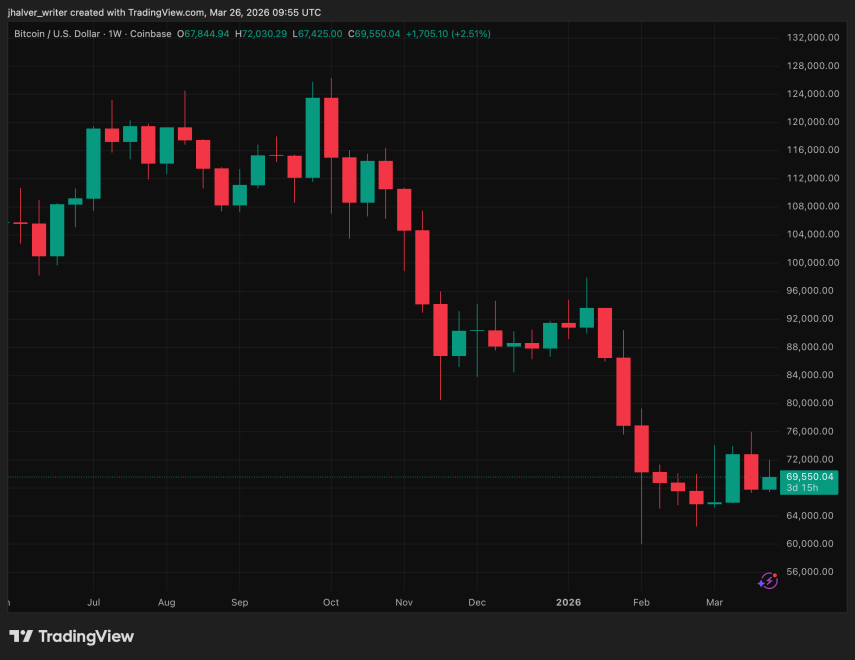
BTC’s price drops slightly after reaching $71k yesterday, trading for around $69k today. Source: BTCUSD on Tradingview

Cover image from Perplexity, BTCUSD chart from Tradingview

Related Questions

QWhat is the main reason Nvidia is facing a certified class action lawsuit?

ANvidia is facing a certified class action lawsuit over alleged under-disclosure of crypto mining revenue, specifically for hiding how much of its 'gaming' GPU sales were actually driven by cryptocurrency miners during 2017-2018.

QWhat significant financial penalty did Nvidia already pay related to this issue?

ANvidia paid a $5.5 million SEC fine in 2022 over inadequate crypto-mining disclosures in fiscal 2018.

QWhat was the key consequence of Nvidia's November 2018 disclosure about its gaming revenue?

AThe November 2018 disclosure, where CFO Colette Kress acknowledged gaming revenue fell short due to excess crypto-related inventory, triggered a roughly 28-29% share price crash.

QWhat time period does the newly certified class action cover for investors?

AThe newly certified class includes investors who purchased Nvidia shares between August 10, 2017 and November 15, 2018.

QWhat did an internal email from an Nvidia VP reveal, according to the judge?

AThe judge highlighted an internal email where an Nvidia VP opined that the company's stock price remained high because of comments they had made about 'ring-fencing the crypto impact', suggesting management was aware the market was being misled.

Related Reads

OpenAI Post-Training Engineer Weng Jiayi Proposes a New Paradigm Hypothesis for Agentic AI

OpenAI engineer Weng Jiayi's "Heuristic Learning" experiments propose a new paradigm for Agentic AI, suggesting that intelligent agents can improve not just by training neural networks, but also by autonomously writing and refining code based on environmental feedback. In the experiment, a coding agent (powered by Codex) was tasked with developing and maintaining a programmatic strategy for the Atari game Breakout. Starting from a basic prompt, the agent iteratively wrote code, ran the game, analyzed logs and video replays to identify failures, and then modified the code. Through this engineering loop of "code-run-debug-update," it evolved a pure Python heuristic strategy that achieved a perfect score of 864 in Breakout and performed competitively with deep reinforcement learning (RL) algorithms in MuJoCo control tasks like Ant and HalfCheetah. This approach, termed Heuristic Learning (HL), contrasts with Deep RL. In HL, experience is captured in readable, modifiable code, tests, logs, and configurations—a software system—rather than being encoded solely into opaque neural network weights. This offers potential advantages in explainability, auditability for safety-critical applications, easier integration of regression tests to combat catastrophic forgetting, and more efficient sample use in early learning stages, as demonstrated in broader tests on 57 Atari games. However, the blog acknowledges clear limitations. Programmatic strategies struggle with tasks requiring long-horizon planning or complex perception (e.g., Montezuma's Revenge), areas where neural networks excel. The future vision is a hybrid architecture: specialized neural networks for fast perception (System 1), HL systems for rules, safety, and local recovery (also System 1), and LLM agents providing high-level feedback and learning from the HL system's data (System 2). The core proposition is that in the era of capable coding agents, a significant portion of an AI's learned experience could be maintained as an auditable, evolving software system.

marsbit57m ago

OpenAI Post-Training Engineer Weng Jiayi Proposes a New Paradigm Hypothesis for Agentic AI

marsbit57m ago

Your Claude Will Dream Tonight, Don't Disturb It

This article explores the recent phenomenon of AI companies increasingly using anthropomorphic language—like "thinking," "memory," "hallucination," and now "dreaming"—to describe machine learning processes. Focusing on Anthropic's newly announced "Dreaming" feature for its Claude Agent platform, the piece explains that this function is essentially an automated, offline batch processing of an agent's operational logs. It analyzes past task sessions to identify patterns, optimize future actions, and consolidate learnings into a persistent memory system, akin to a form of reinforcement learning and self-correction. The article draws parallels to similar features in other AI agent systems like Hermes Agent and OpenClaw, which also implement mechanisms for reviewing historical data, extracting reusable "skills," and strengthening long-term memory. It notes a key difference from human dreaming: these AI "dreams" still consume computational resources and user tokens. Further context is provided by discussing the technical challenges of managing AI "memory" or context, highlighting the computational expense of large context windows and innovations like Subquadratic's new model claiming drastically longer contexts. The core critique argues that this strategic use of human-centric vocabulary does more than market products; it subtly reshapes user perception. By framing algorithms with terms associated with consciousness, companies blur the line between tool and autonomous entity. This linguistic shift can influence user expectations, tolerance for errors, and even perceptions of responsibility when systems fail, potentially diverting scrutiny from the companies and engineers behind the technology. The article concludes by speculating that terms like "daydreaming" for predictive task simulation might be next, continuing this trend of embedding the idea of an "inner life" into computational processes.

marsbit59m ago

Your Claude Will Dream Tonight, Don't Disturb It

marsbit59m ago

Trading

Spot
Futures
活动图片





