New Capital Incentive Pathways Under the New System: The True Picture of Crypto Investment and Financing in 2025

Odaily星球日报Published on 2026-01-05Last updated on 2026-01-05

Abstract

"New Capital Incentive Paths Under New Regulations: The True Picture of Crypto Investment and Financing in 2025" In 2025, the cryptocurrency market achieved substantial regulatory breakthroughs, moving away from its wild growth phase and aligning more closely with mainstream finance. The global crypto market cap reached $3.2 trillion, while stablecoin transaction volumes surpassed $50 trillion, exceeding those of traditional payment giants like Visa and PayPal. This growth was underpinned by two key legislative developments: the enactment of stablecoin legislation, which provided clear legal frameworks for issuers and reserves, and the advancement of a crypto market structure bill, which established a classified regulatory approach. Despite these improvements, the secondary market remained volatile, with Bitcoin experiencing sharp price swings and altcoins performing weakly. In contrast, the primary market displayed a "cautiously active" stance, characterized by a significant shift in investment patterns. A review of the past four years shows a notable decoupling between funding rounds and amounts. In 2024, the number of financing events increased, but the total amount raised remained restrained. By 2025, this trend reversed: the number of deals declined significantly, but the total capital raised increased, with quarterly financing ranging between $3.7 billion and $5.1 billion. This indicates that investors are concentrating their bets on fewer, high-potential projects. ...

Original | Odaily Planet Daily (@OdailyChina)

Author | Ding Dang (@XiaMiPP)
2025 is a year of substantial breakthroughs at the institutional level for the cryptocurrency market, and a year of gradual departure from wild growth and convergence towards the mainstream financial system. In terms of scale, the total global crypto asset market capitalization has reached $3.2 trillion, while stablecoin trading volume has exceeded $50 trillion—a figure far surpassing traditional payment giants like Visa and PayPal. Behind these numbers lies the support of two core legislative advancements.

First, stablecoin-related legislation has been formally enacted. The bill clarifies the issuing entities, reserve requirements, and regulatory mechanisms, providing a clear legal status for "on-chain dollars." This not only reduces policy uncertainty for stablecoin businesses but also directly stimulates investment and financing activity in stablecoin, payment, and settlement-related sectors. Second, the cryptocurrency market structure bill is steadily progressing, incorporating crypto assets into a classified regulatory framework to avoid a "one-size-fits-all" approach, providing project teams and investors with a predictable compliance path.

The combination of these two legislative advancements will, to some extent, reshape the primary market's assessment of risk and return.

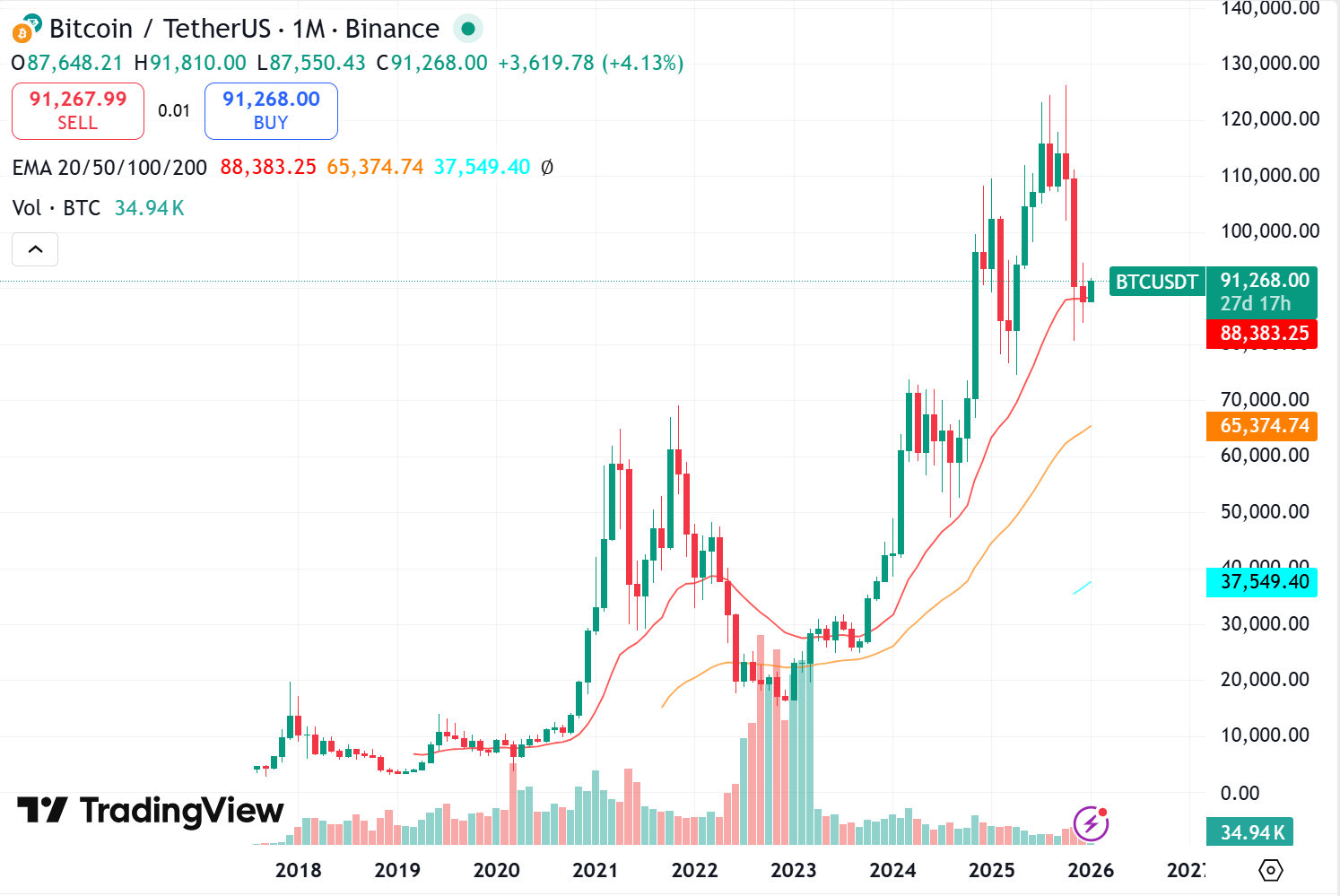
However, in contrast to the improved institutional environment, the secondary market in 2025 did not respond with strong performance. Bitcoin prices fluctuated sharply, and altcoins performed weakly. Against this backdrop, the primary market did not exhibit the widespread frenzy seen in the previous bull market but instead showed a cautiously active态势, with明显的 changes in financing节奏 and preferences.

Four-Year "Cycle" Review: Two Instances of Divergence in Financing Count and Amount
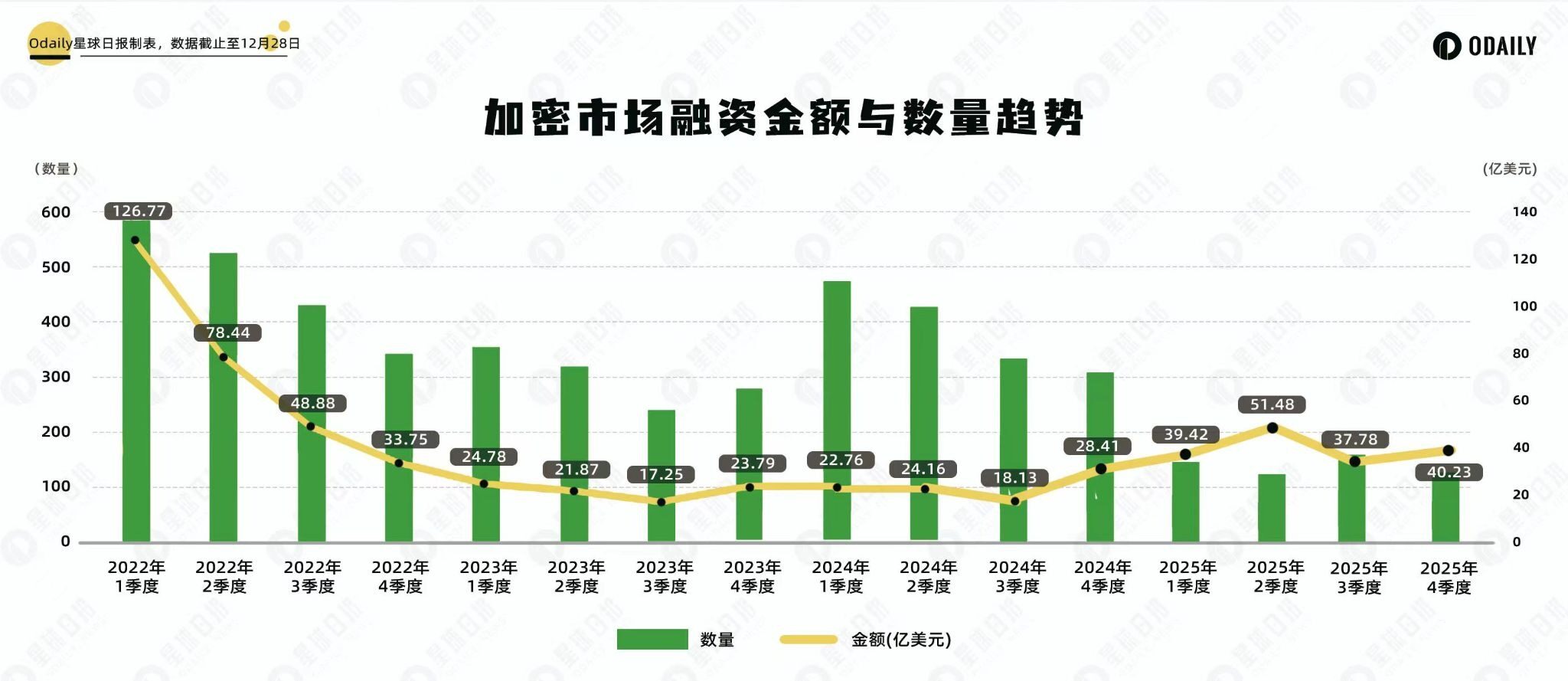
Reviewing the trends in crypto financing over the past four years, the evolution of the relationship between the primary market and secondary market performance becomes clear.

Early 2022 still benefited from the residual heat of the bull market, with both the number of financing events and the amounts raised remaining high; subsequently, as Bitcoin entered a downward cycle, financing activity gradually萎缩. Between 2022 and 2023, investment and financing activities were highly correlated with price movements, remaining overall低迷 under bear market pressure.

2024 became a significant turning point, marking the first divergence between the amount raised and the number of deals.

This year, with the restart of the Bitcoin halving narrative, the number of financing events明显回暖, but the amount raised remained consistently克制. Quarterly financing规模 hovered in the range of $1.8 billion to $2.8 billion, even similar to levels during the bear market. The main reason was that during this period, the crypto market行情 was dominated by Bitcoin and the Meme sector, which stood in stark contrast to the performance of the previous cycle. In the previous cycle, VC-backed projects were often the core of market hotspots, whereas in 2024, VC projects overall performed低迷, struggling to substantially impact the market, which to some extent also抑制了大额融资的出现.

Entering 2025, the divergence phenomenon reappeared, but this time the direction reversed.

The number of financings saw a significant decline, but the amount raised began to回升. Quarterly financing规模 returned to the range of $3.7 billion to $5.1 billion. This means that the average financing size increased significantly; investors are actively reducing the number of investments and instead concentrating their bets on a few projects deemed to have certainty and scalability.

12 Sectors, $178.9 Billion: Structural Changes in the Primary Market

According to incomplete statistics from Odaily Planet Daily, the total primary market investment and financing in 2025 reached $178.9 billion, with a total of 569 financing events. To more accurately depict changes in financing preferences, we have categorized all disclosed financing projects (the actual close time is often earlier than the announcement) into 12 sectors based on business type, target audience, and business model dimensions. These include: CeFi, Infrastructure, RWA, AI, DeFi, SocialFi, Prediction Markets, PayFi, DePIN, BTCFi, L1, and GameFi.
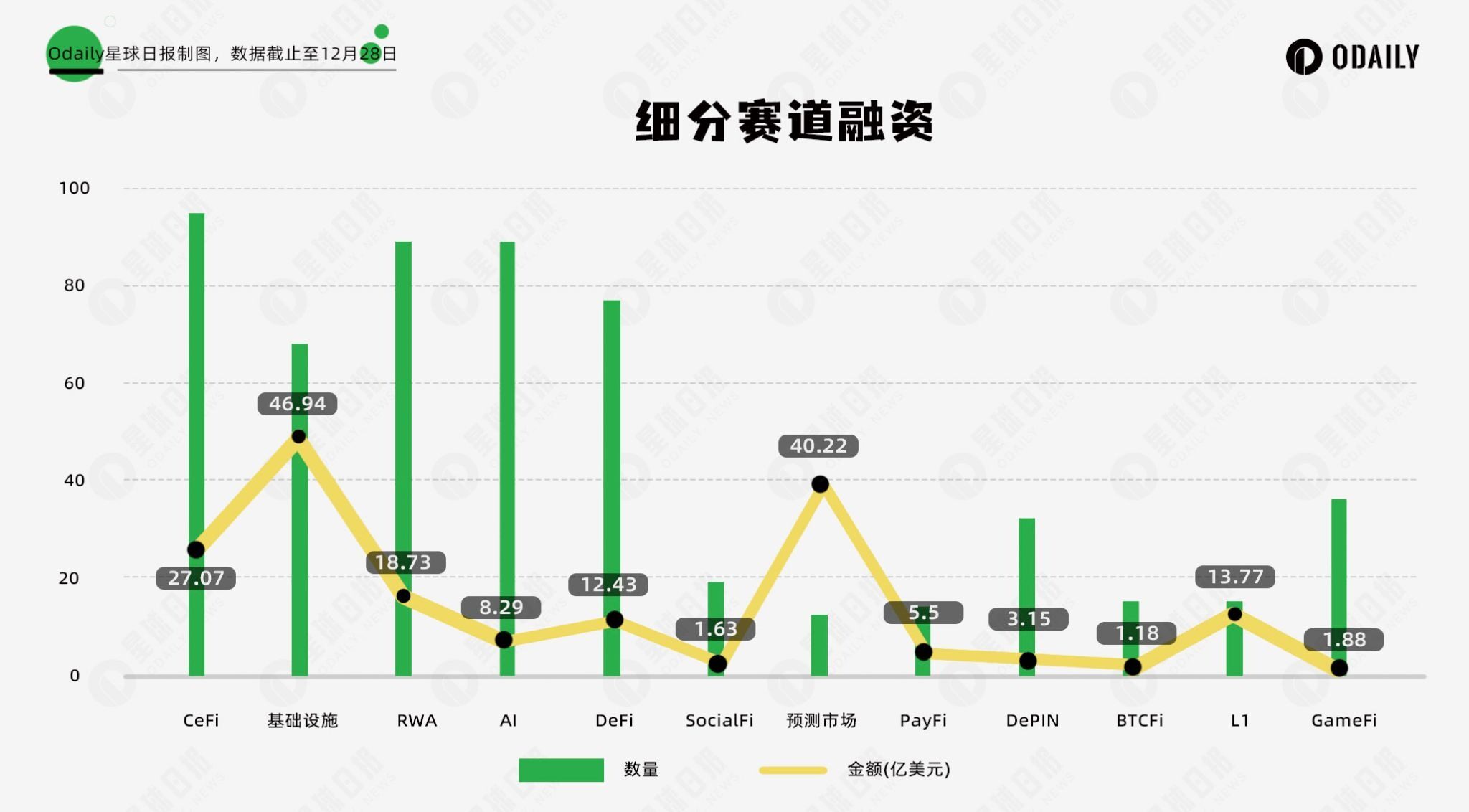
Looking at the financing situation in细分 sectors:

  • CeFi and Infrastructure ranked at the top in terms of both financing amount and number of deals. Underlying capabilities such as trading, custody, clearing, security, and cross-chain remain key areas for continuous capital investment. The market consensus on "infrastructure first" has not wavered.
  • DeFi projects continue to maintain high activity levels. The market still has high demand for innovation in new DeFi protocols, especially as the success of Hyperliquid directly demonstrated to the market that decentralized exchanges can also effectively handle large-scale capital inflows. Perp DEX has become a new financing hotspot.
  • AI and RWA have become new narrative pillars. The former aligns with the main theme of the global tech cycle, while the latter directly benefits from the institutional红利 of tokenizing traditional financial assets. Both paths share a common characteristic: their growth logic no longer relies entirely on the crypto-native market but extends into the broader tech and traditional financial systems.
  • The real dark horse is the Prediction Market sector. Although the number of projects in this sector is not particularly突出 compared to others, the amount raised jumped to become the second-largest sector,仅次于 infrastructure. This indicates that capital is being高度集中地押注 on a few leading projects.
  • In contrast, once-hot sectors like DePIN and GameFi, while still seeing many projects emerge, have experienced a sharp decline in financing appeal, as capital shifts towards areas with greater certainty and economies of scale.

Overall, the primary market is shifting from "casting a wide net" to "intensive cultivation."

Polymarket: Consensus Changes Behind the Top Financing of 2025

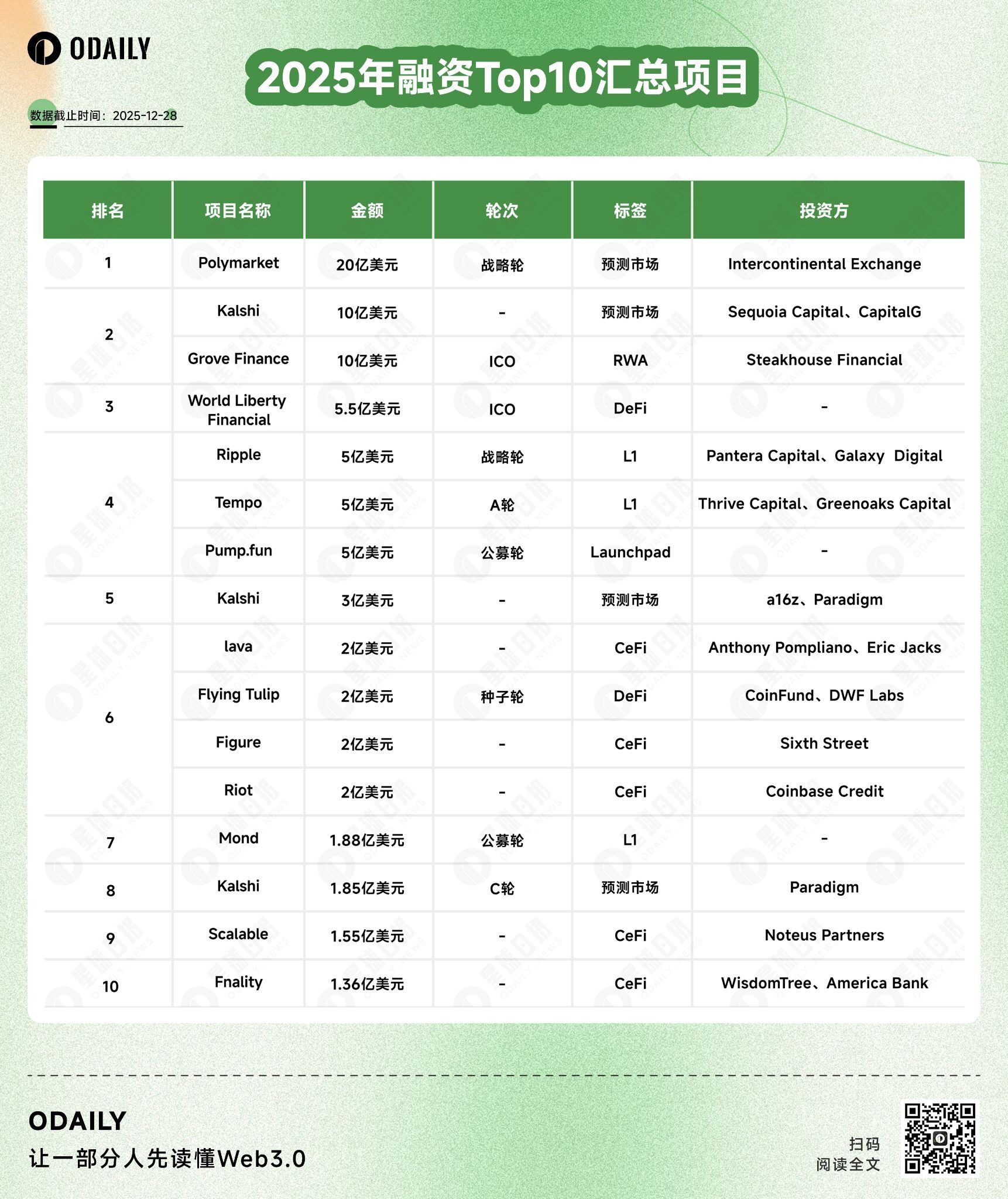
From the list of Top 10 financing amounts in 2025, it can be seen that Polymarket and Kalshi almost constitute the entire narrative of 2025 financing.

Among them, Polymarket has completed nearly $2.5 billion in multiple rounds of financing, with investors including知名加密风投 funds like Polychain, Dragonfly, and Coinbase; Kalshi began to gain momentum in 2025, completing approximately $1.5 billion in financing, supported by Paradigm, a16z, and Coinbase. Unlike Polymarket, Kalshi emphasizes compliance with federal regulation. However, what they share is that prediction markets are being viewed as a financial form with real demand and have now become the most vibrant and positively trending sector.

In the L1 sector, capital preferences similarly persist. On the list, besides the established public chain Ripple, others like Tempo and Mond are new-generation projects. Among them, Mond has already issued tokens, while Tempo has not. This reflects investors' continued investment in underlying infrastructure, with high-performance L1s still seen as the long-term cornerstone for ecosystem expansion.
Conclusion

Overall, the primary market in 2025 did not cool down but is undergoing active convergence and restructuring.

Capital is still flowing, but it is no longer chasing quantity; instead, it is being allocated集中 around certainty, compliance, and scalability potential. This change does not necessarily mean fewer opportunities but may instead signal that the crypto market is entering a more rational and mature stage.

Related Questions

QWhat were the two key legislative developments that supported the growth of the cryptocurrency market in 2025?

AThe two key legislative developments were the formal enactment of the stablecoin-related bill, which provided a clear legal framework for 'on-chain dollars,' and the steady advancement of the cryptocurrency market structure bill, which incorporated crypto assets into a classified regulatory framework.

QHow did the trend of financing events and amounts change from 2024 to 2025?

AIn 2024, there was a first divergence where the number of financing events increased significantly, but the total amount raised remained restrained. In 2025, a second divergence occurred in the opposite direction: the number of financing events dropped significantly, but the total amount of financing increased, indicating a rise in the average deal size as investors concentrated their bets on fewer projects.

QWhich two sectors emerged as new narrative focal points in the 2025 crypto funding landscape, and what was their common characteristic?

AAI and RWA (Real World Assets) emerged as new narrative focal points. Their common characteristic was that their growth logic no longer relied entirely on the crypto-native market but extended into the broader technology and traditional financial systems.

QWhich sector, despite having a relatively low number of projects, saw a massive concentration of funding, becoming the second-largest sector by amount raised?

AThe prediction market sector, with projects like Polymarket and Kalshi, saw a massive concentration of funding, making it the second-largest sector by amount raised, just behind infrastructure.

QWhat overall shift in investment strategy does the 2025 crypto venture capital market represent?

AThe market shifted from a 'wide net' strategy of numerous small bets to a 'precision cultivation' strategy, where capital is concentrated and allocated around projects with regulatory clarity, certainty, and potential for scale, indicating a move towards a more rational and mature stage.
Related Reads

20 Billion Valuation, Alibaba and Tencent Competing to Invest, Whose Money Will Liang Wenfeng Take?

DeepSeek, an AI startup founded by Liang Wenfeng, is reportedly in talks with Alibaba and Tencent for an external funding round that could value the company at over $20 billion. This marks a significant shift, as DeepSeek had previously relied solely on funding from its parent company,幻方量化 (Huanfang Quantitative), and had resisted external investment. The potential valuation would place DeepSeek among the top-tier AI model companies in China, comparable to competitors like MoonDark (valued at ~$18 billion) and ahead of recently listed firms like MiniMax and Zhipu. The funding—which could range from $600 million (for a 3% stake) to $2 billion (for 10%)—is seen as a move to secure resources for model development, retain talent, and support infrastructure needs, particularly as competition in inference models and AI agents intensifies. Both Alibaba and Tencent are eager to invest, not only for financial returns but also to integrate DeepSeek into their broader AI ecosystems. However, DeepSeek’s leadership is cautious about maintaining independence and may prefer financial investors over strategic ones to avoid being locked into a specific tech ecosystem. Alternative options, such as state-backed funds, offer longer-term capital and policy support but may come with slower decision-making and potential constraints on global expansion. With competing AI firms accelerating their IPO plans, DeepSeek’s window for securing optimal terms may be narrowing. The final decision will reflect a trade-off between capital, resources, and strategic independence.

marsbit40m ago

20 Billion Valuation, Alibaba and Tencent Competing to Invest, Whose Money Will Liang Wenfeng Take?

marsbit40m ago

After Losing 97% of Its Market Value, iQiyi Attempts to Use AI to Forcefully Extend Its Lifespan

After losing 97% of its market value since its 2018 peak, iQiyi is aggressively pivoting to AI in a desperate attempt to survive. At its 2026 World Conference, CEO Gong Yu announced an "AI Artist Library" with over 100 virtual performers and a new AIGC platform, "NaDou Pro," promising faster production and lower costs. This shift comes as the company faces severe financial distress: its market cap sits near delisting thresholds at $1.36 billion, with significant losses, declining membership revenue, and depleted cash flow. The AI strategy has sparked controversy. Top actors have issued legal threats against unauthorized digital replicas, while in Hengdian, over 134,000 background actors are seeing their already scarce job opportunities vanish as AI replaces them for background roles. iQiyi's move represents a fundamental shift from being a high-cost content buyer to a landlord" to becoming a "platform capitalist" that transfers production risk to creators. This contrasts with competitors like Douyin (TikTok's Chinese counterpart), which is investing heavily in *real* actor-led short dramas, betting that authentic human connection retains users better than AI-generated content. The article draws a parallel to the 1920s transition to "talkies," which made cinema musicians obsolete but ultimately enriched the art form. In contrast, iQiyi's AI drive is framed not as an artistic evolution but as a cost-cutting measure that could degrade storytelling, replacing genuine human emotion with algorithmically calculated stimulation and potentially numbing audiences' capacity for empathy. The core question remains: can a company focused solely on financial survival preserve the art of storytelling?

marsbit43m ago

After Losing 97% of Its Market Value, iQiyi Attempts to Use AI to Forcefully Extend Its Lifespan

marsbit43m ago

Only a 50% Chance of Passing This Year, Can the CLARITY Bill Succeed Before the Midterm Elections?

The CLARITY Act, which passed the House in July 2025 with strong bipartisan support (294-134), faces a critical juncture in the Senate. The Senate Banking Committee is expected to hold a markup soon, but key issues remain unresolved, including stablecoin yield provisions, DeFi regulations, and securing full Republican committee support. Other contentious points involve the Blockchain Regulatory Certainty Act (BRCA), ethics amendments for government officials, and SEC-related matters. The legislative calendar is tight, with limited time before the midterm elections. If the committee markup is delayed beyond mid-May, the chances of passage in 2026 drop significantly. Senator Cynthia Lummis has warned that failure this year could delay comprehensive crypto market structure legislation until 2030 or later. Galaxy estimates the probability of the CLARITY Act becoming law in 2026 is only about 50%. The bill provides crucial regulatory clarity by defining jurisdictional boundaries between the SEC and CFTC, establishing a path for decentralization, and bringing digital commodity intermediaries under federal regulation. Its passage is seen as vital before potential power shifts in the next Congress, which could bring less favorable leadership to key committees. The timeline is compressed, and the bill must compete for floor time with other priorities like Iran authorization and DHS appropriations. Key hurdles include finalizing the stablecoin yield compromise text, addressing law enforcement concerns about BRCA, and navigating political dynamics around SEC nominations. The outcome of the Banking Committee markup and the level of bipartisan support will be critical indicators of its future success.

marsbit1h ago

Only a 50% Chance of Passing This Year, Can the CLARITY Bill Succeed Before the Midterm Elections?

marsbit1h ago

Trading

Spot
Futures
活动图片