Nevada Fails To Stop Coinbase Prediction Markets: $LIQUID Brings Liquidity Together

bitcoinistPublished on 2026-02-05Last updated on 2026-02-05

Abstract

Nevada regulators have encountered an early setback in their attempt to block Coinbase from operating prediction markets, suggesting that federal commodity definitions may override state-level gambling classifications. This development could pave the way for institutional capital to enter the prediction market sector, significantly increasing trading volume compared to offshore platforms. However, the current infrastructure remains fragmented, with liquidity isolated across different blockchains. LiquidChain ($LIQUID) is presented as a solution, offering a Layer-3 infrastructure that unifies Bitcoin, Ethereum, and Solana into a single execution environment to eliminate this friction. The project's ongoing presale, having raised over $527K, reflects growing investor interest in interoperability infrastructure that can support the next wave of DeFi applications.

Las Vegas just lost a brick from its regulatory wall.

In a clash being watched closely by Wall Street and crypto natives alike, Nevada regulators have hit an early snag in their attempt to block Coinbase’s entry into prediction markets.

The conflict boils down to a single, expensive definition: are prediction markets, where users trade on the outcome of future events, financial hedging instruments, or just disguised sports betting?

Nevada’s argument relies on protecting its state-sanctioned gaming monopoly. But the inability to immediately halt Coinbase’s operations suggests that federal commodity definitions might actually supersede state-level gambling classifications.

Why does that matter? Because it signals a potential green light for institutional capital to enter the prediction sector. If Coinbase can operate regulated prediction markets in the US, the volume potential dwarfs the activity currently seen on offshore platforms like Polymarket.

But there’s a catch. While regulatory friction eases, infrastructure friction is still a nightmare. Right now, traders have to navigate a fragmented maze of wrapped assets and bridged tokens just to find liquidity.

A prediction market on Ethereum can’t easily tap into Bitcoin capital, and Solana users are walled off entirely. As the regulatory gates open, the market is realizing that legal clarity is useless without a unified execution layer to handle the volume.

That structural gap is exactly why investors are turning toward interoperability solutions capable of fusing these isolated capital pools – projects like LiquidChain ($LIQUID).

LiquidChain Unifies the Fragmented DeFi Layer

Coinbase’s win highlights a demand for seamless trading, but let’s be honest: on-chain reality is messy. LiquidChain ($LIQUID) has emerged specifically to fix the liquidity fragmentation that plagues high-frequency sectors like prediction markets.

Rather than relying on risk-heavy bridges or wrapped assets, which introduce counterparty risk, LiquidChain operates as a Layer 3 infrastructure that unifies Bitcoin, Ethereum, and Solana into a single execution environment.

This architecture changes the game for developers. Currently, a team building a decentralized prediction market has to pick a home chain, effectively alienating users from every other ecosystem. LiquidChain allows for a ‘deploy-once, access-all’ framework.

A developer can launch an application on the LiquidChain L3, and the protocol’s Cross-Chain Virtual Machine (VM) handles the settlement across the underlying L1s automatically.
For the user? The complexity just disappears.

A trader holding $SOL can interact with a contract originally designed for $ETH liquidity without ever leaving their wallet environment. This ‘Single-Step Execution’ capability is critical for the adoption of the sophisticated financial products Coinbase is fighting to normalize.

By aggregating liquidity rather than fragmenting it, LiquidChain positions itself as the necessary plumbing for the next wave of DeFi applications that require deep, verifiable settlement across multiple chains simultaneously.

BUY YOUR $LIQUID HERE

Presale Data Signals Appetite for Infrastructure Plays

Smart money is eyeing infrastructure layers, largely because they tend to capture value regardless of which specific application wins the adoption war. We’re seeing this sentiment reflected in the capital flows surrounding the LiquidChain presale. The numbers back this up: the project has raised over $527K, a figure that suggests growing confidence in the ‘unified liquidity’ thesis despite broader market chop.

The token, currently priced at $0.01355, offers an entry point into what effectively functions as a decentralized liquidity clearinghouse. The economic model behind $LIQUID is designed to fuel this ecosystem; tokens aren’t just for governance, they’re the gas that powers the cross-chain settlement engine.

As more applications (whether prediction markets, DEXs, or lending protocols) use the LiquidChain L3, the demand for the token scales with network activity.

Investors seem to be betting on a shift away from ‘chain maximalism’ toward ‘chain agnosticism.’ The ability to use Bitcoin’s security, Ethereum’s smart contracts, and Solana’s speed within a single transaction is a compelling value proposition.

With the presale ongoing, the market is pricing in the potential for LiquidChain to become the standard for cross-chain execution, solving the very fragmentation issues that would otherwise bottleneck the institutional volume that Coinbase’s legal wins are unlocking.

VISIT THE OFFICIAL LIQUIDCHAIN ($LIQUID) PRESALE SITE

This article is for informational purposes only and does not constitute financial advice. Cryptocurrencies are volatile assets. Always conduct your own due diligence before making investment decisions.


Related Questions

QWhat was the outcome of Nevada's attempt to block Coinbase's entry into prediction markets?

ANevada regulators hit an early snag and were unable to immediately halt Coinbase's operations, suggesting federal commodity definitions might supersede state-level gambling classifications.

QWhat is the main infrastructure problem facing prediction markets even as regulatory friction eases?

AThe infrastructure friction is still a nightmare, with traders having to navigate a fragmented maze of wrapped assets and bridged tokens to find liquidity across different blockchains.

QHow does LiquidChain ($LIQUID) propose to solve the liquidity fragmentation problem in DeFi?

ALiquidChain operates as a Layer 3 infrastructure that unifies Bitcoin, Ethereum, and Solana into a single execution environment, allowing for 'deploy-once, access-all' applications and single-step execution for users.

QWhat does the success of the LiquidChain presale, raising over $527K, indicate about investor sentiment?

AIt signals growing confidence in the 'unified liquidity' thesis and a bet on infrastructure layers that capture value regardless of which specific application wins, moving away from chain maximalism toward chain agnosticism.

QWhy is the regulatory clarity for Coinbase's prediction markets significant for institutional capital?

AIt signals a potential green light for institutional capital to enter the prediction sector, as operating regulated markets in the US would allow volume potential that dwarfs current activity on offshore platforms.

Related Reads

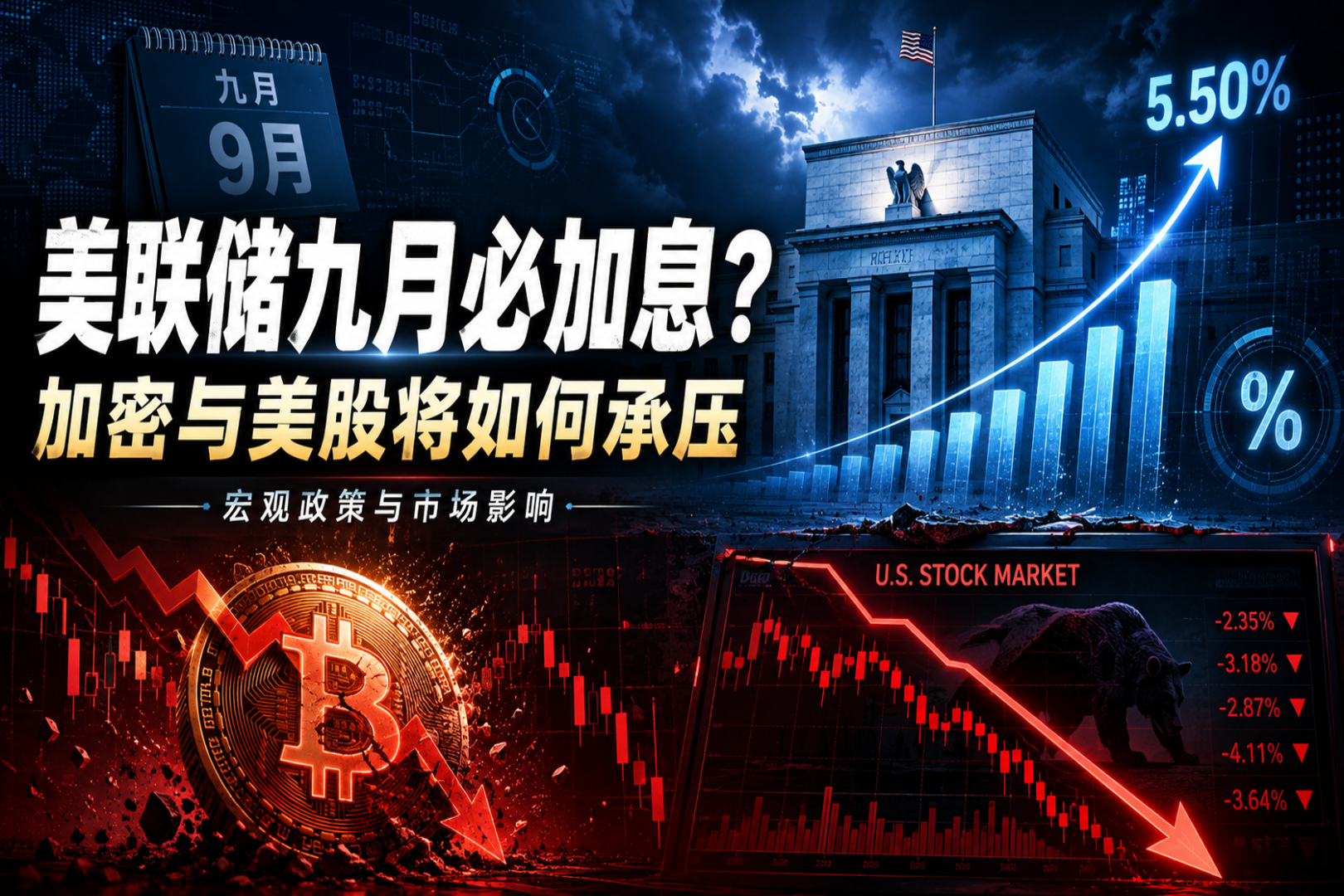
Will the Fed Definitely Raise Interest Rates in September? How Will Crypto and U.S. Stocks Withstand the Pressure?

The market's expectation for a September Fed rate hike surged dramatically in early August, jumping from under 50% to over 80% within a week. This shift followed a contentious July FOMC meeting, where a 9-3 vote to hold rates revealed growing dissent from hawkish members advocating for an immediate hike to combat persistent inflation. The primary catalyst for this repricing is rising oil prices, driven by renewed geopolitical tensions around the Strait of Hormuz, which threaten global supply. Energy costs directly influence inflation metrics, making the upcoming July CPI report (due August 12th) a critical data point. If it shows inflation reaccelerating, the probability of a September hike will solidify. For Bitcoin and crypto assets, this is typically bearish news. Bitcoin continues to behave as a high-beta, liquidity-sensitive risk asset. A rate hike raises the opportunity cost of holding non-yielding assets and could drive capital toward money markets, pressuring crypto prices in the short term. However, historical patterns suggest that if a hike is perceived as the end of a tightening cycle rather than the start, any negative price impact may be brief. U.S. stocks, particularly crypto-linked equities like Coinbase and growth-oriented tech stocks, are also vulnerable. Higher rates increase discount rates in valuation models, putting pressure on high-multiple companies. This coincides with a pivotal tech earnings season where investor focus has shifted from massive AI capital expenditure to tangible revenue and cash flow generation. Companies with negative cash flow and weak growth narratives could face heightened volatility if borrowing costs rise in September. In summary, a September Fed hike has evolved into a mainstream market scenario. Key factors to watch are oil prices, the July CPI report, and Fed communications, which will determine the final decision and its impact on volatile crypto and equity markets.

marsbit9m ago

Will the Fed Definitely Raise Interest Rates in September? How Will Crypto and U.S. Stocks Withstand the Pressure?

marsbit9m ago

A 'Overlooked' Market Event: Joint US-Japan-South Korea Intervention, Rare US Treasury Involvement, and Bessent's Quiet 'Market Rescue'?

Summary: The United States, Japan, and South Korea executed their largest coordinated foreign exchange intervention in nearly 30 years. The action targeted depreciation pressure on the Japanese yen and South Korean won. This move is seen as a significant effort by the US to stabilize the financial markets of its key allies and prevent the spillover of risks. Key details: * Japan reportedly intervened on July 30 using approximately 8.45 trillion yen (about $52.8 billion). South Korean authorities also intervened that day, selling dollars to support the won. * Notably, the US Treasury Department intervened directly in yen markets for the first time in roughly 30 years. The New York Fed, reportedly acting on behalf of the Treasury, sold euros to buy yen via Goldman Sachs and Morgan Stanley on July 31. Analysts view the use of the euro-yen pair as a way to alleviate yen pressure without adding selling pressure to the US dollar. * Prior to the action, the New York Fed conducted "rate checks" on both USD/JPY and EUR/JPY, a newer signaling tool that falls between verbal and physical intervention. The intervention is interpreted as going beyond traditional currency stabilization. Analysts, such as Michael Hartnett of Bank of America, suggest it resembles a "Price Keeping Operation" for the AI era. The core US objectives are perceived to be: 1. Preventing rapid yen depreciation from triggering a sharp rise in Japanese government bond yields. 2. Containing financial stress from spreading across Asian markets like South Korea and Japan. 3. Reducing the risk of disorderly capital flows impacting the US bond market. This coordinated action underscores the importance of Japan and South Korea as critical partners in the US semiconductor and AI supply chain. Stabilizing their financial markets is seen as vital to mitigating risks to the broader tech industry and the US market itself. The intervention coincides with market pressures, including the KOSDAQ index hitting a low since October 2022. While seen as a move to control volatility, some analysts caution it may not fundamentally reverse existing market trends.

marsbit13m ago

A 'Overlooked' Market Event: Joint US-Japan-South Korea Intervention, Rare US Treasury Involvement, and Bessent's Quiet 'Market Rescue'?

marsbit13m ago

Will the Federal Reserve Definitely Raise Interest Rates in September? How Will Cryptocurrencies and US Stocks Bear the Pressure?

In early August 2024, market expectations for a September Federal Reserve rate hike surged dramatically, from below 50% to over 80%, driven by renewed inflation concerns. This shift followed a contentious July FOMC meeting where a 9-3 vote to hold rates revealed a growing hawkish faction advocating for an immediate hike, citing prolonged above-target inflation. The key catalyst is escalating conflict near the Strait of Hormuz, which has pushed oil prices up approximately 20% in July, threatening to reignite inflation. The next critical data point is the July CPI report on August 12th; a hot reading could solidify hike expectations. For crypto assets, particularly Bitcoin, this represents near-term pressure. Bitcoin continues to exhibit high-beta, risk-on characteristics, making it sensitive to tightening liquidity and higher opportunity costs. However, historical precedent suggests that if a hike is perceived as the cycle's end rather than its start, the negative impact may be brief, with markets quickly pivoting to anticipate future rate cuts. U.S. stocks, especially crypto-linked equities like Coinbase and high-valuation tech stocks, face amplified volatility. Higher rates increase discount rates in valuation models, pressuring growth stocks. This coincides with a pivotal tech earnings season where investor focus has shifted from massive AI capital expenditures to demonstrable revenue and cash flow generation. Companies with negative cash flows and weak growth narratives could see severe pressure if a September hike materializes, as financing costs would rise. Key indicators to watch include oil prices, upcoming inflation data, and Fed commentary at events like the Jackson Hole symposium.

Odaily星球日报13m ago

Will the Federal Reserve Definitely Raise Interest Rates in September? How Will Cryptocurrencies and US Stocks Bear the Pressure?

Odaily星球日报13m ago

Trading

Spot
活动图片