Netherlands To Amend Controversial 36% Tax On Unrealized Crypto, Stock Gains

bitcoinistPublished on 2026-02-26Last updated on 2026-02-26

Abstract

Dutch Finance Minister Eelco Heinen has announced that the Netherlands will revise its controversial tax reform bill, which proposed a 36% tax on unrealized gains from crypto, stocks, and other investments. The legislation, known as the Actual Return in Box 3 Act and set to take effect in 2028, has faced strong criticism from lawmakers and investors who argue it is unfair and could drive wealth out of the country. Heinen acknowledged the need for amendments and stated that the government will reexamine the bill with the House of Representatives and the Senate, potentially leading to a complete rewrite if necessary. The current system, which taxes assumed returns, was ruled unsustainable by the Supreme Court, prompting the proposed overhaul.

Dutch financial authorities have revealed that the reform bill to tax unrealized gains on crypto, stocks, and other investments will be revised following criticism from lawmakers and local investors.

Dutch Finance Minister To Revise Tax Overhaul

On Wednesday, the Minister of Finance of the Netherlands, Eelco Heinen, announced that the recently passed bill to tax unrealized gains on crypto and other assets will be reviewed and amended to address multiple concerns brought by the Senate and crypto investors.

“I don’t think the law can go through as it stands,” Heinen told local news outlet RTL Nieuws. “I think something has simply gone wrong here, and the current law needs to be amended.”

The Netherlands plans to overhaul its tax system on January 1, 2028. The proposed system, known as the Actual Return in Box 3 Act, is set to tax investors 36% on the change in value of their crypto and other assets each year, even if these have not been sold.

According to the report, the Dutch finance minister noted that there’s still time to amend the controversial tax overhaul, as it will not be enacted until 2028.

Moreover, he revealed that he has already discussed the bill’s upcoming revision with his state secretary, adding that they are set to examine the legislation and potential amendments with lawmakers.

“We have agreed that we will go back to the drawing board, engage in discussions with the House of Representatives and the Senate, and see how we can amend the law,” he stated.

Heinen also opened the door to a complete rewrite of the crypto tax bill if amendments in certain areas don’t suffice to address the concerns. Nonetheless, he shared that he doesn’t yet know which option will be necessary as they are “just going to have the conversation.”

The Unrealized Crypto, Stock Gains Tax Debate

The new system has been heavily criticized by local investors, who have expressed concerns about being unfairly taxed on their crypto and other assets. Some have argued that the legislation could push wealth out of the country, as crypto investors and other high-net-worth individuals could consider relocating to other jurisdictions with friendlier tax frameworks.

Under the new Box 3 system, the government will calculate tax by comparing the value of an asset at the beginning and end of the year, and the income earned during this period. As a result, both realized and unrealized gains on cryptocurrencies, stocks, bonds, and similar investments will be included.

Only real estate and shares in startups will be exempt from the new system, as they will be taxed when profit is made. Meanwhile, income from these assets will continue to be taxed in the year it is received.

For context, the old Box 3 system taxed investors based on the assumed returns of assets, a practice the Supreme Court ruled unfair and unsustainable after the Dutch state lost several court cases, with every year of delay costing the treasury hundreds of millions, RTL Nieuws detailed.

Since then, lawmakers have been developing the proposed new model that they consider more accurate. However, some reports noted that the government ignored previous concerns and still decided to advance the bill with some adjustments.

Notably, the Dutch House of Representatives passed the legislation two weeks ago, advancing it to the Senate for consideration. RTL Nieuws highlighted that the Dutch Senate, which has yet to discuss the reform plan, also shares similar concerns as investors.
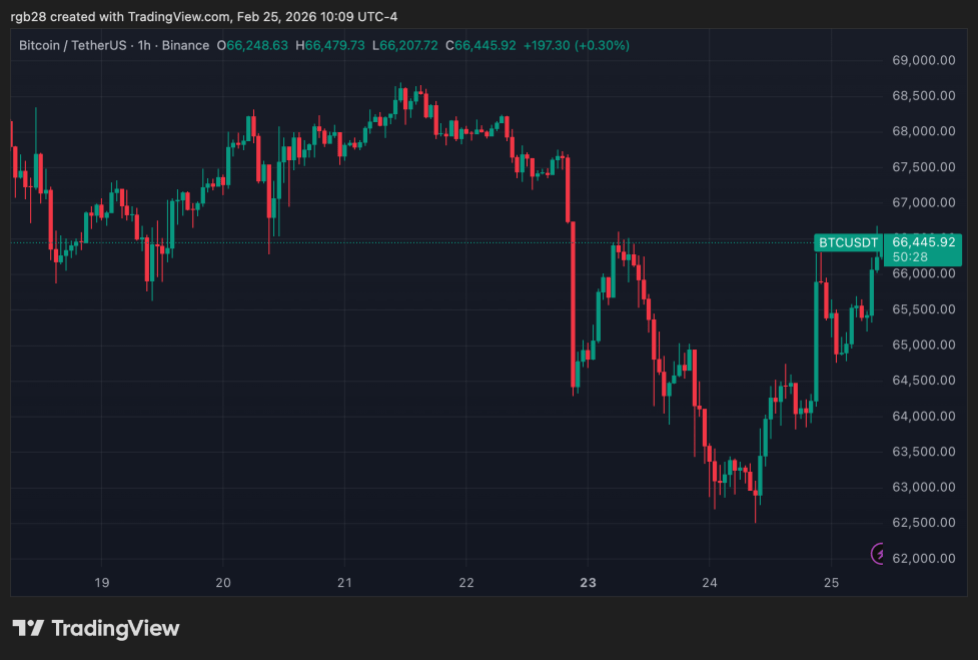
Bitcoin (BTC) trades at $66,445 in the one-week chart. Source: BTCUSDT on TradingView


Related Questions

QWhy is the Netherlands planning to amend the controversial tax on unrealized crypto and stock gains?

ADutch Finance Minister Eelco Heinen announced a review and amendment of the tax overhaul due to criticism from lawmakers and local investors, acknowledging that the current law cannot proceed as it stands and something has gone wrong.

QWhat is the proposed tax rate on unrealized gains under the Actual Return in Box 3 Act?

AThe proposed system would impose a 36% tax on the change in value of crypto and other assets each year, even if they have not been sold.

QWhen is the new tax system scheduled to be implemented in the Netherlands?

AThe tax overhaul is planned to take effect on January 1, 2028.

QWhat are the main concerns raised by investors regarding the unrealized gains tax?

AInvestors are concerned about being unfairly taxed on unsold assets, which could lead to wealth leaving the country as high-net-worth individuals might relocate to jurisdictions with more favorable tax frameworks.

QHow did the old Box 3 system differ from the proposed new model?

AThe old Box 3 system taxed investors based on assumed returns of assets, which was ruled unfair by the Supreme Court, while the new model aims to tax actual returns, including both realized and unrealized gains.

Related Reads

How Does Codex Use a Computer? Three Entry Points and Permission Boundaries

This article explains the three primary methods for Codex to interact with a computer, each with distinct use cases, permission boundaries, and trust levels. **1. Computer Use:** This offers the broadest access, allowing Codex to visually control and interact with the graphical user interface of authorized macOS/Windows apps, system settings, and even iOS simulators. It's ideal for tasks lacking APIs or structured tools, such as operating legacy software or multi-app workflows. However, it's the slowest method and has the widest permission scope, requiring careful supervision for sensitive actions. **2. Chrome Extension:** This grants Codex access to the user's logged-in Chrome browser state, including cookies, profiles, and open tabs. It's best for tasks requiring user identity across websites like Gmail, LinkedIn, Salesforce, or internal dashboards. Its key advantage is multi-tab control for complex workflows. While more powerful for browser-based tasks than Computer Use, it carries higher sensitivity as actions are performed under the user's identity. **3. In-App Browser:** This is a browser isolated within the Codex thread, separate from the user's personal browsing data. It excels in web development and debugging scenarios—previewing local servers, testing responsive layouts, or annotating designs directly on the page. Its isolation is a strength for development but a limitation for tasks requiring login sessions. The core principle is to choose the narrowest, safest, and most structured interface for the task. Use plugins or MCPs first, resort to visual control (Computer Use) only for GUI-dependent tasks, employ the Chrome extension for identity-reliant browser work, and prefer the In-App Browser for isolated development. **Appshots** are clarified as a fourth, complementary tool for *inputting* context—capturing a screenshot of a window to point Codex to something—rather than a method for Codex to *act*. Together, this layered approach highlights a key to AI agent productization: not granting unlimited permissions, but constraining them within clear boundaries for specific tasks while preserving user oversight.

marsbit39m ago

How Does Codex Use a Computer? Three Entry Points and Permission Boundaries

marsbit39m ago

The "Iron Rule" of Chip Equipment Is Being Broken

For years, the semiconductor equipment industry followed an unwritten "iron rule": suppliers offered steep discounts for new tool introductions (Design-in) and faced consistent price pressure during repeat orders, especially during market downturns. This long-standing buyer's market dynamic is now being upended. Recently, SK Hynix's primary equipment suppliers have reportedly requested a 3-4% price *increase*, a nearly unprecedented move. This shift is driven by a severe supply-demand imbalance fueled by the AI compute boom. Securing equipment has become an urgent arms race as chipmakers' expansion speed dictates their ability to fulfill massive AI chip orders. Key areas feeling the strain include: **TCB (Thermal Compression Bonding) Equipment:** Demand is exploding, driven by the simultaneous needs of HBM4 memory stacking, AI chip Chip-on-Substrate (C2S), and logic Chiplet Chip-on-Wafer (C2W) packaging. Players like Hanmi Semiconductor, Hanwha Semitech, and ASMPT are receiving major orders. While hybrid bonding is seen as the future, TCB remains the pragmatic choice for HBM4 mass production, with its lifecycle extended by relaxed specifications and ongoing technological upgrades. **Test Equipment Bottlenecks:** Ironically, AI-driven shortages are now crippling test equipment manufacturing. Critical components like FPGAs, Driver ICs, and CPUs face severe shortages and extended lead times (up to 52 weeks for FPGAs), as AI data center and server vendors prioritize supply. This creates a paradoxical cycle: AI chip shortages drive fab expansion, which requires more test equipment, whose production is delayed because its key parts are diverted to make AI chips. The industry is entering a broad, AI-powered upcycle. SEMI forecasts global semiconductor equipment sales to hit a record $156 billion by 2027, fueled by investment in advanced logic/foundry, HBM-driven DRAM, and advanced packaging (like CoWoS). Major players like TSMC, SK Hynix, and Micron are aggressively ramping capital expenditure. In conclusion, leading equipment vendors are no longer just selling tools; they are selling the critical capability to deliver AI-era capacity. Pricing power is shifting decisively to those with indispensable technology in key process nodes like advanced logic, HBM, and advanced packaging, rewriting the industry's traditional power structure.

marsbit51m ago

The "Iron Rule" of Chip Equipment Is Being Broken

marsbit51m ago

Trading

Spot
Futures
活动图片