Musk Posted a Recruitment Ad for SpaceX, and After Reading the Comments Section, I Understood

marsbitPublished on 2026-05-21Last updated on 2026-05-21

Abstract

On May 20th, SpaceX filed for a landmark IPO with a $1.75 trillion valuation. Shortly after, Elon Musk posted a recruitment call on X, seeking "world-class engineers and physicists" for SpaceX. The application process was starkly simple: email with three bullet points proving "exceptional ability," with real, complex projects as a plus. Musk promised to review qualifying emails himself. The post garnered millions of views and thousands of replies, revealing a spectrum of responses. Most comments, including a highly-upvoted humorous one listing absurd "skills," merely listed credentials or experiences in a conventional, non-differentiating way. This highlighted a key insight: a traditional resume listing degrees and skills often fails to demonstrate true exceptionalism. Effective self-presentation requires "performance efficiency." A standout reply came from an OpenAI engineering lead, who simply stated "codex." This demonstrated that for those who have built significant, recognized products, the product itself becomes the ultimate resume. The article argues that in the AI era, any tangible, shareable output—a tool, research, or online project—serves as a living, self-evident credential more powerful than a list of attributes. However, a twist emerged when applicants found the provided email address non-functional, leading to speculation that the post might also serve as an IPO publicity stunt, projecting an image of aggressive talent acquisition to investors. Ultimately, t...

Author: Curry, Deep Chao TechFlow

On May 20th after US market close, SpaceX submitted its prospectus to the SEC with a valuation of $1.75 trillion, aiming to list on NASDAQ in June.

This is undoubtedly the largest IPO in history, likely surpassing Saudi Aramco's $29 billion fundraising record set six years ago.

Less than a day after the prospectus was submitted, on the afternoon of May 21st, Musk posted a recruitment message on X.

The gist was that SpaceX is hiring world-class engineers and physicists. Zero experience in AI is fine because smart people learn fast. The application method is incredibly simple:

Send an email listing three bullet points proving you have exceptional ability.
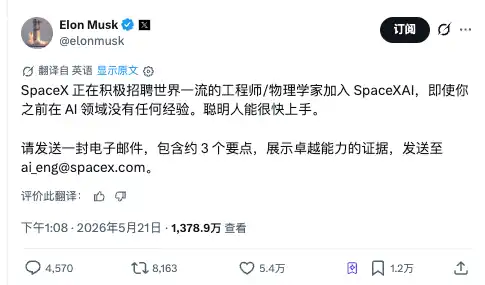
Additionally, Musk noted that having built "something very complex and actually functional" is a plus. Emails passing the basic screening will be reviewed by Musk personally. By the time I wrote this article, the post had over 13 million views and 4,500 replies.

Musk's recruitment stance seems very appealing. Degrees, companies, ten years of experience don't matter, only whether you have "exceptional ability." But upon closer thought, you realize this is actually a much harsher filter than conventional recruitment.

Do you think using 3 bullet points to explain your outstanding qualities is simple or difficult?

A conventionally formatted resume is at least one page long: positions and achievements from past jobs, alma mater, tools you know, awards won... piled together it looks full, but perhaps not a single line directly proves you are "exceptional."

Scrolling through the comments section, you'll also find the vast majority of people cannot do this.

Resumes Are Actually About "Performance Efficiency"

I scrolled through the comments section and roughly understood.

With 4,500 replies, you can probably guess the style—mostly witty one-liners. Currently, the top-rated reply is from a user named Greg who posted a so-called "resume," looking utterly absurd:
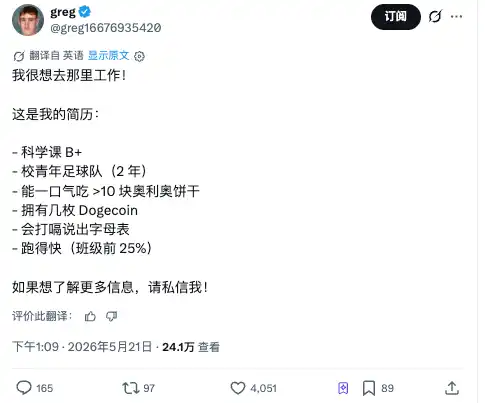
Pure self-deprecating meme is quite funny, and the answer is obviously just a joke, but it also acts as a mirror. Think carefully, the resumes I've submitted in the past seem essentially no different from this?

Replace the content of this resume: top university computer science major GPA 3.8, two years on the school basketball team, proficient in Python and Java, self-studied CFA Level 1, top fifty in school sports meet...

The format is identical, the logic is identical, only the content is less outrageous, but the essence remains listing everything you have point by point indiscriminately.

From Musk's perspective, your Python skill level versus your ability to burp the alphabet—the difference isn't actually that significant.

The comments section isn't just full of jokers. Some seriously posted their degree certificates, others threw in their child's Ivy League acceptance letter, some posted passport photos asking for work visas, and others listed paper publications and conference talks...

Compared to the jokers, these people are surely sincere about applying.

But step back and look: what they are doing is the same as that absurd joke post: listing credentials, piling up experiences, indiscriminately listing any possible shining point, hoping to create an impression of "I am excellent."

Musk asked: what have you built that is complex and useful enough. A typical interviewer in our daily lives might not be that demanding, but similarly hopes for stronger relevance in a resume.

Simply put, a resume is a performance, and performance is about efficiency. What can efficiently impress the other party most of the time is not necessarily long-winded explanations.

Product, The Better Resume

There's actually another highly upvoted comment in the section that I think perfectly satisfies the request in Musk's post: "Please use 3 bullet points to prove your excellence."

And this person even used just 1 bullet point, typing just 1 word:

codex.

Clicking into his profile, I checked—Tibo (full name Thibault Sottiaux) is an Engineering Lead at OpenAI, currently leading the Codex team. Codex is one of the most powerful AI programming tools and something developers worldwide use daily.
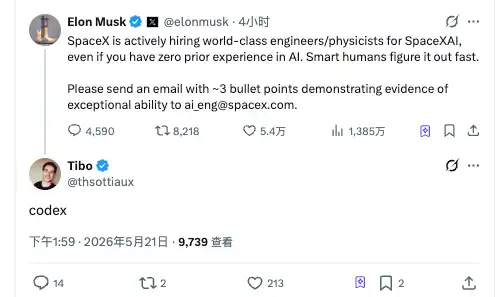
A product name is the entire resume.

The more you need to explain who you are, the less likely you are the person Musk is looking for. People who have truly built things, their name itself is evidence, the product itself is the bullet point. But you might say, he's a project lead at OpenAI, excellent enough to have the capital to reply with just one word. Ordinary people don't have that kind of confidence.

Think from another angle: Tibo can reply like that because he has something others have used, validated, that requires no self-explanation. That thing speaks for him.

Of course, elitism is not to be encouraged, but most of us aren't big shots. Yet sometimes we also just need to productize ourselves, to let the things we've done prove ourselves in a more efficient way.

Pushing this idea one layer down, it's actually unrelated to seniority.

You spent a weekend using vibe coding to build a small tool, consistently shared it and people use it—that's a kind of product; you wrote an industry research post on social media that got cited—that's also a kind of product.

These things are of course small compared to Codex, but they share a common trait: they are things you made, visible to others, requiring no explanation from you.

In the AI era, every work, every output, every tangible result you leave online that others can point to is, in a way, a living resume. It speaks for you.

You don't need to reach Codex's scale, but you should at least have something that can be pointed to.

So, the attachments in resumes today—they themselves might be the better resume.

But, Is the Recruitment Real?

The story actually has a tail end here.

In the comments section, someone, after reading Musk's post, seriously wrote an email and sent it to the address [email protected], only to find it bounced back. The system indicated the address doesn't exist...
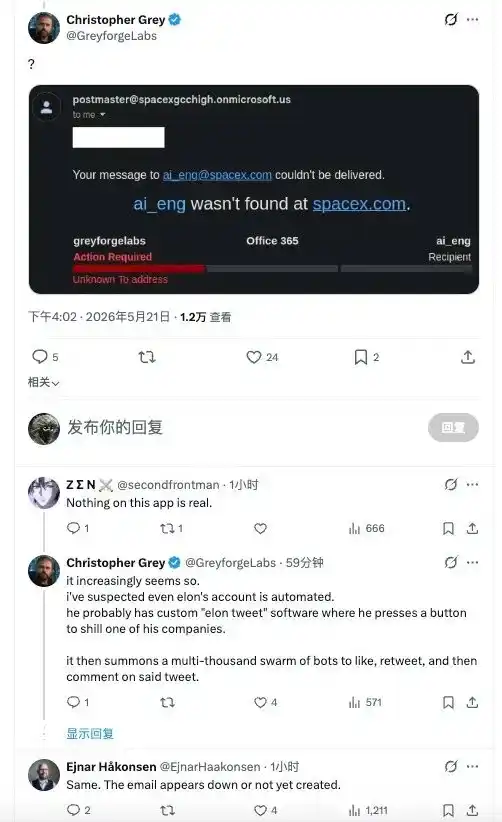
Some suspect Musk's account itself is automated, the recruitment email isn't set up yet, but the recruitment announcement went out first; others think recruiting around an IPO is part of the IPO roadshow, projecting an image of attracting top talent to strengthen the team.

Investors will certainly see Musk's post. So whether the recruitment itself is real can be set aside for now, but the posture the post conveys—"SpaceX is poaching talent"—is clear.

So, is this recruitment post actually hiring or doing a roadshow?

Perhaps the difference between the two isn't that big. In Musk's world, a single tweet can simultaneously be a job posting, an investor relations statement, and a brand advertisement. You see three bullet points; investors see "this company has the ability to attract the world's best talent."

Reading the post and the comments gives a sense of enlightenment. The witty one-liners, the one-word "Codex" self-proof, the bounced emails where applications fail—these are actually three types of roles on the same stage.

Some come to perform, some come to prove themselves, some discover the stage set seems to be made of cardboard...

In an era of scarce attention and cheap content output, finding one's own position and value remains the long-term homework we must do.


Related Questions

QAccording to the article, what was the most effective response to Elon Musk's SpaceX job posting on X, and why was it considered so powerful?

AThe most effective response was from Tibo (Thibault Sottiaux), the engineering lead of OpenAI's Codex team. He simply replied 'codex'. This was powerful because a single word referenced a globally used and complex product he led, which served as irrefutable, self-explanatory proof of his 'exceptional ability'. It demonstrated that a tangible, successful product is the ultimate resume.

QHow does the author describe the fundamental problem with most traditional resumes and the typical responses to Musk's post?

AThe author argues that traditional resumes and many responses to the post follow the same flawed logic: they provide an 'undifferentiated list' of qualifications, degrees, skills, and experiences. This is akin to the satirical resume listing skills like 'burping the alphabet'. The issue is this approach merely proves you have attributes but doesn't directly or efficiently demonstrate exceptional, practical ability to build complex things.

QWhat core piece of advice does the article offer for professionals in the AI era regarding personal branding?

AThe article advises individuals to 'productize' themselves. This means creating tangible, visible outputs—like a useful tool, a well-researched report, or any shareable project—that can act as a 'live resume'. These outputs are evidence of one's abilities that 'speak for themselves' without needing lengthy personal explanation, making them a more efficient form of proof in an attention-scarce world.

QWhat suspicion did some people have about the legitimacy of the SpaceX job posting mentioned at the end of the article?

ASome people suspected the posting might not be entirely genuine. Evidence cited includes that the provided email address (apply@spacex.com) initially bounced back as non-existent. This led to theories that the post could be automated, that the hiring process wasn't fully set up, or that it was partly a publicity move to showcase SpaceX's talent-attraction prowess to investors during its IPO roadshow.

QWhat is the 'three-act play' the author sees in the comments section of Musk's post?

AThe author sees a three-act play: 1) People 'performing' by posting humorous or generic content (like the burping resume). 2) People attempting to genuinely 'prove themselves' by listing credentials and achievements. 3) People discovering the 'stage set might be made of paper' when they find practical issues like the non-functional email address. Together, these represent different engagements with the modern challenge of proving one's value.

Related Reads

AI PC Battle: Bet on the Toll Booth, Not the Camp

**Title:** The AI PC Battle: Don't Bet on Sides, Bet on the Tollbooth **Summary:** The AI PC competition is moving beyond simple "x86 vs. Arm" narratives. The core investment thesis should focus on identifying which players can sustain margins, cash flow, and pricing power throughout the upgrade cycle, rather than backing a particular architecture. The opportunity is analyzed in three layers: 1. **The Advanced Foundry Tollbooth:** TSMC is positioned to collect "tolls" regardless of which chip designer wins, due to its dominant ~70% share in advanced semiconductor manufacturing, which is essential for high-end AI PC chips. 2. **Compute & Platform Spillover:** AMD represents an offensive in the x86 CPU+GPU space, while NVIDIA leverages its GPU and CUDA software stack dominance. Both benefit from the demand for increased local AI compute. 3. **Architecture Diffusion & Turnaround Plays:** ARM and Intel offer potential for significant upside (elasticity), but investments here require stricter discipline due to higher execution risks and competitive challenges. The industry is transitioning from concept to shipment validation. While short-term forecasts for AI PC adoption have been revised down slightly due to tariffs and procurement delays, the long-term trend towards AI becoming a standard PC feature remains intact. The key driver for upgrade cycles will be whether compelling enterprise applications (e.g., privacy-sensitive computing, low-latency inference) emerge beyond consumer-focused features like meeting summarization. Investment strategy should prioritize companies with platform-level advantages and recurring revenue streams. TSMC offers high certainty as the foundational tollbooth. AMD presents a strong offensive play within the established ecosystem. ARM and Intel are higher-risk, higher-potential-reward turnaround bets. The report cautions against chasing short-term hype and emphasizes a disciplined, long-term approach focused on buying ecosystem strength and cash-flow certainty after market enthusiasm subsides. **Key Risks:** Underwhelming AI PC applications slowing upgrade cycles; slow improvement in Windows on Arm compatibility; macro/tariff impacts on PC demand; potential advanced node supply-demand mismatches affecting TSMC; high overall AI sector valuations making stocks vulnerable to a risk-off shift in markets.

marsbit5m ago

AI PC Battle: Bet on the Toll Booth, Not the Camp

marsbit5m ago

Ten-Thousand-Word Analysis: From $10 to $290, MRVL Wins the Entire AI Era by 'Not Making GPUs'

Marvell Technology's stock price surged from under $10 in 2016 to a record $290 in June 2026, fueled not by making GPUs, but by dominating AI infrastructure connectivity. This analysis argues the market misvalues MRVL as merely a smaller Broadcom in custom AI chips, overlooking its true, unique position. Marvell's core strength lies in enabling high-speed data flow for AI clusters through three interconnected businesses. First, it holds a commanding ~70% market share in high-speed optical DSPs (essential for data center light modules), a deep-moat business with accelerating growth. Second, its custom AI chip design business serves hyperscalers like AWS, Microsoft, and Google, with a significant revenue pipeline despite lower margins. Third, stable cash flows come from Ethernet switch chips and enterprise storage controllers. Together, they form a full-stack "AI data movement" platform. CEO Matt Murphy's transformative leadership since 2016, involving strategic divestments, key acquisitions (like Inphi for optical DSPs), and securing long-term agreements with major cloud providers, repositioned the company. A pivotal $2 billion strategic investment from NVIDIA in 2026 underscored Marvell's critical role in the AI ecosystem, particularly through collaborations like NVLink Fusion. While Marvell faces risks—including client concentration (losing the Amazon Trainium3 design), lower-margin business mix, competitive threats, insider selling, and complex supply chains—its fundamentals remain strong. The optical interconnect moat is widening with the acquisition of Celestial AI (photonics fabric), and financial metrics show accelerating revenue growth and operating leverage. With a PEG ratio suggesting undervaluation relative to its growth, the thesis is that the market undervalues Marvell's monopolistic position in AI "plumbing" while overemphasizing its competitive custom chip segment. The story transcends investing, symbolizing how in any complex system—from the internet to AI—the value of "connection" ultimately surpasses that of individual "nodes."

marsbit35m ago

Ten-Thousand-Word Analysis: From $10 to $290, MRVL Wins the Entire AI Era by 'Not Making GPUs'

marsbit35m ago

AI Relay Stations Spark Heated Debate on Zhihu: Behind Cheap Tokens, What Are Users Really Worried About?

A discussion on Zhihu about "AI relay stations" shifted the niche developer topic of "cheap tokens" into broader user awareness. Users moved beyond simply questioning the legitimacy of these services to focus on practical concerns: Where do cheap tokens truly come from? Is the model being accessed the real one? Can relay stations see prompts, code, and API keys? For occasional users, are the risks worth it? The core debate centered less on price and more on trust. A primary worry is model authenticity—the risk of "model swapping," where users paying for a premium model might be routed to a cheaper one, creating an information asymmetry. Others argued that cost comparisons matter; while cheaper than official pay-as-you-go APIs, relay stations may not be the lowest-cost option versus subscriptions, domestic models, or free tiers, making user needs assessment crucial. Speculation about token sources ranged from legitimate bulk discounts to gray-area methods like account sharing or exploiting regional pricing. This opacity makes risk assessment difficult for users. Data security emerged as a critical concern, especially for enterprise use. When processing sensitive information like code, contracts, or client data, the inability to verify a relay station's data handling, retention, or access policies poses significant compliance and confidentiality risks. The evolving consensus suggests relay stations can be used cautiously for low-sensitivity, disposable tasks (e.g., summarizing public info, simple translation). However, they should not be the default for sensitive, professional, or production workflows involving proprietary data, Agents, or automated systems. Recommendations include avoiding large prepayments, not relying on a single service, using test prompts to monitor quality, anonymizing data where possible, and keeping official channels as backups. Ultimately, the discussion framed tokens not just as a billing unit but as a measure of real cost encompassing price, model integrity, data security, and service stability. The popularity of relay stations highlights user demand for affordable access, but the debate underscores a key trade-off: the savings from cheap tokens may come at the price of trust, transparency, and control over one's data and AI experience.

marsbit1h ago

AI Relay Stations Spark Heated Debate on Zhihu: Behind Cheap Tokens, What Are Users Really Worried About?

marsbit1h ago

In-Depth Research Report on TradFi: The Convergence Wave of Crypto and Traditional Finance

In 2026, the crypto industry is undergoing a profound infrastructure-level transformation—TradFi assets are migrating on-chain at an unprecedented pace. According to CoinGecko's Q1 2026 report, the total value locked (TVL) of tokenized real-world assets (RWA) has surpassed $31 billion, a nearly 4x increase from $7.8 billion at the beginning of 2025, with the sector’s aggregate market capitalization reaching $19.3 billion. Among these, the market cap of tokenized stocks surged from $2 million to $486 million, with Q1 spot trading volume reaching $15.1 billion—a single quarter already surpassing the entire second half of 2025. RWA perpetual contract Q1 trading volume reached a staggering $524.8 billion, far exceeding the $313 billion for all of 2025. Meanwhile, BlackRock's BUIDL fund has reached $2.3 billion in scale and has filed for two new tokenized funds, signaling that the world's largest asset manager's tokenization strategy is evolving from pilot to product suite expansion. HTX, as a core participant in the crypto exchange sector, officially launched TradFi perpetual futures products including NVDA, AAPL, MSFT, META, and SPY in 2026, enabling crypto users to gain 24/7 trading access to core U.S. equities. Boston Consulting Group predicts that global tokenized asset scale could reach $16 trillion by 2030, while McKinsey offers a conservative estimate of approximately $2 trillion. The on-chain migration of TradFi assets is no longer a "future narrative" but a structural transformation unfolding in real time, as crypto exchanges evolve from single crypto asset trading platforms toward "multi-asset-class trading infrastructure."

HTX Learn1h ago

In-Depth Research Report on TradFi: The Convergence Wave of Crypto and Traditional Finance

HTX Learn1h ago

Trading

Spot
Futures
活动图片