Monero, Zcash, and Canton Network: Who is the True King of Privacy?

marsbitPublished on 2026-01-13Last updated on 2026-01-13

Abstract

Blockchain transparency poses risks for institutions by exposing sensitive corporate and financial data. While Monero offers complete anonymity by hiding all transaction details, it lacks KYC/AML compliance, making it unsuitable for regulated entities. Zcash provides selective privacy through shielded addresses, allowing users to encrypt transactions but only in an all-or-nothing manner. In contrast, Canton Network enables granular, selective disclosure—allowing institutions to share only specific transaction components with authorized parties (e.g., regulators) while keeping other details private. This aligns with institutional needs for both privacy and compliance. Canton’s adoption by DTCC and over 400 institutions highlights its practical design for real-world financial workflows, positioning it as a leading privacy solution for the institutional era.

Written by: Tiger Research

Key Points

  • The core advantage of blockchain—transparency—can expose corporate trade secrets and investment strategies, posing substantial risks to businesses.
  • Fully anonymous privacy models like Monero do not support KYC or AML, making them unsuitable for regulated institutions.
  • Financial institutions require selective privacy, which protects transaction data while remaining compatible with regulatory compliance.
  • Financial institutions must determine how to connect with open Web3 markets for expansion.

1. Why is Blockchain Privacy Necessary?

One of the core features of blockchain is transparency. Anyone can inspect on-chain transactions in real-time, including who sent the funds, to whom, the amount, and when it was sent.

However, from an institutional perspective, this transparency presents obvious problems. Imagine a scenario where the market can observe how much NVIDIA transferred to Samsung Electronics, or precisely when a hedge fund deployed its funds. Such visibility would fundamentally alter competitive dynamics.

The level of information disclosure tolerable for individuals differs from what businesses and financial institutions can accept. A company's transaction history and the timing of institutional investments constitute highly sensitive information.

Therefore, expecting institutions to operate on a blockchain where all activities are fully exposed is unrealistic. For these participants, a system without privacy is less of a practical infrastructure and more of an abstract ideal with limited real-world application.

2. Forms of Blockchain Privacy

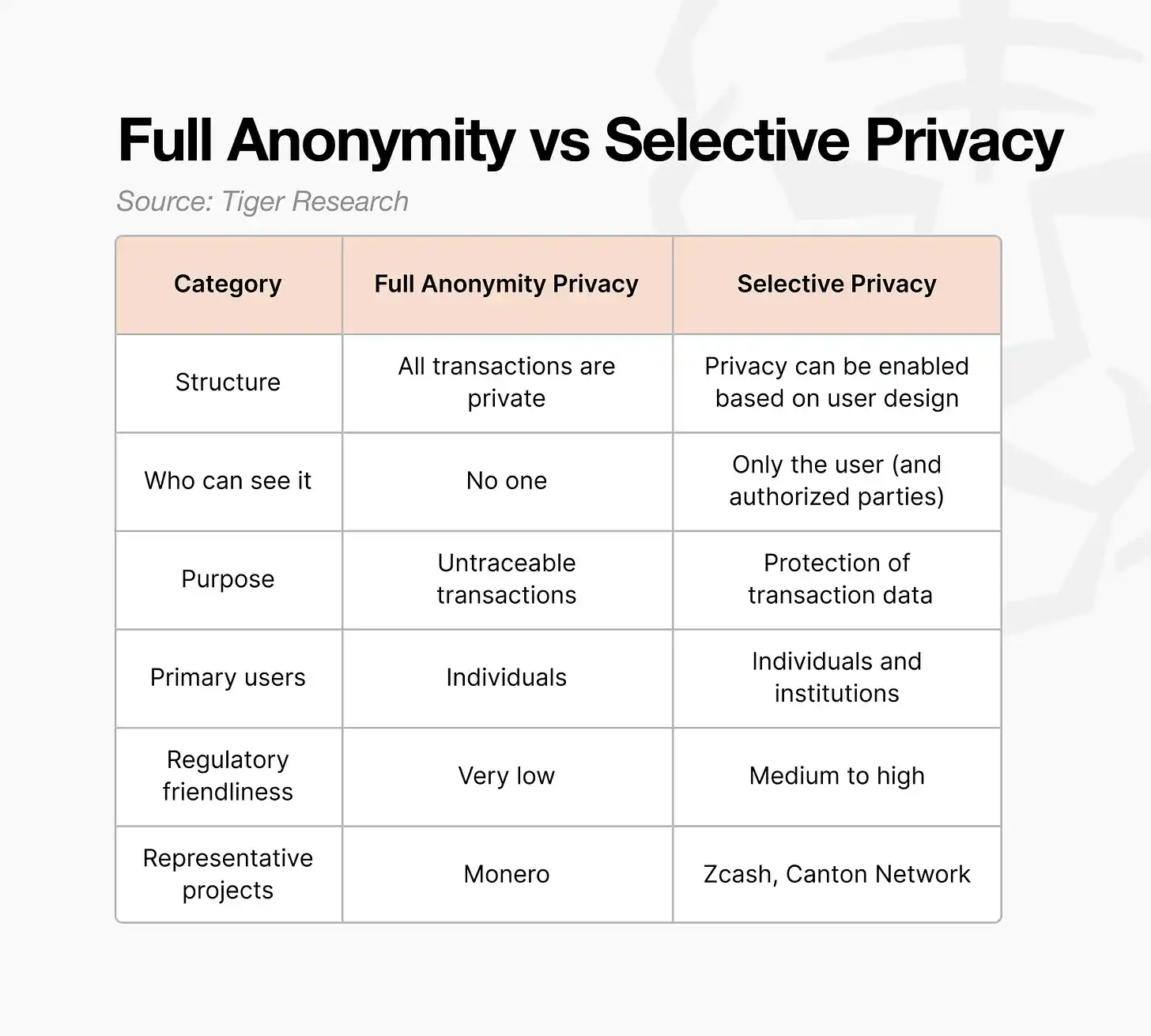
Blockchain privacy is generally divided into two categories:

  • Fully Anonymous Privacy
  • Selective Privacy

The key difference lies in whether information can be disclosed when another party requires verification.
2.1. Fully Anonymous Privacy

Fully anonymous privacy, simply put, hides everything.

The sender, receiver, and transaction amount are all hidden. This model stands in direct opposition to traditional blockchains, which prioritize transparency by default.

The primary goal of fully anonymous systems is to prevent third-party surveillance. Rather than enabling selective disclosure, they aim to completely prevent external observers from extracting meaningful information.
Source: Tiger Research

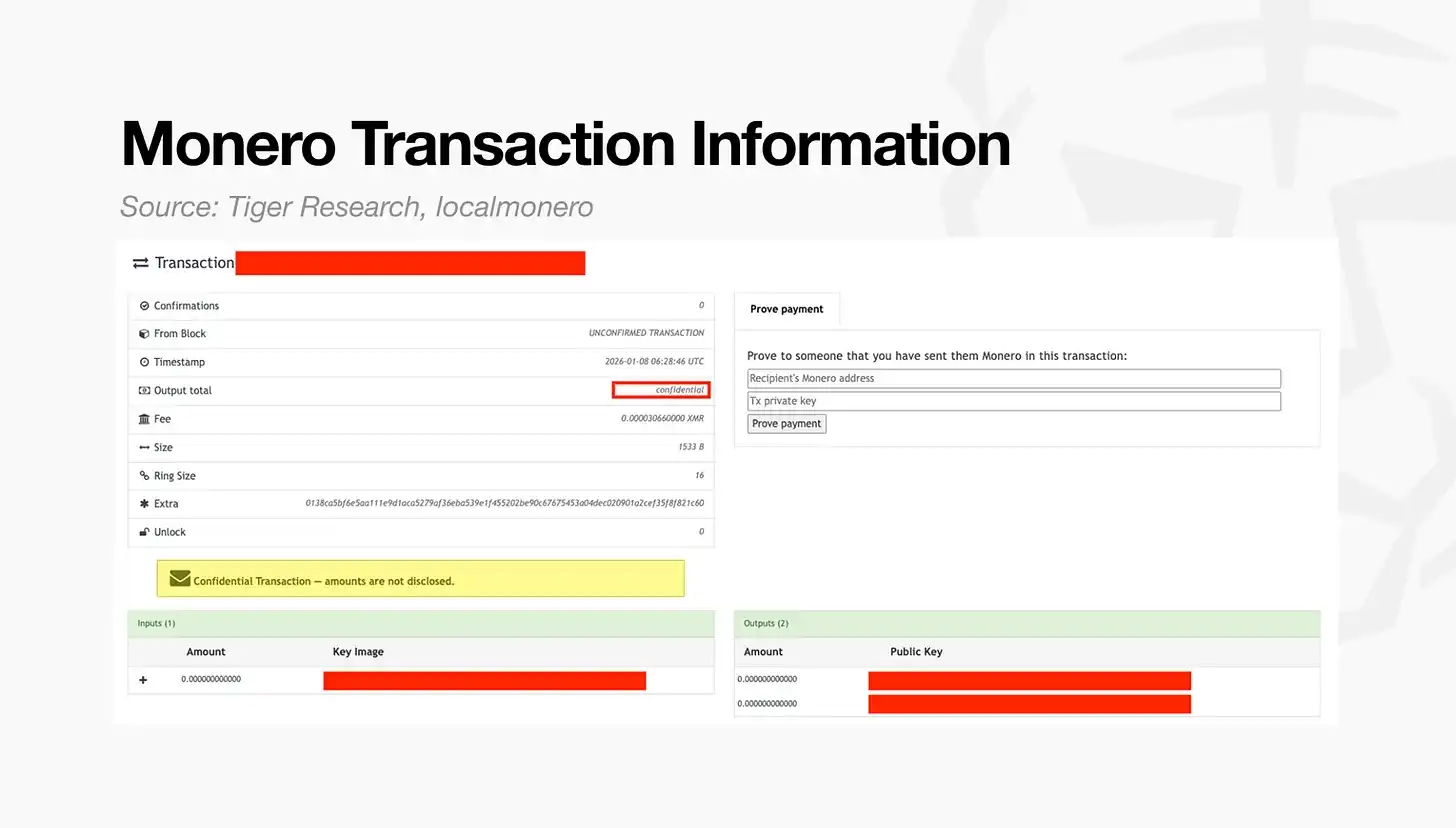
The above image shows a Monero transaction record, a representative example of fully anonymous privacy. Unlike transparent blockchains, details such as the transfer amount and counterparty are not visible.

Two characteristics illustrate why this model is considered fully anonymous:

  • Output Totals: The ledger does not display specific numbers but shows values as "confidential." Transactions are recorded, but their content cannot be interpreted.
  • Ring Signature Size: Although a single sender initiates the transaction, the ledger mixes it with multiple decoys, making it appear as if multiple parties are sending funds simultaneously.

These mechanisms ensure that transaction data remains opaque to all external observers without exception.

2.2. Selective Privacy

Selective privacy operates on a different assumption. Transactions are public by default, but users can choose to make specific transactions private by using designated privacy-enabled addresses.

Zcash provides a clear example. When initiating a transaction, users can choose between two address types:

  • Transparent Addresses: All transaction details are publicly visible, similar to Bitcoin.
  • Shielded Addresses: Transaction details are encrypted and hidden.
Source: Tiger Research

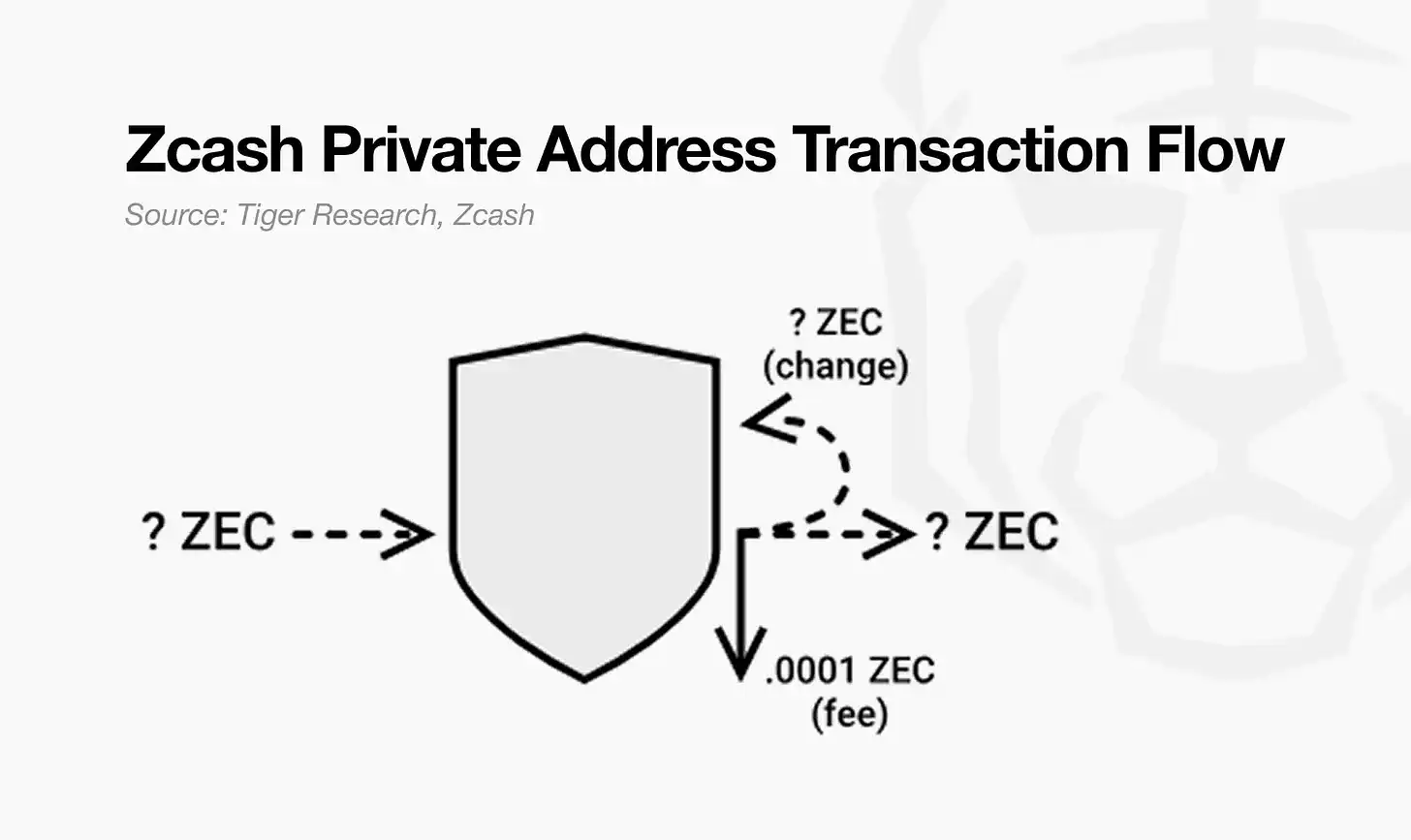
The above image illustrates which elements Zcash can encrypt when using shielded addresses. Transactions sent to shielded addresses are recorded on the blockchain, but their content is stored in an encrypted state.

While the existence of the transaction remains visible, the following information is hidden:

  • Address Type: Shielded (Z) addresses are used instead of transparent (T) addresses.
  • Transaction Record: The ledger confirms that a transaction occurred.
  • Amount, Sender, Receiver: All are encrypted and cannot be observed externally.
  • Viewing Rights: Only parties granted a viewing key can inspect the transaction details.

This is the core of selective privacy. Transactions remain on-chain, but users control who can view their content. When necessary, users can share a viewing key to prove transaction details to another party, while all other third parties remain unable to access that information.

3. Why Financial Institutions Prefer Selective Privacy

Most financial institutions have Know Your Customer (KYC) and Anti-Money Laundering (AML) obligations for every transaction. They must retain transaction data internally and respond immediately to requests from regulators or supervisory bodies.

However, in an environment built on fully anonymous privacy, all transaction data is irreversibly hidden. Because the information cannot be accessed or disclosed under any conditions, institutions are structurally unable to fulfill their compliance obligations.

A representative example is the Canton Network, which has been adopted by the Depository Trust & Clearing Corporation (DTCC) and is currently used by over 400 companies and institutions. In contrast, Zcash, although also a selective privacy project, has seen limited real-world institutional adoption.

What is the reason for this difference?
Source: Tiger Research

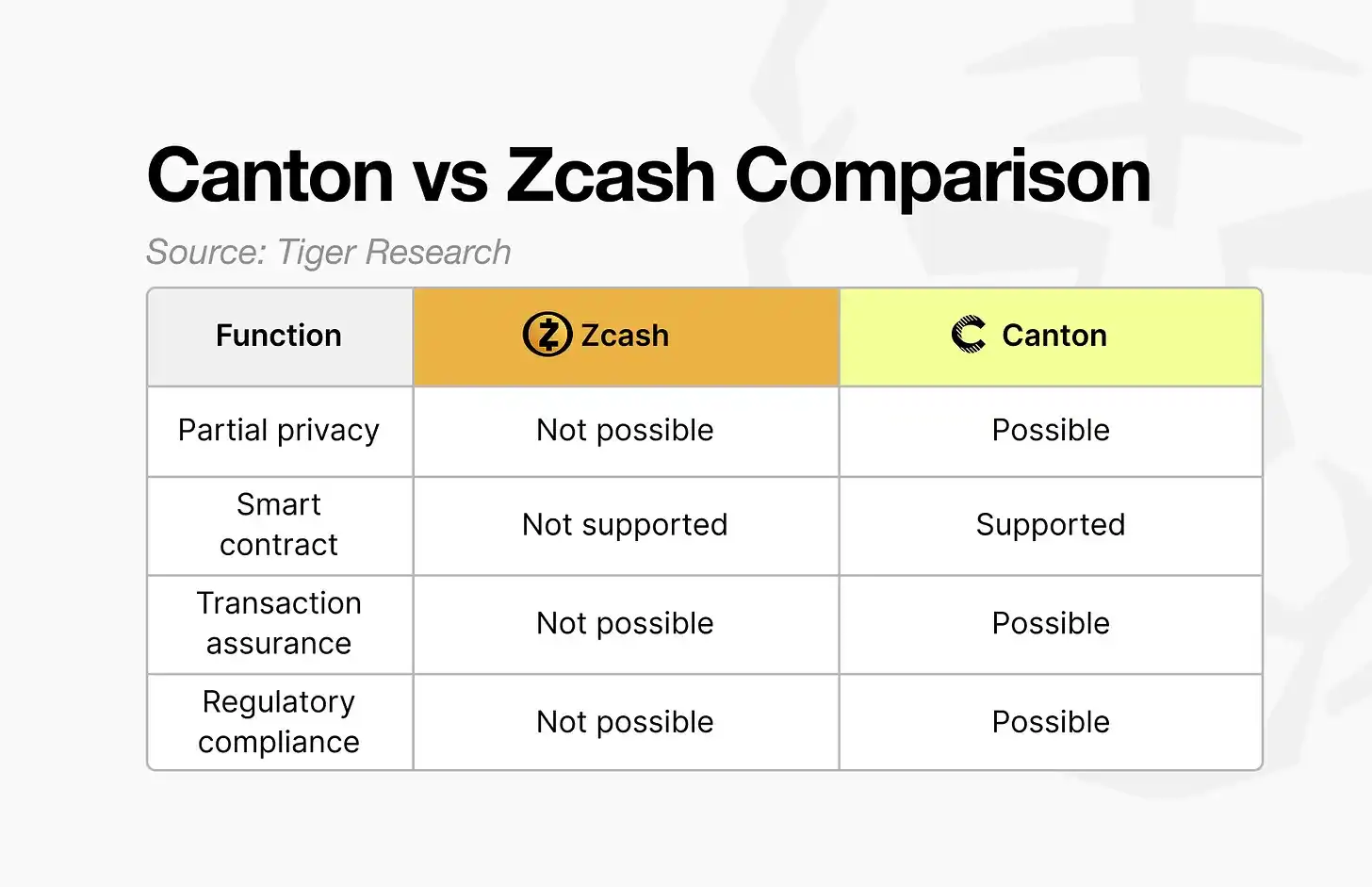
Zcash offers selective privacy, but users cannot choose which information to disclose. Instead, they must choose whether to disclose the entire transaction.

For example, in a transaction where "A sends $100 to B," Zcash does not allow only the amount to be hidden. The transaction itself must be either fully hidden or fully disclosed.

In institutional transactions, different participants require different information. Not all participants need access to all data in a single transaction. However, Zcash's structure forces a binary choice between full disclosure and full privacy, making it unsuitable for institutional transaction workflows.

In contrast, Canton allows transaction information to be divided into separate components for management. For example, if a regulator only requires the transaction amount between A and B, Canton enables the institution to provide only that specific information. This functionality is achieved through Daml, the smart contract language used by the Canton Network.

Other reasons for institutional adoption of Canton are covered in more detail in previous Canton research.

4. Privacy Blockchains in the Institutional Era

Privacy blockchains evolve as demands change.

Early projects like Monero aimed to protect individual anonymity. However, as financial institutions and corporations began entering the blockchain environment, the meaning of privacy shifted.

Privacy is no longer defined as making transactions invisible to everyone. Instead, the core goal has become protecting transactions while still meeting regulatory requirements.

This shift explains why selective privacy models like the Canton Network have gained traction. Institutions need more than just privacy technology; they need infrastructure designed to match real-world financial transaction workflows.

In response to these demands, more institution-oriented privacy projects continue to emerge. Looking ahead, the key differentiator will be how effectively privacy technology can be applied to practical transaction environments.

Alternative forms of privacy that run counter to the current institution-driven trend may emerge. However, in the short term, privacy blockchain is likely to continue evolving around institutional transactions.


Related Questions

QWhy is blockchain privacy necessary for institutions according to the article?

ABlockchain transparency can expose corporate trade secrets and investment strategies, posing substantial risks. Institutions require privacy that protects sensitive transaction data while remaining compatible with regulatory compliance, as full transparency is unrealistic for their operations.

QWhat is the key difference between fully anonymous privacy and selective privacy in blockchain?

AFully anonymous privacy hides all transaction details (sender, receiver, amount) from everyone, while selective privacy allows users to encrypt transactions but grant access to specific parties (e.g., regulators) via view keys when necessary.

QWhy are fully anonymous privacy models like Monero unsuitable for regulated financial entities?

AThey irreversibly hide all transaction data, making it impossible for institutions to fulfill KYC and AML obligations or respond to regulatory requests, as no information can be disclosed under any conditions.

QHow does Canton Network address the limitations of Zcash's selective privacy for institutional use?

ACanton allows granular control over transaction data disclosure using Daml smart contracts, enabling institutions to share specific information (e.g., only amount) with authorized parties, unlike Zcash's all-or-nothing binary approach.

QWhat shift in privacy needs does the article highlight as institutions adopt blockchain technology?

APrivacy is no longer about complete anonymity for all; instead, the focus is on protecting transactions while meeting regulatory requirements, leading to the rise of selective privacy models like Canton Network tailored for real-world financial workflows.

Related Reads

South Korean Exchanges 'Battle' Regulators, Challenging the Boundaries of Enforcement and Legislation

South Korea's cryptocurrency industry is engaged in a rare, direct confrontation with regulators. The Financial Intelligence Unit (FIU), the primary anti-money laundering (AML) watchdog, has recently imposed heavy penalties on major exchanges like Upbit and Bithumb for alleged violations involving unregistered overseas VASPs and AML procedures. However, exchanges are now actively challenging these actions in court and through industry associations. In a significant shift, the Seoul Administrative Court ruled in favor of Upbit's operator, Dunamu, overturning part of an FIU-ordered business suspension. The court found the FIU's penalty criteria and justification insufficiently clear. Similarly, the court suspended the enforcement of a six-month business suspension against Bithumb pending a final ruling, citing potential irreversible harm to the exchange. Beyond legal battles, the industry is contesting proposed legislative amendments. The Digital Asset eXchange Alliance (DAXA) strongly opposes a draft rule that would mandate Suspicious Transaction Reports (STRs) for all crypto transfers over 10 million KRW (~$6,800). DAXA argues this "poison pill" clause violates legal principles and would overwhelm the STR system, increasing reports from 63,000 to an estimated 5.45 million annually for major exchanges, thereby crippling effective AML monitoring. This conflict highlights a structural tension in South Korea's crypto governance: comprehensive digital asset laws are still developing, while regulators rely heavily on AML enforcement. The industry's move from passive compliance to active legal and legislative challenges signifies a new phase, pressing for clearer rules and more proportionate enforcement. While short-term disputes may intensify, this clash could ultimately lead to a more mature and sustainable regulatory framework for South Korea's vibrant crypto market.

marsbit17m ago

South Korean Exchanges 'Battle' Regulators, Challenging the Boundaries of Enforcement and Legislation

marsbit17m ago

After 50x Storage Surge, Justin Sun Always Looks to the Next Decade

Sun Yuchen, known for his controversial stunts like a $30 million lunch with Warren Buffett (canceled due to a kidney stone) and eating a $6.2 million duct-taped banana, is often overshadowed by a significant fact: his decade-long track record of spotting major investment trends. In 2016, he famously advised young people to invest in Bitcoin, Nvidia, Tesla, and Tencent instead of buying property. A hypothetical $20,000 investment in Nvidia and Tesla from that list would now be worth over 50 million RMB. His latest major call was on November 6, 2025, predicting a "50x storage opportunity" tied to the AI boom, which materialized with Sandisk's stock surging nearly 50-fold by 2026. Looking ahead, Sun now focuses on the next frontier: Physical AI. He identifies four key areas: 1. **Embodied AI/Robotics**: He sees this reaching its "iPhone moment," with companies like UBTech and Galaxy General leading in commercialization. 2. **Drones**: Viewed as the first commercially viable form of Physical AI, revolutionizing sectors from warfare (e.g., AeroVironment's Switchblade) to logistics. 3. **Spatial Computing**: Beyond VR, it's about AI understanding physical space, a foundational technology for robotics and autonomous systems, exemplified by Apple's Vision Pro. 4. **Space Exploration**: After a 2025 suborbital flight with Blue Origin, Sun advocates for space as the ultimate frontier, discussing blockchain's potential role in space asset management and data transactions. His investment philosophy involves betting on entire, inevitable trends rather than single companies. For robotics, he sees Tesla (the body/manufacturer) and Nvidia (the brain/AI platform) as complementary plays. In defense drones, he highlights companies making tanks obsolete (AeroVironment) and those augmenting fighter jets (Kratos). For space, he participated in Blue Origin's flight and anticipates SpaceX's potential IPO to redefine the sector's valuation. Sun Yuchen's vision frames the next two decades not as a revolution in information flow (like the internet), but in the fundamental operation of the physical world through AI-powered robots, autonomous systems, and spatial intelligence, ultimately extending human and AI activity into space. While many still focus on conventional assets, he continues to look toward the next technological horizon.

marsbit1h ago

After 50x Storage Surge, Justin Sun Always Looks to the Next Decade

marsbit1h ago

The Billionaires Behind the Most Expensive Midterm Election in History

"The Most Expensive Midterm Elections and Their Billionaire Backers" This analysis details the unprecedented scale of spending in the 2026 midterm elections, highlighting the key billionaire donors shaping the political landscape. Jeff Yass, founder of Susquehanna International Group, has contributed over $81 million, ranking third among individual donors behind George Soros ($102.6M) and Elon Musk ($84.8M). Yass is a major donor to Trump's MAGA Inc. and supports school choice and various candidates. Overall, federal committees have raised over $4.7 billion this cycle, with political ad spending projected to reach $10.8 billion. Republican-aligned groups are significantly out-raising their Democratic counterparts. "Dark money" from undisclosed sources continues to grow. The core stakes involve control of Congress and policy direction for Trump's final term. Donors are also motivated by specific issues: Sergey Brin and Chris Larsen are funding opposition to a proposed California wealth tax and supporting crypto-friendly policies. Other top donors include OpenAI's Greg Brockman and his wife Anna ($50M total to MAGA Inc. and an AI-focused PAC), Richard Uihlein ($45.3M to conservative causes), venture capitalists Marc Andreessen and Ben Horowitz (each over $44M to crypto/AI PACs and MAGA Inc.), Miriam Adelson ($42.6M to GOP leadership PACs), Paul Singer ($33.9M), and Diane Hendricks ($25.8M to MAGA Inc.). The article notes that the peak fundraising period is still ahead, with major primaries approaching.

marsbit1h ago

The Billionaires Behind the Most Expensive Midterm Election in History

marsbit1h ago

The Largest IPO in History Is Approaching, Surpassing SpaceX, 28 Years of AI Self-Iteration, Countdown to Intelligence Explosion

"Anthropic Nears Trillion-Dollar IPO, Fueled by Explosive Growth and 2028 'Intelligence Explosion' Warning Anthropic is considering a deal valuing the AI company near $1 trillion, potentially leading to one of the largest IPOs ever and surpassing SpaceX. Its revenue has skyrocketed, with Annual Recurring Revenue (ARR) reaching $45 billion in May 2026—a 500% increase in just five months. This vertical growth curve is attributed to its key products, Claude Code and Cowork, dominating AI coding and enterprise collaboration. Beyond commercial success, co-founder Jack Clark issued a pivotal warning in an interview: there is a greater than 50% chance that by the end of 2028, AI systems will achieve recursive self-improvement—the ability to autonomously build a 'better version' of themselves, initiating an 'intelligence explosion.' This prophecy underpins the company's astronomical valuation, as the market prices in the potential for transformative and disruptive AI. Further signaling its ambition, Anthropic formed a $1.5 billion joint venture with Goldman Sachs and Blackstone, aiming to disrupt traditional consulting firms like McKinsey by deploying Claude AI for complex strategic work. This move tests AI's capacity to replace high-level cognitive labor, a precursor to its predicted autonomous evolution. The narrative presents a dual future: unprecedented economic opportunity alongside significant risks like economic restructuring and security threats. Anthropic's meteoric rise and Clark's 2028 prediction frame the coming years as a countdown to a potential technological singularity."

marsbit1h ago

The Largest IPO in History Is Approaching, Surpassing SpaceX, 28 Years of AI Self-Iteration, Countdown to Intelligence Explosion

marsbit1h ago

Trading

Spot
Futures

Hot Articles

How to Buy CORE

Welcome to HTX.com! We've made purchasing CORE (CORE) simple and convenient. Follow our step-by-step guide to embark on your crypto journey.Step 1: Create Your HTX AccountUse your email or phone number to sign up for a free account on HTX. Experience a hassle-free registration journey and unlock all features.Get My AccountStep 2: Go to Buy Crypto and Choose Your Payment MethodCredit/Debit Card: Use your Visa or Mastercard to buy CORE (CORE) instantly.Balance: Use funds from your HTX account balance to trade seamlessly.Third Parties: We've added popular payment methods such as Google Pay and Apple Pay to enhance convenience.P2P: Trade directly with other users on HTX.Over-the-Counter (OTC): We offer tailor-made services and competitive exchange rates for traders.Step 3: Store Your CORE (CORE)After purchasing your CORE (CORE), store it in your HTX account. Alternatively, you can send it elsewhere via blockchain transfer or use it to trade other cryptocurrencies.Step 4: Trade CORE (CORE)Easily trade CORE (CORE) on HTX's spot market. Simply access your account, select your trading pair, execute your trades, and monitor in real-time. We offer a user-friendly experience for both beginners and seasoned traders.

5.0k Total ViewsPublished 2024.03.29Updated 2025.03.21

How to Buy CORE

Discussions

Welcome to the HTX Community. Here, you can stay informed about the latest platform developments and gain access to professional market insights. Users' opinions on the price of CORE (CORE) are presented below.

活动图片