MicroStrategy Releases Self-Rescue Script: The Game and Calculations Behind the $1.25 Billion Crypto Sale

marsbitPublished on 2026-06-30Last updated on 2026-06-30

Abstract

MicroStrategy Shifts Strategy with $1.25 Billion BTC Sale Plan to Manage Crisis and Rebuild Capital Facing over $13 billion in unrealized losses on its Bitcoin holdings and a stalled funding model, MicroStrategy has pivoted from its "buy-and-hold-only" dogma. The company announced a new "Digital Credit Capital Framework" centered on active capital management. Key pillars of the plan include a potential $1.25 billion Bitcoin sale to bolster liquidity, a dividend hike and up to $1 billion in buybacks for its battered preferred stock (STRC), and up to $1 billion in common stock (MSTR) repurchases. The goal is to repair its creditworthiness, lift its stock price above the net asset value of its Bitcoin, and eventually restart its equity issuance engine to fund future purchases. This strategic shift, while a pragmatic move for survival, cracks the foundational "never sell" belief that once granted MicroStrategy a premium valuation. It transforms Bitcoin from a static reserve into a managed asset for liquidity, introducing potential future selling pressure. Market focus now shifts to the execution of its buyback program and any actual Bitcoin sales, which will test the resilience of its new framework and its impact on broader crypto market sentiment.

Author: Jae, PANews

The old game is no longer viable. MicroStrategy (MSTR), the world's largest corporate holder of Bitcoin, is choosing to face reality.

On June 29th, an 8-K filing submitted by MicroStrategy to the SEC (U.S. Securities and Exchange Commission) marked a phase-ending point for its longstanding "mindless accumulation" persona. It was replaced by a set of defensive measures under a new "Digital Credit Capital Framework."

Following the news, both the company's common stock (MSTR) and its Series C Preferred Stock (STRC) surged over 12%. The market cast a vote of confidence in MicroStrategy's self-renewal amidst this crisis, but the believers fell silent.

Flywheel Halt + Credit Crisis: MicroStrategy Pushed Into a Corner by $14 Billion Unrealized Loss

In the past, MicroStrategy's business model was a typical "Wall Street perpetual motion machine": Issue more stock to buy Bitcoin → Increase Net Asset Value (NAV) per share → Drive up stock premium → Issue more stock again.

However, the counterforce of Bitcoin's price cycle has ground this machine to a halt.

To date, MicroStrategy holds 847,363 Bitcoins, with an average purchase cost of approximately $75,651 per coin. With the market price of Bitcoin plummeting to under $60,000, its paper loss exceeds $13 billion.

The fuel for the flywheel was: mNAV (Market Cap / Bitcoin NAV) must be greater than 1. When Bitcoin crashes and MSTR's mNAV falls below the critical threshold of 1, the market values MicroStrategy even below the liquidation value of its Bitcoin holdings, causing the flywheel to stop.

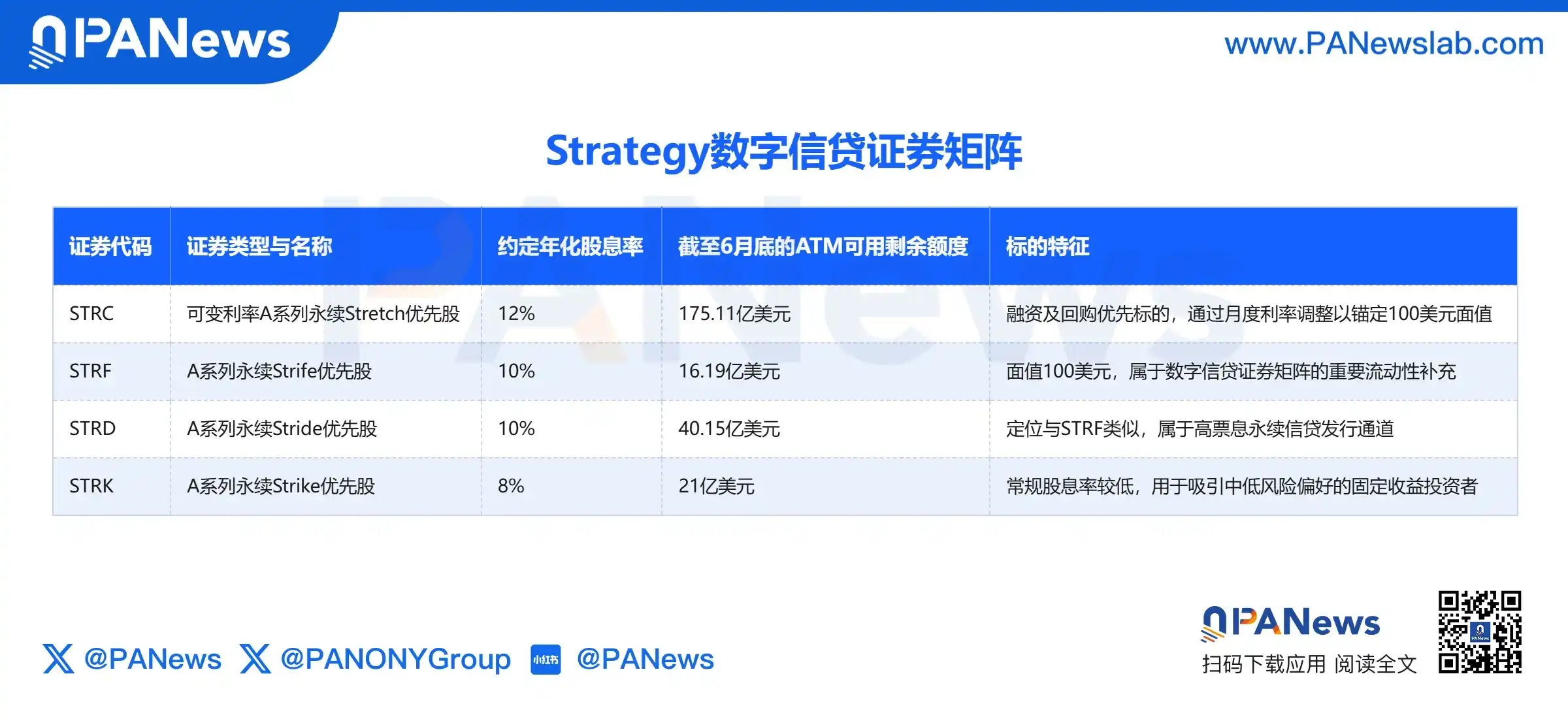
Pressure on the credit side is equally heavy. As the most liquid and actively traded primary financing tool, the price of STRC has crashed, once hitting a historic low of $71.25, representing a discount of over 28% from its $100 face value. This means the ATM (At-The-Market) equity offering channel has effectively closed. Forcing an offering at a deep discount not only constitutes a substantive loss of capital but also further dilutes the equity of existing shareholders.

Industry criticism and legal actions have followed closely. The Rosen Law Firm initiated an investigation into MicroStrategy's disclosure compliance. Ripple CEO Brad Garlinghouse condemned it as "unsustainable financial engineering," and economist Peter Schiff bluntly stated that Michael Saylor "destroyed shareholder value."

Cornered on a precipice, MicroStrategy must re-prove its viability to the market.

Five Pillars to Reconstruct the Capital Edifice: $2B Securities Buyback + $1.25B BTC Liquidation

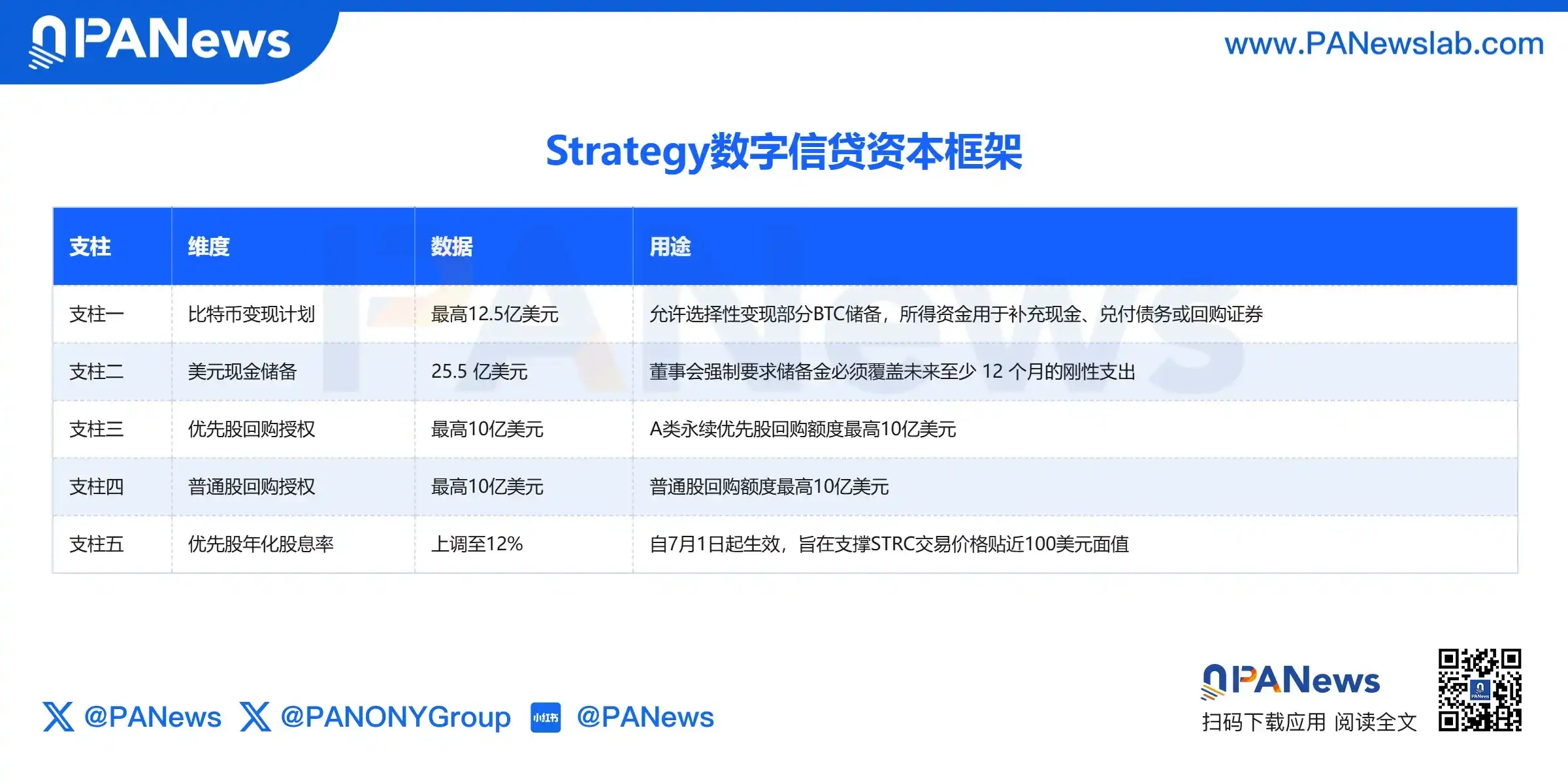
To repair the credit anchor and restart the financing chain, MicroStrategy CEO Phong Le proposed: The company must transition from one-way capital issuance to active capital management. Consequently, MicroStrategy unveiled the "Digital Credit Capital Framework," attempting to support its teetering valuation and liquidity with five pillars.

Pillar One: A $2.55 Billion "Reserve Cushion." As of the end of June, MicroStrategy holds approximately $2.55 billion in cash reserves. Under the new rules, this money can only be used for paying preferred stock dividends and interest on existing debt. Any other use requires special board authorization.

Based on the current annual fixed expenses of about $1.76 billion, this reserve covers roughly 17.4 months, far exceeding the board's set minimum alert level of 12 months.

DeFi researcher Chen Mo pointed out that MicroStrategy placing cash reserves first likely aligns with market expectations. Preserving STRC means preserving credit. If confidence is restored, the possibility of subsequent financing remains.

Pillar Two: Increase STRC Dividend Rate to 12%. Starting July 1st, the annualized dividend rate for STRC was raised from 11.5% to 12%, and the payout frequency changed from monthly to bi-weekly. MicroStrategy aims to lure STRC back to the $99-$100 face value range with high yields. Once it returns to par value, the ATM financing channel can reopen.

Pillar Three: Up to $1 Billion in Preferred Stock Buybacks. The board authorized the repurchase of all issued Series C Preferred Stock. When irrational sell-offs occur in the secondary market and securities are severely discounted, MicroStrategy will prioritize propping up STRC.
Pillar Four: Up to $1 Billion in Common Stock Buybacks. When management believes the MSTR price is significantly below its intrinsic value, buybacks are the most effective "tourniquet," helping to increase Bitcoin per share and enhance long-term shareholder equity.

Pillar Five: Up to $1.25 Billion Bitcoin Liquidation Plan. The board authorized the company to sell portions of its Bitcoin holdings in an orderly and phased manner. Proceeds will be used to replenish reserves, repurchase securities, or pay interest. In the past, MicroStrategy's BTC was a "dead asset," almost exclusively accumulated. Now, it becomes a flexible credit backing and liquidity buffer.

This is the most unexpected pillar in the entire framework. The "buy only, never sell" belief formally yields to the reality of "dynamic management." Notably, while MicroStrategy had previously sold small amounts of Bitcoin to "test" market sentiment, when the formal selling plan was announced, the market reaction seemed calm, with Bitcoin's price remaining stable around $60,000.

CryptoQuant analyst Axel Adler noted that as MicroStrategy continues financing and capital management through Bitcoin-related assets, Bitcoin's role is evolving from a pure value reserve tool into a critical liquidity infrastructure within the company's capital operations system.
With this combination of moves, MicroStrategy has pushed its total available liquidity to $3.8 billion ($2.55B cash + $1.25B BTC liquidation capacity), extending the coverage period for fixed expenses to 25.9 months. According to Bitmine calculations, based on rolling 36-month cycles since 2009, the probability of Bitcoin posting negative returns is less than 0.8%. A 26-month reserve size is sufficient for MicroStrategy to safely navigate volatility during a bear market phase. In other words, even in a bear market, MicroStrategy can survive for at least two years.

The essence of the new framework is: Guide secondary market prices through up to $2 billion in securities buybacks, repair mNAV to above 1, thereby reopening the financing channels, and then use the raised funds to buy Bitcoin.

From "expansion through issuance" to "support through buybacks," MicroStrategy's strategic focus has shifted from pursuing Bitcoin holding scale to maintaining the health of its capital structure and the smoothness of its financing channels.

Crypto analyst Lan Hu clarified: "MicroStrategy's pure HODL model of 'inflow only' has inherent fragility under a high fixed-cost structure. They are now starting to build defensive tools while retaining offensive capabilities. Based on this framework, MicroStrategy can use a limited amount of BTC to buy time and credit stability in stress-test scenarios, similar to establishing a lender-of-last-resort mechanism for 'digital credit' products, where the last lender is their own BTC reserves. For BTC, this is a long-term positive, breaking the previous market expectation. MicroStrategy gains sustainability and is no longer a ticking time bomb."

The Heaviest Cost Behind the Redemption: A Crack in the Faith

While MicroStrategy's capital management transformation props up a liquidity umbrella, it also quietly plants a double-edged sword for the Bitcoin market.

First, the annual $1.76 billion in fixed expenses is the source of "blood loss." Even if MicroStrategy stops buying Bitcoin, it must fork out this massive sum every year. With its traditional business's cash-generating ability declining and Bitcoin not yielding interest, this model essentially bets that Bitcoin will outperform its double-digit cost of capital. If Bitcoin remains stagnant for an extended period, its cash reserves will eventually be depleted by interest payments.

Second, the correlation coefficient between STRC and BTC has reached as high as 0.7. The defensive nature of STRC is being eroded. What should be a low-volatility fixed-income-like preferred stock now moves in sync with high-volatility Bitcoin. If Bitcoin plunges again, the 12% coupon might not compensate for the secondary market discount, potentially accelerating capital flight, which in turn could again shake the pricing foundation of the Digital Credit Capital Framework.

The most profound impact is that the $1.25 billion BTC liquidation plan could lead to a crack in the faith. MicroStrategy previously enjoyed a valuation premium because the market viewed it as a pure proxy asset that would "never sell Bitcoin." Now, with the board publicly approving a selling quota—though a rational financial defense—it undoubtedly tears a gash in the faith of Bitcoin bulls: it has shifted from a major buyer of Bitcoin to a potential source of sell-side pressure.

This reversal of expectations could lead to sustained selling pressure in the Bitcoin market, similar to the persistent redemptions seen after GBTC converted to an ETF. If future MicroStrategy 8-K filings disclose substantive selling records, or if interest expenses force a large-scale, triggered sell-off, it could spark a market-wide panic sell-off.

Moving forward, investors need to closely monitor two signals:

  • Execution progress of the $2 billion buyback: Whether the STRC price returns near its $100 face value will determine the speed of mNAV repair and, consequently, whether the capital engine can be reignited.

  • The first shot of Bitcoin liquidation: MicroStrategy's first substantive Bitcoin selling operation and the market's absorption of it.

From the faith-driven persona of all-in Bitcoin buying to the calculated persona of capital operations, MicroStrategy's transformation marks a pivotal inflection point in DAT capital management history. It is no longer a one-way accumulation machine but is beginning to manage its balance sheet dynamically, akin to how a central bank might, by regulating its own "base money (BTC)" and "credit derivation (Preferred Stock/Common Stock)."

This is both a self-rescue and an evolution.

Whether the "Digital Credit Balancing Act" succeeds will not only determine MicroStrategy's own ceiling but also provide a referenceable blueprint for global DAT capital allocation strategies.


Related Questions

QWhat is MicroStrategy's new 'Digital Credit Capital Framework' and what is its primary goal?

AMicroStrategy's 'Digital Credit Capital Framework' is a new capital management strategy consisting of five pillars designed to repair its creditworthiness, stabilize its valuation, and ensure liquidity in the face of significant Bitcoin losses. Its primary goal is to transition from a one-way, 'buy-and-hold Bitcoin' capital issuance model to an active capital management approach. The framework aims to restore the stock's mNAV (stock market cap/Bitcoin NAV) above 1 by using share repurchases to support prices, thereby reopening its financing channels to potentially fund future Bitcoin purchases.

QWhat are the five pillars of MicroStrategy's new capital framework?

AThe five pillars of MicroStrategy's new 'Digital Credit Capital Framework' are: 1) A $2.55 billion cash reserve for priority expenses. 2) Increasing the STRC perpetual preferred share dividend rate to 12%. 3) Authorizing a buyback of up to $1 billion of its STRC preferred shares. 4) Authorizing a buyback of up to $1 billion of its MSTR common stock. 5) Authorizing the sale of up to $1.25 billion worth of Bitcoin.

QWhy did MicroStrategy's previous 'flywheel' business model stop working?

AMicroStrategy's previous 'flywheel' model of issuing stock to buy Bitcoin, boosting its Bitcoin-per-share value (NAV) to raise its stock premium, and then issuing more stock stopped working because the inverse force of the Bitcoin price cycle broke it. As Bitcoin's price fell below $60,000 (far below its ~$75,651 average purchase cost), the company's mNAV (stock price / Bitcoin NAV) fell below 1. This meant the market valued the company at less than the liquidation value of its Bitcoin holdings, making further stock issuances to buy Bitcoin counterproductive and halting the flywheel.

QWhat is the most significant potential consequence of MicroStrategy authorizing a $1.25 billion Bitcoin sale?

AThe most significant potential consequence is the 'rupture of faith' or a major shift in market expectations. MicroStrategy previously enjoyed a valuation premium because it was seen as a pure, 'never-sell' proxy for Bitcoin. By authorizing substantial sales, it transforms from a permanent buyer into a potential source of selling pressure. This could undermine the foundational belief of its most dedicated investors and, if large-scale sales are triggered, could potentially lead to market-wide panic and a sell-off, similar to the sustained redemptions seen when GBTC converted to an ETF.

QWhat two key signals should investors watch to gauge the success of MicroStrategy's new strategy?

AInvestors should closely watch two key signals: 1) The execution progress of the $2 billion share repurchase program: Specifically, whether the price of its STRC preferred shares returns to near its $100 par value, which is critical for repairing mNAV and restarting the financing engine. 2) The first actual Bitcoin sale: The market's initial reaction and ability to absorb MicroStrategy's first substantial sale of Bitcoin under the new authorization.

Related Reads

$2 Trillion: Countdown to AI's Largest IPO in History

The countdown for the largest IPO in AI history, a potential $2 trillion listing for Anthropic, is underway for October. The staggering valuation, reportedly projected by several investors, contrasts with the company's own internal restraint on setting a public target. Founded five years ago by former OpenAI core members, Anthropic's growth has been meteoric. Annual recurring revenue (ARR) surged from ~$9B in late 2025 to $47B by May 2026, with Q2 2026 revenue of $11.5B marking a 14x year-over-year increase. Bank valuations are even based on internal 2028 revenue forecasts of $190-200B. A key growth driver is Claude Code, its AI coding assistant. Its ARR quintupled in five months to $2.5B by February 2026, now constituting nearly 20% of total revenue. Surveys indicate Anthropic commands roughly 40% of enterprise LLM spending, doubling OpenAI's share in programming-specific use. However, alongside this explosive growth, reports detail significant internal cultural strife. Critics describe a divisive "priesthood" of PhD executives, led by CEO Dario Amodei, who promote a "save humanity" narrative that some employees find cult-like and alienating. This has reportedly created a demoralized workforce and a covert "underground network" of dissent among engineers torn between lucrative pre-IPO equity and a toxic work environment. Anthropic now faces a pivotal paradox: pursuing its mission of "safe" AI requires immense capital for compute, yet that capital demands relentless commercial growth. As it approaches its historic IPO, the company must navigate intense regulatory scrutiny, soaring operational costs, and internal tensions—any of which could destabilize its post-listing trajectory, much like SpaceX's significant post-IPO stock drop. The stage is set for a defining moment in tech history.

marsbit1h ago

$2 Trillion: Countdown to AI's Largest IPO in History

marsbit1h ago

AI Boosting Efficiency and Cutting Costs Makes VC Increasingly Expensive

"AI for Cost Reduction Makes VC Funding More Expensive" Despite the "cost-reduction and efficiency" narrative of AI, venture capital (VC) investment in the AI sector is becoming increasingly costly. While AI tools lower the initial costs for many startups—with team sizes shrinking across funding stages—the market is polarizing. For top-tier AI teams, especially those from leading companies like Google and OpenAI, funding rounds are now larger and valuations are higher than ever at the seed and early stages. For example, new ventures by prominent researchers are securing billions in funding with valuations reaching tens of billions before having a mature product. This creates a "barbell" market: lightweight startups need less capital, while elite AI firms attract massive investments early on. This dynamic raises the cost for VCs to acquire and maintain meaningful ownership stakes. As valuations soar early, securing the same equity percentage requires significantly larger capital commitments. VCs must now invest more upfront and reserve substantial funds for follow-on rounds to avoid dilution, prompting large firms like Accel and a16z to raise massive new funds. Consequently, capital is concentrating intensely in a few perceived winners like OpenAI and Anthropic, widening the gap between large and small VC funds. While high valuations bake in future growth expectations, they also compress potential returns, demanding that portfolio companies achieve unprecedented scale. For major VCs, the core strategy is clear: secure early positions in potential winners and maintain the capital to keep investing as valuations rapidly escalate.

marsbit2h ago

AI Boosting Efficiency and Cutting Costs Makes VC Increasingly Expensive

marsbit2h ago

An Eight-Year Investment Takes a Sharp Turn: Why Did Ethereum Suddenly Abandon Poseidon?

On August 13, Ethereum researcher Justin Drake announced a significant shift in Ethereum's Layer-1 cryptographic roadmap: abandoning the SNARK-friendly hash function Poseidon in favor of traditional functions like SHA2 or BLAKE2. This decision ends eight years of research and investment, marking a major revision to the post-quantum security strategy. Poseidon, introduced in 2019, was highly efficient for zkRollups and zkVMs within SNARK circuits. However, its need for prolonged cryptanalysis and the pressing timeline for quantum resistance revealed limitations. Recent breakthroughs in SNARK design, specifically using binary fields, now enable traditional, battle-tested hash functions to perform as efficiently as Poseidon within SNARKs. Benchmarks show modern laptops can now verify over a million traditional hash calls per second. This change is partly driven by accelerated concerns over quantum computing threats. Reports warn that "Cryptographically Relevant Quantum Computers" could break current blockchain signatures like ECDSA by the early 2030s, risking trillions in assets. Ethereum's response focuses on hash-based post-quantum signature schemes, deemed more quantum-resistant than some lattice-based alternatives under pressure from AI cryptanalysis. Ethereum's updated post-quantum roadmap targets a production-ready "leanVM" for signature aggregation by 2027, with full deployment across consensus, execution, and data layers by 2028. The shift to mature hash functions like SHA2 reduces reliance on newer algorithms and aligns with the goal of using widely analyzed cryptographic primitives. Other major blockchains are also preparing. Solana's core teams have independently chosen the NIST-standardized Falcon signature scheme for its compact size. Starknet plans a phased migration, starting with replacing its Pedersen hash with BLAKE2. Ethereum's move signifies a strategic pivot towards proven security foundations for the quantum era.

marsbit3h ago

An Eight-Year Investment Takes a Sharp Turn: Why Did Ethereum Suddenly Abandon Poseidon?

marsbit3h ago

Programmers Worldwide Are Wasting Money on Anthropic! The Company Can't Stand It Anymore

Anthropic recently published guidelines to help developers using Claude Code reduce unnecessary token costs. The key recommendations include: 1) Clear (/clear) conversations after completing a task to avoid carrying irrelevant file reads and command outputs into the next task. 2) Set the model and reasoning effort level at the start of a session, as switching mid-session invalidates the prompt cache, requiring a full-price recalculation of the entire dialog history. 3) Attach files using @ references instead of typing paths manually to avoid extra tool calls and searches that bloat the context. 4) Add quiet flags to verbose commands (e.g., in CLAUDE.md) to minimize lengthy output in the dialog history. 5) Use /compact while the session cache is still warm (before breaks) to compress the dialog at one-tenth the cost. 6) Offload large-output tasks to a sub-agent, which runs in an isolated context and only returns conclusions, preventing intermediate outputs from polluting the main dialog. The article explains token pricing: input tokens (prefill) are processed in parallel, while output tokens (decode) are generated serially, making output tokens five times more expensive. Caching is crucial for savings—if a request's prefix (system prompt, CLAUDE.md, dialog history) matches the previous one byte-for-byte, reading it costs only 10% of the standard input price. However, cache invalidation occurs when changing models, effort levels, fast mode, compressing dialogs, after cache expiration, or when resuming old sessions. Dialog history also grows quadratically (O(n²)) as file contents and command outputs accumulate, increasing costs per round. Proactive context management—like isolating noisy tasks, using /rewind to trim unproductive turns, and task-based session clearing—is becoming an essential skill for cost-effective AI-assisted development.

marsbit5h ago

Programmers Worldwide Are Wasting Money on Anthropic! The Company Can't Stand It Anymore

marsbit5h ago

Trading

Spot
活动图片